|
 |
martin mijtens d.a
|
|
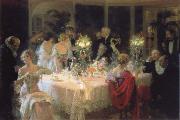
Martin Mijtens d.ä., Martin Meytens, Martin Mytens, född 1648 i Haag, Holland, död 1736 i Stockholm och begravd i Maria Kyrkan, nederländsk konstnär. Far till Martin Mijtens d.y. och son till porträttmålaren Isaac Mijtens.
Mijtens kom till Stockholm före eller under år 1677 och fann där ett så tacksamt fält för sin konst, att han beslöt stanna och 1681 satte han bo. Av hans första verk finns prov i Vibyholms och andra samlingar. De visar, att han hade en fin pensel, behaglig, varm, fastän tunn färg samt livlig och karakteristisk uppfattning av de skildrade. Med sina gråaktiga fonder, de ofta gulbruna draperierna och den enkla, naiva framställningen bildar Mijtens vid denna tid en bestämd motsats till David Klöcker Ehrenstrahl. Men dennes anseende och den gunst hans målningssätt vunnit var så stora, att även Mijtens måste böja sig. Så småningom blir hans bilder något anspråksfullare och djärvare, åtbörder och minspel kraftigare, bisakerna rikare, tonen i det hela mer högstämd, utan att personligheten försummas eller återgivningen av hudfärg överger den varma, åt gult dragande hållningen. Många bilder från denna hans andra period, som ungefär omfattar åren 1685- 1700, finns på Skoklosters slott, där Nils Bielke och hans grevinna, Eva Horn (i landskap), hör till mästarens bästa målningar, och på Vibyholm, i Uppsala (professor Schwedes porträtt i Uppsala museum och Olof Rudbeck d.ä.:s förträffliga bild, 1696, i medicinska fakultetens sessionsrum), i Hammers samling och på inte så få andra ställen. Konstnärens vana att högst sällan signera har gjort, att bilderna från dessa år ofta har blandats ihop med Ehrenstrahls och gått under den senares namn. Säkra skiljetecken är emellertid draperierna, som hos Mijtens saknar stil och ofta verkar tämligen slappt tecknade, och även det livligare åtbördsspelet. Man vet, att Mijtens, trots sin medtävlares anseende, var mycket eftersökt som porträttmålare och samlade förmögenhet på sin konst, så att han kunde bl.a. förvärva ett ej obetydligt konstgalleri. Han var även alltifrån 1692 och ganska länge kyrkoråd i den lilla holländska församlingen i Stockholm. 1697 och 1701 företog han resor till hembygden, den förra gången åtföljd av sin unge lärjunge Lucas von Breda. Utom denne ej obetydande konstnär utbildade Mijtens även sin son , som under det i Tyskland antagna namnet van Meytens berömde målaren (se denne), samt G. de Marees och möjligen flera. Man kan säga att omkring år 1700 vidtog Mijtens tredje maner. Karnationen får en dragning åt rött, som slutligen blir nästan stötande (t. ex. i Fabritius och prins Alexander av Georgiens porträtt på Gripsholms slott), teckningen vårdslösas mer, och de granna röda eller djupblå draperierna är stillösare och hårdare målade än förr. Dock lever ännu inte litet av den forna kraften i karaktärsteckningen, och anordningen bibehåller i mycket den förra prydligheten. Även denna hans nedgång finnes ej sällan företrädd i svenska samlingar. Märkligt är ett självporträtt (nu på Fånö i Uppland), emedan det enligt sägnen skall vara målat på hans höga ålderdom och under sinnessvaghet (om denna vet man för övrigt inget). Utom måleriet idkade han även gravyr samt utförde ett porträtt af Karl XI i svart maner och möjligen ett par andra blad i samma art (Gustaf Adolf de la Gardie, Georg Stiernhielm). Mijtens skall, enligt gammal uppgift, ha avlidit i Stockholm 1736; enligt en urkund levde han ännu i juli 1730. Hans målningssamling såldes av hans arvingar till preussiske överstemarskalken greve Gotter och kom inte långt därefter till storhertigen af Werttemberg. Carl Gustaf Tessin, som tycks ha hyst mycken ringaktning för Mijtens omtalar dock, att denna samling på sin tid ansågs som den enda framstående i riket (utom grefve Johan Gabriel Stenbocks). Att Carl Gustaf Tessin vid samma tillfälle kallar Mijtens "en gammal färgskämmare" och även annars talar illa om hans konst, tycks visa att Mijtens vid mitten af 1700-talet var fullkomligt bortglömd, åtminstone sådan han varit under sin bästa tid. Sedan finns han ej heller mycket omtalad. Först genom konstföreningens utställning 1841 och Nils Arfwidssons anmälan av honom i Frey återupptäcktes han; och man fann då, att Sverige i honom ägt en konstnär av sådan betydelse, att han kan mäta sig även med våra största mästare. Hans inflytande på den svenska konstens fortbildning blev dock ej särskilt stort. David Klöcker Ehrenstrahl och David von Krafft ställer honom i det avseendet fullkomligt i skuggan. |
 |
Martin Archer Shee
|
|
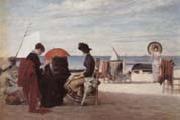
RA (December 23, 1769 - August 13, 1850) was a British portrait painter and president of the Royal Academy.
He was born in Dublin, of an old Catholic Irish family, and his father, a merchant, regarded the profession of a painter as an unsuitable occupation for a descendant of the Shees. Martin Shee nevertheless studied art in the Dublin Society, and came to London. There, in 1788, he was introduced by William Burke to Joshua Reynolds, on whose advice he studied in the schools of the Royal Academy. In 1789 he exhibited his first two pictures, the "Head of an Old Man" and "Portrait of a Gentleman." Over the next ten years he steadily increased in practice. He was chosen an associate of the Royal Academy in 1798, in 1789 he married, and in 1800 he was elected a Royal Academician. He moved to George Romney's former house in Cavendish Square, and set up as his successor.
Shee continued to paint with great readiness of hand and fertility of invention, although his portraits were eclipsed by more than one of his contemporaries, and especially by Thomas Lawrence. The earlier portraits of the artist are carefully finished, easy in action, with good drawing and excellent discrimination of character. They show an undue tendency to redness in the flesh painting defect which is still more apparent in his later works, in which the handling is less "square," crisp and forcible. In addition to his portraits he executed various subjects and historical works, such as Lavinia, Belisarius, his diploma picture "Prospero and Miranda", and the "Daughter of Jephthah."
In 1805 he published a poem consisting of Rhymes on Art, and a second part followed in 1809. Lord Byron spoke well of it in his English Bards and Scotch Reviewers. Shee published another small volume of verse in 1814, entitled The Commemoration of Sir Joshua Reynolds, and other Poems, but this was less successful. He also produced a tragedy, Alasco, set in Poland. The play was accepted at Covent Garden, but was refused a licence, on the grounds that it contained treasonable allusions, and Shee angrily resolved to make his appeal to the public. He carried out his threat in 1824, but Alasco was still on the list of unacted dramas in 1911. He also published two novels - "Oldcourt" (1829, in 3 volumes) and "Cecil Hyde" (1834). |
 |
Maron, Anton von
|
|
Austrian, 1733-1808
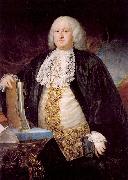
Austrian painter. He studied at the Vienna Akademie and, in 1755, he went to Rome, where he was based for the rest of his life. From 1756 to 1761 he was first the pupil then the assistant of Anton Raphael Mengs. In 1765 he married Mengs's sister, the miniature painter Theresia Concordia Mengs. After collaborating on Mengs's fresco paintings in Rome (at S Eusebio and the Villa Albani; both in situ), Maron, working independently in Rome, spent some time on altar pictures (S Maria dell'Anima) and on various decorative projects. Mengs's influence is evident in Maron's ceiling pictures in the casino of the Villa Borghese (1784; in situ), where five paintings tell the Story of Aeneas and Dido in the style of quadri riportati, using clear construction, sharply defined drawing and a historical concept based on antiquity. Although he received many commissions for this type of work, Maron's true gifts lay in the field of portraiture. Along with Pompeo Batoni, Maron was the most celebrated portrait painter in 18th-century Rome, and he received an enormous number of commissions from princes, diplomats and church dignitaries and from English aristocrats visiting Rome as part of their Grand Tour. Maron painted such sitters in the same style as did Batoni, usually full-length and life-size, in elegantly fashionable dress, against backgrounds of Classical sculptures and views of Rome. Portraits such as those of Francis, Prince of Anhalt Dessau |
 |
Mariotto Albertinelli
|
|
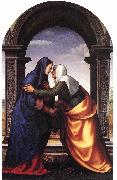
(October 13, 1474 - November 5, 1515) was a High Renaissance Italian painter of the Florentine school, closely involved with Fra Bartolomeo and influenced by Raphael.
He was born in Florence.
Already as a 12-year old boy, he became a pupil of Cosimo Rosselli, and a fellow-pupil with Fra Bartolomeo with whom he formed such an intimate brotherly rapport that in 1494 the two started their own studio in Florence. Vasari's opinion was that Mariotto was not so well grounded in drawing as Bartolomeo, and he tells that, to improve his hand he had taken to drawing the antiquities in the Medici garden, where he was encouraged by Madonna Alfonsina, the mother of Duke Lorenzo II de' Medici. When the Medici were temporarily banished in 1494, he returned to his friend, whose manner he copied so assiduously, according to Vasari, that his works were taken for Baccio's. When, in the wake of Savonarola's morality campaign, Baccio joined the Dominican order as Fra Bartolomeo in 1500 and gave up painting, Albertinelli, beside himself with the loss, would have joined him; but, spurred by his success in completing an unfinished Last Judgment of Bartolomeo's, he resolved to carry on alone. Among his many students were Jacopo da Pontormo, Innocenzo di Pietro Francucci da Imola and Giuliano Bugiardini.
Mariotto was a most restless person and carnal in the affairs of love and apt to the art of living, and, taking a dislike to the studies and brain-wracking necessary to painting, being also often stung by the tongues of other painters, as is their way, he resolved to give himself to a less laborious and more jovial profession, and so opened the most lovely hostelry outside the Porta San Gallo, and at the sign of the Dragon at the Ponte Vecchio a tavern and inn. This life he led for many months, saying that he had taken up an art that was without muscles, foreshortening or perspective and, better still, without faultfinding, and that the art that he had given up imitated flesh and blood, but this one created flesh and blood; in this if you had good wine you heard yourself praised, but in that every day you were blamed. But at last the low life became an annoyance to him, and, filled with remorse, he returned to painting. |
 |
marc-aurele de foy suzor-cote
|
|
Canadian Painter, 1869-1937
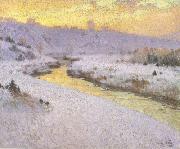
was a Canadian painter and sculptor. He was born in Arthabaska, Quebec in 1869. He studied at the École des Beaux-Arts in Paris with L??on Bonnat during the 1890s. After his return to Quebec in 1908, he produced many impressionist paintings of the Quebec landscape, as well as portraits, nudes, historical paintings and later sculptures. |
 |
Manuel da Costa Ataide
|
|
(1762 to 1830), was a Brazilian painter, sculptor, gilder and teacher.
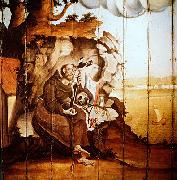
He was an important artist of the baroque school in Minas Gerais and had a major influence on painting in the region, with many students and followers. His method of composition, particularly in perspective works on church ceilings, continued to be used until the middle of the nineteenth century. Contemporary documents often refer to him as a teacher of painting. In 1818 Ataede tried without success to obtain official permission to found an art school in Mariana, his home town. He owned technical manuals and theoretical tracts such as Andrea Pozzo's "Perspectivae Pictorum Architectorum" from which he must have studied technique.
His art is characterised by the use of bright colours, especially blue.
He was a contemporary and colleague of Antonio Francisco Lisboa (Aleijadinho). In the period 1781 to 1818 he completed and gilded Aleijadinhoes images for the Sanctuary of Bom Jesus de Matosinhos in Congonhas.
|
 |
MANTEGNA, Andrea
|
|
Italian Early Renaissance Painter, ca.1431-1506
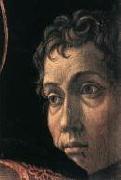
Italian painter and printmaker. He occupies a pre-eminent position among Italian artists of the 15th century. The profound enthusiasm for the civilization of ancient Rome that infuses his entire oeuvre was unprecedented in a painter. In addition to its antiquarian content, his art is characterized by brilliant compositional solutions, the bold and innovative use of perspective and foreshortening and a precise and deliberate manner of execution, an aspect that was commented upon during his lifetime. He was held in great esteem by his contemporaries for his learning and skill and, significantly, he is the only artist of the period to have left a small corpus of self-portraits: two in the Ovetari Chapel; his presumed self-portrait in the Presentation in the Temple (Berlin, Gemeldegal.); one in the Camera Picta (Mantua, Pal. Ducale) and the funerary bust in his burial chapel in S Andrea, Mantua, designed and probably executed by himself. His printmaking activity is technically advanced and of great importance, although certain aspects of the execution remain to be clarified. |
 |
Mancini, Antonio
|
|
Italian Academic Painter, 1852-1930
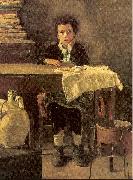
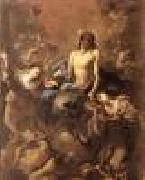
Italian painter. He entered the Istituto di Belle Arti, Naples, at the age of 12; while still an adolescent he produced accomplished works such as Head of a Young Girl (1867; Naples, Capodimonte). On his graduation in 1873, Mancini, together with Francesco Paolo Michetti and Vincenzo Gemito, was at the forefront of VERISMO in Neapolitan art. Sharing a studio with Gemito, he painted the street boys, musicians and dancers of Naples, creating an anti-academic, popular art. His patron, Albert, Count Cahen of Antwerp (1846-1903), encouraged him to visit Paris in 1875, where he met Manet and Degas. After a second visit in 1877 |
 |
MAGNASCO, Alessandro
|
|
Italian Rococo Era Painter, 1667-1749
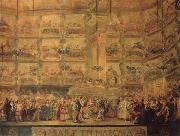
Painter and draughtsman, son of (1) Stefano Magnasco. He did not study with his father, who died when he was a small child. He went to Milan, probably between 1681 and 1682, and entered the workshop of Filippo Abbiati (1640-1715). His Christ Carrying the Cross (Vitali, priv. col., see Franchini Guelfi, 1987, fig. 238) faithfully repeats the subject and composition of Abbiati's painting of the same subject (Pavia, Pin. Malaspina). Alessandro Magnasco's early works were influenced by the harsh and dramatic art of 17th-century Lombardy, with dramatic contrasts of light and dark and livid, earthy tones, far removed from the bright, glowing colours of contemporary Genoese painting. The depiction of extreme emotion in the St Francis in Ecstasy (Genoa, Gal. Pal. Bianco) was inspired by Francesco Cairo's Dream of Elijah (Milan, S Antonio Abate). However, Magnasco was already expressing himself in a very personal manner, with forms fragmented by swift brushstrokes and darting flashes of light. The Quaker Meeting (1695; ex-Vigan? priv. col., see Franchini Guelfi, 1991, no. 18) is one of his first genre scenes. In this early period he specialized as a figurista, creating small human figures to be inserted in the landscapes and architectural settings of other painters. He also began collaborating with the landscape painter Antonio Francesco Peruzzini, with a specialist in perspective effects, |
 |
Luis Paret y alcazar
|
|
Spanish Rococo Era Painter, 1746-1799
was a Spanish painter of the late-Baroque or Rococo period. He was born in Madrid he first trained with Antonio Gonz??lez Velazquez and attended the Academia Real de San Fernando in Madrid, where he won a second prize in a painting contest in 1760, and first prize in 1766. He entered the studio of the French painter Charles de la Traverse, who worked for the Marchese of Ossun, the ambassador of France in Spain. Unfortunately upon returning to Madrid, despite becoming a teacher in the Academia de San Fernando at age 33 years, he mainly received royal commissions to paint and engrave vistas of ports, the Spanish equivalent of vedute, and also of planned works of construction. For some years, he was banished to Puerto Rico, where he trained the painter Jose Campeche. |
 |
Louisa Anne Meredith
|
|
English miniaturist, watercolourist, engraver, poet, writer and botanist .
1812-1895
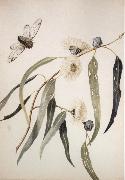
was an English and Australian writer and illustrator. Louisa Anne Meredith, the daughter of Thomas Twamley and Louisa Ann Meredith, was born near Birmingham, England on 20 July 1812. She was educated chiefly by her mother, and in 1835 published a volume, Poems, which was favourably reviewed. This was followed in 1836 by The Romance of Nature, mostly in verse, of which a third edition was issued in 1839. Another volume was published in the same year, The Annual of British Landscape Scenery, an account of a tour on the River Wye from Chepstow to near its source at Plynlimon. Shortly afterwards Miss Twamley was married to her cousin, Charles Meredith. Charles had emigrated to Van Dieman's Land in 1821 with his father George and family. They had been pioneers of grazing, whaling and other activities around Swansea on Tasmania's East Coast. Charles had become a squatter in the Canberra district of New South Wales They sailed for New South Wales in June 1839, and arrived at Sydney on 27 September 1839. After travelling into the interior as far as Bathurst, Mrs Meredith returned to the coast and lived at Homebush for about a year. By the time of his return to New South Wales, severe economic depression caused by excessive land speculation had destroyed the value of Charles' property, and towards the end of 1840 they relocated to Tasmania. An interesting account of her first 11 years in Australia is given in her two books, Notes and Sketches of New South Wales (1844), reprinted at least twice, and My Home in Tasmania (1852), which was soon republished in the United States of America under the title Nine Years in Australia. For much of her life Mrs Meredith lived on properties around Swansea. In 1860 she published Some of My Bush Friends in Tasmania which contained elaborate full-colour plates printed by the new chromolithography process. The illustrations were drawn by herself, and simple descriptions of characteristic native flowers were given. In the following year an account of a visit to Victoria in 1856, Over the Straits, was published, and in 1880 Tasmanian Friends and Foes, Feathered, Furred and Finned. This went into a second edition in 1881. In 1891, in her eightieth year, Mrs Meredith went to London to supervise the publication of Last Series, Bush Friends in Tasmania. Published at the outset of a severe financial depression in the Australian colonies, this project and the collapse of the bank where most of her savings were held ruined her financially. She died at Melbourne on 21 October 1895 and was survived by sons Owen and George. Mrs Meredith was the author of two novels, Phoebe's Mother (1869), which had appeared in the Melbourne weekly The Australasian in 1866 under the title of Ebba, and Nellie, or Seeking Goodly Pearls (1882). Mrs Meredith took great interest in politics, her husband Charles being a Member of the Tasmanian Legislative Council for several terms between the mid 1850s until just before his death in 1881. |
 |
Louis Anquetin
|
|
1861-1932,French painter. He came to Paris in 1882 and studied art at the Ateliers of Bonnat and Cormon, where he was a contemporary and friend of Henri de Toulouse-Lautrec, Emile Bernard and Vincent van Gogh. His early work shows the influence of Impressionism and of Edgar Degas. In 1887 Anquetin and Bernard devised an innovative method of painting using strong black contour lines and flat areas of colour; Anquetin aroused much comment when he showed his new paintings, including the striking Avenue de Clichy: Five O'Clock in the Evening (1887; Hartford, CT, Wadsworth Atheneum) at the exhibition of Les XX in Brussels and at the Salon des Independants in Paris in 1888. The new style, dubbed Cloisonnisme by the critic Edouard Dujardin (1861-1949), resulted from a study of stained glass, Japanese prints and other so-called 'primitive' sources; it was close to the Synthetist experiments of Paul Gauguin and was adopted briefly by van Gogh during his Arles period. Anquetin's works were shown alongside Gauguin's and Bernard's at the Caf? Volpini exhibition in 1889, |
 |
Losenko, Anton
|
|
Russian Painter, 1737-1773
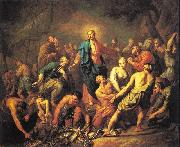
Ukrainian painter, active in Russia. He trained (1753-8) under Ivan Argunov, and from 1758 he was a student at the recently founded Academy of Art in St Petersburg, where he later taught. From 1760 to 1769 he spent time in Paris, where he studied at the Acad?mie Royale de Peinture et de Sculpture under Jean Reteux (1692-1768) and Joseph-Marie Vien. He then studied in Rome. |
 |
LONGHI, Alessandro
|
|
Italian painter, Venetian school (b. 1733, Venezia, d. 1813, Venezia).
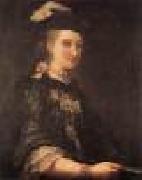
Painter, engraver and writer, son of (1) Pietro Longhi. He must have received his first artistic training from his father, although the only evidence of this is the similarity of their styles. He was apprenticed to Giuseppe Nogari, one of the better Venetian portrait painters of the first half of the eighteenth century, and his earliest works are bust-length, mostly life-size portraits in Nogari's style. He first exhibited in 1757 and by 1758 must have been considered a reasonably established artist, |
 |
Leonor de Almeida Portugal
|
|
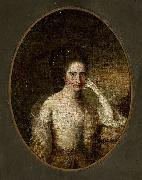
Leonor de Almeida Portugal de Lorena e Lencastre (Lisboa, 31 de outubro de 1750 - Benfica, 11 de outubro de 1839) foi uma nobre e poetisa portuguesa. |
 |
Leonardo Alenza Y Nieto
|
|
b Madrid, 6 Nov 1807; d Madrid, 30 June 1845
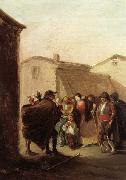
Spanish painter and illustrator. He studied at the Real Academia de S Fernando, Madrid, under Juan Antonio Ribera y Fern?ndez and Jos? de Madrazo y Agudo. He worked independently of court circles and achieved some fame but nevertheless died in such poverty that his burial was paid for by friends. He is often described as the last of the followers of Goya, in whose Caprichos and drawings he found inspiration for the genre scenes for which he became best known. Of these scenes of everyday life and customs the more interesting include The Beating (Madrid, Cas?n Buen Retiro) and Galician with Puppets (c. 1835; Madrid, Cas?n Buen Retiro; see SPAIN, fig. 17). Alenza y Nieto's numerous drawings include the illustrations for Alain-Ren? Lesage's Gil Blas (Madrid, 1840), for an edition of the poems of Francisco de Quevedo published by Castello and for the reviews Semanario pintoresco and El Reflejo. The painting Triumph of David |
 |
Leon Augustin Lhermitte
|
|
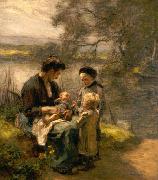
(1844 - 1925) was a French realist painter and etcher whose primary subject matter was of rural scenes depicting the peasant worker.
He was born in Mont-Saint-Pere. A student of Lecoq de Boisbaudran, he gained recognition after his show in the Paris Salon in 1864.
His many awards include the French Legion of Honour (1884) and the Grand Prize at the Exposition Universelle in 1889. Lhermitte died in Paris in 1925.
Lhermittees innovative use of pastels won him the admiration of his contemporaries. Vincent Van Gogh wrote that eIf every month Le Monde Illustre published one of his compositions ... it would be a great pleasure for me to be able to follow it. It is certain that for years I have not seen anything as beautiful as this scene by Lhermitte ... I am too preoccupied by Lhermitte this evening to be able to talk of other things.e
Lhermitte's etchings and paintings are housed in museums around the world including Boston, Washington, Chicago, Montreal, Brussels, Rheims, Paris, Moscow and Florence.
|
 |
LENS, Andries Cornelis
|
|
Flemish painter (b. 1739, Antwerpen, d. 1822, Bruxelles).
Flemish painter and writer. He was the son of the flower painter Cornelis Lens (d after 1766) and studied first under Charles Ykens II (1719-53) and then under Balthazar Beschey. In 1756 he was awarded first prize at the Academie of Antwerp and in 1763 was appointed to the staff on the strength of his decoration (destr.) of the refectory of the Alexians at Lier. He also came to the attention of Charles Alexandre, Duke of Lorraine and Bar, Governor-General of the Netherlands |
 |
Lemuel Francis Abbott
|
|
1760-1803
Lemuel Francis Abbott Locations
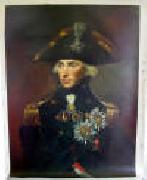
English painter. He was the son of a clergyman and went to London to study with Francis Hayman shortly before the latter death in 1776; he may have completed his studies in Derby with Joseph Wright of Derby. By the early 1780s Abbott had established a busy portrait practice in London. The formula he adopted for most of his head-and-shoulder portraits can be seen in Sir William Herschel (1785; London, N. Mar. Mus.): the body is parallel to the picture plane, and the sitter head is moved into three-quarter profile, as if his attention has been suddenly distracted. In later portraits, such as those of fellow artists Francesco Bartolozzi (c. 1792; London, Tate) or Joseph Nollekens (c. 1797; London, N.P.G.), the sitter hand or some attribute balances the movement of the head. Only male portraits by Abbott are known, and his patrons were mostly drawn from the professional classes, particularly the Navy; there are several versions of Lord Nelson (e.g. 1798; London, N. Mar. Mus.). His style is crisp but scratchy in technique, and often the anatomy of his figures is inaccurate. Paint is handled in a manner comparable with that of Gainsborough Dupont, but Abbott sense of composition is superior. In 1798 he was certified insane, but he continued to exhibit at the Royal Academy in London for two further years. Several of his works were probably finished by another hand. |
 |
Legros, Alphonse
|
|
French-born British Painter and Sculptor, 1837-1911
British etcher, painter, sculptor and teacher of French birth. He is said to have been apprenticed at the age of 11 to a sign-painter, at which time he may also have attended classes at the Ecole des Beaux-Arts in Dijon. He was employed as assistant on a decorative scheme in Lyon Cathedral before moving in 1851 to Paris, where he worked initially for the theatre decorator C. A. Cambon (1802-75). He soon became a pupil of Horace Lecoq de Boisbaudran, whose methodical instruction and liberality in fostering individual talent proved of lasting benefit to Legros. In 1855 he enrolled at the Ecole des Beaux-Arts, Paris, attending irregularly until 1857. During this period Legros had a taste for early Netherlandish art and for French Romanticism, which was later superseded by his admiration for Claude, Poussin and Michelangelo. |
 |
Laurits Andersen Ring
|
|
Danish, 1854-1933
Laurits Andersen Ring (1854-1933) was one of the foremost painters of Danish symbolism. He was born as Laurits Andersen in the village Ring in southern Zealand. In 1881 he the took the name of his birth place, and was since known as L.A. Ring.
For a while, he lived at Baldersbronde near Hedehusene in the old school building, which was later to be the home of another painter, Ludvig Find. Ring has produced several paintings from these towns.
As a painter, he never distanced himself from his humble origin, but rather made it his dominant theme. Most of his paintings depict the village life and landscapes of southern Zealand from Præsto to Nestved. There are several examples of his work at practically every Danish art museum including the Hirschsprung Collection in Copenhagen.
He was married on July 25, 1896 to fellow painter Sigrid Kahler, who was the daughter of ceramic artist Herman Kahler. |
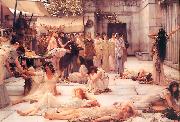 |
Laura Theresa Alma-Tadema
|
|
(1852 C 15 August 1909 in Hindhead) was from 1871 the second wife of the painter Lawrence Alma-Tadema and a painter in her own right.
A daughter of Dr George Napoleon Epps (who was brother of Dr John Epps), her two sisters were also painters (Emily studied under John Brett, a Pre-Raphaelite, and Ellen under Ford Madox Brown), whilst Edmund Gosse and Rowland Hill were her brothers-in-law. It was at Madox Brown's home that Alma-Tadema first met her in December 1869, when she was aged 17 and he 33. (His first wife had died in May that year.) He fell in love at first sight,and so it was partly her presence in London (and partly the fact that only in England had his work consistently sold) that influenced him into relocating in England rather than elsewhere when forced to leave the continent by the outbreak of the Franco Prussian War in July 1870. Arriving in London at the beginning of September 1870 with his small daughters and sister Artje, Alma-Tadema wasted no time in contacting Laura, and it was arranged that he would give her painting lessons. During one of these, he proposed marriage. As he was then thirty-four and Laura was now only eighteen, her father was initially opposed to the idea. Dr Epps finally agreed on the condition that they should wait until they knew each other better. They married in July 1871 and, though this second marriage proved childless, it also proved enduring and happy, with Laura acting as stepmother to her husband's children by his first marriage.
The Paris Salon in 1873 gave Laura her first success in painting, and five years later, at the Paris International Exhibition, she was one of only two English women artists exhibited. |
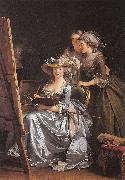 |
Labille-Guiard, Adelaide
|
|
French Neoclassical Painter, 1749-1803
French painter. Labille-Guiard was a painter of the French nobility before the Revolution and survived to paint the citizens of the Directory. Emerging from the 18th-century tradition of powdered wigs and shimmering satins, she captured informal moments in the lives of her subjects, frequently depicting them interrupted from some pastime |
 |
KEY, Adriaan
|
|
Flemish painter (b. ca. 1544, Antwerpen, d. after 1589, Antwerpen). |
 |
KEIRINCKX, Alexander
|
|
Flemish painter (b. 1600, Antwerpen, d. 1652, Amsterdam).
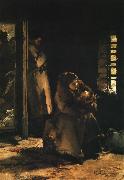
Flemish painter. He was the son of Matthijs Keirinckx and Anna Masson. In 1619 he became a master in Antwerp's Guild of St Luke, he married Clara Matthausen on 18 June 1622, and in 1624 he took on Artus Verhoeven as an apprentice. From 1636 onwards he is regularly recorded in Amsterdam, where he was registered as a citizen in the year of his death. He visited Great Britain, possibly in 1625 (Walpole mentions two signed and dated drawings of London views from this year) and definitely in 1640-41, when he undertook commissions from King Charles I to paint views of royal castles and palaces. |
 |
Kazimierz Alchimowicz
|
|
(1840 ?C 1916) was a Lithuanian-born Polish romantic painter.
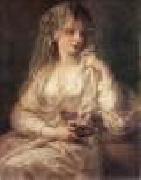
Born in Dziembrow, Lithuania, Alchimowicz was banished to Siberia for six years for his participation in the January Uprising. After his return, he enrolled in a drawing class in Warsaw taught by Wojciech Gerson. The class had a great influence on his later artistic works. He later studied art in Munich, Germany and Paris, France. While staying in France, Alchimowicz was a craftsmen decorating porcelain and earthenware crafts. He settled permanently in Warsaw in 1880 to paint professionally. His artistic inspiration mainly came from patriotic topics and history. |
 |
KAUFFMANN, Angelica
|
|
Swiss Neoclassical Painter, 1741-1807
Swiss-born Italian painter. She began studying art in Italy as a child, showing great precocity, and in 1766 her friend Joshua Reynolds took her to London. There she became known for her decorative work with architects such as Robert Adam. Her pastoral compositions incorporate delicate and graceful depictions of gods and goddesses; though her paintings are Rococo in tone and approach, her figures are Neoclassical (see Classicism and Neoclassicism). Her portraits of female sitters are among her finest works. |
 |
Juan de Arellano
|
|
(3 August 1701 - 13 October 1776) was a Spanish painter of the Baroque era who specialized in floral still life paintings.
Born in Santorcaz, near Madrid, where he died. He was a pupil of Juan de Solis. Heavily influenced by Flemish and Italian painters (such as Mario Nuzzi), Juan de Arellano was considered to be exceptional in this thematic. According to one of his colleagues, de Arellano decided to focus exclusively on floral paintings because it offered more pay while requiring less work . Some of de Arellano's most famous pieces include Bouquet of Flowers (c.1660), and Garland of Flowers, Birds and Butterfly, currently on display at the Louvre. He also painted for the sacristy of the church of San Jerenimo el Real of Madrid. See Bodegen for a description of one style of Spanish still life painting. |
|