|
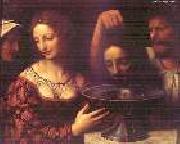 |
LUINI, Bernardino
|
|
Italian High Renaissance Painter, ca.1480-1532
Italian painter and draughtsman. He was one of the generation of Lombard painters active around 1500 who, influenced by Leonardo and Raphael, blended High Renaissance innovations with indigenous Milanese elements to create a Lombard Renaissance style. Luini's paintings were extremely popular with both collectors and critics from c. 1790 to the end of the 19th century. This widespread popularity, however, had unfortunate consequences: many of his frescoes were detached from their original settings, many of the panel paintings were transferred to canvas and other works were heavily restored. As a result few survive in a good state. About 700 works are attributed to Luini, but many of these attributions are over optimistic.
|
 |
ludwig van beethoven
|
|
Born: December 1770
Birthplace: Bonn, Germany
Died: 26 March 1827 (cirrhosis of the liver, plus dropsy)
Best Known As: The composer of Beethoven's Fifth |
 |
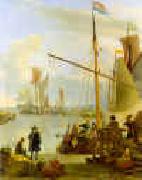
Ludolf Bakhuizen
|
|
(December 28, 1630 - November 17, 1708) was a German-born Dutch Golden Age painter who was the leading Dutch painter of maritime subjects after the two Willem van de Veldes (father and son) left for England in 1672.
He was born in Emden, East Frisia, and came to Amsterdam in about 1650, working as a merchant's clerk and a calligrapher. He discovered so strong a genius for painting that he relinquished the business and devoted himself to art from the late 1650s, initially in pen drawings. He studied first under Allart van Everdingen and then under Hendrik Dubbels, two eminent masters of the time, and soon became celebrated for his sea-pieces, which often had rough seas.
He was an ardent student of nature, and frequently exposed himself on the sea in an open boat in order to study the effects of storms. His compositions, which are numerous, are nearly all variations of one subject, the sea, and in a style peculiarly his own, marked by intense realism or faithful imitation of nature. In his later years Bakhuizen employed his skills in etching; he also painted a few examples each of several other genres of painting, such as portraits, landscapes and genre paintings. |
 |
Ludolf Backhuysen
|
|
b.Dec. 18, 1631, Emden, East Frisia [Germany]
d.Nov. 17, 1708, Amsterdam, Neth.
Dutch
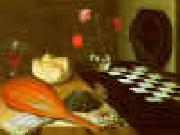
Ludolf Backhuysen Gallery |
 |
Lubin Baugin
|
|
1610-1663
French
Lubin Baugin Gallery
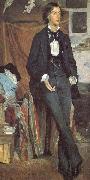
French painter. He became a master in the painters guild of Saint-Germain-des-Pras in 1629. From c. 1636 he was in Italy, but he is known to have been in Paris again in 1641; in 1645 he became a member of the Acadmie de St Luc, and in 1651 he was also a member of the Acadmie Royale after the temporary amalgamation of the two institutions. Like many of his generation he was deeply influenced by the art of the Fontainebleau school. |
 |
Louise-Catherine Breslau
|
|
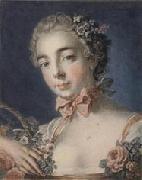
(6 December 1856 - 12 May 1927) was a German/Swiss artist.
Born Maria Luise Katharina Breslau in Munich, Germany, she spent her childhood in Zurich, Switzerland and as an adult made Paris, France her home. Suffering from asthma all her life, Breslau turned to drawing as a child to help pass the time while confined to her bed. Although she became one of the most sought after portraitists of her time, after her death she and her work were all but forgotten. It has only been in the past few years that interest in Breslau and her works has been growing.
Breslau was born into a prosperous bourgeois family; her father was a well-respected physician specializing in obstetrics and gynecology. When Breslau was two years old, her father accepted the position of professor and head physician of Obstetrics and Gynecology at the University of Zurich; Switzerland became home to the Breslau family. |
 |
Louis-Marin Bonnet
|
|
French, 1736 - 1793
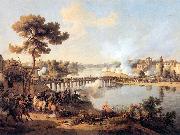
French engraver and publisher. He came from a family of artisans and owed his training in engraving to his brother-in-law, the engraver Louis Legrand (1723-1808). Through Legrand, Bonnet became the pupil of Jean-Charles Francois in 1756, a year before the latter discovered the CRAYON MANNER technique of engraving, designed to reproduce the effect of a coloured-chalk drawing. Around the end of 1757 Bonnet used the new technique to engrave a Cupid after Francois Eisen. Gilles Demarteau, a rival of Jean-Charles Francois |
 |
Louis-Francois, Baron Lejeune
|
|
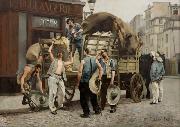
(3 February 1775, Strasbourg - 29 February 1848) was a French general, painter, and lithographer. His memoirs have frequently been republished and his name is engraved on the Arc de Triomphe.
He studied painting in the studio of Pierre-Henri de Valenciennes, alongside Jean-Victor Bertin, but left the studio to volunteer in the Compagnie des arts de Paris in 1792. He received his baptism of fire in the battle of Valmy later that year. He became a sergeant in the 1st Arsenal battalion and in 1793 moved to the artillery at La Fere, assisting in the sieges of Landrecies, Le Quesnoy and Valenciennes. At Valenciennes he became aide-de-camp to general Jacob then, as a lieutenant on attachment to the engineers, took part in the 1794 Holland campaign and the 1795 campaign.
Called to the depot in 1798, he succeeded brilliantly in his exams and was made a captain on attachment to the engineers. He became aide-de-camp to marshal Berthier in 1800, a post he retained until 1812 and in which he took an active part in practically all of the Napoleonic campaigns. He was wounded and captured in Spain. He was promoted to full captain after Marengo and chef de bataillon after Austerlitz, also become a knight of the Legion d'honneur and a colonel at the Siege of Saragossa.
The German campaign of 1806 brought him to Munich, where he visited the workshop of Alois Senefelder, the inventor of lithography. Lejeune was fascinated by the possibilities of the new method and whilst there he made the drawing on stone of his famous Cossack (printed by C. and ~f. Senefelder, 1806). Whilst he was taking his dinner, and with his horses harnessed and waiting to take him back to Paris, one hundred proofs were printed, one of which he subsequently submitted to Napoleon. The introduction of lithography into France was greatly due to the efforts of Lejeune.
In 1812, during the French invasion of Russia, he was made general de brigade and chief of staff to Davout. Frostbitten on the face, Lejeune left his post during the retreat from Russia and was arrested on the orders of Napoleon. Freed in March 1813, Lejeune was then sent to the Illyrian provinces, before rejoining the army under the orders of marshal Oudinot, becoming his chief of staff. During the Saxony campaign, Lejeune was present at the Battle of Lutzen (1813), the crossing of the River Spree and at Bautzen. He was made an officer of the Legion d'honneur and a commander of the Order of Maximilian of Bavaria. At the battle of Hoyersverda, when Below's corps wiped out the 12th corps formed up in square on the plain, Lejeune (at risk of being kidnapped) ventured into the enemy lines with one battalion, general Wolf's cavalry and six 12 pounder guns. He thus broke the whole of the Prussian artillery and saved marshal Oudinot and his army. Wounded several times and lastly at Hanau, he was authorised to leave the army in November 1813 after more than 20 years' service. After his departure from the army, he devoted himself to painting.
|
 |
Louis Carrier-Belleuse
|
|
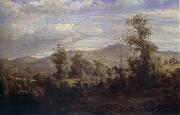
(1848-1913) was a French painter and sculptor.
He was son and pupil of Albert-Ernest Carrier-Belleuse. He designed the patterns of the Faïencerie (earthenware factory) from Choisy-le-Roi, where he was artistic director. He was also the sculptor of the Equestrian monument to General Manuel Belgrano
|
 |
Louis Buvelot
|
|
Swiss-born Australian Painter
1814-1888
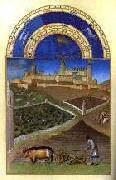
was a Swiss-born landscape painter who emigrated to Australia in 1865 and influenced the Heidelberg School of painters. Buvelot was born in Morges, Vaud, Switzerland, second son of Francois Simeon Buvelot, postal official, and his wife Jeanne-Louise nee Heizer, a school teacher. Louis Buvelot worked under Marc-Louis Arland at Lausanne, and from around 1834 continued his studies at Paris with Camille Flers, a well-known landscape painter of the day. After a few months there he migrated to Bahia, Brazil where he worked on his uncle's coffee plantation. In October 1840 Buvelot moved to Rio de Janeiro and attracted the notice of the emperor Dom Pedro II, who bought some of his pictures and decorated him with the Order of the Rose. In November 1843 Buvelot married Marie-Felicite, nee Lalouette (born 1816). Buvelot returned to Switzerland in 1852 and in 1856 was awarded a silver medal for a picture exhibited at Berne. |
 |
LIMBOURG brothers
|
|
Flemish painters (b. 1370-80, Nijmegen, d.
1416, Nijmegen).
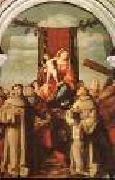
family of Franco-Flemish manuscript illuminators. The Limbourg brothers, Pol, Jan, and Herman, were trained as goldsmiths. They succeeded Jacquemart de Hesdin in 1411 as court painters to Jean, duc de Berry. Their masterpiece is the magnificent book of hours known as the Tr??s Riches Heures (c.1415; Mus??e Cond??, Chantilly). This is filled with exquisite illustrations of the daily life of the aristocracy and peasantry, including a series of calendar illuminations that are considered the finest extant examples of the International Gothic style
|
 |
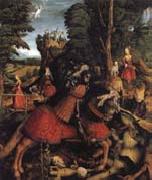
LICINIO, Bernardino
|
|
Italian painter, Venetian school (b. ca. 1489, Poscante, d. ca. 1565, Venezia) |
 |
Leonhard Beck
|
|
German Northern Renaissance Painter, ca.1480-1542, Illuminator, painter, draughtsman and woodcutter, son of Georg Beck. He first appears as an illuminator and collaborator with his father in two Psalters for the Augsburg monastery of SS Ulrich and Afra in 1495, producing 35 coloured initial letters for each of them (Augsburg, Staats- & Stadtbib., Cod. 49a). These are vigorously coloured but fairly uniform in character, with small, lively biblical scenes excellently adapted to the letters. Red, green and blue predominate; ochre tones provide a link with the gold ground. The initial letter X is composed of splendidly curled, entwining foliage with birds and half-figures of prophets; the Virgin, Joseph, the Christ Child in the manger and the choir of angels are each enclosed in one of its sectors. The figures are presented in a light, easy manner; the draughtsmanship avoids unnecessary detail. |
 |
Leonardo Bazzaro
|
|
(Milan, 1853-1937) was an Italian painter.
After picking up the basics in the studio of the painter Gaetano Fasanotti, Bazzaro enrolled at the Brera Academy in Milan, where he was awarded the Fumagalli Prize in 1875. The following years saw a series of perspective views set in Milanese churches and mansions. The success achieved with the public and critics alike at a number of major national and international events prompted him to take an interest also in portraiture and landscape painting, for which his favourite settings were Venice and Chioggia. The works of the 1880s and 1890s also include increasingly intimist scenes of everyday life in the setting of Valsassina, Valle deAosta and Verbano. Bazzaro continued to take part in numerous exhibitions in the region of Lombardy as well as the Venice Biennale and the Rome Quadrenniale right up to his death, always achieving great success with collectors and being asked to execute replicas of his most popular subjects.
|
 |
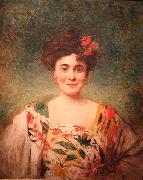
Leonaert Bramer
|
|
(24 December 1596 - 10 February 1674 (buried)) was a Dutch painter, best known for probably being one of the teachers of Johannes Vermeer, although there is no similarity between their work. Bramer's dark and exotic style is unlike Vermeer's style. Bramer was primarily a genre and history painter, but also made some unique frescos, not very often found north of the Alps. Leonaert Bramer is one of the most intriguing personalities in seventeenth-century Dutch art. He was a talented and diligent draughtsman, evidently Roman Catholic and a lifelong bachelor.
Bramer was born in Delft. In 1614, at the age of 18, he left on a long trip eventually reaching Rome in 1616, via Atrecht, Amiens, Paris, Aix (February 1616), Marseille, Genoa, and Livorno. In Rome he was one of the founders of the Bentvueghels group of Northern artists. He lived with Wouter Crabeth and got into a fight with Claude Lorraine. He dedicated a poem to Wybrand de Geest. Bramer remained on and off in Rome until October 1627, visiting Mantua and Venice, often for deliveries and to meet Domenico Fetti. In Italy Bramer was nicknamed Leonardo della Notte ("Leonardo of the night"). In 1648 he went to Rome for a second time.
By 1628 he was back in Delft, where he joined the Guild of Saint Luke in 1629 and the schutterij. Among his many patrons were members of the House of Orange, but local burgomasters and schepen also bought his paintings in great numbers.[3] He was a many sided artist, designing for tapestry firms in Delft, painting murals and ceilings, some of which are illusionistic in style. He painted real frescos in the Civic Guard house, the nearby stadholder's palaces in Honselersdijk, Rijswijk, the Communal Land Housde and the Prinsenhof in Delft.[3] Due to the Dutch climate they no longer survive.
He evidently knew the greatest of his Delft contemporaries, Johannes Vermeer, as he came to the latter's defence when his future mother-in-law was trying to prevent him from marrying her daughter.
|
 |
Leon Joseph Florentin Bonnat
|
|
(20 June 1833 - 8 September 1922) was a French painter.
He was born in Bayonne, but from 1846 to 1853 he lived in Madrid, where his father owned a bookshop. While tending his father's shop, he copied engravings of works by the Old Masters, developing a passion for drawing. In Madrid he received his artistic training under Madrazo. He later worked in Paris, where he became known as a leading portraitist, never without a commission. His many portraits show the influence of Velezquez, Jusepe de Ribera and other Spanish masters, as well as Titian and Van Dyke, whose works he studied in the Prado. Following the period in Spain Bonnat worked the ateliers of the history painters Paul Delaroche and Leon Cogniet (1854) in Paris. Despite repeated attempts, he failed to win the prix de Rome, finally receiving only a second prize. However, a scholarship from his native Bayonne allowed him to spend three years in Rome (1858 - 60) independently. During his stay in Rome, he became friends with Edgar Degas, Gustave Moreau, Jean-Jacques Henner and the sculptor Henri Chapu.
He won a medal of honor in Paris in 1869, going on to become one of the leading artists of his day. Bonnat went on to win the Grand Officer of the Legion d'honneur and became a professor at the Ecole des Beaux Arts in 1882. Bonnat was quite popular with American students in Paris. In addition to his native French, he spoke Spanish and Italian and knew English well, to the relief of many monolingual Americans. In May 1905 he succeeded Paul Dubois as director of the Ecole des Beaux-Arts. Bonnat "was a liberal teacher who stressed simplicity in art above high academic finish, as well as overall effect rather than detail," explains Julius Kaplan (see References). Bonnat's emphasis on overall effect on the one hand, and rigorous drawing on the other, put him in a middle position with respect to the Impressionists and academic painters like his friend Jean-Leon Gerôme.
|
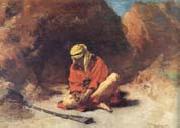 |
Leon Bonnat
|
|
French Academic Painter, 1833-1922,was a French painter. He was born in Bayonne, but from 1846 to 1853 he lived in Madrid, Spain, where his father owned a bookshop. In Madrid he received his artistic training under Madrazo. He later worked in Paris, where he became known as a leading portraitist. His many portraits show the influence of Velazquez and the Spanish realists. He won a medal of honor at Paris in 1869, where he became one of the leading artists of his day. Bonnat went on to become a professor at the Ecole des Beaux Arts in 1882. In May 1905 he succeeded Paul Dubois as director. His vivid portrait-painting is his most characteristic work, but his subject pictures, such as the Martyrdom of St Denis in the Pantheon, are also famous. Some of Bonnat's more notable students include: Gustave Caillebotte, Suzor-Cote, Georges Braque,Raoul Dufy, Marius Vasselon, Fred Barnard, |
 |
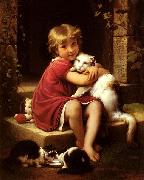
Leon Benouville
|
|
Paris 1821 - Paris 1859.
was a French painter. Leon Benouville first studied with his elder brother Jean-Achille Benouville (1815-1891) in the studio of François-Edouard Picot before he transferred to Ecole des Beaux-Arts in 1837. Like his brother he received the Prix de Rome in 1845. In Rome, as a Prix de Rome pensionary at the Villa Medici, he stayed with his brother and met the sculptor Charles Gumery. |
 |
Leon Bazille Perrault
|
|
(20 June 1832, Poitiers - 1908, Royan) was a French painter.
A student of William Bouguereau and François-Edouard Picot, he exhibited at the Salon from 1863 onwards, producing several works, in the academic tradition. He was famous for his le petit naufrag (The little shipwrecked boy, 1874) and his paintings of children.
|
 |
Leon Bakst
|
|
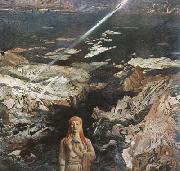
Russian Art Deco Designer and Illustrator, 1866-1924 |
 |
LEDESMA, Blas de
|
|
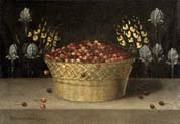
Spanish painter documented 1602-1614 in Granada,Spanish painter. He is known to have worked in Granada from 1602, and in 1614 he designed a stucco vault decoration for the Alhambra. Archival sources testify to his renown as a painter of decorative fresco grotesques (untraced) and still-lifes. His activity as a still-life painter remains debatable, partly because he has been confused with Blas de Prado and also because of Torres Marten's controversial attributions. Ledesma's only unanimously accepted autograph painting is Still-life with Cherries and Flowers (Atlanta, GA, High Mus. A.), signed in Granada. A highly decorative painting, it shows none of the sophistication of still-lifes by Juan Senchez Cot?n, in Granada from 1603. It is painted meticulously and drily. Depicting a severely drawn, rather flat basket on a narrow ledge flanked by flowers behind it, the rigorously symmetrical composition is relieved only by soft lighting and the studied disarray of some fallen cherries. Two other unsigned and poorly preserved still-lifes of analogous subject-matter have been attributed to Ledesma |
 |
Karl Briullov
|
|
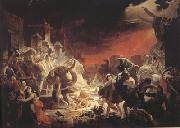
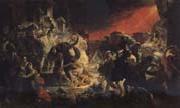
Russian Neoclassical/Romantic Painter, 1799-1852,was an internationally renowned Russian painter. He is regarded as a key figure in transition from the Russian neoclassicism to romanticism. Born of French parents in Saint Petersburg, Carlo Brulleau (as his name was spelled until 1822) felt drawn to Italy from his early years. Despite his education at the Imperial Academy of Arts (1809?C1821), Briullov never fully embraced the classical style taught by his mentors and promoted by his brother, Alexander Briullov. After distinguishing himself as a promising and imaginative student and finishing his education, he left Russia for Rome where he worked until 1835 as a portraitist and genre painter, though his fame as an artist came when he began doing historical painting. His best-known work, The Last Day of Pompeii (1830?C1833), is a vast composition compared by Pushkin and Gogol to the best works of Rubens and Van Dyck. It created a sensation in Italy and established Briullov as one of the finest European painters of his day. After completing this work, he triumphantly returned to the Russian capital, where he made many friends among the aristocracy and intellectual elite and obtained a high post in the Imperial Academy of Arts. |
 |
Karl Bodmer
|
|
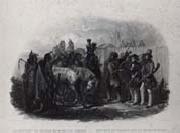
Swiss Painter, 1809-1893,Swiss painter and graphic artist, active in the USA and France. His earliest exposure to art probably came from his uncle, the landscape painter and engraver Johann Jakob Meyer (1787-1858). When he was 22, Bodmer moved to Paris, where he studied art under Sebastien Cornu. In Paris he met his future patron, Prince Maximilian of Wied-Neuwied, who was planning an ambitious scientific expedition to North America. Bodmer was engaged to accompany the expedition and to provide sketches of the American wilderness. After touring the East Coast, the party made their way westward via the Ohio and Mississippi rivers to St Louis, MO, and in 1833 travelled up the Missouri River into country scarcely inhabited by white men. On the journey north to Ft MacKenzie, WY, Bodmer recorded the landscape and the groups of Indians they encountered. Having wintered in Ft Clark, ND, they returned to New York and then Europe in 1834. |
 |
Karl Blechen
|
|
German Romantic, 1798-1840
sometimes given as Karl Blechen, was a German painter, specializing in fantastic landscapes, sometimes with demons and grotesque figures. Born in Cottbus, he drew the attention of prominent architect Karl Friedrich Schinkel, who cast him as a decorative painter. Blechen however aimed for higher work and began producing landscape paintings. In 1827 he went to Italy |
 |
Julius von Blaas
|
|
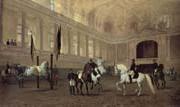
1845-1923,was an Italian painter, the second son of Karl, born at Albano, Italy. He studied under his father, devoted himself principally to equestrian subjects, and went to Rome where he painted genre scenes from the Campagna. His "Race of Intoxicated Slavonic Peasants" (1869) is in the Imperial Museum of Vienna, as is "Antlassritt" (1899). Julius von Blaas was much employed by the Austrian court as a portrait painter and became professor in the Academy of Vienna. |
 |
Jules Breton
|
|
1827-1906
French Jules Breton Locations
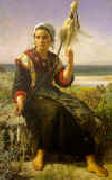
French painter and writer. After the death of his mother he was brought up in the village of Courrires by his father, grandmother and uncle. The last instilled in him respect for tradition and a commitment to the philosophical ideas of the 18th century. Breton father, as supervisor of the lands of the Duc de Duras, encouraged him to develop a deep knowledge of and affection for his native region and its heritage, which remained central to his art. |
 |
Jules Bastien-Lepage
|
|
French Realist Painter, 1848-1884
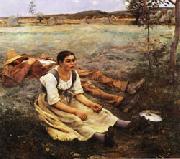
French painter. Bastien-Lepage grew up on a farm. Although his earliest efforts in drawing were encouraged, his parents violently objected when he decided to become a professional artist. To mollify them he worked for a time as a postal clerk in Paris while studying at the Ecole des Beaux-Arts. In 1868 he left the civil service and was accepted into Alexandre Cabanel's atelier. During this apprenticeship, Bastien-Lepage won two prizes in drawing, and in 1870 he made his d?but at the Salon with a Portrait of a Young Man (untraced). In the Franco-Prussian War (1870-71) he joined a regiment of sharpshooters and was severely wounded in the chest. When he recovered he attempted unsuccessfully to find work as an illustrator. |
 |
Juan de Borgona
|
|
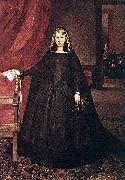
Spanish Painter,
ca.1470-1534
was a High Renaissance painter who was born in the Duchy of Burgundy, probably just before it ceased to exist as an independent state, and was active in Spain from about 1495 to 1534. His earliest documented work was painted in 1495 for the cloister of the Cathedral of Toledo. Borgoña??s compositions are well balanced with finely drawn figures in elegant, tranquil poses. They are set either against open spaces leading on to craggy landscapes or against gold embroidered drapery. There were a number of foreign painters active in Spain in this period, including Juan de Flandes. Borgona??s students include Pedro de Cisneros the Elder (died 1546), Antonio de Comontes (ca. 1500-1519), |
 |
Juan Bautista del Mazo
|
|
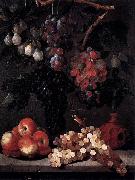
Juan Bautista Martenez del Mazo (c.1612 - 10 February 1667) was a Spanish Baroque portrait and landscape painter, the most distinguished of the followers of Velezquez, whose style he imitated more closely than did any other artist. A fine painter himself, Mazo was a master of landscape, as proven by his most celebrated work View of Saragossa.
|
 |
Juan Bautista de Espinosa
|
|
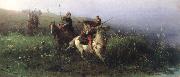
(1590-1641, Madrid) was a Spanish still life painter.
More paintings remain of him than biographical data and there is only one known painting remaining.
It is only known that he worked in Toledo and Madrid from 1612 to 1626 and, judging by his style, he was trained in Holland. De Espinosa's style is judged to be the transition from Flemish Baroque to Spanish Baroque.
Several mural paintings in Spanish churches are also attributed to him; one of these is in Alcaudete.
|
 |
jozef brandt
|
|
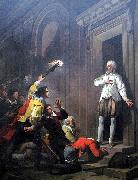
Jozef Brandt (b. Szczebrzeszyn, 1841 - Radom, 1915) was a Polish painter, best known for his paintings of battles.
Brandt studied in Warsaw in the school of J.N. Leszczynski and at the Noblemen Institute. In 1858 he left for Paris to study at the Ecole centrale Paris but was persuaded by Juliusz Kossak to abandon engineering in favor of painting. At one point he studied as a painter under Franz Adam.
|
 |
Joseph-Benoit Suvee
|
|
(3 January 1743 - 9 February 1807) was a Flemish painter strongly influenced by French neo-classicism.
He was born in Bruges. Initially a pupil of Matthias de Visch, he came to France aged 19 and became a pupil of Jean-Jacques Bachelier. In 1771, he won the Prix de Rome. In Rome from 1772 to 1778, he prolonged the usual duration allowed to pensionaries of the French Academy in Rome. He was named an academician on his return to Paris and he opened an art school for young women at the Louvre. He emulated and competed with Jacques-Louis David, earning his enduring hatred.
Named the French Academy in Rome's director in 1792, replacing François-Guillaume Menageot, he was imprisoned for a while in the Prison Saint-Lazare and only able to take up the post in 1801. After a brilliant career, and a six years' stay in Rome as the Academy's Director, he died there suddenly.
His works include Achilles depositing the body of Hector at the feet of the body of Patroclus, (1769, Louvre), and Cornelia, mother of the Gracchi, (1795, Louvre).
|
 |
Joseph Blondel
|
|
Merry-Joseph Blondel (Paris, July 5, 1781 - Paris, June 12, 1853) was a French neo-classic painter.
After a first training in the Dilh et Guerhard porcelain factory, he later was a painting student of Jean-Baptiste Regnault. He won in 1803 Price of Rome with his painting Enee portant son pere Anchise. He lived in Villa Medicis, in Rome, Italy, from 1809 to 1812, and won a gold award for his painting Mort de Louis XII. He then started a career as an interior decorator (Fontainebleau Castel, Brongniart Palace, Louvre Museum, Senat). |
|