|
 |
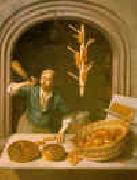
Joseph Bidauld
|
|
Carpentras(Vaucluse)1758-Montmorency (Val d'Oise)1846
French painter. He was apprenticed in Lyon for six years with his brother Jean-Pierre-Xavier Bidauld (1745-1813), a landscape and still-life painter. Subsequently, they left Lyon to travel together in Switzerland and Provence. In 1783 he moved to Paris, where he met Joseph Vernet (from whom he received valuable advice), Joseph-Siffred Duplessis and Jean-Honor? Fragonard. In 1785 he went to Rome with the assistance of Cardinal de Bernis and his patron, the dealer and perfumer Dulac. He stayed there for five years, travelling through Tuscany, Umbria and Campania and painting such works as Roman Landscape (1788; Basle, Kstmus.). Bidauld was closely involved with the circle of French Neo-classical painters in Rome in the 1780s. He was friendly with Louis Gauffier, Nicolas-Antoine Taunay and especially with Guillaume Lethiere, who became his brother-in-law and with whom he occasionally collaborated. On his return to Paris in 1790 he travelled extensively in France, |
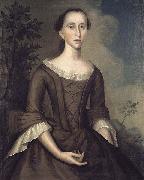 |
Joseph Badger
|
|
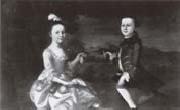
(ca.1707-1765) was a portrait artist in Boston, Massachusetts in the 18th-century. He painted some 80 portraits of merchants, businessmen, clergy, and other notables, and their wives and children.
Badger was born in Charlestown, Massachusetts, to tailor Stephen Badger and Mercy Kettell. In 1731 he married Katharine Felch; they moved to Boston around 1733. He was a member of the Brattle Street Church.
He "began his career as a house-painter and glazier, and ... throughout his life continued this work, besides painting signs, hatchments and other heraldic devices, in order to eke out a livelihood when orders for portraits slackened."
|
 |
Jorg Breu the Elder
|
|
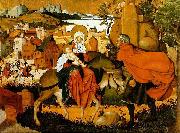
(c. 1475 -- 1537), of Augsburg, was a painter of the German Danube school. He was the son of a weaver.
He journeyed to Austria and created several multi-panel altarpieces there in 1500-02, such as the Melk Altar (1502). He returned to Augsburg in 1502 where he became a master. He travelled to Italy twice, in ca. 1508 and in 1514/15.
After his death in 1537, his son, Jörg Breu the Younger continued to lead his Augsburg workshop until his own death 10 years later. |
 |
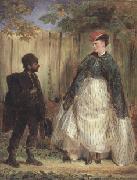
John wharlton bunney
|
|
1828-1882
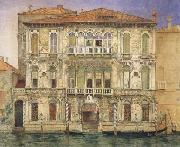
was an English topographical and landscape artist of the nineteenth century. His father was a merchant captain whom Bunney, as a boy, accompanied on several voyages around the world. Bunney demonstrated a strong talent for drawing and draftsmanship from an early age. The young Bunney became a follower of John Ruskin; he studied with Ruskin at the Working Men's College soon after its founding in 1854, and later worked as a clerk for Smith, Elder & Co., Ruskin's publisher. Bunney was able to give up his clerical job and make his living by his art and art teaching by 1859; Ruskin commissioned him to execute a series of drawings in Italy and Switzerland.Bunney married Elizabeth Fallon in 1863. The couple settled in Florence; they would have four children. Bunney worked for Ruskin's St. George's Company (later the Guild of St George) in northern Italy for the remainder of his life. In his career there, Bunney produced a noteworthy pictorial record of Italy in his era. Ruskin said that Bunney's work was "so faithful and careful as almost to enable the spectator to imagine himself on the spot." Bunney was a friend of many of the Pre-Raphaelites, especially William Holman Hunt. From 1870 on, Bunney lived and painted in Venice. In 1876 Ruskin commissioned Bunney to paint a picture that included the entire western facade of St. Mark's Basilica |
 |
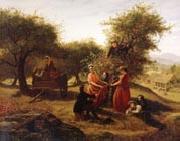
John George Brown
|
|
1831-1913
John George Brown Galleries
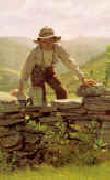
John George Brown (November 11, 1831 - February 8, 1913), American painter, was born in Durham, England, on 11 November 1831. He studied at Newcastle-on-Tyne, in the Edinburgh Academy, and after moving to New York City in 1853, he studied with Thomas Seir Cummings at the schools of the National Academy of Design, of which he became a member in 1863.New International Encyclopedia He was its vice-president, 1899-1904, and originated the idea of the removal of the Academy to a new site in 110th Street.
In 1866 he became one of the charter members of the Water-Color Society, of which he was president from 1887 to 1904. He generally confined himself to representations of street child life, bootblacks, newsboys, etc.; his Passing Show (Paris, Salon, 1877) and Street Boys at Play (Paris Exhibition, 1900) are good examples of his popular talent. Brown's art is best characterized as British genre paintings adapted to American subjects. Essentially literary, it is executed with precise detail, but is poor in color, and more popular with the general public than with connoisseurs. |
 |
John Brett
|
|
John Brett (1831-1902) was an artist associated with the Pre-Raphaelite movement (although is not considered to be a Pre-Raphaelite painter himself), mainly notable for his highly detailed landscapes. Brett was born near Reigate on 8 December 1831, the son of an army vet. In 1851 he began lessons in art with James Duffield Harding, a landscape painter. He also studied with Richard Redgrave. In 1853 he entered the Royal Academy schools, but was more interested in the ideas of John Ruskin and William Holman Hunt, whom he met through his friend the poet Coventry Patmore. Inspired by Hunt's ideal of scientific landscape painting Brett visited Switzerland, where he worked on topographical landscapes and came under the further influence of John William Inchbold.
|
 |
John Bettes the Elder
|
|
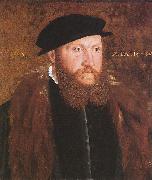
(active c. 1531 - 1570) was a Tudor artist whose few known paintings date from between about 1543 and 1550. His most famous work is his Portrait of a Man in a Black Cap. His son John Bettes the Younger, with whom he is sometimes confused, was a pupil of Nicholas Hilliard who painted portraits during the reign of Elizabeth I and James I.
Nothing is known of John Bettes's life, except that he was living in Westminster in 1556, according to a documented court case. He is first recorded as working for Henry VIII at Whitehall Palace in 1531. Queen Catherine Parr's accounts for 1546/47 record payments to Bettes for "lymning" (painting in miniature) the king's and queen's portraits, and for six other portraits. Her new year's gift of 1547 to Prince Edward was a pair of portraits of the king and herself. Bettes has been identified as the designer of the engraved title-border for William Cuningham's Cosmographical Glasse, printed by John Day in 1559. He may also be the designer of engravings for Edward Hall's Chronicle, published in 1550, and of a woodcut portrait of Franz Burchard, the Saxon ambassador to England, published in 1560. In 1576, John Foxe referred to Bettes as already dead. An earlier second edition of Foxe's Actes and Monuments printed in 1570 refers to Bettes' death. |
 |
John Bauer
|
|
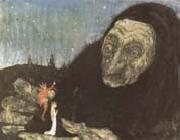
June 4, 1882 ?C November 20, 1918, was a Swedish painter and illustrator. Best known for his illustrations of Bland tomtar och troll Bauer was born and raised in Jonkoping with his two brothers, and sister, Anna Bauer. Anna whose early death at 13 had a profound effect on John and his brothers. Living in an apartment situated above their father charcuterie, he was always given to sketching and drawing. At sixteen, he set off for Stockholm to study art, and after two years he entered the Royal Swedish Academy of Arts. At the academy he met Esther Ellquist, whom he would marry in December of 1906. Together they embarked on a two year long trip to Germany and Italy to study art (1908-1910). Bauer wife became the model for many of Bauer paintings, most notably The Fairy Princess in 1905. Bauer suffered from depression and self-doubts. By 1918 his marriage was falling apart, divorce was being discussed, and the world was at war. John and Esther, and their two-year old son, Bengt or Putte, were on their way to a new home in Stockholm, where John hoped for spiritual renewal and a new life for himself and his family. In the wake of the recent well-publicized train accident of Geta, John booked their return to Stockholm on a ferry, the Per Brahe steamer. John Bauer died in the shipwreck of Per Brahe along with Ester and Bengt |
 |
john banister
|
|
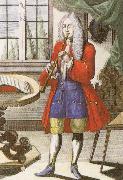
Banister was a violinist, composer and flageolet player for the English court. Much of his life was astir with accusations and innuendo. Nevertheless, he was able to remain in the King's service until his death and a great demand was laid upon him for his "play" songs. |
 |
John Ballantyne
|
|
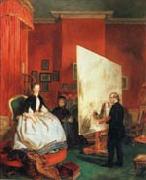
British Portrait painter , (1815-1897)
was an English ornithologist. The Gould League in Australia was named after him. His identification of the birds now nicknamed "Darwin's finches" was pivotal in the inception of Darwin's theory of evolution by natural selection, though they are barely mentioned in Charles Darwin's book, On the Origin of Species.Gould was born in Lyme Regis, Dorset, the son of a gardener, and the boy probably had a scanty education. Shortly afterwards his father obtained a position on an estate near Guildford, Surrey, and then in 1818 became foreman in the Royal Gardens of Windsor. The young Gould started training as a gardener, being employed under his father at Windsor from 1818 to 1824, and he was subsequently a gardener at Ripley Castle in Yorkshire. He became an expert in the art of taxidermy and in 1824 he set himself up in business in London as a taxidermist |
 |
johannes brahms
|
|
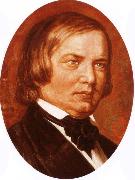
Born: 7 May 1833
Birthplace: Hamburg, Germany
Died: 3 April 1897 (liver cancer)
Best Known As: German composer of "Brahms' Lullaby" ("Wiegenlied")
|
 |
Johann Christian Brand
|
|
(March 6, 1722 ?C June 12, 1795)was an Austrian painter (son of the German painter Christian Hilfgott Brand (1694-1756) who taught in Vienna with Karl Aigen) and brother of Friedrich August Brand.Johann Christian Brand influenced ending the baroque era of landscape painting. He died in Vienna.
Johann Christian Brand was born in Vienna on March 6, 1722. Influential in ending the baroque era, Johann studied at the Vienna Academy from 1736.He was awarded with the titles Kammermaler* in 1766 and "Professor of Landscape Drawing" in 1772. |
 |
Johann Barthold Jongkind
|
|
1819-1891
Dutch
Johann Barthold Jongkind Gallery
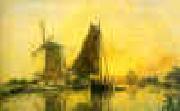
was a Dutch painter and printmaker regarded as a forerunner of Impressionism who influenced Claude Monet.
Jongkind was born in the town of Lattrop in the Overijssel province of the Netherlands near the border with Germany. Trained at the art academy in The Hague, in 1846 he moved to the Montmartre quarter of Paris, France where he studied under Eugene Isabey and Francois-Edouard Picot. Two years later, the Paris Salon accepted his work for its exhibition, and he received acclaim from critic Charles Baudelaire and later on from Emile Zola. Jongkind was to experience little success, however, and he suffered bouts of depression complicated by alcoholism. Jongkind returned to live in Rotterdam in 1855, and remained there until 1860. Back in Paris, in 1861 he rented a studio on the rue de Chevreuse in Montparnasse where some of his paintings began to show glimpses of the Impressionist style to come. In 1862 he befriended the young Claude Monet who later referred to Jongkind as the "master." The following year Jongkind exhibited at the first Salon des Refus??s. Despite several successes, in another of his down periods the Impressionist group did not accept his work for their first exhibition in 1874. In 1878 with his wife, painter of nude people Josephine Fesser, Jongkind moved to live in the small town of La Cote-Saint-Andre near Grenoble in the Isere departement in the southeast of France where he died in 1891. He is buried there in the local cemetery. |
 |
Johan Vilhelm Gertner
|
|
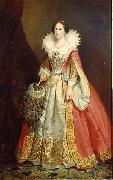
(10 March 1818 - 28 March 1871) was a Danish painter, best known for his portraiture. One of the last students of Christoffer Wilhelm Eckersberg, who was known as the father of the Golden Age of Danish Painting, Gertner belonged to the tail end of the Golden Age, a period during which Danish art moved towards a more realistic style, relying on inspiration both from French Realism and emerging photographic techniques.
Gertner was born on 10 March 1818 to a craftsman at the Holmen naval base. He attended the Royal Danish Academy of Fine Arts from 1831 to 1837 where he was one of Christoffer Wilhelm Eckersberg, known as the farther of Goldn Age of Danish Painting. Eckersberg taught him a naturalistic approach to painting, but Gertner went much further with inspiration from French art and the emerging techniques of photography.
His virtuosity in producing almost photographically precise portraits impressed many; in particular, his ability to reproduce textures and materials e crisp silk dresses, lustrous medals and jewellery, dark mahogany furniture, silky wallpapers, and soft carpets e won him much acclaim. Others, such as the influential art historian and critic Niels Lauritz Høyen, who opposed any foreign influence on Danish painting, disapproved of his style, preferring more sincere and sensitive portrayals. He was a professor at the Academy from 1858.
|
 |
Johan Christoffer Boklund
|
|
(15 July 1817 - 9 December 1880) was a Swedish history, genre, and portrait painter from Kulla-Gunnarstorp in Scania.He was the son of a gardener. At the age of fifteen, Boklund came to Lund, where he worked on illustrations for Sven Nilsson's works on Scandinavian fauna (under the supervision of Magnus Körner). He then became a student at the Royal Danish Academy of Fine Arts in Copenhagen where J. L. Lund was his teacher.
In 1837, Boklund went to Stockholm and began studying at the Royal Swedish Academy of Arts. He made a living as a lithograph and drawing teacher, and produced several small genre paintings of the everyday life (such as Flicka med blomster (English: Girl with flowers) and Köksinteriör (English: Kitchen interior)) and history paintings of the 17th century (such as Gustaf Adolfs afsked från Maria Eleonora (English: Gustaf Adolf's farewell from Maria Eleonora), which was awarded with a medal at the academy).
Together with fellow Swedish painter Johan Fredrik Höckert, Boklund traveled to Munich in Germany in 1846 and stayed there for eight years. During the summers he went on study trips to Bavaria, Tyrol, and northern Italy. During this period, Boklund primarily devoted his painting to the history genre with subjects from the 17th century, but he also made some paintings depicting picturesque and architectural interior. In 1853, he sent his painting Den nyfikne trumpetaren (English: The curious trumpet player) home to Sweden and it earned him a scholarship from the government. This allowed Boklund to move to Paris, where he worked at Thomas Couture's atelier from 1854 to 1855. In December 1855 he returned to Sweden. |
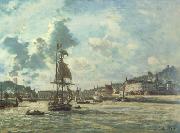 |
Johan Barthold Jongkind
|
|
Dutch Impressionist Painter, 1819-1891
was a Dutch painter and printmaker regarded as a forerunner of Impressionism who influenced Claude Monet. Jongkind was born in the town of Lattrop in the Overijssel province of the Netherlands near the border with Germany. Trained at the art academy in The Hague, in 1846 he moved to the Montmartre quarter of Paris, France where he studied under Eugene Isabey and Francois-Edouard Picot. Two years later, the Paris Salon accepted his work for its exhibition, and he received acclaim from critic Charles Baudelaire and later on from Emile Zola. Jongkind was to experience little success, however, and he suffered bouts of depression complicated by alcoholism. Jongkind returned to live in Rotterdam in 1855, and remained there until 1860. Back in Paris, in 1861 he rented a studio on the rue de Chevreuse in Montparnasse where some of his paintings began to show glimpses of the Impressionist style to come. In 1862 he befriended the young Claude Monet who later referred to Jongkind as the "master." The following year Jongkind exhibited at the first Salon des Refus's. Despite several successes, in another of his down periods the Impressionist group did not accept his work for their first exhibition in 1874. |
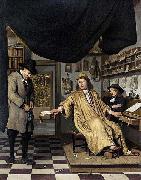 |
Job Adriaenszoon Berckheyde
|
|
(27 January 1630 - 10 June 1698) was a Dutch artist of the 17th century, active in Haarlem, Amsterdam, and The Hague.
Job Berckheyde was born in Haarlem and was the older brother of the painter Gerrit who he later taught to paint. He was apprenticed on 2 November 1644 to Jacob Willemszoon de Wet, and his master's influence is apparent in his first dated canvas, "Christ Preaching to the Children" (1661), one of his few biblical scenes. On 10 June 1653 he repaid a loan from the Haarlem Guild of Saint Luke. From 1656-1660 the two brothers made an extended trip along the Rhine to Germany, stopping off at Cologne, Bonn, Mannheim and finally Heidelberg, following the example of their fellow guild member Vincent van der Vinne. The brothers worked in Heidelberg for Charles I Louis, Elector Palatine (with Job producing portraits and hunting scenes, and receiving a gold chain from the Elector in reward) but were ultimately unable to adapt to court life and so returned to Haarlem, where they shared a house and perhaps a studio. He became a member of the Haarlem rederijkersgilde 'De Wijngaardranken' in 1666-1682. He is registered in Amsterdam 1682-1688, where he became a member of the Guild of St Luke there in 1685-1688.Berckheyde was buried in Haarlem. |
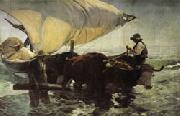 |
Joaquin Sorolla Y Bastida
|
|
Spanish Realist/Impressionist Painter , 1863-1923
Spanish painter, b. Valencia. He is noted for his large landscapes in full, glowing sunlight, painted in strong color and in a bold, fluent style. Sorolla's best-known works include Beaching the Boat and The Swimmers. |
 |
Joachim Beuckelaer
|
|
1535-1574
Flemish
Joachim Beuckelaer Galleries
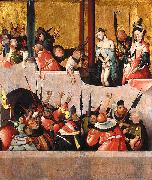
b Antwerp, c. 1534; dAntwerp, c. 1574). Flemish painter. He came from an Antwerp family of obscure painters and seems to have spent his entire life there. He trained in the studio of Pieter Aertsen, who in 1542 had married Beuckelaers aunt; he became an independent master and also married in 1560. His earliest known work dates from that year, and his development can be followed closely to 1570. The example of Beuckelaers master remained decisive throughout his career. Not only did he take over Aertsens new repertory of secular subjects, he also completely adopted his stylistic idiom and manner of painting, so that it can be difficult to distinguish the two hands. Beuckelaer was, however, by no means a slavish imitator, and as regards execution he fully bears comparison with Aertsen. |
 |
Jheronimus Bosch
|
|
c. 1450 - 9 August 1516), was a Dutch painter. His work is known for its use of fantastic imagery to illustrate moral and religious concepts and narratives.
Hieronymus Bosch was born Hieronymus (or Jeroen, respectively the Latin and Middle Dutch form of the name "Jerome") van Aken (meaning "from Aachen"). He signed a number of his paintings as Bosch (pronounced Boss in Middle Dutch). The name derives from his birthplace, 's-Hertogenbosch, which is commonly called "Den Bosch".
Little is known of Bosches life or training. He left behind no letters or diaries, and what has been identified has been taken from brief references to him in the municipal records of 's-Hertogenbosch, and in the account books of the local order of the Brotherhood of Our Lady. Nothing is known of his personality or his thoughts on the meaning of his art. Bosches date of birth has not been determined with certainty. It is estimated at c. 1450 on the basis of a hand drawn portrait (which may be a self-portrait) made shortly before his death in 1516. The drawing shows the artist at an advanced age, probably in his late sixties
|
|