|
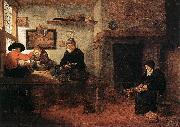 |
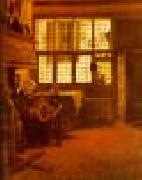
BREKELENKAM, Quiringh van
|
|
Dutch painter (active c. 1647-1669 in Leiden)
Dutch painter. He probably trained in Leiden, possibly under Gerrit Dou. In 1648, with several other painters, he founded the Guild of St Luke in Leiden. He married for the first time in 1648 and again in 1656, a year after his first wife's death. In 1649 his sister Aeltge married the painter Johannes Oudenrogge (1622-53), and the couple soon moved to Haarlem while the Brekelenkam family remained in Leiden. About 1656 Brekelenkam apparently acquired a licence to sell beer and brandy, perhaps because his income as a painter was insufficient to support his large family (six children from his first marriage and three from his second). He continued to be active as an artist and paid his guild dues fairly regularly. The last dues were paid in 1667, and his last dated painting, the Portrait of a Man Aged 33, is from 1669. |
 |
BREGNO, Antonio
|
|
Italian Early Renaissance Sculptor and Architect, active ca.1425-1457 |
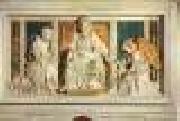 |
BREGNO, Andrea
|
|
Italian Early Renaissance Sculptor and Architect, 1418-1503
Andrea Bregno was invited to move from Venice to Rome when the Venetian Paul II was elected Pope. During the pontificate of the Della Rovere Pope Sixtus IV he received many commissions and headed a large workshop, producing many wall tombs of cardinals and other figures of the papal curia with varying degrees of personal responsibility. He was famous among his contemporaries, and was compared to the Greek sculptor Polykleitos in the epitaph of his tomb in Santa Maria sopra Minerva. Raphael's father, Giovanni Santi, mentioned Bregno in the 1480s, in his biography of Federico da Montefeltro, duke of Urbino. Bregno often worked with Mino da Fiesole in Rome, and his refined Lombard manner was rendered more classical by the contact and by the example of Roman sculptures that were increasingly coming to light, of which Andrea Bregno was an early collector: a certain "Prospettivo Milanese", writing in 1499-1500 refers to a torso in the collection of a "Maestro Andrea" that seems to have been the Belvedere Torso.
He moved in humanist circles and was an esteemed friend of the humanist in Sixtus' circle, Bartolomeo Platina, the librarian of the Vatican Library. Bregno played a significant role in the standardization of an authentically classicizing style of epigraphy, in the inscriptions that accompany his tombs. In the Sistine Chapel he collaborated with Mino da Fiesole and Giovanni Dalmata to produce the little cantoria or choristers' gallery set into the wall, with its own coffered ceiling and carved marble balusters, and the marble screen. |
 |
BREENBERGH, Bartholomeus
|
|
Dutch Baroque Era Painter, ca.1598-1657
Dutch painter, draughtsman and etcher. He was one of at least eight children of a wealthy Protestant family in Deventer, where his father was the town pharmacist. After his father's death in 1607, the family left Deventer, probably moving to Hoorn. No artist then living in Hoorn could plausibly have been Breenbergh's teacher, and given the fact that his earliest works reveal the stylistic influence of the Pre-Rembrandtists, it is more probable that he was apprenticed in Amsterdam. In 1619 he was called upon to give testimony in Amsterdam: on this occasion his profession was listed as 'painter'. His oeuvre can be divided stylistically and iconographically into two distinct groups. He belonged to the first generation of DUTCH ITALIANATES, northern artists who travelled to Italy in the 1620s and were inspired by the light and poetry of the southern landscape. The work of this period consists of numerous Italianate landscape drawings and paintings. |
 |
BRAY, Salomon de
|
|
Dutch Baroque Era Painter, 1597-1664
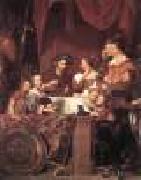
De Bray established himself in Haarlem before 1617, where he is supposed to have been taught by Hendrick Goltzius and Cornelis van Haarlem, and where he married in 1625. He painted history paintings, portraits and landscapes. As a Catholic he probably also made altar pieces for clandestine churches. He cooperated in the decoration of Huis ten Bosch in The Hague. His works draw on the spirit of the Dutch classicism beginning at that time, and are comparable with those of Pieter de Grebber.
De Bray was also active as a designer of silverwork, as a poet, as an architect and as a town planner. As an architect, he was involved in the construction or expansion of Haarlem's City Hall, Zijlpoort, and St. Annakerk (Church of St. Anne), and Nijmegen's city orphanage. One of his poems was set to music by his friend the composer Cornelis Padbru??.
Salomon de Bray was the father of ten children, of whom three (including Jan de Bray) became artists. He probably died of the plague, as some of his children and was buried in the Sint-Bavokerk in Haarlem. |
 |
BRAY, Jan de
|
|
Dutch Baroque Era Painter, ca.1627-1697
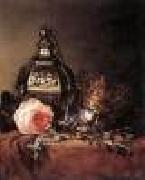
Painter, draughtsman and etcher, son of Salomon de Bray. He spent virtually the whole of his career in Haarlem, except for the period 1686-8, when he lived in Amsterdam. After training with his father, Jan began working as a portrait painter in Haarlem in 1650, an activity he continued for the next 40 years. Between 1667 and 1684 he served on the committee for the Haarlem Guild of St Luke, whose leading members he portrayed in a picture dated 1675 (Amsterdam, Rijksmus.) that includes a self-portrait (Jan is seen standing and drawing on the left). He married three times, in 1668, 1670 and 1672. His first two wives died a year after their marriage, his third two years afterwards, and in each case the death was followed by disputes over the inheritance. Jan's bankruptcy of 1689 may have been a result of one of the lawsuits. |
 |
BRAY, Dirck
|
|
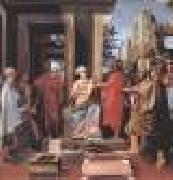
Dutch painter, Haarlem school (active 1651-1678) |
 |
BRAMANTINO
|
|
Italian High Renaissance Painter, ca.1460-1530
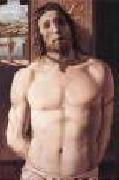
Leonaert/Leonard Bramer alias Nestelghat (Dec 24, 1596, Delft - buried Feb 10, 1674, Delft) was a Dutch painter, best known for probably being one of the teachers of Johannes Vermeer, although there is no similarity between their work. Bramer's dark and exotic style is unlike Vermeer's style. Bramer was primarily a genre and history painter, but also made some unique frescos, not very often found north of the Alps. Leonaert Bramer is one of the most intriguing personalities in seventeenth-century Dutch art. He was a talented and diligent draughtsman, evidently Catholic and a life long bachelor. |
 |
BRAMANTE
|
|
Italian High Renaissance Architect and Painter, 1444-1514
In the first decade of the 16th century Donato Bramante was the chief architect in Rome, which had just replaced Florence as the artistic capital of Europe because the patronage of Pope Julius II (reigned 1503-1513) attracted all the leading Italian artists to that city. It is particularly the triumvirate of artists - Michelangelo the sculptor and painter, Raphael the painter, and Bramante the architect - who dominated this period, usually called the High Renaissance, and whose influence overwhelmed the following generations.
Donato di Pascuccio d'Antonio, called Bramante, was born in 1444 at Monte Asdruvaldo near Urbino. Nothing is known of the first 30 years of his life. During that period, however, the court of Federigo da Montefeltro at Urbino was a flourishing humanistic and cultural center, attended by artists such as Piero della Francesca, Melozzo da Forll, and Luciano Laurana, who probably influenced the young Bramante. The first notice of Bramante dates from 1477, when he decorated the facade of the Palazzo del Podestaat Bergamo with a frescoed frieze of philosophers. |
 |
BOURSSE, Esaias
|
|
Dutch Baroque Era Painter, 1631-1672
He was the youngest son of immigrants from Wallonia. His parents, Jacques Boursse and Anna des Forest, married in 1618 in Amsterdam. We know nothing more about the education of Esaias Boursse, other than the fact that he travelled to Italy in about 1650 to study the great Renaissance examples. No reminders of those examples is to be found in his work. In the past art historians have tried to place him among Rembrandt's pupils. There is no objective evidence at all to prove this though. Maybe this opinion has been inspired by the fact that the painters were neighbours in the Sint Antoniebreestraat in Amsterdam (nowadays called Jodenbreestraat, still housing the Rembrandt House Museum).
Boursse's financial position will not have been good, since in 1661 he sailed with the Verenigde Oostindische Compagnie, on the ship Amersfoort. It travelled to Ceylon (nowadays called Sri Lanka). Boursse drew the inhabitants, landscapes and city views, which have been preserved in an album which can be found in the print room of the Rijksmuseum Amsterdam. In 1663, the painter was back in Amsterdam.
In 1672, Boursse sailed with Verenigde Oostindische Compagnie again. The Amersfoort set sail on October 24 and on November 16 Boursse died at sea.
The life of Esaias Boursse is the story of a painter who could not earn a living by painting alone and therefore had to look for an alternative source of income. The fact that he was no exception is proven by the life stories of for example Jan Steen (who was also an innkeeper) and Johannes Vermeer (who was also an art dealer). A major difference though, is the fact that Steen and Vermeer had to feed and house a (large) family. Boursse seems to have remained unmarried and childless. Financially, Boursse's career was a success. He remains one of the highest paid artists in living memory. |
 |
Bourdon, Sebastien
|
|
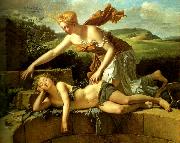
French, 1616-1671.French painter. Bourdon was active in Rome (1634 C37), in Sweden (1652 C54) as Queen Christina's court portrait painter, and in Paris; he also worked in his native Montpellier, where he painted The Fall of Simon Magus for the cathedral. The Finding of Moses is in the National Gallery of Art, Washington, D.C. |
 |
bouillon
|
|
Pierre Bouillon (1776 - October 15, 1831) was a French painter and engraver. Born at Thiviers, he studied with the Academie-trained history painter Nicolas-Andre Monsiau. He was awarded the grand prize of the Institut de France in July, 1797. His drawing of Laocoön and His Sons was the basis of Charles Clement Bervic's celebrated print of the statue |
 |
BOTTICINI, Francesco
|
|
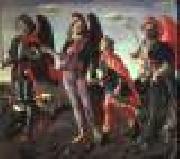
Italian Early Renaissance Painter, ca.1446-1498
Francesco di Giovanni Botticini (1446 ?C July 22, 1498) was an Italian Early Renaissance painter. He studied under Cosimo Rosselli and Andrea del Verrocchio. He was born in Florence in 1446 and is mostly remembered for his painting entitled "Assumption of the Virgin"; he died in 1498 (some sources say 1497). He established his own workshop after a brief period as Neri di Bicci's assistant; the shop was renowned for its decorative works, a few of which can be seen in the cloistered church of Empoli. Some of Botticini's works are said to be overshadowed by his Florentine contemporaries, such as Filippino Lippi and Botticelli, who often influenced Botticini's works. |
 |
BOTTICELLI, Sandro
|
|
Italian Early Renaissance Painter, 1445-1510
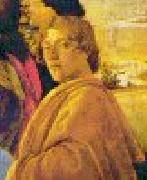
Alessandro di Mariano di Vanni Filipepi, better known as Sandro Botticelli or Il Botticello ("The Little Barrel"; March 1, 1445 ?C May 17, 1510) was an Italian painter of the Florentine school during the Early Renaissance (Quattrocento). Less than a hundred years later, this movement, under the patronage of Lorenzo de' Medici, was characterized by Giorgio Vasari as a "golden age", a thought, suitably enough, he expressed at the head of his Vita of Botticelli. His posthumous reputation suffered until the late 19th century; since then his work has been seen to represent the linear grace of Early Renaissance painting, and The Birth of Venus and Primavera rank now among the most familiar masterpieces of Florentine art.
Details of Botticelli's life are sparse, but we know that he became an apprentice when he was about fourteen years old, which would indicate that he received a fuller education than did other Renaissance artists. Vasari reported that he was initially trained as a goldsmith by his brother Antonio. Probably by 1462 he was apprenticed to Fra Filippo Lippi; many of his early works have been attributed to the elder master, and attributions continue to be uncertain. Influenced also by the monumentality of Masaccio's painting, it was from Lippi that Botticelli learned a more intimate and detailed manner. As recently discovered, during this time, Botticelli could have traveled to Hungary, participating in the creation of a fresco in Esztergom, ordered in the workshop of Fra Filippo Lippi by Vitez J??nos, then archbishop of Hungary.
By 1470 Botticelli had his own workshop. Even at this early date his work was characterized by a conception of the figure as if seen in low relief, drawn with clear contours, and minimizing strong contrasts of light and shadow which would indicate fully modeled forms. |
 |
BOTH, Jan
|
|
Dutch painter (b. ca. 1618, Utrecht, d. 1652, Utrecht
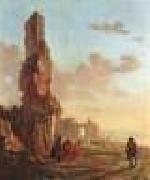
Brother of Andries Both. He was one of the foremost painters among the second generation of DUTCH ITALIANATES. While working in Italy he specialized in genre scenes; however, on his return to the Netherlands he concentrated on wooded landscapes bathed in a golden light that illuminates the highly detailed foliage and trees. These realistic landscapes represent his most original contribution to Dutch painting and were much imitated by his contemporaries and by later artists. |
 |
BOTH, Andries
|
|
Dutch Baroque Era Painter, ca.1612-1641
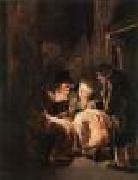
Andries Both (1612/1613, Utrecht - March 23, 1642, Venice) Dutch genre painter, one of the bamboccianti, and brother of Jan Dirksz Both.
Both was the son of a glass painter, and studied under Abraham Bloemaert. According to Joachim von Sandrart, Andries and his brother Jan cooperated on the paintings, with Jan painting the landscapes and Andries the figures, though this view has been revised in the 20th century. Andries stayed in Rouen in 1633, and he traveled on to Rome, where is documented from 1635 to 1641. He first shared a studio with a fellow painter from Utrecht, Jan van Causteren. In 1638 his brother joined him, living on the Via Vittoria in the parish of San Lorenzo in Lucina and perhaps both joining the Accademia di San Luca and the group of painters led by Pieter van Laer. In 1641 the brothers traveled back to Holland, but Andries met his death in Venice on the way, drowning in a canal as he was returning from some festivities. |
 |
BOSSE, Abraham
|
|
French Baroque Era Engraver, 1602-1676
Roughly 1600 etchings are attributed to him, with subjects including: daily life , religion, literature , history, fashion[8], technology, and science. Most of his output was illustrations for books, but many were also sold separately. His style grows from Dutch and Flemish art, but is given a strongly French flavour. Many of his images give fascinating and informative detail about middle and upper-class daily life in the period, although they must be treated with care as historical evidence. His combination of very carefully depicted grand interiors with relatively trivial domestic subjects was original and highly influential on French art, and also abroad ?? William Hogarth's engravings are, among other things, a parody of the style. Most of his images are perhaps best regarded as illustrations rather than art.
Watercolour of a ball by Abraham Bosse, a similar subject to many of his most famous etchingsHe was apprenticed in Paris about 1620 to the Antwerp-born engraver Melchior Tavernier (1564?C1641), who was also an important publisher. His first etchings date to 1622, and are influenced by Jacques Bellange. Following a meeting in Paris about 1630, he became a follower of Jacques Callot, whose technical innovations in etching he popularised in a famous and much translated Manual of Etching(1645), the first to be published. He took Callot's highly detailed small images to a larger size, and a wider range of subject matter.
Unlike Callot, his declared aim, in which he largely succeeded, was to make etchings look like engravings, to which end he sacrificed willingly the freedom of the etched line, whilst certainly exploiting to the full the speed of the technique. Like most etchers, he frequently used engraving on a plate in addition to etching, but produced no pure engravings. |
 |
BOSSCHAERT, Johannes
|
|
Flemish painter (b. ca. 1610, Middelburg, d. ca. 1650, Utrecht)
was a member of the Bosschaert family of still life painters. He was the second son of Ambrosius Bosschaert. Little is known about his life, including the date of his death. |
 |
BOSSCHAERT, Ambrosius the Elder
|
|
Dutch Baroque Era Painter, 1573-1621
Painter and dealer. He left Antwerp with his parents c. 1587 because as Protestants they were vulnerable to religious persecution; the family moved to Middelburg, where in 1593 Ambrosius became a member of the Guild of St Luke, of which he served as Dean on several occasions (1597, 1598, 1603, 1604, 1612 and 1613). In 1604 he married Maria van der Ast, the sister of Balthasar van der Ast who later became his pupil and possible collaborator. Bosschaert bought a house in Middelburg in 1611. There are flower-pieces by Bosschaert that are signed (with a monogram) and dated between 1605 and 1621, though there were two periods of artistic inactivity, in 1611-13 and 1615-16, when he was probably more active as a dealer in the art of both Dutch and foreign artists (e.g. Veronese and Georg Flegel). He was recorded in Bergen-op-Zoom in 1615 and became a citizen of Utrecht in 1616, where his name appears in the register of the Utrecht Guild of St Luke for the same year. In 1619 he was involved in a court case in Breda, where he lived from that year. He died during a journey to The Hague. |
 |
BOSCH, Hieronymus
|
|
Netherlandish Northern Renaissance Painter, ca.1450-1516
Bosch produced several triptychs. Among his most famous is The Garden of Earthly Delights. This painting depicts paradise with Adam and Eve and many wondrous animals on the left panel, the earthly delights with numerous nude figures and tremendous fruit and birds on the middle panel, and hell with depictions of fantastic punishments of the various types of sinners on the right panel. When the exterior panels are closed the viewer can see, painted in grisaille, God creating the Earth. These paintings have a rough surface from the application of paint; this contrasts with the traditional Flemish style of paintings, where the smooth surface attempts to hide the fact that the painting is man-made.
Bosch never dated his paintings and may have signed only some of them (other signatures are certainly not his). Fewer than 25 paintings remain today that can be attributed to him. Philip II of Spain acquired many of Bosch's paintings after the painter's death; as a result, the Prado Museum in Madrid now owns several of his works, including The Garden of Earthly Delights.
|
 |
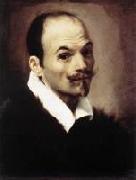
Boris Kustodiev
|
|
1878-1927
Russian
Boris Kustodiev Galleries
The Russian Revolution of 1905, which shook the foundations of society, evoked a vivid response in the artist's soul. He contributed to the satirical journals Zhupel (Bugbear) and Adskaya Pochta (Hell??s Mail). At that time, he first met the artists of Mir Iskusstva (World of Art), a group of innovative Russian artists. He joined their association in 1910 and subsequently took part in all their exhibitions.
In 1905, Kustodiev first turned to book illustrating, a genre in which he worked throughout his entire life. He illustrated many works of classical Russian literature, including Nikolai Gogol's Dead Souls, The Carriage, and The Overcoat; Mikhail Lermontov's The Lay of Tsar Ivan Vasilyevich, His Young Oprichnik and the Stouthearted Merchant Kalashnikov; and Leo Tolstoy's How the Devil Stole the Peasants Hunk of Bread and The Candle.
In 1909, he was elected into Imperial Academy of Arts. He continued to work intensively, but a grave illness??tuberculosis of the spine??required urgent attention. On the advice of his doctors he went to Switzerland, where he spent a year undergoing treatment in a private clinic. He pined for his distant homeland, and Russian themes continued to provide the basic material for the works he painted during that year. In 1918, he painted The Merchant's Wife, which became the most famous of his paintings.
The Merchant's Wife, (1918).In 1916, he became paraplegic. "Now my whole world is my room", he wrote. His ability to remain joyful and lively despite his paralysis amazed others. His colourful paintings and joyful genre pieces do not reveal his physical suffering, and on the contrary give the impression of a carefree and cheerful life. His Pancake Tuesday/Maslenitsa (1916) and Fontanka (1916) are all painted from his memories. He meticulously restores his own childhood in the busy city on the Volga banks.
In the first years after the Russian Revolution of 1917 the artist worked with great inspiration in various fields. Contemporary themes became the basis for his work, being embodied in drawings for calendars and book covers, and in illustrations and sketches of street decorations. His covers for the journals The Red Cornfield and Red Panorama attracted attention because of their vividness and the sharpness of their subject matter. Kustodiev also worked in lithography, illustrating works by Nekrasov. His illustrations for Leskov's stories The Darner and Lady Macbeth of the Mtsensk District were landmarks in the history of Russian book designing, so well did they correspond to the literary images. |
 |
BORGIANNI, Orazio
|
|
Italian Baroque Era Painter, 1578-1616
Orazio Borgianni (c. 1575 - buried 15 January 1616) was an Italian painter and etcher of the Mannerist and early-baroque periods. He was the stepbrother of the sculptor and architect Giulio Lasso.
Borgianni was born in Rome, where he was documented in February 1604. He was instructed in the art of painting by his brother, Giulio Borgiani, called Scalzo. The patronage by Philip II of Spain induced him to visit that Spain, where he signed an inventory in January 1605. He returned to Rome from Spain after April 1605 at the height of his career, and most of the work of his maturity was carried out 1605-16. In Spain, he signed a petition to begin an Italianate academy of painting and executed a series of nine paintings for the Convento de Portacoeli, Valladolid, where they remain. From his time in Spain, there remain two of his paintings in the Prado Museum: St Christopher and the Stigmatization of St Francis.
On his return to Rome he was patronized by the Spanish ambassador, for whom he painted several pictures, and he was also employed in painting for the churches. He painted as late as 1630. after which he returned to Spain. He frescoed in the apse of the church of San Silvestro in Capite in Rome, a Martyrdom of S.Stefano I and a Messengers of Constantine call on Saint Silvestro (1610). His canvas of San Carlo Borromeo in the church of San Carlo alle Quattro Fontane (1612) is an eclectic and emotive synthesis of both Carracci and tenebrist styles. The influence of Caravaggio is also evident in a painting of the same saint (1616) now in the Hermitage Museum. A lively self-portrait of an earnest, somewhat foppish Borgianni is in the Rome Galleria Nazionale d'Arte Antica. |
 |
BORDONE, Paris
|
|
Italian High Renaissance Painter, 1500-1571
Bordone was born at Treviso, but had moved to Venice by late adolescence. He apprenticed briefly and unhappily (according to Vasari) with Titian. Vasari may have met the elder Bordone.
From the 1520s, we have works by Bordone including the Holy Family in Florence, Sacra Conversazione with Donor (Glasgow), and Holy Family with St. Catherine (Hermitage Museum). The St. Ambrose and a Donor (1523) is now in Brera. In 1525-6, Bordone painted an altarpiece for the church of S. Agostino in Crema, a Madonna with St. Christopher and St George (now in the Palazzo Tadini collection at Lovere). A second altarpiece, Pentecost, is now in Brera gallery.
In 1534-5, he painted his large-scale masterpiece for the Scuola di San Marco a canvas of the Fisherman delivering the Marriage Ring of Venice to the Doge (Accademia). However, when this latter painting is compared to the near-contemoporary, and structurally similar, Presentation of the Virgin, Bordone's limitations, his use of superior perspective, which creates dwarfed distant perspectives, and limited coloration relative to the brilliant tints of Titian.
Bordone is best at his smaller cabinet pieces, showing half-figures, semi-undressed men and women from mythology or religious stories in a muscular interaction despite the crowded space.
|
 |
BONZI, Pietro Paolo
|
|
ca. 1576, Cortona, d. 1636,
Roma
Pietro Paolo Bonzi (c. 1576-1636) also known as il Gobbo dei Carracci (hunchback of the Carracci) or il Gobbo dei Frutti (of fruits), was an Italian painter, best known for his landscapes and still-lifes.
he was born in Cortona, he was part of the circle of Annibale Carracci and Domenichino, and trained under Giovanni Battista Viola in Rome. In Rome, he worked for Cardinal Pier Paolo Crescenzi in Rome. There are only two still-life paintings known with his signature; he thus forms one of the first Italian artists in Rome working in this style. The Giustiniani inventories of 1638 cite paintings by Bonzi and other still-lifes are documented in the 1670 inventory of Principe Lorenzo Onofrio Colonna's collection. He also worked in fresco and in 1622-23 worked with Pietro da Cortona on the ceiling of a gallery in the Palazzo Mattei di Giove. Other commissions cited by Baglione include his work in the Palazzo Pallavicini-Rospigliosi. |
 |
BONSIGNORI, Francesco
|
|
Italian painter, Veronese school (b. 1455, Verona, d. 1519, Caldiero)
Italian painter. His father, Albertus Bonsignori, was reputedly an amateur painter; and besides Francesco, the oldest and most talented of his children, three other sons, including Bernardino (c. 1476-c. 1520) and Girolamo (b c. 1479), are also recorded as painters. Barely 20 paintings and fewer than a dozen drawings have been attributed to Francesco Bonsignori. |
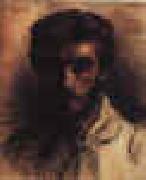 |
Bonnat, LEon
|
|
French, 1833-1922.French portrait and historical painter. He is best known for his portraits of famous men, including Thiers, Victor Hugo, and Dumas fils. Bonnat is represented in the Metropolitan Museum. |
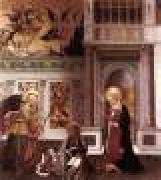 |
BONFIGLI, Benedetto
|
|
Italian painter, Umbrian school (b. ca. 1420, Perugia, d. 1496, Perugia)
Benedetto Bonfigli (c. 1420?CJuly 8, 1496) was an Italian painter of the Quattrocento born in Perugia, and active around Umbria. He is also known as Buonfiglio. He was the teacher of the painter Pietro Perugino.
His earliest work was an ' Annunciation,' originally in the Orfanelli at Perugia. His masterpiece is a series of frescoes in the Palazzo del Consiglio in the same city, which represent the Lives of St. Louis of Toulouse and St. Herculanus; they were begun in 1454 and not finished in 1496, in which year Bonfigli's will is dated. An Adoration of the Magi (c. 1460) was painted for San Domenico. A Banner (gonfalone) was painted in 1465 for the brotherhood of San Bernardino, and representing the deeds of their patron saint; another Gonfalone painted for the brotherhood of San Fiorenzo in 1476, in honor of the Virgin, who had been prayed to intercede for the cessation of the plague. He painted a Virgin of Mercy' (1478) for the church of the Commenda di Santa Croce; and several others in and around Perugia. He was much influenced by Domenico Veneziano and Pietro della Francesca. He also painted frescoes of Sant Ercolano and San Ludovico (1454) for the Palazzo del Consiglio. He died in Perugia.
|
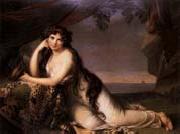 |
BONE, Henry
|
|
British, 1755-1834,Cornish enamel painter, was born at Truro. He was much employed by London jewellers for small designs in enamel, before his merits as an artist were well known to the public. In 1800 the beauty of his pieces attracted the notice of the Royal Academy, of which he was then admitted as an associate; in 1811 he was made an academician. Up to 1831 he executed many beautiful miniature pieces of much larger size than had been attempted before in England; among these his eighty-five portraits of the time of Queen Elizabeth, of different sizes, from 5 by 4 to 13 by 8 in. are most admired. They were disposed of by public sale after his death. His Bacchus and Ariadne, after Titian, painted on a plate, brought the great price of 2200 guineas. He had 2 sons, who were also notable enamallists: Henry Pierce Bone & Robert Trewick Bone. |
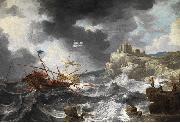 |
Bonaventura Peeters
|
|
(Antwerp, 23 July 1614 - Hoboken (Antwerp), 25 July 1652) was a Flemish Baroque painter who specialized in seascapes and shipwrecks, known as Zeekens (small seascapes).
Peeters, brother of the seascape painters Jan Peeters I, Gillis Peeters, and Catharina Peeters, learned to paint from his father, who became a master in Antwerp's guild of St. Luke in 1607 - 1608, and his earlier works are related to the tonal phase of Dutch landscape painting. Later paintings, however, reflect the stronger colors of Italianate classicism. This shift follows the general changes in artistic style at the time. Like his brother Jan, dramatic shipwrecks with dark billowy clouds, form a significant part of his oeuvre, as do serene ports and "portraits" of ships.Also, while many of Peeters's paintings reflect actual locations, and he may have even travelled along the coast of Scandinavia, his many views of far-away Mediterranean and Middle Eastern ports reflect a growing taste for the exotic and are probably inspired from fantasy and from prints. This tradition developed simultaneously in Flemish painting and in Dutch Golden Age painting, with many artists, including Peeters, working in both Antwerp and in the Dutch Republic. |
|