|
 |
Theophanes the Cretan
|
|
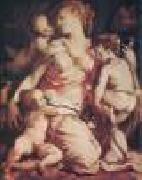
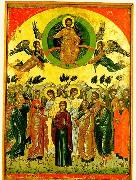
active 1527-1559,was a leading icon painter of the Cretan school in the first half of the sixteenth century, and in particular the most important figure in Greek wall-painting of the period.
He was born in Heraklion (date unknown), and no doubt trained there, but all his known work was done in mainland Greece. Frescoes bearing his signature survive in the Greek monasteries of Mt. Athos, especially Stavronikita monastery and Lavra, and Meteora which has his earliest dated work, from 1527. He also did many panel icons, either for iconostases or small portable works. Theophanes was active from about 1527-48, and trained his sons and several pupils, often themselves Cretan. By 1535 both he and his two sons had become monks in the Lavra monastery of Mount Athos, where many of his best works remain. Theophanes returned to Crete before his death in 1559.
Two detached wallpaintings attributed to Theophanes are in the Hermitage Museum in Saint Petersburg. Like most Cretan painters of this date, his work shows some influence from Western painting, but less in his case than with many artists. Some faces are personalised or looking out to the viewer, and his figures are modelled to convey volume. His work is more conscious of visual perspective than older Byzantine artists, but he does not use the geometrical perspective schemes by then standard in the West. He uses traditional Byzantine compositions, in a rather austere and powerful manner.
He should not be confused with Theophanes the Greek (Feofan Grek), an icon painter who worked in Muscovite Russia in the late fourteenth century. |
 |
Theodore Clement Steele
|
|
1847-1926
Theodore Clement Steele Galleries
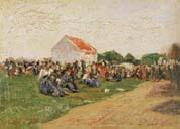
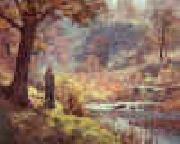
Theodore Clement Steele (September 11, 1847-July 24, 1926) was an American Impressionist painter known for his Indiana landscapes. Steele was born in Owen County, Indiana, and later moved to Indianapolis after study in Cincinnati, Chicago and Munich. He is considered to be the most important of the Hoosier Group of painters and his work is widely collected by museums and individuals. Steele earned his living primarily as a portrait painter and his portraits include one of notable Hoosier Poet James Whitcomb Riley and the official portraits of several Indiana governors. Steele exhibited at and was on the art selection for the Louisiana Purchase Exposition in 1904 and was elected to the National Academy of Design in 1913. He enjoyed plein air, or outdoor, painting, which is reflected in many of the landscapes he painted. Steele went through a notable change in style after his return from Munich in 1885. Steele's work, which in the Munich time period sported drab colors and high contrasts, shifted towards a brighter, more vivid color palette after his return to Indiana. Upon T.C. Steele's return, his family lived in the Talbot House, or Tinker Mansion, which is at what is now 16th and Pennsylvania Streets in Indianapolis. In 1898, Steele and J. Ottis Adams bought a home in Brookville, Indiana, which they called "The Hermitage." Steele sold his interest in the home to Adams after the death of his first wife.
He received an honorary master's degree from Wabash College in 1900 and an honorary doctorate from Indiana University in 1916. |
 |
Theodore Chasseriau
|
|
1819-1856
French
Theodore Chasseriau Locations
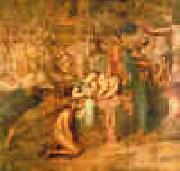
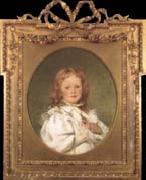
1819?C56, French painter, b. Santo Domingo. He entered Ingres studio at the age of 12; five years later he gained immediate recognition with the exhibition of his Cain, Cursed and Return of the Prodigal. Chass??riau was the only artist of the age who successfully combined Ingres sense of line and Delacroix rich color and vitality and, at the same time, created his own personal style. After his visit to Algeria in the 1840s, he emphasized the exotic, romantic elements in his painting, while still adhering to classical techniques. Among his best-known works are the Two Sisters, Arabian Challenge, and Tepidarium (all: Louvre). His mural decorations for the Cour des Comptes of the Palais d Orsay, Paris, were destroyed except for a few fragments preserved in the Louvre. His untimely death cut short a brilliant career. |
 |
Theobald Chartran
|
|
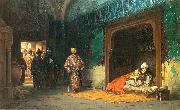
French Academic Painter, 1849-1907, He was a classical French academic painter. As 'T', he was one of the artists responsible for occasional caricatures of Vanity Fair magazine, specializing in French and Italian subjects. His work for Vanity Fair included Pope Leo XIII, Giuseppe Garibaldi, Umberto I of Italy, William Henry Waddington, all in 1878, Charles Gounod, Giuseppe Verdi, Ernest Renan, Jules Grevy, Napoleon Joseph Charles Paul Bonaparte, Victor Hugo, Marshal MacMahon, Granier de Cassagnac, Louis Blanc, and Alexandre Dumas, Fils, all in 1879. |
 |
Stanislaw Chlebowski
|
|
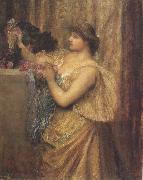
(1835-1884) was a Polish painter with Russian and Turkish connections. He was a renowned specialist in oriental themes.
Chlebowski was born in Podole, and learned drawing in Odessa. Between 1853-1859, he studied at the Academy of Fine Arts in St. Petersburg, and then on a scholarship for six years in Paris as the pupil of the French orientalist painter Jean-Leon Gerôme. Chlebowski traveled to Spain, Italy, Germany, and Belgium. His first success was selling his painting "Joanne deArc in Amiens prisone to Napoleon III of France
In the years 1864-1876 Chlebowski was master painter for Sultan Abdelaziz and took up residence in Constantinople. Chlebowski became popular with the Sultanate. During his services, he had obtained permission to bring with him a large Icon of Mother of God Leading our Way having been rescued from a Odegon Monastry in 1453. He had come across it in one of the magasins with old relics, unheeded by the Ottoman keeper. This account is certified in a letter by Comite National Polonais a Constantinople, dated June 27, 1938.
In 1876 he moved to Paris. In 1881 he returned permanently to Krakow. The subject matter of his watercolors and oil paintings is diverse. He painted images of historical battles related to the history of Turkey, oriental genre scenes, landscapes, and portraits of Sultans. He died near Poznae in Kowanewko at age 49.
Chlebowski lived abroad for a long time and as a result his paintings were very rare in Poland. The National Museum in Krakow houses some of his other important Orientalist works such as "Entree de Mahomet II e Stamboul".
|
 |
Sir edward coley burne-jones,Bt.,A.R.A.,R.W.S
|
|
1833-1898
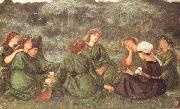
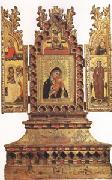
English painter and decorative artist. He was the leading figure in the second phase of the Pre-Raphaelite movement. His paintings of subjects from medieval legend and Classical mythology and his designs for stained glass, tapestry and many other media played an important part in the Aesthetic Movement and the history of international Symbolism. |
 |
Simone Dei Crocefissi
|
|
Fourteenth century
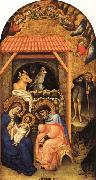
Fourteenth century.Italian painter. He was the son of a Bolognese cobbler and was almost certainly the pupil of Jacopo di Scannabecchi di Dalmasio, who married his sister in 1350. Simone was already a master painter when first recorded in 1355, probably living opposite S Domenico, Bologna, |
 |
Sebastiano Conca
|
|
Italian Baroque Era Painter , 1680-1764
was an Italian painter. He was born at Gaeta, then part of the Kingdom of Naples, and apprenticed in Naples under Francesco Solimena. In 1706, along with his brother Giovanni, who acted as his assistant, he settled at Rome, where for several years he worked in chalk only, to improve his drawing. He was patronized by the Cardinal Ottoboni, who introduced him to Clement XI, who commissioned a well-received Jeremiah painted for the church of St. John Lateran. Conca was knighted by the pope. He collaborated with Carlo Maratta in the Coronation of Santa Cecilia in the namesake's church of Santa Cecilia in Trastevere (1721-24). He was elected in 1718 to the Accademia di San Luca and its director in 1729-1731 and 1739-1741. His painting was strongly influenced by the Baroque painter Luca Giordano. Among Conca's pupils were Pompeo Battoni, Andrea Casali, Placido Campoli, Corrado Giaquinto, Gaetano Lapis, Salvatore Monosilio, Literio Paladini, Drancesco Preziao, Rosalba Maria Salvioni, Gasparo Serenari, and Agostino Masucci, He received widespread official acclaim and patronage. He worked for a time for the Savoy family in Turin on the Oratory of San Filippo and Santa Teresa, in the Venaria (1721-1725), for Basilica di Superga (1726), and Royal Palace (1733). He painted frescoes of Probatica, or Pool of Siloam, in the Ospedale di Santa Maria della Scala (hospital) of Siena. In Genoa, he painted large allegorical canvases of the Palazzo Lomellini-Doria (1738-1740). In 1739, he published a guide to painting: Ammonimenti (or Admonishments), which blended moralistic advice with technique. He returned to Naples in 1752, and enjoyed the royal patronage of Charles III. |
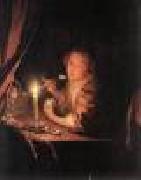 |
SCHALCKEN, Godfried
|
|
Dutch Baroque Era Painter, 1643-1706
Dutch painter and etcher, active also in England. He was the second son of Cornelis Schalcken from Heusden, a clergyman in Made, and Aletta Lydius, who came from a famous clerical family in Dordrecht. In 1654 the family moved to Dordrecht, where Cornelis was appointed headmaster of the Latin school. There Godfried was apprenticed to Samuel van Hoogstraten. He completed his training in Leiden with Gerrit Dou and by 1665 had returned to Dordrecht. Schalcken's earliest known works, for example the Doctor's Visit (1669; Germany, priv. col., on loan to Cologne, Wallraf-Richartz-Mus.), are dominated by the influence of Dou and the Leiden 'fine painters'. Like Dou, Schalcken painted small genre pieces with a wealth of painstakingly rendered detail, and his themes and frequent use of artificial lighting are strongly reminiscent of the Leiden master. The six prints known by him, including a portrait of Gerrit Dou and a few portraits after van Hoogstraten, must also originate from this period. Possibly under the influence of Caspar Netscher and Frans van Mieris, Schalcken soon afterwards adopted a freer touch with gentler transitions and a lighter palette and applied himself to painting genre pieces with elegant figures. |
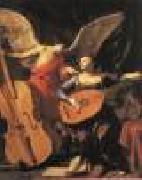 |
SARACENI, Carlo
|
|
Italian painter, Roman school (b. 1579, Venezia, d. 1620, Venezia). Italian painter. He is best known for his jewel-like paintings representing sacred and secular themes, which combine a delicate technique inspired by Adam Elsheimer with a note of observed realism owed to Caravaggio. He also painted altarpieces and worked in fresco. |
 |
samuel taylor coleridge
|
|
Born: 21 October 1772
Birthplace: Devonshire, England
Died: 25 July 1834 (heart attack)
Best Known As: The author of The Rime of the Ancient Mariner |
 |
Samuel S. Carr
|
|
American, 1837-1908,was an American pastoral and landscape painter. Originally from England, he relocated to the U.S. (specifically, New York City, where he later studied mechanical drawing in 1865) around 1862. He is recorded as having lived in Brooklyn from 1879 to 1907, along with his sister, Annie, and her husband, John Bond. He never married. He is a fairly well-known artist |
 |
Salomon de Caus
|
|
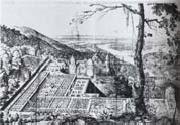
b France, 1576; bur Paris, 28 Feb 1626,He was a Huguenot from the Dieppe region (Normandy). Between c. 1595 and 1598 he visited Italy, where he was strongly influenced by the gardens laid out c. 1570 by Bernardo Buontalenti at Pratolino, near Florence, and by their mechanical artifices. De Caus's work also reveals a knowledge of the gardens of the Villa d'Este in Tivoli. From c. 1598 to 1610 he was in Brussels, in the service of the Stadholder of the Netherlands, Albert, Archduke of Austria. There he was the engineer responsible for wells, fountains and the automatic works in the two grottoes (destr. 1768) in the garden of the Stadholder's residence. From 1610 he lived in England, moving in the artistic circle of Henry, Prince of Wales, to whom he taught drawing and for whom he built a picture gallery at Richmond. Together with Constantino de' Servi (1554-1622) he was engineer and supervisor of the waterworks at Richmond Palace. De Caus dedicated his first book, La Perspective (1612), to Prince Henry and included garden designs for the Prince in his second book, Les Raisons des forces movvantes (1615). He worked at several sites in England, including Somerset House in London, where he is thought to have erected a Parnassus, and at Greenwich Palace, Hatfield House and Gorhambury House (Herts) and Wilton House (Wilts). Nothing has survived of his work of this period. |
 |
SAFTLEVEN, Cornelis
|
|
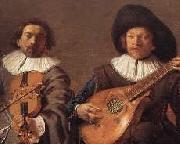
Dutch painter (b. 1607, Gorinchem, d. 1681, Rotterdam).Painter and draughtsman. After training as a painter in Rotterdam, he may have visited Antwerp c. 1632-4. From c. 1634 he was in Utrecht, where his brother (2) Herman the younger had settled, and they collaborated on a portrait of Godard van Reede and his Family (1634-5; Maarssen, Slot Zuylen). In 1637 Cornelis was back in Rotterdam, where in 1648 he married Catharina van der Heyden (d Rotterdam, 1654). The year after her death, he married Elisabeth van der Avondt. He became dean of the Guild of St Luke in Rotterdam in 1667. |
 |
ROSSELLI, Cosimo
|
|
Italian Early Renaissance Painter, 1439-1507
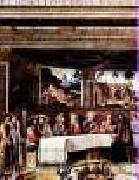
Painter. He was documented in Neri di Bicci's workshop between May 1453 and October 1456; in 1459 he received his first known commission, for an altarpiece in Santa Tr?nita, Florence (untraced). It is thought that he subsequently worked with Benozzo Gozzoli, whose influence is evident in his early work, but Cosimo was receptive to the styles of almost all his more gifted contemporaries, including Alesso Baldovinetti (said by Baldinucci to have been his master), Andrea del Verrocchio and the Pollaiuolo brothers. Cosimo's first surviving works of importance are the frescoes in the style of Baldovinetti in the Salutati Chapel, Fiesole Cathedral, datable to between 1462 and 1466, but these are heavily restored. |
 |
Rosalba carriera
|
|
Italian Rococo Era Painter, 1675-1757
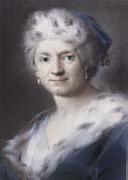
Italian pastellist and painter. She was a daughter of Andrea Carriera, who worked in the mainland podesteria of the Republic of Venice, and of Alba Foresti, an embroiderer. She had two sisters: Angela, who married the painter Giovanni Antonio Pellegrini, and Giovanna, who, like Rosalba herself, never married. Pier Caterino Zeno (see Campori, 1886) and other, anonymous sources recorded that she was a pupil of Giuseppe Diamantini; according to Mariette, she originally painted snuff-boxes and later became a pupil of Federico Bencovich. There are more precise records of her life and of some of her works from 1700 onwards |
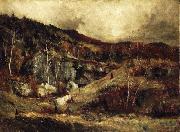 |
Robert Crannell Minor
|
|
(1839-1904), American artist, was born in New York City on 30 April 1839, and received his art training in Paris under Diaz, and in Antwerp under Joseph Van Luppen. His paintings are characteristic of the Barbizon school, and he was particularly happy in his sunset and twilight effects; but it was only within a few years of his death that he began to have a vogue among collectors. In 1897 he was elected a member of the National Academy of Design, New York. After 1900 he lived at Waterford, Connecticut, where he died on 4 August 1904. |
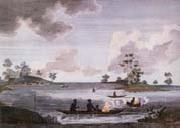 |
Robert Cleveley
|
|
British, 1747-1809,was an English maritime painter. His father and twin brother (John Cleveley the Elder, c.1712?C1777, and John Cleveley the Younger, 1747?C1786) were also artists, with John the Younger (and possibly Robert too, to judge from his style) gaining some training in watercolours from Paul Sandby, previously a teacher at the Royal Military Academy, Woolwich. John the Elder had tried and failed to make a living in working in a dockyard, and so did Robert, as a caulker. However, mocked by other dockyard workers for wearing gloves whilst working, John did not enjoy his time there, giving it up and in 1770 volunteering for the navy as a clerk. His first service as a clerk was briefly under Captain William Locker (who acted as patron to artists probably known to John the Elder), then soon afterwards under Captain George Vandeput on his voyage in the Asia to the West Indies and North America, during which time Vandeput became a lifelong friend. The Asia returned in 1777, and from then to the end of his life Robert followed a double career as purser on board various ships stationed in the Home Fleet (though most probably exercising his functions through a deputy for some or all of the time) and as a marine painter. This meant he could exhibit his works as "Robert Cleveley of the Royal Navy". First exhibiting at the Royal Academy in 1780, his specialism was naval battles (though he also produced pictures of royal naval occasions, such as his "View of the Fleet at Spithead Saluting George III at his Review in 1793", now at the National Maritime Museum) and many of his works were reproduced as engravings. Like his brother John, he also exploited their brother James' presence as a carpenter on Captain Cook's third voyage to gain access to art produced on the voyage and to produce art to cash in on the popular demand for South Sea images (eg a 1789 print of A view of Botany Bay). He did, however, still make occasional voyages with Vandeput, such as when he served as eassistant to the clerk of the kitchene in the royal entourage when the royal yacht Princess Augusta (under Vandeput) took Prince William Henry, later Duke of Clarence, to Hanover in July and August 1783. |
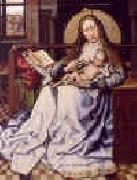 |
Robert Campin
|
|
1406-1444
Robert Campin Location
South Netherlandish painter. He is first mentioned in 1405-6 as a painter in Tournai. As he purchased citizenship there in 1410, he may have been born elsewhere. There is evidence of some connection with Valenciennes, where the name Campin is said to have been common, but nothing certain is known of his artistic training and background. |
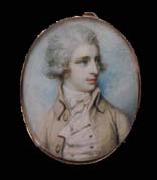 |
Richard Cosway
|
|
English Rococo Era Miniaturist, 1742-1821,Painter, draughtsman, dealer and collector. Probably the son of a schoolmaster, he showed a precocious talent for drawing and studied at Shipley's Drawing School in the Strand, where he won several prizes. He attended the Richmond House academy, set up by Charles Lennox, 3rd Duke of Richmond, where he met Giovanni Battista Cipriani. He first exhibited at the Society of Artists in 1760, showing there again between 1767 and 1779. He also showed at the Free Society of Artists between 1761 and 1766. In 1769 he entered the Royal Academy Schools, becoming an ARA in 1770, when he began to exhibit at the Academy, and RA the following year. In 1781 Cosway married the Anglo-Florentine artist Maria Cosway, n?e Hadfield, and they moved in 1784 to Schomberg House, Pall Mall, which became a centre for fashionable London society. In 1786 he made a brief visit to Paris and in 1791 he moved to a larger house in Stratford Place, London. |
 |
Richard Caton Woodville
|
|
1856 - 1927
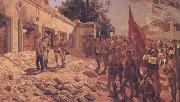
was an English artist and illustrator, who is best known for being one of the most prolific and effective painters of battle scenes in the late nineteenth, and early twentieth centuries. The son of American Richard Caton Woodville (The First), who was also a talented artist, Woodville studied at the Dusseldorf School under the great Prussian military artist Wilhelm Camphausen, and then Eduard von Gebhardt, before briefly studying in Russia and then Paris under Gerome. Woodville spent most of his career working for the Illustrated London News where he quickly developed a reputation as a talented reporter and writer, but was also published in Cornhill Magazine, Strand Magazine, and The Tatler. Richard Caton Woodville first experienced battle first-hand when he was sent by the Illustrated London News to report upon the Russo-Turkish War (1877 C 1878), and then again in the 1882 Anglo-Egyptian War where he made numerous sketches, and also obtained photographs of the trenches at Tel-e-Kebir for his friend and co-artist Alphonse-Marie-Adolphe de Neuville whom had been commissioned to paint a scene of the battle. In 1879 Woodville's Before Leuthen, Dec 3rd, 1757 was exhibited in the Royal Academy. It proved popular, and afterwards he began to regularly be exhibited in Burlington House, where 21 of his battle paintings were eventually shown. His most popular works there were ones that dealt with contemporary wars, such as the Second Anglo-Afghan War, Candahar [sic], and Maiwand, Saving the Guns (Walker Art Gallery), the Zulu War, and the First Boer War. His works from Egypt were exhibited at the Fine Art Society in 1883, where his painting The Moonlight Charge at Kassassin proved very popular. The following year he exhibited by Royal Command another painting he had done of the war in Egypt, entitled The Guards at Tel-e-Kebir (Royal Collection). He continued to paint scenes of battle, and few battles or wars that Great Britain fought during his life were not touched upon by him, including the Second Boer War, and World War I. Despite his precocious talent for capturing the dramatic moments of contemporary battles, Woodville also enjoyed recreating historical scenes in both oil, and watercolour. The Illustrated London News commissioned him to complete a commemorative special series recreating the most famous British Battles of history. He depicted The Charge of the Light Brigade (Royal Collection, Madrid) and The Charge of the 21st Lancers at Omdurman (Walker Art Gallery), Battle of Blenheim, Battle of Badajos and several Battle of Waterloo pictures. During World War I, Woodville was compelled to return to the depiction of current events, and three of his Great War works were displayed in the Royal Academy. |
 |
Ramon Casas i Carbo
|
|
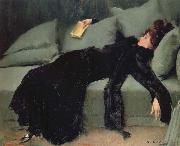
1866-1932,was a Catalan artist. Living through a turbulent time in the history of his native Barcelona, he was known as a portraitist, sketching and painting the intellectual, economic, and political elite of Barcelona, Paris, Madrid, and beyond; he was also known for his paintings of crowd scenes ranging from the audience at a bullfight to the assembly for an execution to rioters in the Barcelona streets. |
 |
Ramon Casas
|
|
1866-1932
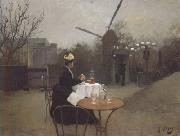
was a Catalan artist. Living through a turbulent time in the history of his native Barcelona, he was known as a portraitist, sketching and painting the intellectual, economic, and political elite of Barcelona, Paris, Madrid, and beyond; he was also known for his paintings of crowd scenes ranging from the audience at a bullfight to the assembly for an execution to rioters in the Barcelona streets. Also a graphic designer, his posters and postcards helped to define the Catalan art movement known as modernisme. Casas was born in Barcelona. His father had made a fortune in Matanzas, Cuba; his mother was from a well-off Catalan family. In 1877 he abandoned the regular course of schooling to study art in the studio of Joan Vicens. In 1881, still in his teens, he was a co-founder of the magazine L'Avenç; the 9 October 1881 issue included his sketch of the cloister of Sant Benet in Bages. That same month, accompanied by his cousin Miquel Carb i Carb, a medical student, he began his first stay in Paris, where he studied that winter at the Carolus Duran Academy and later at the Gervex Academy, and functioned as a Paris correspondent for L'Avenç. The next year he had a piece exhibited in Barcelona at the Sala Paris, and in 1883 in Paris the Salon des Champs Elysies exhibited his portrait of himself dressed as a flamenco dancer; the piece won him an invitation as a member of the salon of the Societe d'artistes françaises. The next few years he continued to paint and travel, spending most autumns and winters in Paris and the rest of the year in Spain, mostly in Barcelona but also in Madrid and Granada; his 1886 painting of the crowd at the Madrid bullfighting ring was to be the first of many highly detailed paintings of crowds. That year he survived tuberculosis, and convalesced for the winter in Barcelona. |
 |
Polk, Charles Peale
|
|
American, 1767-1822
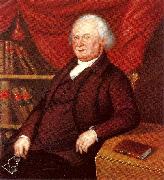
American painter. Orphaned as a child, he was raised in Philadelphia, PA, by his uncle, Charles Willson Peale, who taught him to paint. In 1791 Polk moved to Baltimore, MD, where he achieved limited success as a portrait painter. Seeking commissions, he moved to Frederick, MD, in 1796. Over the next five years during travels as an itinerant limner through western Maryland and Virginia he reached his mature style. Abandoning his academic training, Polk developed a distinctive but naive artistic vocabulary with a heightened palette, electric highlights and an exaggerated attenuation of the human form. The portraits of Isaac Hite and his wife Eleanor Madison Hite, as well as James Madison sr and Eleanor Conway Madison (all Middletown, VA, Belle Grove), were commissioned in 1799 and are accepted as his masterpieces. Isaac Hite also commissioned the quintessentially 'republican' portrait of Thomas Jefferson (New York, Victor Spark priv. col.), executed at Monticello in 1799. In 1801 Polk moved to Washington, DC, working as a clerk in the Treasury. During the next 16 years he painted few portraits in oil |
 |
Pietro da Cortona
|
|
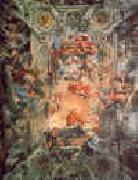
1596-1669 Italian Pietro da Cortona Galleries Italian painter, draughtsman and architect. He was, together with Gianlorenzo Bernini and Franceso Borromini, one of the three leading artists of the Roman Baroque. As a painter he developed the early Baroque style, initiated by Annibale Carracci, to a magnificent and imposing High Baroque. His fresco decorations set a standard for European Baroque painting until they were eclipsed by Giambattista Tiepolo's works and those of other Venetian masters of the 18th century. As an architect Cortona was far less influential. His imaginative designs for fa?ades and stucco decorations were, however, conclusive and independent solutions to problems central to Roman Baroque architecture.
|
 |
Pieter Cornelisz. van Slingelandt
|
|
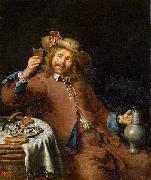
(20 October 1640 - 7 November 1691) was a Dutch Golden Age painter.
According to Houbraken, his teacher was Gerard Dou, who he imitated so well that many of his works were later misattributed to him. According to Houbraken he was rather introverted and very methodical and conscientious, spending months on his works and striving for perfection. Houbraken especially liked a piece where a maid holds a mouse by the tail as a cat jumps for it.
Houbraken wrote that while Slingelandt was working on a family portrait for the gentleman Francois Meerman (1630-1672), |
 |
Pieter Coecke van Aelst
|
|
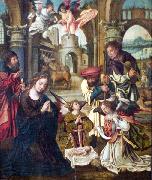
(August 14, 1502 - December 6, 1550) was a Flemish painter. He studied under Bernaert van Orley and later lived in Italy before entering the Antwerp Guild of painters in 1527. In 1533, he travelled to Constantinople for one year in a failed attempt to establish business connections for his tapestry works. Van Aelst established a studio in Brussels in 1544, where he created paintings and tapestries. His students include Gillis van Coninxloo, Willem Key, Hans Vredeman de Vries, Michiel Coxcie, and possibly Pieter Brueghel the Elder, who did eventually marry van Aelst's daughter, Mayken. His second wife, Mayken Verhulst, was an artist as well, and, according to Carel van Mander, the first teacher of her grandchildren, Pieter Brueghel the Younger and Jan Brueghel the Elder. He was also the uncle of Joachim Bueckelaer. Van Aelst's studio is also well known for its engraved works.
In particular, van Aelst is noted for his 1539 translation of Sebastiano Serlio's architectural treatise, Architettura, which is credited with having played a crucial role in spreading Renaissance ideas to the Low Countries and hastening the transition from the late Gothic style prevalent in the area at the time. He was in charge of the spectacular decorations for the 1549 Royal entry into Antwerp of Philip II of Spain, "the most famous entry of the century", according to Roy Strong.
|
|