|
 |
CLEVE, Cornelis van
|
|
Flemish painter, Antwerp school (b. 1520, Antwerpen, d.
after 1570, Antwerpen). |
 |
CLERCK, Hendrik de
|
|
Flemish Baroque Era Painter, ca.1570-1630
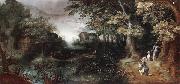
Flemish painter and draughtsman. In 1587 he was working in Rome with the Brussels painter Frans van de Kasteele. That he subsequently lived in Brussels is confirmed by documentary evidence and by his status as court painter to the governors of the southern Netherlands. Stylistically, de Clerck's work (both paintings and drawings) is close to that of the Antwerp late Mannerist Marten de Vos, traditionally thought to have been his teacher, but it is possible that he was apprenticed to Joos van Winghe in Italy. He was later a member of the Brussels painters' guild, where from 1601 to 1611 Jan van Overstraeten was registered as his pupil. It was in 1594 that de Clerck was appointed court painter in Brussels, first to Archduke Ernest. In 1596, after the Archduke's death, his brother Emperor Rudolf II arranged for de Clerck to stay on as court painter in the service of the new Archdukes, Albert and Isabella. In 1609 de Clerck and Wenceslas Cobergher were commissioned to decorate the ceiling of the oratorium in the archducal palace in Brussels |
 |
claudio monteverdi
|
|
Period: Baroque (1600-1749)
Country: Italy
Born: May 15, 1567 in Cremona, Italy
Died: November 29, 1643 in Venice, Italy
Genres: Ballet, Choral Music, Miscellaneous Music, Opera, Vocal Music
|
 |
Claude-joseph Vernet
|
|
French Painter, 1714-1789
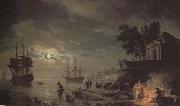
Vernet probably received his first lessons in painting from his father, Antoine, who then encouraged him to move to the studio of Philippe Sauvan (1697-1792), the leading master in Avignon. Sauvan supplied altarpieces to local churches and decorative works and mythologies for grand houses in the area. After this apprenticeship Vernet worked in Aix-en-Provence with the decorative painter Jacques Viali ( fl 1681- 1745), who also painted landscapes and marine pictures. In 1731 Vernet independently produced a suite of decorative overdoors for the h?tel of the Marquise de Simiane at Aix-en-Provence; at least two of these survive (in situ) and are Vernet's earliest datable landscapes. These are early indications of his favoured type of subject, and Vernet would have studied works attributed to such 17th-century masters as Claude Lorrain, Gaspard Dughet and Salvator Rosa in private collections at Aix and Avignon. Three years later Joseph de Seytres, Marquis de Caumont, who had previously recommended Vernet to the Marquise de Simiane, offered to sponsor a trip to Italy. |
 |
claude vignon
|
|
Claude Vignon (19 May 1593 - 10 May 1670) was a leading French painter and engraver working in the Baroque manner.
He was born at Tours and received early training in Paris. About 1610 he travelled to Rome where his mature style was formed in the circle of French painters there that included Simon Vouet and Valentin de Boulogne, a prominent member of the Caravaggisti working, like Bartolomeo Manfredi, in the manner established by Caravaggio.
He returned from Italy, after a tour in Spain, in 1623. His paintings are represented in most of the major museums. |
 |
Claude Monet
|
|
French Impressionist Painter, 1840-1926
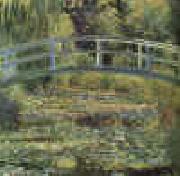
Claude Oscar Monet (14 November 1840 C 5 December 1926) was a founder of French impressionist painting, and the most consistent and prolific practitioner of the movement's philosophy of expressing one's perceptions before nature, especially as applied to plein-air landscape painting. The term Impressionism is derived from the title of his painting.
Claude Monet was born on 14 November 1840 on the fifth floor of 45 rue Laffitte, in the ninth arrondissement of Paris . He was the second son of Claude-Adolphe and Louise-Justine Aubree Monet, both of them second-generation Parisians. On 20 May 1841, he was baptised into the local church parish, Notre-Dame-de-Lorette as Oscar-Claude. In 1845, his family moved to Le Havre in Normandy. His father wanted him to go into the family grocery store business, but Claude Monet wanted to become an artist. His mother was a singer.
On the first of April 1851, Monet entered the Le Havre secondary school of the arts. He first became known locally for his charcoal caricatures, which he would sell for ten to twenty francs. Monet also undertook his first drawing lessons from Jacques-François Ochard, a former student of Jacques-Louis David. On the beaches of Normandy in about 1856/1857 he met fellow artist Eugene Boudin who became his mentor and taught him to use oil paints. Boudin taught Monet "en plein air" (outdoor) techniques for painting.
On 28 January 1857 his mother died. He was 16 years old when he left school, and went to live with his widowed childless aunt, Marie-Jeanne Lecadre.
After several difficult months following the death of Camille on 5 September 1879, a grief-stricken Monet (resolving never to be mired in poverty again) began in earnest to create some of his best paintings of the 19th century. During the early 1880s Monet painted several groups of landscapes and seascapes in what he considered to be campaigns to document the French countryside. His extensive campaigns evolved into his series' paintings.
Camille Monet had become ill with tuberculosis in 1876. Pregnant with her second child she gave birth to Michel Monet in March 1878. In 1878 the Monets temporarily moved into the home of Ernest Hosched, (1837-1891), a wealthy department store owner and patron of the arts. Both families then shared a house in Vetheuil during the summer. After her husband (Ernest Hoschede) became bankrupt, and left in 1878 for Belgium, in September 1879, and while Monet continued to live in the house in Vetheuil; Alice Hosched helped Monet to raise his two sons, Jean and Michel, by taking them to Paris to live alongside her own six children. They were Blanche, Germaine, Suzanne, Marthe, Jean-Pierre, and Jacques. In the spring of 1880 Alice Hosched and all the children left Paris and rejoined Monet still living in the house in Vetheuil. In 1881 all of them moved to Poissy which Monet hated. From the doorway of the little train between Vernon and Gasny he discovered Giverny. In April 1883 they moved to Vernon, then to a house in Giverny, Eure, in Upper Normandy, where he planted a large garden where he painted for much of the rest of his life. Following the death of her estranged husband, Alice Hosched married Claude Monet in 1892.
|
 |
claude lorraine
|
|
Claude Lorrain (also Claude Gell??e or Le Lorrain) (Lorraine, c. 1600 ?C Rome, 21 or 23 November 1682) was an artist of the neo-classical era who was active in Italy, and is admired for his achievements in landscape painting. |
 |
Claude Lorrain
|
|
French
1600-1682
Claude Lorrain Galleries
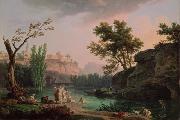
In Rome, not until the mid-17th century were landscapes deemed fit for serious painting. Northern Europeans, such as the Germans Elsheimer and Brill, had made such views pre-eminent in some of their paintings (as well as Da Vinci in his private drawings or Baldassarre Peruzzi in his decorative frescoes of vedute); but not until Annibale Carracci and his pupil Domenichino do we see landscape become the focus of a canvas by a major Italian artist. Even with the latter two, as with Lorrain, the stated themes of the paintings were mythic or religious. Landscape as a subject was distinctly unclassical and secular. The former quality was not consonant with Renaissance art, which boasted its rivalry with the work of the ancients. The second quality had less public patronage in Counter-Reformation Rome, which prized subjects worthy of "high painting," typically religious or mythic scenes. Pure landscape, like pure still-life or genre painting, reflected an aesthetic viewpoint regarded as lacking in moral seriousness. Rome, the theological and philosophical center of 17th century Italian art, was not quite ready for such a break with tradition.
In this matter of the importance of landscape, Lorrain was prescient. Living in a pre-Romantic era, he did not depict those uninhabited panoramas that were to be esteemed in later centuries, such as with Salvatore Rosa. He painted a pastoral world of fields and valleys not distant from castles and towns. If the ocean horizon is represented, it is from the setting of a busy port. Perhaps to feed the public need for paintings with noble themes, his pictures include demigods, heroes and saints, even though his abundant drawings and sketchbooks prove that he was more interested in scenography.
Lorrain was described as kind to his pupils and hard-working; keenly observant, but an unlettered man until his death. The painter Joachim von Sandrart is an authority for Claude's life (Academia Artis Pictoriae, 1683); Baldinucci, who obtained information from some of Claude's immediate survivors, relates various incidents to a different effect (Notizie dei professoni del disegno).
John Constable described Claude Lorrain as "the most perfect landscape painter the world ever saw", and declared that in Claude??s landscape "all is lovely ?C all amiable ?C all is amenity and repose; the calm sunshine of the heart" |
 |
Claude Joseph Vernet
|
|
Claude-Joseph Vernet (14 August 1714 - 3 December 1789) was a French painter. His son, Antoine Charles Horace Vernet, was also a painter.
Vernet was born in Avignon. When only fourteen years of age he aided his father, Antoine Vernet (1689-1753),[1] a skilled decorative painter, in the most important parts of his work. The panels of sedan chairs, however, could not satisfy his ambition, and Vernet started for Rome. The sight of the sea at Marseilles and his voyage thence to Civitavecchia (Papal States' main port on the Tyrrhenian Sea) made a deep impression on him, and immediately after his arrival he entered the studio of a marine painter, Bernardino Fergioni.
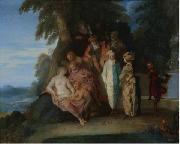
Slowly Vernet attracted notice in the artistic milieu of Rome. With a certain conventionality in design, proper to his day, he allied the results of constant and honest observation of natural effects of atmosphere, which he rendered with unusual pictorial art. Perhaps no painter of landscapes or sea-pieces has ever made the human figure so completely a part of the scene depicted or so important a factor in his design. In this respect he was heavily influenced by Giovanni Paolo Panini, whom he probably met and worked with in Rome. Vernet's work draws on natural themes, but in a way that is neither sentimental or emotive. The overall effect of his style is wholly decorative.[2] "Others may know better", he said, with just pride, "how to paint the sky, the earth, the ocean; no one knows better than I how to paint a picture". His style remained relatively static throughout his life. His works' attentiveness to atmospheric effects is combined with a sense of harmony that is reminiscent of Claude Lorrain. |
 |
Claude Gillot
|
|
(April 28,1673 Langres - May 4,1722 Paris) was a French painter, best known as the master of Watteau and Lancret. He had Watteau as an apprentice between 1703 and 1708.
He was a painter, engraver, book illustrator, metal worker, and designer for the theater.
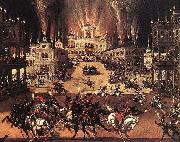
His sportive mythological landscape pieces, with such titles as Feast of Pan and Feast of Bacchus, opened the Academy of Painting at Paris to him in 1715; and he then adapted his art to the fashionable tastes of the day, and introduced the decorative fetes champetres, in which he was afterwards surpassed by his pupils. He was also closely connected with the opera and theatre as a designer of scenery and costumes.
|
 |
Claude Deruet
|
|
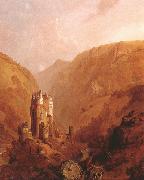
(1588-1660) was a famous French Baroque painter of the 17th century, from the city of Nancy.
Deruet was an apprentice to Jacques Bellange, the official court painter to Charles III, Duke of Lorraine. He was in Rome between ca. 1612 and 1619, where - according to Andre Felibien - he studied with the painter and etcher Antonio Tempesta. During his stay in Rome, he painted the Japanese samurai Hasekura Tsunenaga on a visit to Europe in 1615.
Deruet was made a noble by the Duke of Lorraine in 1621, and was then made a Knight of the Order of St Michel in 1645 by Louis XIII, who had in 1641 absorbed most of Lorraine into France. He had a luxurious residence in Nancy, named La Romaine, where Louis XIII and his Queen stayed in 1633.
Claude Lorrain was an apprentice to Claude Deruet in 1623 for one year. He also married and had two sons, one of whom became a painter.
|
 |
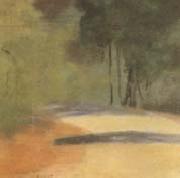
Clarkson Frederick Stanfield
|
|
English Painter, 1793-1867
He is often wrongly referred to as William Clarkson Stanfield. The son of Mary Hoad and James Field Stanfield, an Irish actor and author, he was apprenticed to a heraldic coach painter at the age of 12, but in 1808 he abandoned this and went to sea in a collier. In 1812 he was press-ganged and spent two years on HMS Namur, the guard-ship at Sheerness. After being discharged as the result of an injury in 1814, he joined the merchant navy, sailing to China in the Indiaman Warley in 1815. Soon after his return in 1816 he missed his ship and became a scene painter, first at the Royalty Theatre, Stepney, and then at the Royal Coburg, Lambeth. There he was later joined by David Roberts, who became a lifelong friend, and in 1822 both men were employed as scene painters at the Theatre Royal, Drury Lane. During the next 12 years Stanfield established himself as the most talented scene painter of his day, causing a sensation with some of his huge moving dioramas such as the scenes of Venice in the pantomine Harlequin and Little Thumb (1831). Meanwhile he was building an equally impressive reputation as an easel painter. He first exhibited at the Royal Academy in 1820 and continued to exhibit there regularly until his death. He was elected ARA in 1832 and RA in 1835. |
 |
Clarice Beckett
|
|
Australian Painter, 1887-1935,Australian painter. She studied at the National Gallery School, Melbourne (1914-16), and with Max Meldrum became involved (c. 1917) with the Meldrum circle of artists, which included Colin Colahan (1897-1987), Justus Jorgensen (1893-1975), John Farmer (b 1897) and Percy Leason (1889-1959). In 1919 she moved to the seaside suburb of Beaumaris, where she lived and worked for the rest of her life. |
 |
Clara Peeters
|
|
Clara Peeters (1594 - c. 1657) was a Flemish painter noted for painting still lifes, particularly of breakfast scenes and florals.
Few details of her life are known. She was baptized in Antwerp in 1594, and married there in 1639. She is known to have lived in Amsterdam and The Hague. Her first known work was dated 1608, when she was 14. The quality of this work reveals a master teacher, and scholars believe she was influenced by Osias Beert. He was probably also an influence on the flower paintings of her contemporary, Catarina Ykens I (1608/1618 - 1666/1685), who was the wife of Frans Ykens, a pupil of Beert's. Clara Peeters's last painting was dated 1657, and is now lost. The circumstances of her death are unknown.
|
 |
CLAESZ, Pieter
|
|
Dutch Baroque Era Painter, ca.1597-1660
Dutch painter of German birth. He apparently spent his entire career in Haarlem, where he specialized in still-life paintings. Well over 100 works survive, dating from 1621 to 1660. Most of his pictures are dated and monogrammed PC. Since those initials were shared by the Antwerp still-life painter CLARA PEETERS |
 |
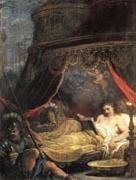
CLAEISSENS, Antoon
|
|
Flemish painter (b. ca. 1538, Brugge, d. 1613, Brugge).
Flemish painter and draughtsman. In 1587 he was working in Rome with the Brussels painter Frans van de Kasteele. That he subsequently lived in Brussels is confirmed by documentary evidence and by his status as court painter to the governors of the southern Netherlands. Stylistically, de Clerck's work (both paintings and drawings) is close to that of the Antwerp late Mannerist Marten de Vos, traditionally thought to have been his teacher, but it is possible that he was apprenticed to Joos van Winghe in Italy. He was later a member of the Brussels painters' guild, where from 1601 to 1611 Jan van Overstraeten was registered as his pupil. It was in 1594 that de Clerck was appointed court painter in Brussels, first to Archduke Ernest. In 1596, after the Archduke's death, his brother Emperor Rudolf II arranged for de Clerck to stay on as court painter in the service of the new Archdukes, Albert and Isabella. In 1609 de Clerck and Wenceslas Cobergher were commissioned to decorate the ceiling of the oratorium in the archducal palace in Brussels |
 |
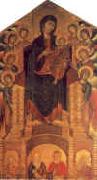
Ciro Ferri
|
|
Italian Baroque Era Painter and Sculptor , ca.1634-1689
was an Italian Baroque sculptor and painter, the chief pupil and successor of Pietro da Cortona. He was born in Rome, where he began working under Cortona and with a team of artists in the extensive fresco decorations of the Quirinal Palace (1656-1659). He collaborated with Cortona and completed for him the extensive frescoed ceilings and other internal decorations begun in the Pitti Palace, Florence (1659-1665). His independent masterpiece is considered an extensive series of scriptural frescoes in the church of Basilica di Santa Maria Maggiore (Bergamo). In addition, also well known is his an altarpiece of St Ambrose Healing the Sick in the church of Sant'Ambrogio della Massima in Rome. In 1670, he began the painting of the cupola of Sant'Agnese in Agone in central Rome, in a style recalling of Lanfranco's work in the dome of Sant'Andrea della Valle; but died before it was completed in 1693 by his successor Sebastiano Corbellini. He executed also a large amount of miscellaneous designs, such as etchings and frontispieces for books; and served as an architect as well. Ferri was appointed to direct the Florentine students in Rome, and Gabbiani was one of his leading pupils. As regards style, Ferri ranks as chief of the grand manner of Cortona, as opposed to the more sober and spare style promulgated by Andrea Sacchi, and continued by Carlo Maratta and others. |
 |
Cimabue
|
|
Italian b1240 - d1302
Cimabue Location
Italian painter and mosaicist. His nickname means either bull-head or possibly one who crushes the views of others (It. cimare: top, shear, blunt), an interpretation matching the tradition in commentaries on Dante that he was not merely proud of his work but contemptuous of criticism. Filippo Villani and Vasari assigned him the name Giovanni, but this has no historical foundation. He may be considered the most dramatic of those artists influenced by contemporary Byzantine painting through which antique qualities were introduced into Italian work in the late 13th century. His interest in Classical Roman drapery techniques and in the spatial and dramatic achievements of such contemporary sculptors as Nicola Pisano, however, distinguishes him from other leading members of this movement. As a result of his influence on such younger artists as Duccio and Giotto, the forceful qualities of his work and its openness to a wide range of sources, Cimabue appears to have had a direct personal influence on the subsequent course of Florentine, Tuscan and possibly Roman painting.
|
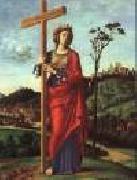 |
CIMA da Conegliano
|
|
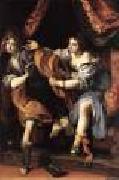
Italian Painter, ca.1459-1517
Italian painter. He belonged to the generation between Giovanni Bellini and Giorgione and was one of the leading painters of early Renaissance Venice. His major works, several of which are signed, are almost all church altarpieces, usually depicting the Virgin and Child enthroned with saints; he also produced a large number of smaller half-length Madonnas. His autograph paintings are executed with great sensitivity and consummate craftsmanship. Fundamental to his artistic formation was the style that Bellini had evolved by the 1470s and 1480s; other important influences were Antonello da Messina and Alvise Vivarini. Although Cima was always capable of modest innovation, his style did not undergo any radical alteration during a career of some 30 years, and his response to the growing taste for Giorgionesque works from the early 16th century remained superficial. He seems to have maintained a sizeable workshop, |
 |
CIGOLI
|
|
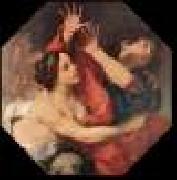
Italian Baroque Era Painter, 1559-1613
was an Italian painter and architect of the late Mannerist and early Baroque period, trained and active in his early career in Florence, and spending the last nine years of his life in Rome. Lodovico Cardi was born at Villa Castelvecchio di Cigoli, in Tuscany, whence the name by which he is commonly known. Initially, Cigoli trained in Florence under the fervid mannerist Alessandro Allori. Later, influenced by the most prominent of the Contra-Maniera painters, Santi di Tito, as well as by Barocci, Cigoli shed the shackles of mannerism and infused his later paintings with an expressionism often lacking from 16th century Florentine painting. For example, for the Roman patron, Massimo Massimi, he painted an Ecce Homo[1] (now in Palazzo Pitti). Supposedly unbenknownst to any of the painters, two other prominent contemporary painters, Passignano and Caravaggio, had been requested canvases on the same theme. It is unclear if they are completely independent. Cigoli's painting seems to have been made with knowledge of Caravaggio's canvas; however, while Cigoli's work lacks the power of Caravaggio's naturalism, the background shade and sparse foreground shows how much he was moving away from crowded Florentine historical paintings. This work was afterwards taken by Bonaparte to the Louvre, and was restored to Florence in 1815. One of his early paintings was of Cain slaying Abel. He then gained the employ of the Grand-Duke in some works for the Pitti Palace, where he painted a Venus and Satyr and a Sacrifice of Isaac. Other important pictures are St. Peter Healing the Lame Man in St Peter's; Conversion of St. Paul in the church of San Paolo fuori le Mura, and a Story of Psyche in a fresco incorporated in the decorative scheme of the Villa Borghese; a Martyrdom of Stephen, which earned him the name of the "Florentine Correggio", a Stigmata of St. Francis at Florence. Cigoli was made a Knight of Malta at the request of Pope Paul III. Cigoli, a close personal friend of Galileo Galilei, painted a last fresco in the dome of the Pauline chapel of the church of Santa Maria Maggiore in Rome, depicting the Madonna standing upon a pock-marked lunar orb. This is the first extant example of Galileo's discoveries about the physical nature of the moon (as he himself drew it in Sidereus Nuncius) having penetrated the visual arts practice of his day. Until this image, the moon in pictures of the Virgin had always been mythical and smooth, perfectly spherical as described by Platonic & Ptolemaic tradition. |
 |
CIGNANI, Carlo
|
|
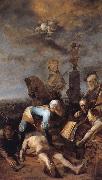
Italian Baroque Era Painter, 1628-1719
Italian painter and draughtsman. He was the leading master in Bologna during the later decades of the 17th century, commanding a position of authority comparable to that of Carlo Maratti in Rome. He bore the title of Conte, and his biographer Giovan Pietro Zanotti wrote that he 'always worked for glory, not for need'. Zanotti's emphasis on Cignani's 'new manner' refers to the reflective, intimate mood of his art, presaged in the later pictures of Guido Reni and Guercino, and in those of Simone Cantarini. This gentle manner, which prevailed in the second half of the 17th century, |
 |
Christopher Paudiss
|
|
German Baroque Era Painter, 1630-1666, was a Bavarian Baroque painter and a student of Rembrandt van Rijn. After working in Stuttgart (1656), Prague, Dresden (1659-60), Vienna and Salzburg, he stayed his last four years in Freising where he worked for Furstbischof Albrecht Sigismund von Bayern. He was married twice. His paintings and frescoes show dark pictures of everyday life. |
 |
Christoph Amberger
|
|
(c. 1505 --1562) was a painter of Nernberg in the 16th century, a disciple of Hans Holbein, his principal work being the history of Joseph in twelve pictures.
Amberger travelled to Northern Italy and Venice between 1525 and 1527. He died in Augsburg.
|
 |
Christoffer Wilhelm Eckersberg
|
|
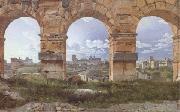
Danish Neoclassical Painter, 1783-1853
Danish painter and teacher. He has been called 'the father of Danish painting' because of the influence he exerted on Danish painters in the second quarter of the 19th century. With Christen K?bke he was the leading painter of the Danish 'Golden Age' (c. 1800-1850). |
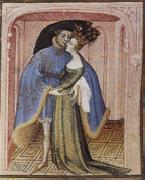 |
Christine de Pisan
|
|
French poet and arguably the first female author.
1364-1430
French writer. She was the daughter of an astrologer to Charles V and the wife of a court secretary and took up writing to support her children when she was widowed, producing 10 volumes of graceful verse, including ballads, rondeaux, lays, and complaints, many in the courtly-love tradition. Some works, both poetry and prose, champion women, notably The Book of the City of Ladies (1405). |
|