|
 |
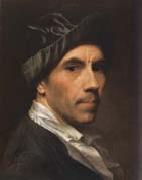
Christian Wilhelm Ernst Dietrich
|
|
German Painter, 1712-1774,German painter and etcher. He received his first training from his father, Johann Georg Dietrich (1684-1752), a court painter at Weimar, and was sent to Dresden at the age of 13 to study under the landscape painter Johann Alexander Thiele (1685-1752). In 1728 they travelled to Arnstadt to paint landscapes for stage sets. In 1730 Thiele presented his pupil to Frederick-Augustus I, Elector of Saxony, as a prodigy; Frederick-Augustus appointed him court painter and entrusted him to his minister Heinrich, Graf von Brehl, for whom he worked on some decorative paintings. From 1732 he used the name 'Dietricy' to sign his paintings. He travelled in Germany from 1734 and may have visited the Netherlands, the source of his artistic inspiration. He returned from his travels in 1741 and was appointed court painter to Frederick-Augustus II, Elector of Saxony, who sent him to Italy in 1743 to study. He visited Venice and Rome but returned to Dresden in 1744. |
 |
Christian Seybold
|
|
1690/7-1768
German painter, active in Austria. He went to Vienna in his youth and, apparently self-taught (Hagedorn), became a portrait-painter. His earliest known work, surviving only in an engraving (1728) by Andreas Schmutzer (1700-40) and Josef Schmutzer, is a portrait of Graf Johann Adam Questenberg in the formal Baroque style. Subsequently, under the influence of Balthasar Denner, he turned to a more intimate style of representation, |
 |
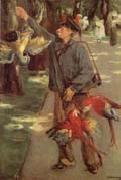
christian schubart
|
|
German poet,writer on music and composer. A distinguished keyboard player, he served at the Werttemberg court, 1769-73, then worked in Augsburg and Ulm. After imprisonment, 1777-87 (for insulting a duke's mistress), he became court and theatre poet at Stuttgart. As a composer he was best known for his lieder. His writings, including an important work on musical aesthetics (1806) and essays in his own periodical, stress expression in music. His poetry was often set; Schubert's four settings include Die Forelle and An meine Klavier.
|
 |
Christian Rohlfs
|
|
German Painter, 1849-1938
German painter and printmaker. He studied painting at the Kunstschule in Weimar (1870). Prolonged illness forced him to interrupt his studies, which he resumed in 1874 under Ferdinand Schauss (1832-1916) and Alexandre Struys (1852-1941). Through visits to Paris in the 1870s, he came into contact with the art of the Barbizon school, painting en plein-air on his return to Weimar. Under the influence of Struys he painted figurative works, such as Roman Builders (1879; Menster, Westfel. Landesmus.), and nudes in the tradition of academically enlightened Realism. In 1881 Rohlfs worked in a studio under Max Thedy (1858-1924). From c. 1883 he painted mainly landscapes with the approval of Ludwig von Gleichen-Russwurm (1836-1901), who was studying with Theodor Hagen (1842-1919), and was influenced in an indirect way by Albert Brendel (1827-95), who had taught at Weimar from 1875. He often chose formats that were unusually large for landscape paintings in this period, presenting landscape in a similar way to history painting. Atmosphere and light played an important role even in these early pictures, for example Sawmill at Ehringsdorf on the Ilm (930x780 mm, 1883; Weimar, Schlossmus.). From 1884 he worked as an independent painter. After 1885 colour became increasingly important for its own sake; light and shade were suggested purely by colour, which was applied in impasto spots and brushstrokes to create chiaroscuro values that determined the form, for example Wild Garden near Weimar (1888; Weimar, Schlossmus.). By the end of the 1880s he had developed an independent style parallel to Impressionist painting. When he saw works by Monet exhibited in Weimar in 1897, these corroborated his own efforts. |
 |
Christian Molsted
|
|
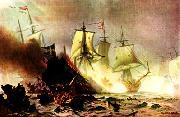
(1862-1930) was a Danish artist who specialized in marine painting. He is best known for his painting of the frigate Niels Juel during the Battle of Helgoland on 9 May 1864.
Born in Dragør on 15 October 1862, Mølsted was the son of fisherman Andreas Adolf Nikolaj Mølsted and Ane Hans-Nielsdatter. With financial support from a relative, he completed his school education in Copenhagen at Det tekniske Selskab where he graduated in 1879. After sailing to Madeira that summer on the frigate Jylland, he entered the Danish Academy in October 1880 with mentors such as Frederik Vermehren, Jorgen Roed, Julius Exner and Carl Bloch. During his studies, Mølsted travelled to Paris and London where he was able to observe contemporary art. He graduated from the Academy with a painting diploma in January 1885. He first exhibited in December 1884 and thereafter at the spring exhibitions. In 1889, he was awarded the Neuhausen Prize for his Skibe i Havnen ved Larsens Plads. His subjects are for the most part taken from the coasts around Copenhagen or in Jutland. Among the artist favorite subjects were the heroic battles of captains Tordenskjold and Willemoes. Historical details, as well as detailed information about the ships, was provided for the paintings by Otto Dorge, a Dragør local expert. Later in life, he also made genre paintings. Mølsted's works were widely appreciated for his perfectionist approach, his attention to historical detail and his ability to bring things to life. He died on 10 May 1930 in Dragør. |
 |
Christian Mali
|
|
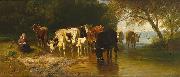
painted Magd mit Kuhen an der Tranke am See an einem sonnigen Fruhlingsmorgen, Munchen in 1880 |
 |
Christian Krohg
|
|
1852-1925
Norwegian
Christian Krohg Gallery
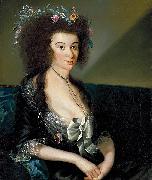
Krohg was educated in Germany at the Baden School of Art in Karlsruhe under Hans Gude[1], and later worked in Paris from 1881 to 1882. Inspired by the thoughts of the realists he chose motives primarily from everyday life ?C often its darker or socially inferior sides. Particularly well known are his pictures of prostitutes, and his novel Albertine from 1886 is about this theme. The book caused a scandal when first published, and was confiscated by the police. Krogh??s powerful and straightforward style made him one of the leading figures in the transition from romanticism to naturalism, characteristic of Norwegian art in this period. Through his periodic residence at Skagen, where he arrived for the first time in 1879, he had great influence on Anna and Michael Ancher, and provided early support to Edvard Munch.
Krohg was a journalist in the Oslo newspaper Verdens Gang 1890-1910, where he wrote remarkable portrait interviews. Later he became a professor director at Statens Kunstakademi (The Norwegian Academy of Arts) 1909-1925.
He was married to Oda Krohg. |
 |
Christian Gullager
|
|
Christian Gullager (1759-1826) was an artist specializing in portraits and theatrical scenery in the late 18th century; he worked in Boston, Massachusetts, New York, and Philadelphia. Born in Copenhagen, he trained at the Royal Danish Academy of Fine Arts. In America, portrait subjects included president George Washington. He designed scenery for Boston's Federal Street Theatre. |
 |
Christian Friedrich Tieck
|
|
1776-1851 Berlin,was a German sculptor and a brother of Ludwig Tieck. Tieck was born in Berlin, where he also died. He was taught by Johann Gottfried Schadow. Based on a concept by Karl Friedrich Schinkel, Tieck created the tomb of General Gerhard von Scharnhorst at Berlin's Invalidenfriedhof in 1822. He also created a bust of Wilhelm Heinrich Wackenroder and a lion made of bronze after a model by Christian Daniel Rauch. |
 |
Christian Friedrich Gille
|
|
1805-1899
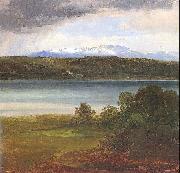
German painter, engraver and lithographer. Between 1825 and 1833 he studied engraving under Johann Gottfried Abraham Frenzel, lithography under Louis Z?llner and painting under Johan Christian Dahl at the Hochschule f?r Bildende K?nste, Dresden. Dahl encouraged in Gille an appreciation for the natural formations and changing conditions of light that had inspired Dahl's friend and mentor, the Romantic painter Caspar David Friedrich. Gille, however, did not adopt Friedrich's tendency to find mystical significance in these phenomena. Gille's prints are highly descriptive in style and include Saxon landscapes, genre scenes, animal studies and portraits of celebrated men. His paintings and sketches, in oils, watercolour and pen and brown ink, were mostly of landscapes, many with animal staffage. |
 |
Christian Ernst Bernhard Morgenstern
|
|
(29 September 1805 - 12 Februar 1867) was a German landscape painter. Morgenstern is regarded as one of the pioneers in Germany of early Realism in painting. He gained this reputation in Hamburg 1826-1829 together with his contemporary Adolph Friedrich Vollmer while both were still studying; from 1830 onwards, Morgenstern, together with Friedrich Wasmann, Johan Christian Dahl and Adolph Menzel, introduced Munich to Realist painting.
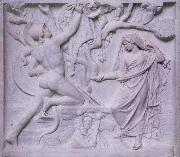
Morgenstern was born in Hamburg as one of six children to a painter of miniatures, Johann Heinrich Morgenstern (1769-1813). After the early death of his father he was placed as an apprentice in the graphic workshop of the brothers Suhr. Cornelius Suhr took the young Morgenstern as his servant on a two-year journey through Germany to publicise the panorama prints which the brothers Suhr produced. 1822 followed another long journey to St. Petersburg, where they stayed for a year and to Moscow. On their return to Hamburg Morgenstern succeeded in leaving Suhr (Vollmer took his place). He became a student of the Hamburg painter Siegfried Bendixen with whom he stayed from 1824 to 1827, then continued his studies at the Royal Danish Academy of Fine Arts in Copenhagen (1827-1828) and undertook study journeys through Sweden and Norway. Bendixen introduced him to the wealthy aristocrat and supporter of the arts, Carl Friedrich von Rumohr, patron to many young Hamburg artists, on whose estate in Holstein he spent several summers. In 1830 Morgenstern went to Munich on Ruhmor's advice. He settled there permanently while undertaking extensive yearly study trips: for the first years through Bavaria, then in the summer of 1836 and in the following summers to the Alsace as guest of a patron of the arts. The winter 1839/40 he returned to Hamburg to stay with his mother. In 1841 he visited Venice and Trieste together with the landscape painter Eduard Schleich and in 1843, and again in 1846 the central Alps. In the summer of 1850 he stayed on Heligoland. |
 |
Christian Daniel Rauch
|
|
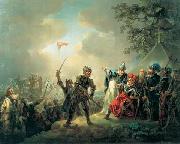
1777 Arolsen-1857 Dresden,was a German sculptor. Rauch was born at Arolsen in the Principality of Waldeck. His parents were poor and unable to place him under efficient masters. His first instructor taught him little else than the art of sculpting gravestones, and Professor Ruhl of Kassel could not give him much more. A wider field of improvement opened up before him when he removed to Berlin in 1797; but he was obliged to earn a livelihood by becoming a royal lackey, and to practise his art in spare hours. Queen Louisa of Prussia, surprising him one day in the act of modeling her features in wax, sent him to study at the Academy of Art. Not long afterwards, in 1804, Count Sandrecky gave Rauch the means to complete his education at Rome, where Wilhelm von Humboldt, Antonio Canova and Bertel Thorvaldsen befriended him. Among other works, he executed bas-reliefs of "Hippolytus and Phaedra," "Mars and Venus wounded by Diomede," and a "Child praying." In 1811 Rauch was commissioned to execute a monument for Queen Louisa of Prussia. |
 |
Christian August Lorentzen
|
|
(10 August 1749 - 8 May 1828) was a Danish painter. He was the instructor of Martinus Rørbye.
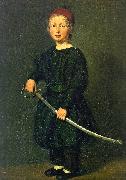
Christian August Lorentzen was born on 10 August 1749 as the son of a watchmaker. He arrived in Copenhagen around 1771 where he frequented the Royal Academy of Fine Arts but it is unclear whether he received formal training.From 1779 to 1782 he want abroad to develop his skills, visiting the Netherlands, Antwerp and Paris where he copied old masters. In 1792 he traveled to Norway to paint prospects.
In a number of painting, such as Slaget på Reden (1801, Danish Museum of National History and Den rædsomste nat (1807, Danish National Gallery, he documented key events from the English Wars between 1801 and 1814. Later in his career he mainly painted portraits, landscapes and scenes from Ludvig Holberg's comedies.
As a professor at the Royal Academy in Copenhagen from 1803 and until his death in 1828, he exercisized great influence on the next generation of painters such as Martinus Rørbye among others. |
 |
Christian Albrecht Jensen
|
|
1792-1870
Danish
Christian Albrecht Jensen Galleries
1792-1870
Danish
Christian Albrecht Jensen Galleries
was a Danish painter, born in Bredstedt, Nordfriesland. In 1818, he traveled to Rome, and met the sculptor Bertel Thorvaldsen. His work is representative of the Golden Age of Danish Painting.
|
 |
Christen Kobke
|
|
1810-1848
Danish
Christen Kobke Galleries
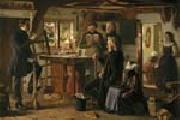
He lived in Kastellet until 1833 and made many paintings of the area. His painting "Gården ved bageriet i Kastellet" (ca. 1832) hangs in the Ny Carlsberg Glyptotek museum in Copenhagen.
In 1832 he shared a studio with friend, landscape painter Frederik Hansen Sødring. He painted a portrait of Sødring which now hangs in the Hirschsprung Collection.
In 1834 he moved, along with his parents, outside of Copenhagen??s fortifications near Sortedamssøen, a lake area. He painted many views overlooking the lake towards the city and the embankments surrounding the city. His work becomes larger, more monumental.
Like many of his contemporary artists he came under the influence of Niels Lauritz Høyen, art historian, who promoted a nationalistic art. Høyen called for artists to search for subject matter in the folk life of their country instead of searching for themes in other lands, such as Italy (which was at that time considered a requirement for an artist??s training). On a visit to Hillerod in 1835 he painted a romantic picture of Frederiksborg Palace, "Frederiksborg Slot ved Aftenbelysning" ("Frederiksborg Palace in the Evening Light").
At the end of 1837 he married Susanna Cecilie Kobke (1810-1849), and shortly afterwards painted a portrait of his young bride.
One of the Small Towers on Frederiksborg Castle, c.1834-35.In 1838 he received a travel stipend from the Academy, left his new wife and traveled over Dresden and Munich to Italy accompanied by decorative painter Georg Hilker. They arrived in Rome by year??s end where he met brother-in-law Frederik Christopher Krohn, sculptor and medallionist, and many other Danish artists. He traveled, along with Constantin Hansen the following summer to Naples, Sorrento, Pompeii and Capri where he painted out in the open air.
He returned home in 1840 with a large collection of sketches for later use and inspiration. Unfortunately, most his later work with these Italian themes was uninspired, and they found little favor. Kobke even considered at the time becoming a decoration painter, having participated in 1844-1845 in the decoration of the Thorvaldsens Museum, a museum dedicated to the artistic works of Bertel Thorvaldsen.
Two years after his father died in 1843 the family sold the property outside Copenhagen, and Kobke moved back into the city. His application for admission to the Academy, which was accompanied by one of his failed Italian landscapes, was rejected in 1846. He died in 1848 of pneumonia, and is buried in Assistens Kirkegard.
Kobke, a national romantic, painted portraits, landscapes and architectural paintings. Most of Kobke??s portraits show friends, family members and fellow artists. He found most of his motifs in his immediate surroundings. Now he is recognized internationally for his well composed and harmonic paintings, for their coloristic qualities and for his sense of the everyday life. But in his lifetime he was almost forgotten, especially because of his early death and limited production. Despite his talent and the praise of various contemporaries, Kobke had never been inundated with commissions.
Kobke is recognized today as one of the most talented among Denmark??s Golden Age painters and the most internationally renowned Danish painter of his generation. The painterly interpretations he made of his surroundings stand as highpoints of the period.
His works are in the collections of not only Danish museums but also such international museums as the J. Paul Getty Museum
|
 |
Christen Dalsgaard
|
|
(October 30, 1824-February 11, 1907), Danish painter, was born on the Krabbesholm estate on the fjord near Skive, and was son of the estate owner, Jens Dalsgaard.
|
 |
Childe Hassam
|
|
1859-1935
Childe Hassam Locations
Frederick Childe Hassam (b. October 17, 1859, Dorchester, Boston, Massachusetts ?C d. August 27, 1935, East Hampton, New York) was a prominent and prolific American Impressionist painter, noted for his urban and coastal scenes. Along with Mary Cassatt and John Henry Twachtman, Hassam was instrumental in promulgating Impressionism to American collectors, dealers, and the museums. He produced over 3,000 paintings, watercolors, etchings, and lithographs in his career, and was a founding member of The Ten, an influential group of American artists of the early 20th century. His most famous works are the ??Flag?? paintings, completed during World War I.
Hassam (pronounced HASS'm;) (known to all as Childe, pronounced like child) was born in his family home in a suburb of Boston in 1859. His father Frederick was a cutlery merchant and descended from a long line of New Englanders, while his mother Rosa was a native of Maine. He demonstrated an interest in art early in his life. He had his first lessons in drawing and watercolor while attending the Mather public school, but his parents took little notice of his nascent talent.
A disastrous fire in November 1872 wiped out much of Boston??s commercial district including his father??s business. To help out the family, Hassam dropped out of high school and his father lined up a job for him in the accounting department of publisher Little Brown & Company. His poor aptitude for figures, however, convinced his father to allow him to pursue an art career, and Hassam found employment with George Johnson, a wood engraver. He quickly proved an adept draftsman (??draughtsman?? in the Boston directory) and he produced designs for commercial engravings, such as images for letterheads and newspapers. Around 1879, Hassam began creating his earliest oil paintings but his preferred medium was watercolors, mostly outdoor studies.
|
 |
Chigot Eugene
|
|
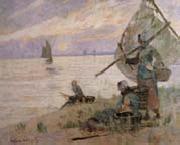
French history painter and marine specialist , 1860-1890
|
 |
Chase, William Merritt
|
|
American Impressionist Painter, 1849-1916
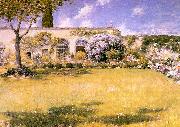
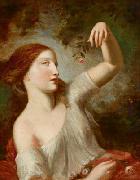
American painter and printmaker. He received his early training in Indianapolis from the portrait painter Barton S. Hays (1826-75). In 1869 he went to New York to study at the National Academy of Design where he exhibited in 1871. That year he joined his family in St Louis, where John Mulvaney (1844-1906) encouraged him to study in Munich. With the support of several local patrons, enabling him to live abroad for the next six years, Chase entered the K?nigliche Akademie in Munich in 1872. Among his teachers were Alexander von Wagner (1838-1919), Karl Theodor von Piloty and Wilhelm von Diez (1839-1907). Chase also admired the work of Wilhelm Leibl. The school emphasized bravura brushwork, a technique that became integral to Chase's style, favoured a dark palette and encouraged the study of Old Master painters, particularly Diego Vel?zquez and Frans Hals. Among Chase's friends in Munich were the American artists Walter Shirlaw, J. Frank Currier and Frederick Dielman (1847-1935), |
 |
Charles-Joseph Natoire
|
|
(3 March 1700 - 23 August 1777) was a French painter in the Rococo manner, a pupil of François Lemoyne and director of the French Academy in Rome, 1751-1775. Considered during his lifetime the equal of François Boucher, he played a prominent role in the artistic life of France.
He is remembered above all for the series of the History of Psyche for Germain Boffrand's oval salon de la Princesse in the Hôtel de Soubise, Paris, and for the tapestry cartoons for the series of the History of Don Quixote, woven at the Beauvais tapestry manufacture, most of which are at the Château de Compiegne.
|
 |
Charles-Francois Daubigny
|
|
French Barbizon School Painter, 1817-1878
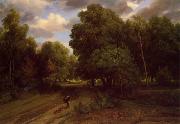
was one of the painters of the Barbizon school, and is considered an important precursor of Impressionism. Daubigny was born into a family of painters and was taught the art by his father Edmond François Daubigny and his uncle, miniaturist Pierre Daubigny. Initially Daubigny painted in a traditional style, but this changed after 1843 when he settled in Barbizon to work outside in nature. Even more important was his meeting with Camille Corot in 1852 in Optevoz (Is??re). On his famous boat Botin, which he had turned into a studio, he painted along the Seine and Oise, often in the region around Auvers. From 1852 onward he came under the influence of Gustave Courbet. In 1866 Daubigny visited England, eventually returning because of the Franco-Prussian war in 1870. In London he met Claude Monet, and together they left for the Netherlands. Back in Auvers, he met Paul Cezanne, another important impressionist. |
 |
Charles-edouard Chaise
|
|
(1759, Paris - 1798, Fontainebleau) was a French neoclassical painter.
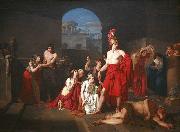
His father was a painter, art dealer and member of the Academie de Saint-Luc. Charles-Edouard studied under Jean Bonvoisin in 1775, then under Jean-Jacques Lagrenee, before winning second prize in the 1778 prix de Rome with David condemning to death the Amalekite bringing him Saul's diadem.
|
 |
Charles-Amable Lenoir
|
|
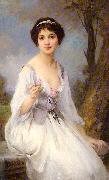
(22 October 1860 - 1926) was a French painter. Like his mentor, William-Adolphe Bouguereau, he was an academic painter and painted realistic portraits as well as mythological and religious scenes. His artistic career was so prestigious that he won the Prix de Rome twice and was awarded the Legion d'honneur.
Lenoir was born in Châtellaillon, a small town just outside of La Rochelle. His mother was a seamstress and his father was a customs officer. When he was young, his father was reassigned and the family moved to Fouras. He did not start out in life as an artist, but instead began his education at a teachers' college in La Rochelle. Upon graduation, he worked as a teacher and supervisor at the lycee in Rochefort.
In August 1883 he was accepted into the École des Beaux-Arts de Paris, he also joined the Academie Julian where he was a student of William-Adolphe Bouguereau and Tony Robert-Fleury. Lenoir made his artistic debut at the Salon in 1887 and continued to exhibit there until his death. He was quickly noticed in the art world, and in 1889 won the Second Prix de Rome for his painting, Jesus et le paralytique (Jesus and a Sick Man with Palsy), and he won the First Prix de Rome the following year for Le Reniement de Saint Pierre (The Denial of St. Peter).His awards did not stop with the Prix de Rome; works shown at the Salons also won prizes, and he received a third-class medal in 1892 for Le Grenier a Vingt Ans (The Garret at twenty years) and a second-class medal in 1896 for La Mort de Sappho (The Death of Sappho). |
 |
Charles Wilson Peale
|
|
1741-1827
Charles Wilson Peale Galleries
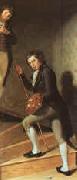
Finding that he had a talent for painting, especially portraitures, Peale studied for a time under John Hesselius and John Singleton Copley. Friends eventually raised enough money for him to travel to England to take instruction from Benjamin West. Peale studied with West for two years beginning in 1767, afterward returning to America and settling in Annapolis, Maryland. There, he taught painting to his younger brother, James Peale, who in time also became a noted artist.
Peale's enthusiasm for the nascent national government brought him to the capital, Philadelphia, in 1776, where he painted portraits of American notables and visitors from overseas. His estate, which is on the campus of La Salle University in Philadelphia, can still be visited. He also raised troops for the War of Independence and eventually gained the rank of captain in the Pennsylvania militia by 1777, having participated in several battles. While in the field, he continued to paint, doing miniature portraits of various officers in the Continental Army. He produced enlarged versions of these in later years. He served in the Pennsylvania state assembly in 1779-1780, after which he returned to painting full-time.
Peale painted in the trompe l'oeil style,[1] and was quite prolific as an artist. While he did portraits of scores of historic figures (such as John Hancock, Thomas Jefferson and Alexander Hamilton), he is probably best known for his portraits of George Washington. The first time Washington ever sat for a portrait was with Peale in 1772, and there would be six other sittings; using these seven as models, Peale produced altogether close to 60 portraits of Washington. In January 2005, a full length portrait of "Washington at Princeton" from 1779 sold for $21.3 million dollars - setting a record for the highest price paid for an American portrait.
Peale had a great interest in natural history, and organized the first U.S. scientific expedition in 1801. These two major interests combined in his founding of what became the Philadelphia Museum, and was later renamed the Peale Museum.
This museum is considered the first. It housed a diverse collection of botanical, biological, and archaeological specimens. Most notably, the museum contained a large variety of birds which Peale himself acquired, and it was the first to display North American mammoth bones.
The display of the mammoth bones entered Peale into a long standing debate between Thomas Jefferson and Comte de Buffon. Buffon argued that Europe was superior to the Americas biologically, which was illustrated through the size of animals found there. Jefferson referenced the existence of these mammoths (which he believed still roamed northern regions of the continent) as evidence for a greater biodiversity in America. Peale's display of these bones drew attention from Europe, as did his method of re-assembling large skeletal specimens in three dimensions.
The museum was among the first to adopt Linnaean taxonomy. This system drew a stark contrast between Peale's museum and his competitors who presented their artifacts as mysterious oddities of the natural world.
The museum underwent several moves during its existence. At various times it was located in several prominent buildings including Independence Hall and the original home of the American Philosophical Association.
The museum would eventually fail in large part because Peale was unsuccessful at obtaining government funding. After his death, the museum was sold to, and split up by, showmen P. T. Barnum and Moses Kimball. |
 |
Charles Willson Peale
|
|
1741-1827
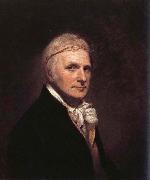
Painter and museum founder. After serving as a saddler's apprentice in Annapolis, MD, from 1754 to 1761, he worked at various trades, including painting signs and portraits. In 1766 some prominent Marylanders underwrote his studies in London with Benjamin West, from whom he absorbed the fundamentals of the British portrait tradition. Peale probably attended the informal life classes offered at St Martin's Lane Academy, precursor to the Royal Academy Schools, and drew from casts in the Duke of Richmond's collection in Whitehall. He visited the studios of such important British portrait painters as Joshua Reynolds, Francis Cotes and Allan Ramsay and studied the techniques of miniature painting, sculpture and engraving. In London he executed his first major commission |
 |
Charles William Mitchell
|
|
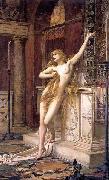
(1854 - 1903) was an English Pre-Raphaelite painter from Newcastle. A contemporary of John William Waterhouse, his work is similar in many ways. His one famous piece was Hypatia, shown in 1885 and likely inspired by the Charles Kingsley serialized novel Hypatia or New Foes with an Old Face. This painting is currently in the Laing Art Gallery. |
 |
Charles Wellington Furse
|
|
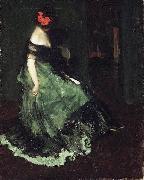
(January 13, 1868 - October 16, 1904) was an English painter.
He was born at Staines, the son of the Rev. C. W. Furse, archdeacon of Westminster, and rector of St John's, Smith Square and descended collaterally from Sir Joshua Reynolds; and in his short span of life achieved such rare excellence as a portrait and figure painter that he forms an important link in the chain of British portraiture which extends from the time when Van Dyck was called to the court of Charles I into the 20th century.
His talent was precocious; at the age of seven he gave indications of it in a number of drawings illustrating Scott's novels. He entered the Slade School in 1884, winning the Slade scholarship in the following year, and completed his education at Julians Atelier in Paris. Hard worker as he was, his activity was frequently interrupted by spells of illness, for he had developed signs of consumption when he was still attending the Slade school. An important canvas called Cain was his first contribution (1888) to the Royal Academy, to the associateship of which he was elected in the year of his death. For some years before he had been a staunch supporter of the New English Art Club, to the exhibitions of which he was a regular contributor.
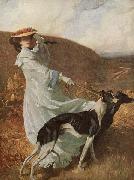
In October 1900 he married Katharine Symonds, the daughter of John Addington Symonds. She later became known as Dame Katharine Furse. The couple had 2 sons. His fondness for sport and of an open-air life found expression in his art and introduced a new, fresh and vigorous note into portraiture. There is never a suggestion of the studio or of the fatiguing pose in his portraits. The sitters appear unconscious of being painted, and are generally seen in the pursuit of their favourite outdoor sport or pastime, in the full enjoyment of life. Such are the Diana of the Uplands, the Lord Roberts and The Return from the Ride at the Tate Gallery; the four children in the Cubbing with the York and Ainsty, The Lilac Gown, Mr. and Mrs. Oliver Fishing and the portraits of Lord Charles Beresford and William Johnson Cory.
Most of these pictures, and indeed nearly all the work completed in the few years of Furse's activity, show a pronounced decorative tendency. His sense of space, composition and decorative design can best be judged by his admirable mural decorations for Liverpool town hall, executed between 1899 and 1902. A memorial exhibition of Furse's paintings and sketches was held at the Burlington Fine Arts Club in 1906.
|
 |
Charles Webster Hawthorne
|
|
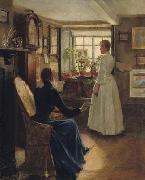
(January 8, 1872 - November 29, 1930) was an American portrait and genre painter and a noted teacher who founded the Cape Cod School of Art in 1899.
He was born in Lodi, Illinois and his parents returned to Maine, raising him in the state where Charles' father was born. |
 |
Charles W. Bartlett
|
|
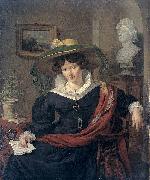
(born 1 June 1860 in Bridport, Dorset) was an English painter and printmaker. He studied metallurgy and worked in that field for several years. At age 23, he enrolled in the Royal Academy in London, where he studied painting and etching. After three years of study in London, he entered the private studio school Academie Julian in Paris, where he studied under Jules Joseph Lefebvre (1836-1911) and Gustave Boulanger (1824-1888).
In 1889, he returned to England and married Emily Tate, but shortly thereafter, his wife and infant son died in childbirth. Bartlett then traveled to Europe, spending several productive years in Holland, Brittany and Venice with his friend and fellow artist Frank Brangwyn (1867-1956). Brangwyn is believed to have introduced Bartlett to Japanese prints. Bartlett produced some of his most important early works on the Continent, especially studies of peasants painted in broad areas of color. He was invited to join the Societe Nationale des Beaux-Arts in France in 1897. In 1898, he returned to England and married Catherine Kate Main. |
 |
Charles Van Beveren
|
|
Charles van Beveren, born at Mechlin in 1809, was instructed in the rudiments of art in the academy of his native city and at Antwerp. He settled in Amsterdam in 1830, subsequently visiting Paris, Rome, and other cities of Italy, and distinguished himself as a painter of history, genre, and portraits. He died at Amsterdam in 1850. The best known of his works are:
The Confession of a Sick Girl (in the Pinakothek at Munich).
Male Figure. A study (in the Rotterdam Museum).
The Vision of St. Ignatius.
The Death of St. Anthony of Padua (in the church of Moses and Aaron at Amsterdam, his chef-d'oeuvre). |
|