|
 |
Henri Edmond Cross
|
|
1856-1910
French
Henri Edmond Cross Locations
French painter and printmaker. The only surviving child of Alcide Delacroix, a French adventurer and failed businessman, and the British-born Fanny Woollett, he was encouraged as a youth to develop his artistic talent by his father cousin, Dr Auguste Soins. He enrolled in 1878 at the Ecoles Academiques de Dessin et d Architecture in Lille, where he remained for three years under the guidance of Alphonse Colas (1818-87). He then moved to Paris and studied with Emile Dupont-Zipcy (1822-65), also from Douai, whom he listed as his teacher when exhibiting at Salons of the early 1880s. His few extant works from this period are Realist portraits and still-lifes, painted with a heavy touch and sombre palette (example in Douai, Mus. Mun.). |
 |
Heinrich Eddelien
|
|
Matthias Heinrich Elias Eddelien (22 Januar 1802 in Greifswald - 24 December 1852 in Stuer) was a Danish history painter of German origin. Eddelien arrived in Copenhagen as a young man and attended the Royal Danish Academy of Fine Arts from 1821 studying under Christoffer Wilhelm Eckersberg. In 1837, he was awarded the Academy's large gold medal. From 1839 to 1843, he travelled to Italy and Germany to widen his studies. He painted portraits, altarpieces and decorative works, including the Pompeian Apartment in Christian VIII's Palace at Amalienborg Palace. His principal work is the decoration of Christian IV's Chapel in Roskilde Cathedral but this led to the laming of his right arm. He died when receiving spa treatment at Stuer. |
 |
Hans Eworth
|
|
Flemish Northern Renaissance Painter, active 1540-1573
Flemish painter, active in England. Jan Euworts was listed in 1540 as a freeman of the Guild of St Luke in Antwerp, but by 1545 he had moved to England, where until 1571 his name, spelt in a wide variety of ways (e.g. Eeworts, Eottes, Euertz, Evance, Eworts, Ewotes, Ewout, Ewoutsz., Eywooddes, Hawarde, Heward, Huett etc), appeared in numerous naturalization, tax and parish documents. About 35 paintings are generally attributed to him, consisting primarily of dated portraits of the English gentry and nobility. The majority are signed with the monogram HE, which led to their being attributed to the Flemish painter Lucas de Heere during the 18th and 19th centuries. Cust reattributed the paintings to Eworth on the basis of an inventory (1590) of the collection of John, 1st Baron Lumley, in which three monogrammed portraits were listed as being by Haunce Eworth |
 |
Hamilton Easter Field
|
|
(1873-1922) was an important American artist, teacher, author, critic, collector and patron of the arts |
 |
Gustav Eberlein
|
|
1847Spickerschausen-1926 Berlin,German sculptor. He attended the Realschule in Hannoversch Menden until 1861. He was apprenticed to a goldsmith in 1861-4 and thus learnt embossing, carving, chasing and engraving. He subsequently travelled as a journeyman, finding employment in Hildesheim, then in Kassel with the court jeweller, Ruhl. From 1867 to 1870, Eberlein trained as a sculptor under August von Kreling (1819-76), director of the Kunstgewerbeschule in Nuremberg, also working as Kreling's assistant to support his studies. On receiving a grant from Elisabeth of Prussia (the widow of Frederick William IV) for three further years of study, |
 |
GRECO, El
|
|
Greek-born Spanish Mannerist Painter, 1541-1614
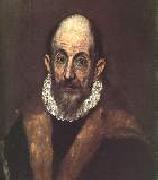
Greek painter, designer and engraver, active in Italy and Spain. One of the most original and interesting painters of 16th-century Europe, he transformed the Byzantine style of his early paintings into another, wholly Western manner. He was active in his native Crete, in Venice and Rome, and, during the second half of his life, in Toledo. He was renowned in his lifetime for his originality and extravagance and provides one of the most curious examples of the oscillations of taste in the evaluation of a painter,
|
 |
Greco El
|
|
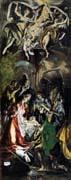
Spanish painter of Greek origin (b. 1541, Candia, d. 1614, Toledo). Paintings in Crete (until 1567) Paintings in Venice (1567-70) Paintings in Rome (1570-75) First commissions in Spain (1576-80) , He was a painter, sculptor, and architect of the Spanish Renaissance. "El Greco" (The Greek) was a nickname,a reference to his Greek origin, and the artist normally signed his paintings with his full birth name in Greek letters, (Domenikos Theotokopoulos). El Greco was born in Crete, which was at that time part of the Republic of Venice, and the centre of Post-Byzantine art. He trained and became a master within that tradition before travelling at age 26 to Venice, as other Greek artists had done. In 1570 he moved to Rome, where he opened a workshop and executed a series of works. During his stay in Italy, El Greco enriched his style with elements of Mannerism and of the Venetian Renaissance. In 1577 he moved to Toledo, Spain, where he lived and worked until his death. In Toledo, El Greco received several major commissions and produced his best known paintings. El Greco's dramatic and expressionistic style was met with puzzlement by his contemporaries but found appreciation in the 20th century. |
 |
Gerbrand van den Eeckhout
|
|
1621-1674
Dutch
Gerbrand van den Eeckhout Location
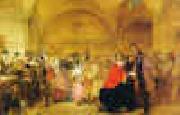
Dutch painter, draughtsman and etcher. He was the son of the goldsmith Jan Pietersz. van den Eeckhout and a great friend as well as a pupil of Rembrandt, according to Houbraken, who commented that van den Eeckhout painted in the style of his master throughout his career. This is certainly true of van den Eeckhout (biblical) history paintings, but less so of either his portraits, which gradually displayed more Flemish elegance, or his genre pieces (from 1650), in which he followed various trends; he adapted his style to suit his subject with sensitive versatility. He was also a gifted colourist and an artist of great imagination, superior in both these respects to such better-known Rembrandt pupils as Ferdinand Bol and Nicolaes Maes. Moreover, he was extremely productive, and there is at least one dated painting for virtually every year between 1641 and 1674. In addition, he created a large body of drawings comprising histories, figures, landscapes and genre scenes executed in various media, including watercolour. He also made several etchings, mostly studies of heads, such as the Self-portrait (1646; B. 66). He died a bachelor, aged 53. |
 |
George Elgar Hicks
|
|
1824-1914
British
George Elgar Hicks Gallery
Born on March 13, 1824 in Lymington, Hampshire, George Elgar Hicks was the second son of a wealthy magistrate. His parents encouraged Hicks to become a doctor and so Hicks studied medicine at University College from 1840-42. However, after three years "ardous and disagreeable study" Hicks decided he wanted to be an artist. Due to this, Hicks began training as an artist considerably later in life than most artists of the time. In 1843, Hicks attended Sass's Academy and by 1844 had entered the Royal Academy Schools.
In 1847 Hicks married Maria Hariss and six of their eight children were born in the seven years following. He did not achieve much success as an artist during this period and later referred to his art at this time as "small and unimportant." He blamed this on the fact he had little time to study art or interact with other artists, due to his busy family life.
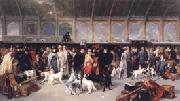
In 1859, Hicks painted his first large genre painting, Dividend Day. Bank of England (exhibited at the Royal Academy in 1859) following the success of Frith's paintings Ramsgate Sands and Derby Day at the Royal Academy. It was a typical genre painting, showing a scene from the Bank of England and featuring a broad range of social classes. Hicks painted several more large modern life paintings in the following years which were generally poorly reviewed by critics. These include The General Post Office. One minute to 6 (1860), Billingsgate Fish Market (1861) and Changing Homes (1862). Hicks paintings were often of subjects that no other artists attempted, such as the General Post Office and Billingsgate Fish Market. Hicks was one of the few artists that showed lasting interest in the emulation of Frith's style and is generally considered Frith's principal imitator.
By the late 1860s, the popularity of genre painting had waivered and Hicks began to focus on painting historical subjects, leading to society portraiture in the 1870s.
In 1884, Hicks remarried following the death of Maria in 1881. He retired in the 1890s and died a month before the declaration of World War I in 1914. |
 |
George Earle
|
|
English , born May 25, 1803, London, Eng. -died Jan. 18, 1873, Torquay, Devonshire |
 |
George earl
|
|
1824-1908
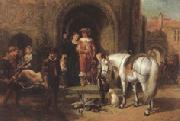
1824-1908.was a painter, primarily of sporting dogs and other animals. He was also the father of Maud Earl and Percy Earl, and the brother of Thomas Earl, all three of whom were also animal artists. Earl was a keen sportsman and this is reflected in his work and reputation as a dog painter. He was also an early member of The Kennel Club. Although chiefly remembered as a canine artist due to his success depicting them |
 |
georg engelhardt schroder
|
|
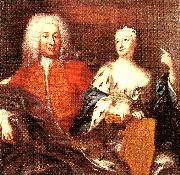
Georg Engelhard Schröder, född den 31 maj 1684 i Stockholm, gift 1727 med Anna Brigitta Spöring, död den 17 maj 1750; konstnär, porträtt- och historiemålare.
Georg Engelhard Schröders far, Veit Engelhard, hade omkring år 1670 kommit från N??rnberg och bosatt sig i Stockholm där Georg Engelhard föddes 1684. Han blev tidigt elev hos konstnären och målaren David von Krafft (1655-1724) men lämnade honom 1703 för utlandsstudier.
Under 21 år for Georg Engelhard runt i Europa. Han vistades först en tid i Nordtyskland, innan färden gick vidare till Italien. I Venezia förblev han under fem år och kopierade gamla mästare, sysslade med vedutamåleri och hade kontakt med pastellmålarinnan Rosalba Carriera (1675-1757). I Roma tog han intryck av barockmålarna Carlo Dolci (1616-1686), Carlo Maratta (1625-1713), Francesko Trevisani (1656-1746) m.fl. och tillägnade sig det raska men ytliga framställningssätt, som tillhörde den tidens italienska konst. I Paris samlade han impulser hos den franske målaren Noel Nicolas Coypel (1690-1734). Reminiscenser av den italienska och franska konsten kan man påträffa flerstädes i hans kompositioner. I London stannade han i sju år och tog starka intryck av Godfrey Knellers (1646-1723) och Dahls porträttkonst.
När Daniel von Krafft avled 1724 kallades Georg Engelhard Schröder hem till Sverige och efterträdde i december sin gamle läromästare som kunglig hovkonterfejare. Som sådan uppbar han lön. Konung Fredrik I satte stort värde på sin konterfejare, och lät honom måla otaliga porträtt av sig och sin drottning Ulrika Eleonora. År 1745 utnämndes han till hovintendent. Georg Engelhard anlitades mycket och samlade ihop en betydande förmögenhet. På 1740-talet nåddes Sverige av den nya franska smaken, i främsta rummet via konstnären Gustaf Lundberg (1695-1786), varvid Georg Engelhard kom att skjutas åt sidan. Han representerade i Sveriges 1700-talsmåleri sista skedet i det italienska inflytandet.
Långt ifrån den förnämste, var dock Georg Engelhard en av sin tids mest uppburne målare. Han arbetade inom ett vitt fält: utförde kyrktavlor, allegorier, historiska motiv och porträtt. Hans arbeten har ej sällan någonting vacklande och obestämt, vilket i förening med mycken ojämnhet i utförandet gör många av dem mindre tilltalande för konstkännaren. Han har dock efterlämnat verk, som vittnar om, att han, när han allvarligt uppbjöd sin förmåga, var mäktig till både varm och djup uppfattning samt hade stor skicklighet i färgbehandling och i framställningens enskildheter. |
 |
Frederick Edwin Church
|
|
1826-1900
Frederick Edwin Church Galleries
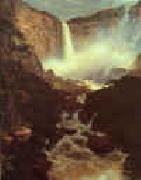
Frederic Edwin Church (May 4, 1826 ?C April 7, 1900) was an American landscape painter born in Hartford, Connecticut. He was a central figure in the Hudson River School of American landscape painters. While committed to the natural sciences, he was "always concerned with including a spiritual dimension in his works".
The family wealth came from Church's father, Joseph Church, a silversmith and watchmaker in Hartford, Connecticut.(Joseph subsequently also became an official and a director of The Aetna Life Insurance Company) Joseph, in turn, was the son of Samuel Church, who founded the first paper mill in Lee, Massachusetts in the Berkshires, and this allowed him(Frederic) to pursue his interest in art from a very early age. At eighteen years of age, Church became the pupil of Thomas Cole in Catskill, New York after Daniel Wadsworth, a family neighbor and founder of the Wadsworth Atheneum, introduced the two. In May 1848, Church was elected as the youngest Associate of the National Academy of Design and was promoted to Academician the following year. Soon after, he sold his first major work to Hartford's Wadsworth Atheneum.
Church settled in New York where he taught his first pupil, William James Stillman. From the spring to autumn each year Church would travel, often by foot, sketching. He returned each winter to paint and to sell his work.
Between 1853 and 1857, Church traveled in South America, financed by businessman Cyrus West Field, who wished to use Church's paintings to lure investors to his South American ventures. Church was inspired by the Prussian explorer Alexander von Humboldt's Cosmos and his exploration of the continent; Humboldt had challenged artists to portray the "physiognomy" of the Andes.
|
 |
Frederic Edwin Church
|
|
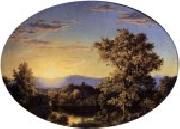
American Hudson River School Painter, 1826-1900 ..American painter. He was a leading representative of the second generation of the HUDSON RIVER SCHOOL, who made an important contribution to American landscape painting in the 1850s and 1860s. The son of a wealthy and prominent businessman, he studied briefly in Hartford with two local artists, Alexander Hamilton Emmons (1816-84) and Benjamin Hutchins Coe (1799-1883). Thanks to the influence of the Hartford patron DANIEL WADSWORTH, in 1844 he became the first pupil accepted by Thomas Cole. This was an unusual honour |
 |
Frederic E.Church
|
|
1826-1900
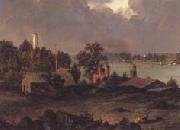
American painter. He was a leading representative of the second generation of the HUDSON RIVER SCHOOL, who made an important contribution to American landscape painting in the 1850s and 1860s. The son of a wealthy and prominent businessman, he studied briefly in Hartford with two local artists, Alexander Hamilton Emmons (1816-84) and Benjamin Hutchins Coe (1799-1883). Thanks to the influence of the Hartford patron DANIEL WADSWORTH, in 1844 he became the first pupil accepted by Thomas Cole. |
 |
Frans van mieris the elder
|
|
Dutch Baroque Era Painter, 1635-1681
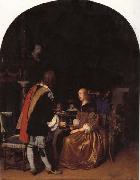
was a Dutch genre and portrait painter. The leading member of a Leiden family of painters, his sons Jan (1660-1690) and Willem (1662 C1747) and his grandson Frans van Mieris the Younger (1689 C1763) were also accomplished genre painters. Frans was the son of Jan Bastiaans van Mieris, a goldsmith, carver of rubies and diamond setter at Leiden. His father wished to train him to his own business, but Frans preferred drawing, and took service with Abraham Torenvliet, a glazier who kept a school of design. In his father's shop he became familiar with the ways and dress of people of distinction. His eye was fascinated in turn by the sheen of jewelry and stained glass; and, though he soon gave up the teaching of Torenvliet for that of Gerard Dou and Abraham van den Tempel, he acquired a manner which had more of the finish of the exquisites of the Dutch school than of the breadth of the disciples of Rembrandt. It should be borne in mind that he seldom chose panels of which the size exceeded 12 to 15 inches, and whenever his name is attached to a picture above that size we may surely assign it to his son Willem or to some other imitator. Unlike Dou when he first left Rembrandt, or Jan Steen when he started on an independent career, Mieris never ventured to design figures as large as life. Characteristic of his art in its minute proportions is a shiny brightness and metallic polish. The Music Lesson,National Museum of Serbia , BelgradeThe subjects which he treated best are those in which he illustrated the habits or actions of the wealthier classes; but he sometimes succeeded in homely incidents and in portrait, and not unfrequently he ventured on allegory. He repeatedly painted the satin skirt which Ter Borch brought into fashion, and he often rivalled Ter Borch in the faithful rendering of rich and highly-coloured woven tissues. But he remained below Ter Borch and Metsu, because he had not their delicate perception of harmony or their charming mellowness of touch and tint, and he fell behind Gerard Dou, because he was hard and had not his feeling for effect by concentrated light and shade. In the form of his composition, which sometimes represents the framework of a window enlivened with greenery, and adorned with bas-reliefs within which figures are seen to the waist, his model is certainly Dou. |
 |
Francois-Edouard Picot
|
|
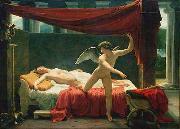
(10 October 1786 - 15 March 1868) was a French painter during the July Monarchy, painting mythological, religious and historical subjects.
|
 |
Francisco de herrera the elder
|
|
Spanish Baroque Era Painter, ca.1590-1656
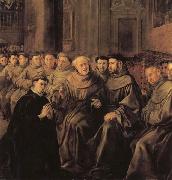
Spanish painter. His early works are in the Mannerist style. Under the influence of Francisco Zurbaren, he developed the naturalistic style seen in his four scenes from the life of St. Bonaventure (1627). About 1650 he moved to Madrid. His last documented work, a painting of St. Joseph (1648) influenced by Anthony Van Dyck, features elongated forms and elaborate draperies. He achieved considerable fame in Sevilla, where Diego Velezquez was briefly his pupil. His work marked the transition from Mannerism to the Baroque. His son, Francisco Herrera the Younger |
 |
Francis William Edmonds
|
|
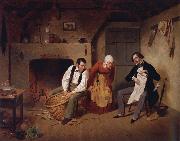
American, 1806-1863,American painter and banker. He achieved recognition both as a painter and as a banker, juggling careers with consummate skill. In 1826 he enrolled at the National Academy of Design while working in a New York bank. Somewhat insecure, he initially exhibited between 1836 and 1838 under the pseudonym E. F. Williams, but favourable reviews subsequently prompted him to use his own name. In 1840-41 Edmonds spent eight months in Europe, where he studied the Old Masters; he particularly admired the 17th-century Dutch painters Pieter de Hooch and Gabriel Metsu. |
 |
Forbes, Edwin
|
|
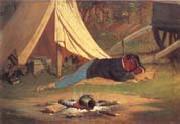
1839-1895 ,was an American landscape painter and etcher who first gained fame during the American Civil War for his detailed and dramatic sketches of military subjects, including battlefield combat scenes. Forbes was born in New York, studied under A. F. Tait, and began as an animal and landscape painter. During the Civil War, he was special artist for Frank Leslie Magazine. Many of the spirited etchings he drew during the conflict were later presented by General Sherman to the government. They are now preserved in the War Office at Washington because of their historic value. After the war, Forbes painted landscape and cattle scenes, among which are Orange County Pasture (1879) and Evening??Sheep Pasture (1881). In 1877 he was made an honorary member of the London Etching Club. He died in 1895 in Brooklyn and is buried in Green-Wood Cemetery. |
 |
Ferdinand Victor Eugene Delacroix
|
|
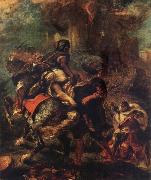
Charenton Saint Maurice 1798-Paris 1863,was a French Romantic artist regarded from the outset of his career as the leader of the French Romantic school. Delacroix's use of expressive brushstrokes and his study of the optical effects of colour profoundly shaped the work of the Impressionists, while his passion for the exotic inspired the artists of the Symbolist movement. A fine lithographer, Delacroix illustrated various works of William Shakespeare, the Scottish writer Sir Walter Scott, and the German writer Johann Wolfgang von Goethe. In contrast to the Neoclassical perfectionism of his chief rival Ingres, Delacroix took for his inspiration the art of Rubens and painters of the Venetian Renaissance, with an attendant emphasis on color and movement rather than clarity of outline and carefully modeled form. Dramatic and romantic content characterized the central themes of his maturity, and led him not to the classical models of Greek and Roman art, but to travel in North Africa, in search of the exotic.Friend and spiritual heir to Theodore Gericault, |
 |
Felix Esterl
|
|
(1894 -1931 ) - Painter
painted Still life with fruits, foliage plants and jug in |
 |
Eyre Crowe
|
|
Sir Eyre Alexander Barby Wichart Crowe GCB GCMG (30 July 1864 - 28 April 1925) was a British diplomat. Crowe was appointed Companion of the Order of the Bath (CB) in 1907, Knight Commander of the Order of St Michael and St George (KCMG) in 1911, Knight Commander of the Order of the Bath (KCB) in 1917, Knight Grand Cross of the Order of St Michael and St George (GCMG) in the 1920 New Year Honours,[1] and Knight Grand Cross of the Order of the Bath (GCB) in the 1923 Birthday Honours.
Eyre Crowe was born in Leipzig and educated at Desseldorf and Berlin and in France, with a German mother and a German wife. His father Joseph Archer Crowe had been a British consul-general and ended his career as commercial attache for all of Europe (1882-1896). His grandfather Eyre Evans Crowe was a journalist, writer and historian, and his uncle, Eyre Crowe, was an artist.
Crowe first visited England in 1882 when he was seventeen to cram for the Foreign Office examination and at the time was not fully fluent in English.[2] Even later in life it was reported that when angry he spoke English with a German accent. He married his widowed German cousin Clema Gerhardt in 1903. Crowe's wife's uncle was Henning von Holzendorff, who was to become the Chief of the German Naval Staff in the First World War. Due to being half-German, Crowe was often attacked in the press and by Christabel Pankhurst and William le Queux for this during the First World War.
|
 |
EYCK, Jan van
|
|
Flemish Northern Renaissance Painter, ca.1395-1441
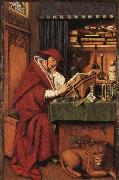
Painter and illuminator, brother of Hubert van Eyck. According to a 16th-century Ghent tradition, represented by van Vaernewijck and Lucas d'Heere, Jan trained with his brother Hubert. Pietro Summonte's assertion (1524) that he began work as an illuminator is supported by the fine technique and small scale of most of Jan's works, by manuscript precedents for certain of his motifs, and by his payment in 1439 for initials in a book (untraced) for Philip the Good, Duke of Burgundy. Jan is first documented in The Hague in August 1422 as an established artist with an assistant and the title of 'Master', working for John III, Count of Holland (John of Bavaria; reg 1419-25), who evidently discovered the artist while he was bishop (1389-1417) of the principality of Liege. |
 |
EYBL, Franz
|
|
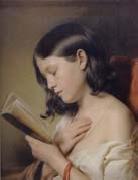
1805, Vienna - 1880, Vienna,Austrian painter and lithographer. He entered the Vienna Akademie at the age of ten, studying sculpture under Josef Klieber and landscape painting (1817-20) with Joseph Messmer (1780-1845), from whom he also learnt the new technique of lithography. He then spent three years with Johann Baptist Lampi (i) and Franz Caucig (1762-1828), drawing after antique statues and casts. He studied history painting (1823-8), during which period he came under the influence of Johann Peter Krafft, who introduced him to the principles of realism, suggesting that he work directly from nature and reflect contemporary, everyday subject-matter in his painting. Together with Josef Danhauser and Matthias Ranftl (1805-54), Eybl was among the most significant followers of Krafft's ideas, |
 |
Evert Oudendijck
|
|
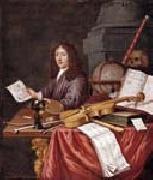
(1650, Haarlem - 1695, Haarlem), was a Dutch Golden Age painter.
According to Houbraken he painted stag hunts and other hunting scenes in landscapes, along with the artist "Drossaart". He was the father of Adriaen Oudendijck.
According to the RKD he was registered in the Haarlem Guild of St. Luke in 1663 as the pupil of Adriaen van Ostade which would make him about 15 years old at that time.His registration as a member of the guild in 1646 is therefore impossible.
Though Evert Oudendijk is listed in the Haarlem guild register as a member in 1646, he probably became a member in 1664 (a year suspiciously lacking member registrations), like other members mistakenly registered in 1646, such as Evert Collier and Egbert van Heemskerck. He is listed two other times in the Haarlem guild; in 1663 (listed as Ostade's pupil "Evert Adriaanszen van Oudendijck") and as painter in 1670.
|
 |
Evert Collier
|
|
(c. 1640 - few days before September 8, 1708) was a Dutch painter known for vanitas still-life and trompe l'oeil paintings. His first name is sometimes spelled "Edward" or "Edwaert" or "Eduwaert" or "Edwart," and his last name is sometimes spelled "Colyer" or "Kollier".
Evert Collier was born between 1630 and 1650 in Breda, Noord-Brabant, and died in 1708. He is believed to have trained in Haarlem, as his earliest paintings show the influence of Pieter Claesz and Vincent Laurensz van der Vinne. By 1667, he had moved to Leiden, where he became a member of the Guild of St. Luke in 1673. He moved to Amsterdam by 1686 and to London in 1693. He was buried September 8, 1708 at St. James's, Piccadilly. |
 |
Evelyn De Morgan
|
|
1855-1919
British
Evelyn De Morgan Galleries
She was born Evelyn Pickering. Her parents were of upper middle class. Her father was Percival Pickering QC, the Recorder of Pontefract. Her mother was Anna Maria Wilhelmina Spencer Stanhope, the sister of the artist John Roddam Spencer Stanhope and a descendant of Coke of Norfolk who was an Earl of Leicester.
Evelyn was homeschooled and started drawing lessons when she was 15. On the morning of her seventeenth birthday, Evelyn recorded in her diary, "Art is eternal, but life is short..." "I will make up for it now, I have not a moment to lose." She went on to persuade her parents to let her go to art school. At first they discouraged it, but in 1873 she was enrolled at the Slade School of Art. Her uncle, John Roddam Spencer Stanhope, was a great influence to her works. Evelyn often visited him in Florence where he lived. This also enabled her to study the great artists of the Renaissance; she was particularly fond of the works of Botticelli. This influenced her to move away from the classical subjects favoured by the Slade school and to make her own style.
In 1887, she married the ceramicist William De Morgan. They lived together in London until he died in 1917. She died two years later on 2 May 1919 in London and was buried in Brookwood Cemetery, near Woking, Surrey.
|
 |
Evaristo Baschenis
|
|
1617-1677
Italian
Evaristo Baschenis Galleries
Italian painter. He came from a family of painters originally from Averara, Lombardy, but with different branches active in the provinces of Bergamo and Trentino, mostly specializing in fresco decoration of churches. He probably started working within the same regional tradition but soon came to specialize in still-lifes and moved beyond his familys limited and provincial style to create a richer and more complex art. |
 |
Evariste Vital Luminais
|
|
(October 13, 1822 - 1896) was a French painter.
He was born in Nantes. He scored a success at the Paris Salon of 1884 with the painting Flight of King Gradlon. Another Luminais' important painting is The Sons of Clovis II.
|
 |
Evans, De Scott
|
|
American, 1847-1898
was an American artist who worked in Indiana, Ohio and New York. He was known for portraits, still lifes, landscapes and other genres. Born in Boston, Indiana to David S. and Nancy A. (Davenport) Evans. His father was a physician. Evans changed his signature to D. Scott Evans and later to De Scott Evans. He also signed paintings with the names David Scott, S. S. David, and Stanley S. David. He attended Miami University's preparatory school in the 1860s, studying with professor Adrian Beaugureau at Miami and later in Cincinnati. In 1873, he became head of the art department at Mount Union College and after several terms there, he moved to Cleveland to teach and to paint. From Cleveland, he moved to New York. He died along with 500 other passengers and crew, including his daughters when the French steamer La Bourgogne was rammed by a sailing ship in July 1898. |
 |
Eva Gonzales
|
|
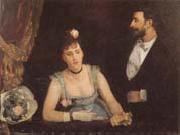
French Impressionist Painter, 1849-1883.was a French Impressionist painter. Like her teacher, Edouard Manet, she never exhibited with the Impressionist painters in their controversial exhibitions in Paris, but she is considered part of the group because of her painting style. She was Manets only formal student and modeled frequently for several members of the Impressionist school. She married Henri Guerard and used him and her sister Jeanne Gonzales as the subjects for many of her paintings. Her career was cut short when she died in childbirth at the age of thirty-four, exactly six days after the death of her teacher, Manet. The painting she is completing in Manets Portrait of Eva Gonzales demonstrates the mastery she had achieved at that age. However, it should be noted that this depiction of Gonzales is less than flattering in that her dress, her posture and technique are not actually not those of a professional to painting. The work that Gonzales is working on is in actuallity not her own, but actually one of Manets paintings |
|