|
 |
marie suzanne giroust roslin
|
|
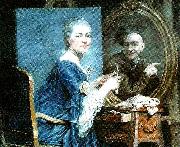
Marie-Suzanne Giroust, född 9 mars 1734 i Paris, Frankrike, död 31 augusti 1772 i Paris, var en fransk konstnär, i huvudsak verksam inom pastellmåleri. Hon var gift med den svenske porträttmålaren Alexander Roslin från 1759 till sin död.
Dotter till Barthelemy Giroust och Marie Suzanne Leroy. När Giroust var sju år gammal, dog hennes far som var juvelerare. Fyra år senare dog även hennes mor, och hon flyttade in hos släktingar. Arvet efter fadern gav henne möjlighet att uppta målarstudier. Hon inledde sina studier hos Maurice Quentin de La Tour, men det var hos Joseph-Marie Vien hon kom att finna sig tillrätta. I Viens atelj?? träffade hon 1752 Alexander Roslin och blev förälskad. Girousts förmyndare kunde dock inte acceptera den svenske målaren som blivande make, då han var fattig och protestant.[1] Paret kämpade för sin kärlek, och Giroust vägrade att träffa de friare som hennes förmyndare föreslog för henne.[1] Efter medling av bland andra Roslins vän och beskyddare, Comte de Caylus, kunde Roslin och Giroust gifta sig, den 5 januari 1759. Paret Roslin fick mellan 1760 och 1772 sex barn, tre döttrar och tre söner, varav två döttrar och två söner nådde vuxen ålder.
Alexander Roslin erkände offentligen sin hustrus talang som konstnär, och han hävdade att hon var en skickligare pastellmålare än han själv. Giroust invaldes 1770 i den franska konstakademin, Acad??mie royale. 1771 utställde hon sitt porträtt av abb?? Lemonnier, som fick mycket beröm. Hon måladet i pastell.
Marie-Suzanne Giroust avled i bröstcancer i slutet av augusti 1772. |
 |
Marguerite Gerard
|
|
Marguerite Gerard (28 January 1761 in Grasse - 18 May 1837 in Paris) was a French painter and etcher. She was the daughter of Marie Gilette and perfumer Claude Gerard. At 8 years-old she became the sister-in-law of Jean-Honore Fragonard, and when she was 14 she became his pupil, and she often worked with him. She was also the aunt of the artist Alexandre-Évariste Fragonard. |
 |
margareta capsia gavelin
|
|
Margareta Capsia, född 1682 i Sverige, död 20 juni 1759 i Åbo, var en svensk-finländsk konstnär, den första kvinnliga konstnären i Finland och en av de första i Skandinavien. Hon var kyrkomålare och målade altartavlor, men utförde även personporträtt.
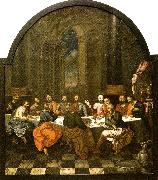
Capsias föräldrar Gottfried Capsia och Anna Schultz hade kommit till Sverige från Holland. Hon gifte sig i Stockholm 1719 med prästen Jacob Gavelin och flyttade till Vasa 1721, där hon gjorde sig känd som altarmålare i Österbotten. 1730 flyttade paret till Åbo, där hon blev känd i hela landet som konstnär. Hon målade altatavlorna i en rad kyrkor, bla målade hon 1739 Säkylä kyrkas altartavla, och i den gamla kyrkan i Paltamo, den så kallade bildkyrkan, finns bland annat en altartavla från 1727 som föreställer nattvarden. Hennes altartavlor beskrivs som individualistiska och naivt ärliga bibelillustrationer, och hon ansågs som landets då främsta altarkonstnärer tillsammans med Mikael Toppelius.
Hon var en av de få kvinnliga konstnärerna kända i Skandinavien före 1800-talet, tillsammans med Ulrika Pasch i Sverige och Johanne Marie Fosie i Danmark. I Finland var även Helena Arnell känd under samma tid. |
 |
Marc Charles Gabriel Gleyre
|
|
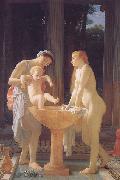
Charles Gleyre (full name Marc Gabriel Charles Gleyre) (Chevilly, Vaud canton, 2 May 1806 - 5 May 1874), was a Swiss artist. He took over the studio of Paul Delaroche in 1843 and taught a number of younger artists who became prominent, including Claude Monet, Pierre Auguste Renoir, Alfred Sisley and James Abbott McNeill Whistler.
Self portraitHis father and mother died when he was eight or nine years of age; and he was brought up by an uncle in Lyon, France, who sent him to the industrial school of that city.
Going to Paris in his late teens, he spent four years in intense artistic study. The following four years Gleyre spent in meditative inactivity in Italy, where he became acquainted with Horace Vernet and Louis Leopold Robert; and six years more were spent wandering in Greece, Egypt, Nubia and Syria. At Cairo he was attacked with ophthalmia, or inflammation of the eye, and in Lebanon he was struck down by fever. He returned to Lyons in shattered health.
On his recovery he proceeded to Paris, and, establishing a modest studio in the rue de Universite, began carefully to work out the ideas which had been slowly shaping themselves in his mind. Mention is made of two decorative panels Diana leaving the Bath, and a Young Nubian as almost the first fruits of his genius; but these did not attract public attention until much later, and the painting by which he practically opened his artistic career was the Apocalyptic Vision of St John, sent to the Salon of 1840.
This was followed in 1843 by Evening, which at the time received a medal of the second class, and afterwards became widely popular under the title Lost Illusions. It depicts a poet seated on the bank of a river, with his head drooping and a wearied posture, letting his lyre slip from a careless hand, and gazing sadly at a bright company of maidens whose song is slowly dying from his ear as their boat is borne slowly from his sight.
|
 |
Maksymilian Gierymski
|
|
Gierymski (Warsaw 1846 - Reichenhall, Bavaria 1874) was a Polish painter, specializing mainly in watercolours. He was the older brother of painter Aleksander Gierymski.
As a seventeen-years-old boy, he participated in the January Uprising. He was educated at the Warsaw Drawing School initially, but then received a government scholarship in 1867 and went to study at the Academy of Fine Arts in Munich. He became one of the leading painters of the Munich realistic school. Initially best known for this battle paintings, he also created many landscape paintings, especially of southern Poland, which he visited several times.
Successful western Europe completely, he did not gain approval nor popularity in Poland of the 19th century, although he sent paintings to exhibitions in Warsaw regularly from 1968 on. He did however win awards at exhibitions in Munich (1869) and in Berlin (1872).
|
 |
Ludwig Guttenbrunn
|
|
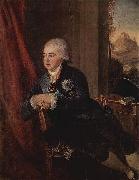
Ludwig Guttenbrunn (1750 - 1819) was an artist who worked in the latter part of the 18th century and early 19th century. He specialized in portraiture and history painting. |
 |
Ludwig Emil Grimm
|
|
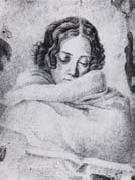
1790-1863,German draughtsman, engraver and painter. He was a brother of the philologists and fairy-tale collectors Jakob Grimm (1785-1863) and Wilhelm Grimm (1786-1859). He attended the Kunstakademie in Kassel from 1805 to 1807. He then moved to Munich to study with the engraver Carl Ernst Hess (1755-1828), and he became a student at the Akademie der Bildenden Kenste there. He revealed a talent for portraiture in numerous sketches of his family and friends. In 1814 he served with the Prussian army in the military campaign against France, then completed his studies in Munich. In 1816 he visited Italy, |
 |
Luca Giordano
|
|
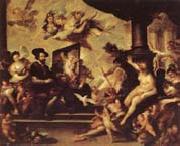
Italian Baroque Era Painter, ca.1634-1705
Italian painter and draughtsman, active also in Spain. He was one of the most celebrated artists of the Neapolitan Baroque, whose vast output included altarpieces, mythological paintings and many decorative fresco cycles in both palaces and churches. He moved away from the dark manner of early 17th-century Neapolitan art as practised by Caravaggio and his followers and Jusepe de Ribera, and, drawing on the ideas of many other artists, above all the 16th-century Venetians and Pietro da Cortona, he introduced a new sense of light and glowing colour, of movement and dramatic action. |
 |
Luca Giordano
|
|
1632-1705
Italian
Luca Giordano Gallery
Charles II of Spain towards 1687 invited him over to Madrid, where he remained for 10 years (1692-1702). In Spain, he produced works for the Royal Palace of Madrid, the Buen Retiro palace, El Escorial, Toledo, and other sites. Giordano was popular at the Spanish court, and the king granted him title as a "caballero". One anecdote of Giordano's speed at painting is that, he was once asked by the Queen of Spain what his wife looked like. On the spot, he painted his wife into the picture before him for the Queen.
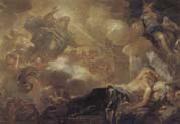
In Spain he executed numerous works, continuing in the Escorial the series commenced by Cambiasi, and painting frescoes of the Triumphs of the Church, the Genealogy and Life of the Madonna, the stories of Moses, Gideon, David and the Celebrated Women of Scripture, all works of large dimensions. His Dream of Solomon (1693, now at Prado) dates from this period. His pupils, Aniello Rossi and Matteo Pacelli, assisted him in Spain. In Madrid he worked more in oil-colour, a Nativity there being one of his best productions. |
 |
Louis Gauffier
|
|
1762-1801
French
Louis Gauffier Gallery
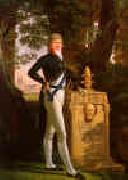
French painter. Following his move to Paris, where he became a pupil of Hugues Taraval and a student at the Academie Royale, in 1784 Gauffier shared the Prix de Rome with Jean-Germain Drouais and Antoine-Denis Chaudet (for sculpture), his own work being Christ and the Woman of Canaan (Paris, Ecole N. Sup. B.-A.). During his time in Rome (1785-9) Gauffier worked hard, but his health was poor and the results variable. On his return to Paris he was accepted (agree) by the Academie as a history painter. Soon after, he returned to Rome in order to escape the worsening situation in Revolutionary Paris, although he continued to send his Neo-classical works to the Salon. In March 1790 he married Pauline Chatillon (d July 1801), a portrait painter whom he and Drouais had taught.. |
 |
Libri, Girolamo dai
|
|
Italian Painter, ca.1474-1555
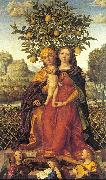
Illuminator and painter, son of Francesco dai Libri. He was evidently trained by his father, but he received commissions for altarpieces as well as manuscripts. Documents indicate that he lived in Verona all his life, but an early miniature of the Nativity, the only work by him in a series of choir-books almost certainly painted in Ferrara, suggests that he may have spent some time there. Vasari's record that he worked as an illuminator in the monastery of S Salvatore in Candiana (Padua) may be true, as some of Girolamo's surviving miniatures were executed for the abbey. The only record of Girolamo's views on his art occurs in a register of 1544: 'a good and worthy painter must know how to imitate nature well and to feign that which nature makes, and he must be universal in depicting landscapes |
 |
Leopold Graf Von Kalckreuth
|
|
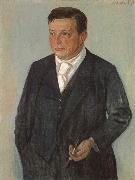
1855-1928,German painter and etcher. The son of the late Romantic landscape painter Eduard Stanislaus, Graf von Kalckreuth (1820-94), he studied from 1875 to 1878 under Ferdinand Schauss (1832-1916), Willem Linnig (1819-85) and Alexander Struys (1852-1941) at the Kunstschule in Weimar founded by his father. In 1879, after military service, he enrolled at the Akademie in Munich, where he attended Gyula Benczer's drawing classes and continued his study of painting under Karl Theodor von Piloty and Wilhelm von Diez (1839-1907). In 1883 he travelled to the Netherlands and then to Italy and France. In 1885 he accepted a teaching appointment at the Kunstschule in Weimar, but in 1890 he resigned and returned to Munich. During the next five years he worked at Heckricht in Silesia (now Jedrzychowice, Poland), perfecting his oil technique. In 1892 he was a founder-member of the Munich Secession. Kalckreuth's work from this period reflects the influence of several contemporaries; the portrait of the Artist's Wife of 1888 (Leipzig, Mus. Gesch.) recalls the portraits of Franz von Lenbach and Max Liebermann, while the visionary element brought to the genre scene Rainbow (1894-6; Munich, Neue Pin.) is close to the work of Fritz von Uhde. |
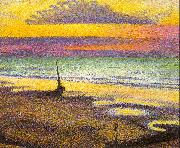 |
Lemmen, Georges
|
|
Belgian Art Nouveau Painter, 1865-1916
Belgian painter and decorative artist. He showed a precocious talent, first exhibiting in 1875. His only formal study was at a local school of drawing. Between 1884 and 1886 he showed at the Essor group in Brussels paintings that were based on Derer and Holbein and closely related to those of Lemmen's contemporary, Khnopff. When Lemmen became a member of Les XX in 1888 his style developed quickly, influenced principally by French Neo-Impressionism and the English Arts and Crafts Movement. Lemmen adopted the pointillist technique following Seurat's first showing with Les XX in 1887. His best pointillist canvases include The Carousel (1890-91; Toulon, Mme Thevenin-Lemmen priv. col., see Belgian Art, 1880-1914, exh. cat., New York, Brooklyn |
 |
LANFRANCO, Giovanni
|
|
Italian painter (b. 1582, Parma, d. 1647, Roma).
Italian painter and draughtsman. A major figure in the development of the Roman Baroque in the 1620s, he painted many altarpieces and some cabinet pictures, but was notable above all for a number of dome frescoes that are indebted to the works of Correggio; most celebrated is the Assumption of the Virgin (1625-7) in the dome of S Andrea della Valle, Rome. He also influenced the development of art in Naples, where, between 1634 and 1646, he executed a series of vast fresco commissions that look forward to the art of Luca Giordano and Francesco Solimena. A vast number of Lanfranco's preparatory drawings survive, the majority of which are now in the Museo e Gallerie Nazionali di Capodimonte, Naples. Broadly speaking they are of two types: small (up to 200*250 mm) compositional sketches, either in brown pen, with or without brown wash, on white or beige fine paper, or in red chalk, sometimes with red wash, or, more rarely, in black chalk or a combination of both red and black; and slightly larger
|
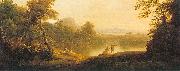 |
Lambert, George
|
|
English Painter, ca.1700-1765
English painter. He was a pupil of Warner Hassels ( fl 1680-1710), a portrait painter in Godfrey Kneller's circle, but Lambert's earliest dated painting, Classical Landscape with Two Figures (1723; priv. col.), already shows the influence of the landscape painter John Wootton. From 1726 he worked in London as a scene painter at Lincoln's Inn Fields Theatre; he followed the impresario John Rich to Covent Garden Theatre in 1732 and continued to work there until his death. In 1735 he was a founder-member of the prestigious Beef-Steak Club, an association of actors, men of letters and artists, among them William Hogarth and Rich. |
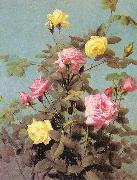 |
Lambdin, George Cochran
|
|
American Painter, 1830-1896
American painter. He was a son of the portrait and landscape painter James R. Lambdin (1807-89), who had founded a museum in Pittsburgh in 1828 and directed the Pennsylvania Academy of the Fine Arts in Philadelphia from 1845 to 1864. George Lambdin studied with his father and began exhibiting at the Pennsylvania Academy in 1848 and at the National Academy of Design, New York, in 1856. In the mid-1850s he travelled, probably to Munich, Paris and Rome. His early works were sentimental genre paintings, the best known of which are Our Sweetest Songs (1857; New York, N. Acad. Des.) and the Dead Wife (The Last Sleep) (exh. 1858; Raleigh, NC Mus. A.). The latter was shown at the Exposition Universelle in Paris in 1867 together with one of his depictions of a Civil War subject, Consecration, 1861 (1865; Indianapolis, IN, Mus. A.). In 1868-9 he was at the Tenth Street Studio Building, New York, where he continued to exhibit anecdotal genre, especially childhood subjects, as in The Pruner (1868; Boston, MA, Mus. F.A.). He was elected an Academician by the Pennsylvania Academy in 1863 and by the National Academy of Design in 1868. In Germantown, after a short trip abroad in 1870, Lambdin turned to floral studies, especially of roses from his own garden. Some of his floral still-life subjects were conventional table-top arrangements in glass or ceramic vases, but most were paintings of blooming plants and shrubs as they grow in nature or in garden pots, their foliage and blossoms silhouetted against blue sky or a neutral wall, as in Autumn Sunshine |
 |
LA TOUR, Georges de
|
|
French Baroque Era Painter, 1593-1652
French painter. He was well known in his lifetime, especially for his depictions of candlelit subjects, then was forgotten until the 20th century, when the identification of works previously misattributed established his reputation as a giant of French painting. His early works were painted in a realistic manner and influenced by the dramatic chiaroscuro of Caravaggio. The paintings of La Tour's maturity are marked by a startling geometric simplification of the human form and by the depiction of interior scenes lit only by the glare of candles or torches. His religious paintings done in this manner have a monumental simplicity and a stillness that expresses both contemplative quiet and wonder. Little is known of his life, and only four or five of his paintings are dated. |
 |
Klimt, Gustav
|
|
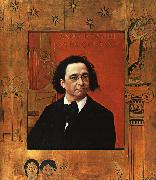
Austrian Art Nouveau Painter, 1862-1918
Artist Gustav Klimt, like composer Gustav Mahler, philosopher Ludwig Wittgenstein and big-time thinker Sigmund Freud, was a hotshot of Vienna's glory days as it ushered in the 20th century. Influenced by Impressionism, Symbolism and Art Nouveau, Klimt founded the Vienna Secession (1898), an avant-garde art movement that included a broad base of artisans and craftsmen as well as painters. Klimt himself was known more for elaborate graphic schemes than "painterly" work -- his most famous piece, The Kiss (1908), shows his distinctive gold-encrusted decorations over a semi-realistic portrait of an embracing couple. He used the framework of myth and allegory and he painted women, in ornate portraits and erotic exposures that were scandalous by Victorian-era standards. He also had time for more than painting -- after his death he was credited with as many as 14 illegitimate children. A big influence on the decorative arts in Austria, his most famous paintings include Salome |
 |
Kate Greenaway,RWS,RI
|
|
1846-1901
English painter, illustrator and writer. The daughter of a Fleet Street wood-engraver, John Greenaway (1818-90), she trained at Islington School of Art, Heatherleys Academy and the Slade School of Fine Art, all in London. In 1868 she did her first commercial work, producing Christmas and Valentine cards for Marcus Ward, Belfast. |
 |
Justus van Gent
|
|
(or Joos van Wassenhove), Justus or Jodocus of Ghent, or Giusto da Guanto (c. 1410 - c. 1480) was an Early Netherlandish painter who later worked in Italy.
The public records of the city of Ghent have been diligently searched, but in vain, for a clue to the history of Justus or Jodocus, whom Vasari and Guicciardini called Giusto da Guanto. Flemish annalists of the 16th century have enlarged upon the scanty, unsourced statements of Vasari, and described Jodocus as a pupil of Hubert van Eyck. The registers of the Guild of St Luke at Ghent comprise six masters of the name of Joos or Jodocus who practised at Ghent in the 15th century. But none of the works of these masters has been preserved, and it is impossible to compare their style with that of Giusto.
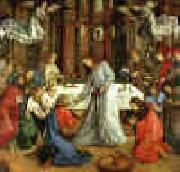
Federico da Montefeltro and His Son, GuidobaldoBetween 1465 and 1474, this artist executed the Communion of the Apostles which Vasari described, and which is now in the Galleria Nazionale delle Marche in Urbino. It was painted for the brotherhood of Corpus Christi at the bidding of Frederick of Montefeltro, who was introduced into the picture as the companion of Caterino Zeno, a Persian envoy at that time on a mission to the court of Urbino. From this curious production it may be seen that Giusto, far from being a pupil of the putative Hubert Van Eyck, must have been studied with a later master, possibly Dieric Bouts.
As a composer and draughtsman Giusto compares unfavourably with the better-known painters of Flanders; though his portraits are good, his ideal figures are not remarkable for subtlety of character and expression. Technically, he compares on a level with that of Geertgen tot Sint Jans, whose most famous pictures are preserved in the Kunsthistorisches Museum at Vienna. Vespasian, a Florentine bookseller who contributed much to form the antiquarian taste of Frederick of Montefeltro, states that this duke sent to the Netherlands for a capable artist to paint a series of ancient worthies for a library recently erected in the palace of Urbino. It has been conjectured that the author of these 28 portraits of "Famous Men," which are still in existence at the Louvre and in the Galleria Nazionale delle Marche at Urbino, was Justus van Gent.
Seven (?) Liberal Arts: a young man (Constanzo Sforza?) before Music (National Gallery, London). Another painting from this cycle, with Federigo da Montefeltro before Rhetoric was destroyed in Berlin in 1945Yet there are notable divergences between these pictures and the Communion of the Apostles. Still, it is possible that Giusto should have been able, after a certain time, to temper his Flemish style by studying the masterpieces of Santi and Melozzo, and so to acquire the mixed manner of the Flemings and Italians which these portraits of worthies display. Such an assimilation, if it really took place, might justify the Flemings in the indulgence of a certain pride, considering that Raphael not only admired these worthies, but copied them in the sketch-book which is now the ornament of the Venetian Academy. There is no ground for presuming that Giusto da Guanto is identical with Justus d'Allamagna who painted the Annunciation (1451) in the cloisters of Santa Maria di Castello at Genoa. The drawing and coloring of this wall painting shows that Justus d'Allamagna was as surely a native of south Germany as his homonym at Urbino was a born Netherlander.
|
 |
Julius Grun
|
|
Julius Gren (1823-1896)Aliases: Gustav Julius GrenProfessions: Porträtmaler; Genre Painter; Historical-scenes painter. |
 |
Juan Gris
|
|
1887-1927
Born in Madrid, he studied mechanical drawing at the Escuela de Artes y Manufacturas in Madrid from 1902 to 1904, during which time he contributed drawings to local periodicals. From 1904 to 1905 he studied painting with the academic artist Jose Maria Carbonero.
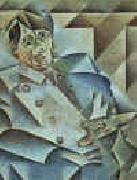
In 1906 he moved to Paris and became friends with Henri Matisse, Georges Braque, Fernand Leger, and in 1915 he was painted by his friend, Amedeo Modigliani. In Paris, Gris followed the lead of another friend and fellow countryman, Pablo Picasso. His portrait of Picasso in 1912 is a significant early Cubist painting done by a painter other than Picasso or Georges Braque. (Although he regarded Picasso as a teacher, Gertrude Stein acknowledged that Gris "was the one person that Picasso would have willingly wiped off the map.")
Portrait of Picasso, 1912, The Art Institute of Chicago.Although he submitted darkly humorous illustrations to journals such as Le Rire, L'assiette au beurre, Le Charivari, and Le Cri de Paris, Gris began to paint seriously in 1910. By 1912 he had developed a personal Cubist style.
At first Gris painted in the analytic style of Cubism, but after 1913 he began his conversion to synthetic Cubism, of which he became a steadfast interpreter, with extensive use of papier coll??. Unlike Picasso and Braque, whose Cubist works were monochromatic, Gris painted with bright harmonious colors in daring, novel combinations in the manner of his friend Matisse.
In 1924, he first designed ballet sets and costumes for Sergei Diaghilev and the famous Ballets Russes.
Gris articulated most of his aesthetic theories during 1924 and 1925. He delivered his definitive lecture, Des possibilit??s de la peinture, at the Sorbonne in 1924. Major Gris exhibitions took place at the Galerie Simon in Paris and the Galerie Flechtheim in Berlin in 1923, and at the Galerie Flechtheim in D??sseldorf in 1925.
He died in Boulogne-sur-Seine (Paris) in the spring of 1927 at the age of forty, leaving a wife, Josette, and a son, Georges. |
 |
joseph michael gandy
|
|
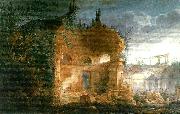
Joseph Michael Gandy (1771 - 1843) was an English artist, visionary architect and architectural theorist, most noted for his imaginative paintings depicting Sir John Soane's architectural designs. He worked extensively with Soane both as draughtsman and creative partner from 1798 until 1809 when he (ultimately unsuccessfully) set up his own practice.
Gandy built little in his career, having a reputation as a difficult individual to deal with. However his work included the Phoenix Fire and Pelican Life Insurance Offices (1804?C1805, destroyed ca. 1920) in London, Doric House at Sion Hill in Bath (1818), and the remodelling of Swerford Park house in Oxfordshire (1824?C1829). Commercially he was a failure and served two terms in a debtors' prison, but his published and exhibited work was largely a critical and popular success. In 1821 he published two articles in the Magazine of Fine Arts on The Philosophy of Architecture. He intended to expand upon this subject in an eight-volume work entitled Art, Philosophy and Science of Architecture, of which his unpublished manuscript survives.
His paintings show a dramatic use of two-point perspective and architectural precision, and also reflect his (and Soane's) fascination with Roman ruins. His architectural fantasies owe a clear debt to Piranesi and play upon historical, literary and mythological themes with a feeling for the sublime that is the equal of his contemporaries J. M. W. Turner and John Martin.
He died in a private asylum in Devon where he had been placed by his family in 1839. Many of his paintings can be seen in the Pictures Room of Sir John Soane's Museum in London. |
 |
Joos van Ghent
|
|
Netherlandish Northern Renaissance Painter, active ca.1460-1480 |
 |
John William Godward
|
|
English
1861-1922
Godward was a Victorian Neo-classicist, and therefore a follower in theory of Frederic Leighton. However, he is more closely allied stylistically to Sir Lawrence Alma-Tadema, with whom he shared a penchant for the rendering of Classical architecture, in particular, static landscape features constructed from marble.
The vast majority of Godward's extant images feature women in Classical dress, posed against these landscape features, though there are some semi-nude and fully nude figures included in his oeuvre (a notable example being In The Tepidarium (1913), a title shared with a controversial Alma-Tadema painting of the same subject that resides in the Lady Lever Art Gallery). The titles reflect Godward's source of inspiration: Classical civilisation, most notably that of Ancient Rome (again a subject binding Godward closely to Alma-Tadema artistically), though Ancient Greece sometimes features, thus providing artistic ties, albeit of a more limited extent, with Leighton.
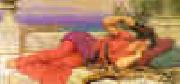
Given that Classical scholarship was more widespread among the potential audience for his paintings during his lifetime than in the present day, meticulous research of detail was important in order to attain a standing as an artist in this genre. Alma-Tadema was, as well as a painter, an archaeologist who attended historical sites and collected artefacts that were later used in his paintings: Godward, too, studied such details as architecture and dress, in order to ensure that his works bore the stamp of authenticity. In addition, Godward painstakingly and meticulously rendered those other important features in his paintings, animal skins (the paintings Noon Day Rest (1910) and A Cool Retreat (1910) contain superb examples of such rendition) and wild flowers (Nerissa (1906), illustrated above, and Summer Flowers (1903) are again excellent examples of this).
The appearance of beautiful women in studied poses in so many of Godward's canvases causes many newcomers to his works to categorise him mistakenly as being Pre-Raphaelite, particularly as his palette is often a vibrantly colourful one. However, the choice of subject matter (ancient civilisation versus, for example, Arthurian legend) is more properly that of the Victorian Neoclassicist: however, it is appropriate to comment that in common with numerous painters contemporary with him, Godward was a 'High Victorian Dreamer', producing beautiful images of a world which, it must be said, was idealised and romanticised, and which in the case of both Godward and Alma-Tadema came to be criticised as a world-view of 'Victorians in togas'. |
 |
John Greenwood
|
|
1737-1792
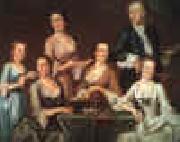
American artist, b. Boston, Mass. An engraver and painter, Greenwood executed some of the first genre paintings in America. He is also noted for his satirical works peopled with small, energetic figures reminiscent of Hogarth's. |
 |
John Greenhill
|
|
(c. 1644 -19 May 1676) was an English portrait painter, a pupil of Peter Lely, who approached his teacher in artistic excellence, but whose life was cut short by a dissolute lifestyle.
Greenhill was born at Salisbury, Somerset (now Wiltshire) around 1644, the eldest son of John Greenhill, registrar of the diocese of Salisbury, and Penelope Champneys, daughter of Richard Champneys of Orchardleigh, Somerset. His grandfather was Henry Greenhill of Steeple Ashton in Wiltshire. His father was connected through his brothers with the East India trade.
Greenhill's first attempt was a portrait of his paternal uncle, James Abbott of Salisbury, whom he is said to have sketched surreptitiously, as the old man would not sit for him. About 1662 he moved to London, and became a pupil of Sir Peter Lely. His progress was rapid, and he acquired some of Lely's skill and method. He carefully studied Vandyck's portraits, and George Vertue commented that he copied so closely Vandyck's portrait of "Thomas Killigrew and his dog" that it was difficult to know which was the original. Vertue also says that his progress excited Lely's jealousy.
Greenhill was at first industrious, and married early. But a taste for poetry and drama, and living in Covent Garden in the vicinity of the theatres, led him to associate with many members of the free-living theatrical world, and he fell into "irregular habits". On 19 May 1676, while returning from the "Vine Tavern" (in Holborn) in a state of intoxication, he fell into the gutter in Long Acre, and was carried to his lodgings in Lincoln's Inn Fields, where he died the same night. He was buried in St Giles in the Fields church. He left a widow and family, to whom Lely gave an annuity. |
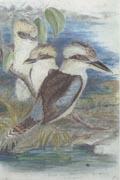 |
John Gould
|
|
1804 - 1881. (Born Sept. 14, 1804, Lyme Regis, Dorsetshire, England. Died Feb. 3, 1881, London)
was an English ornithologist. The Gould League in Australia was named after him. His identification of the birds now nicknamed "Darwin's finches" was pivotal in the inception of Darwin's theory of evolution by natural selection, though they are barely mentioned in Charles Darwin's book, On the Origin of Species.Gould was born in Lyme Regis, Dorset, the son of a gardener, and the boy probably had a scanty education. Shortly afterwards his father obtained a position on an estate near Guildford, Surrey, and then in 1818 became foreman in the Royal Gardens of Windsor. The young Gould started training as a gardener, being employed under his father at Windsor from 1818 to 1824, and he was subsequently a gardener at Ripley Castle in Yorkshire. He became an expert in the art of taxidermy and in 1824 he set himself up in business in London as a taxidermist, |
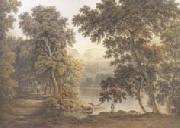 |
John glover
|
|
English-born Australian Painter, 1767-1849
English painter. He was employed first as a schoolteacher at Appleby (Cumbria) and after 1794 as a drawing-master at Lichfield (Staffs), from where he sent drawings to London each year; on his occasional visits to the capital he received lessons from William Payne and was clearly influenced by him. In the 1790s he also began to practise in oils, some of which were exhibited at the Royal Academy from 1795 onwards. At the first exhibition of the Society of Painters in Water-Colours (April-June 1805) Glover's pictures were priced more highly than those of any other exhibitor; he was elected President of the Society in 1807 and again in 1814-15. A typical watercolour is his Landscape with Waterfall (U. Manchester, Whitworth A.G.). |
 |
John Giles Eccardt
|
|
John Giles Eccardt (1720 - 1779) was a German-born British portrait painter. He came to England in the company of the French painter Jean-Baptiste van Loo for whom he worked as an assistant. When Van Loo departed the country, Eccardt remained and set up a portrait-painting business. In the following years he did portraits of a number of leading members of British society including twenty six of his chief patron Horace Walpole. He died in 1779. |
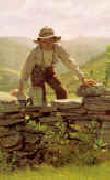 |
John George Brown
|
|
1831-1913
John George Brown Galleries
John George Brown (November 11, 1831 - February 8, 1913), American painter, was born in Durham, England, on 11 November 1831. He studied at Newcastle-on-Tyne, in the Edinburgh Academy, and after moving to New York City in 1853, he studied with Thomas Seir Cummings at the schools of the National Academy of Design, of which he became a member in 1863.New International Encyclopedia He was its vice-president, 1899-1904, and originated the idea of the removal of the Academy to a new site in 110th Street.
In 1866 he became one of the charter members of the Water-Color Society, of which he was president from 1887 to 1904. He generally confined himself to representations of street child life, bootblacks, newsboys, etc.; his Passing Show (Paris, Salon, 1877) and Street Boys at Play (Paris Exhibition, 1900) are good examples of his popular talent. Brown's art is best characterized as British genre paintings adapted to American subjects. Essentially literary, it is executed with precise detail, but is poor in color, and more popular with the general public than with connoisseurs. |
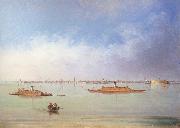 |
John Gadsby Chapman
|
|
American Painter, 1808-1889,was an American artist famous for The Baptism of Pocahontas, which was commissioned by the United States Congress and hangs in the United States Capitol rotunda. John Chapman was born in 1808 in Alexandria, Virginia. Chapman began his study of art in Philadelphia for two years, then departed for Europe where he eventually spent time in Italy. In 1831, Chapman returned to his hometown of Alexandria, and exhibited his artwork in the nearest metropolitan areas, such as Washington, D.C., Richmond, and Philadelphia. He specialized in landscapes and portraits. By 1834, Chapman had moved to New York City and become a member of the National Academy of Design, and found work as an illustrator. In New York, Chapman embarked on a series of historic paintings, such as Landing at Jamestown and the Crowning of Powhatan. The success of these paintings helped Chapman land a commission from the United States Congress in February 1837 to paint a historical scene for the rotunda of the Capitol building. For this work, Chapman received a total payment of $10,000. On November 30th, 1840, The Baptism of Pocahontas was formally unveiled in the Capitol rotunda. On the swell of this success, Chapman moved his family to Rome, and made an earnest living selling paintings of rural Campagna to American visitors. However, at the onset of the American Civil War, the tourist industry dried up, affecting Chapman fortunes greatly. In addition, Chapman own son, Conrad Chapman, returned to America to fight on the side of the Confederate States of America. The economic deprivation inflicted on Chapman during the 1860s became insurmountable. In Rome, he was forced to live off the kindness of fellow expatriates, and finally returned to America, sick and poor, to spend his last days with another son, John Linton Chapman, in Brooklyn, New York. It was there, in 1889, that he died a pauper. |
 |
John Atkinson Grimshaw
|
|
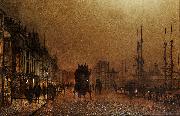
(6 September 1836 - 13 October 1893) was a Victorian-era artist, a "remarkable and imaginative painter" known for his city night-scenes and landscapes.
His early paintings were signed "JAG," "J. A. Grimshaw," or "John Atkinson Grimshaw," though he finally settled on "Atkinson Grimshaw."
John Atkinson Grimshaw was born 6 September 1836 in Leeds. In 1856 he married his cousin Frances Hubbard (1835-1917). In 1861, at the age of 24, to the dismay of his parents, he left his job as a clerk for the Great Northern Railway to become a painter. He first exhibited in 1862, mostly paintings of birds, fruit and blossom, under the patronage of the Leeds Philosophical and Literary Society. He became successful in the 1870s and rented a second home in Scarborough, which became a favourite subject.
Several of his children, Arthur Grimshaw (1864-1913), Louis H Grimshaw (1870-1944), Wilfred Grimshaw (1871-1937) and Elaine Grimshaw (1877-1970) became painters.
|
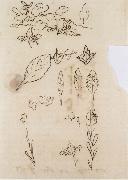 |
Johann Wolfgang von Goethe
|
|
Frankfurt 1749-1832 Weimar,was a German writer and according to George Eliot, "Germany's greatest man of letters and the last true polymath to walk the earth." Goethe's works span the fields of poetry, drama, literature, theology, humanism and science. Goethe's magnum opus, lauded as one of the peaks of world literature, is the two-part drama Faust. Goethe's other well-known literary works include his numerous poems, the Bildungsroman Wilhelm Meister's Apprenticeship and the epistolary novel The Sorrows of Young Werther. Goethe was one of the key figures of German literature and the movement of Weimar Classicism in the late 18th and early 19th centuries; this movement coincides with Enlightenment, Sentimentality (Empfindsamkeit), Sturm und Drang and Romanticism. The author of the scientific text Theory of Colours, he influenced Darwin with his focus on plant morphology. He also served at length as the Privy Councilor ("Geheimrat") of the duchy of Weimar. Goethe is the originator of the concept of Weltliteratur ("world literature"), having taken great interest in the literatures of England, France, Italy, classical Greece, Persia, Arabic literature, amongst others. His influence on German philosophy is virtually immeasurable, having major effect especially on the generation of Hegel and Schelling, although Goethe himself expressly and decidedly refrained from practicing philosophy in the rarefied sense. Goethe's influence spread across Europe, and for the next century his works were a major source of inspiration in music, drama, poetry and philosophy. Goethe is considered by many to be the most important writer in the German language and one of the most important thinkers in Western culture as well. |
|