|
 |
Hugo van der Goes
|
|
1440-1482
Flemish
Hugo van der Goes Galleries
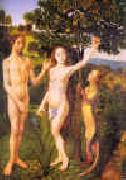
Hugo became a member of the painters' guild of Ghent as a master in 1467. In 1468 he was involved in the decoration of the town of Bruges in celebration of the marriage between Charles the Bold and Margaret of York and he provided heraldic decorations for Charles's joyeuse entr??e to Ghent in 1469 and again in 1472. He was elected dean of the Ghent guild in 1473 or 1474.
In 1475, or some years later, Hugo entered Rooklooster, a monastery near Brussels belonging to the Windesheim Congregation, and professed there as a frater conversus. He continued to paint, and remained at Rooklooster until his death in 1482 or 1483. In 1480 he was called to the town of Leuven to evaluate the Justice Scenes left unfinished by the painter Dieric Bouts on his death in 1475. Shortly after this, Hugo, returning with other members of his monastery from a trip to Cologne, fell into a state of suicidal gloom, declaring himself to be damned. After returning to Rooklooster, Hugo recovered from his illness, and died there. His time at Rooklooster is recorded in the chronicle of his fellow monk, Gaspar Ofhuys. A report by a German physician, Hieronymus M??nzer, from 1495, according to which a painter from Ghent was driven to melancholy by the attempt to equal the Ghent Altarpiece, may refer to Hugo.
His most famous surviving work is the Portinari Triptych (Uffizi, Florence), an altarpiece commissioned for the church of San Egidio in the hospital of Santa Maria Nuova in Florence by Tommaso Portinari, the manager of the Bruges branch of the Medici Bank. The triptych arrived in Florence in 1483, apparently some years after its completion by van der Goes. The largest Netherlandish work that could be seen in Florence, it was greatly praised. Giorgio Vasari in his Vite of 1550 referred to it as by "Ugo d'Anversa" ("Hugo of Antwerp"). This the sole documentation for its authorship by Hugo; other works are attributed to him based on stylistic comparison with the altarpiece.
Hugo appears to have left a large number of drawings, and either from these or the paintings themselves followers made large numbers of copies of compositions that have not survived from his own hand. A drawing of Jacob and Rachel preserved at Christ Church, Oxford is thought to be a rare surviving autograph drawing. |
 |
HORENBOUT, Gerard
|
|
Flemish Northern Renaissance Painter and Manuscript Illuminator, ca.1465-1541
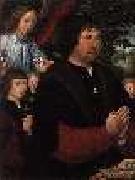
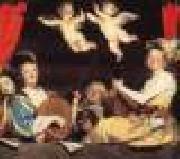
Painter, designer, scribe and cartographer. He may have been the pupil of Li?vin de Stoevere ( fl 1463), the only painter of the five artists who guaranteed his admission fee into the guild of painters and illuminators in Ghent in 1487. Horenbout became a versatile and productive artist, painting altarpieces, portraits and illuminated manuscripts and designing tapestries and stained-glass windows. He also collaborated with the nuns of the convent of Galilee near Ghent in making a model garden with flowers made of cloth that he delivered to Margaret of Austria, Regent of the Netherlands, at her court in Mechelen. He seems to have achieved a degree of wealth commensurate with his output: in 1503 he acquired a house |
 |
HONTHORST, Gerrit van
|
|
Dutch Baroque Era Painter, ca.1590-1656
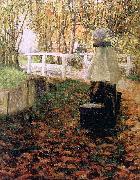
Dutch portrait, genre, and allegorical painter. In Italy (c.1610?C1620) he gained a sound understanding of the works of Caravaggio, which greatly affected his style. He was a master at painting candlelit genre pieces and biblical scenes. Upon his return to Holland, he introduced the Italian manner of illusionistic decoration into Dutch interiors, as in his decorative scheme for the palace of Honselaarsdijk. In 1628, Charles I invited him to England, where he decorated Whitehall and painted portraits of the king and nobility. Several of these are now in the National Gallery, London. He also worked for the court of Denmark, and from 1637 to 1652 at The Hague. Together with Terbrugghen and Baburen he led the influential Utrecht school of painting that introduced Caravaggesque dramatic realism into Dutch art. |
 |
Hitchcock, George
|
|
American Painter, 1850-1913
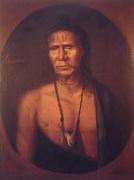
American painter, active in the Netherlands. A descendant of Roger Williams (the founder of Rhode Island), he practised law for several years in New York before deciding in 1879 to become an artist. He studied in Paris with Gustave Boulanger and Jules Lefebvre, in D?sseldorf, and in The Hague with H. W. Mesdag. He settled in Egmond-aan-Zee, near Alkmaar, in 1883, and was soon widely known for his paintings of religious subjects in contemporary settings and of sunlit views of tulip fields. He returned to the USA only occasionally in later years. Hitchcock's style, similar to Impressionism, has been appreciated more in Europe than in the USA. A good example of his style is the Blessed Mother (1892; Cleveland, OH, Mus. A.). He received some recognition in the USA, such as election to associate membership in the National Academy of Design, New York, |
 |
Hesselius Gustavus
|
|
American portrait painter.
1682-1755
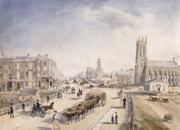
He was trained in Sweden as a wood-engraver, gilder and painter. In 1712 he accompanied his brother, a Lutheran pastor, to America, where he settled in Philadelphia, PA. About 1720 he moved to the Annapolis, MD, area, returning before 1730 to Philadelphia, where he lived until his death. He was one of the first European-trained painters to settle permanently in America and introduced a greater technical skill and increased realism into Colonial painting. His painterly, atmospheric style, which derived from European Baroque, contrasted with the more linear technique of American-born painters. During most of his career he was the leading painter of the Middle Colonies. In addition to mythological scenes, altarpieces and portraits of prominent individuals, Hesselius undertook utilitarian work that included painting the country seat at Springettsbury of Thomas Penn (1702-75) and the interior of the Pennsylvania State House, as well as flower-boxes, |
 |
Henry Gritten
|
|
Australian Landscape artist
1818-1873
was an English/Australian artist. Gritten was the son of a London picture dealer, was born probably in 1817. He studied art and was on friendly terms with David Roberts and other leading artists of the period. He began exhibiting at the Royal Academy in 1835, and during the next 10 years 12 of his pictures were hung at its exhibitions. He was a more frequent exhibitor at the British Institution, and had 30 of his pictures hung there between 1836 and 1848. In the latter year he went to the United States and in about 1852 arrived in Australia. He went first to the Bendigo goldfields, but soon resumed painting in Victoria and Tasmania; there is a View of Hobart in 1857 by him at the National Library of Australia at Canberra. He was represented at the first exhibition of the Victorian Academy of Art held at Melbourne in 1870. He died suddenly at Melbourne leaving a widow and four children in poor circumstances. Gritten was quite a capable painter of his period who had a hard struggle in Australia. |
 |
Henry de Groux
|
|
Belgian
1867-1930
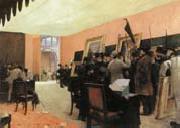
Henry de Groux (1866 in Brussels - 1930 in Marseilles) was a Belgian Symbolist painter, sculptor and lithographer. His 1889 painting Christ aux Outrages, widely described as his masterwork, depicted Jesus being attacked by a mob. Later in life, he produced many works depicting the horrors of the First World War.
Ride of the Valkyries (ca. 1890)
Royal Museums of Fine Arts, Brussels, BelgiumDe Groux was a member of les XX, but was expelled when he refused to have his works displayed in the same gallery as Vincent van Gogh. He subsequently moved to Paris, where he befriended Emile Zola; during the social unrest resulting from the Dreyfus affair, de Groux acted as one of Zola's bodyguards.
As well, de Groux was a fervent diarist; beginning in 1892, he produced 18 volumes detailing the life of a European artist in the late 19th and early 20th centuries. In 2002, his descendants donated these volumes to the Institut national d'histoire de l'art; selected excerpts were published in 2007 Henry de Groux 1866-1930 - journal - Henry De Groux, Rodolphe Rapetti, Pierre Wat - Editions Kime. |
 |
Henri Gervex
|
|
French Academic Painter, 1852-1929.French painter. His artistic education began with the Prix de Rome winner Pierre Brisset (1810-90). He then studied under Alexandre Cabanel at the Ecole des Beaux-Arts in Paris, where his fellow pupils included Henri Regnault, Bastien-Lepage, Forain, Humbert (1842-1934) and Cormon; and also informally with Fromentin. Gervexs first Salon picture was a Sleeping Bather (untraced) in 1873: the nude, both in modern and mythological settings, was to remain one of his central artistic preoccupations. In 1876 he painted Autopsy in the H?tel-Dieu (ex-Limoges; untraced), the sort of medical group portrait he repeated in 1887 with his Dr Pean Demonstrating at the Saint-Louis Hospital his Discovery of the Hemostatic Clamp (Paris, Mus. Assist. Pub.), which celebrated the progress of medical science with a sober, quasi-photographic realism. Gervexs most controversial picture was Rolla (1878; Bordeaux, Mus. B.-A.), refused by the Salon of 1878 on grounds of indecency, partly because of the cast-off corset Degas had insisted he include. The painting shows the central character in a de Musset poem, Jacques Rolla, who, having dissipated his family inheritance, casts a final glance at the lovely sleeping form of the prostitute Marion before hurling himself out of the window. As his friend, Manet, had done the year before with his rejected Nana (1877; Hamburg, Ksthalle), Gervex exhibited his work in a commercial gallery, with great success. |
 |
Henri Gascar
|
|
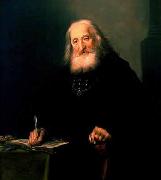
Henri Gascar, Portrait of Barbara Palmer, 1st Duchess of Cleveland
James II of England, then Duke of York (1660s)Henri Gascar (1635 -1 Jan 1701) was a French-born portrait painter who achieved artistic success in England during the reign of Charles II. He painted many leading ladies at court, including several of the King's mistresses.
Gascar was born in Paris, the son of Pierre Gascar, a minor painter and sculptor. Gascar came to England about 1674, probably at the behest of Louise de Keroualle, Duchess of Portsmouth, Charles II's favourite mistress. Gascar (or Gascard, as he seems to have spelt his name at first) was already known as a skillful portrait-painter; among the portraits already painted by him was that of Nicolas de Lafond, author of the "Gazette of Holland", painted in 1667, and engraved by Peter Lombart.
The patronage of the Duchess of Portsmouth insured Gascar a rapid success in England. His flamboyant style, contrasting with the stolid English approach, seemed to suit the frivolity of the time and he painted many of the ladies of Charles II's court. His lack of attention to detail in the likeness he made up for by the sumptuous draperies and tawdry adornments around the subject. For a short time he became fashionable, and is said to have amassed a fortune of over £10,000.
Among the portraits painted by him during his time in England were Charles II (engraved by Peter Vanderbank); Louise, Duchess of Portsmouth (twice - once engraved by Étienne Baudet); Barbara, Duchess of Cleveland (nee Villiers), and her daughter, Barbara Fitzroy; Charles Lennox, 1st Duke of Richmond; Frances Stewart, Duchess of Richmond; George FitzRoy, 1st Duke of Northumberland; Nell Gwyn; Sophia Bulkeley (engraved by Robert Dunkarton); Edmund Verney; and Philip Herbert, 7th Earl of Pembroke. It is stated that the last-named portrait was done surreptitiously for Louise, Duchess of Portsmouth. A portrait by Gascar of James II as Duke of York was in that king's collection. |
 |
Hendrik Gerritsz. Pot
|
|
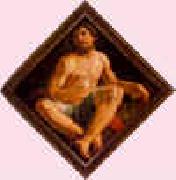
(c. 1580 - 15 October 1657 (buried)) was a Dutch painter. He lived and painted in Haarlem, where he was an officer of the militia, or schutterij. Dutch artist Frans Hals painted Pot in militia sash in Hals' The Banquet of the Officers of the St George Militia Company (c. 1639). Pot is the man reading a book on the far right.
Pot was born in Amsterdam and spent his early years in Amsterdam and Haarlem. In 1632 he traveled to London, where he painted the Royal Family. He lived from 1633 to 1648 in Haarlem, after which he moved to Amsterdam, where he died in 1657.. He served as Dean of the Haarlem Guild of St. Luke in 1626, 1630 and 1635. He served as the Guild's headman or Hoofdman in 1634 and 1648. He died in Amsterdam. |
 |
Hendrick Goltzius
|
|
1558-1617 Dutch
Hendrik Goltzius (1558 - January 1, 1617), Dutch printmaker, draftsman, and painter, was born at Millebrecht, in the duchy of Julich. He was the leading Dutch engraver of the early Baroque period, noted for his sophisticated technique.
After studying painting on glass for some years under his father, he was taught the use of the burin by Dirk Volkertszoon Coornhert, a Dutch engraver of mediocre attainment, whom he soon surpassed, but who retained his services for his own advantage. He was also employed by Philip Galle to engrave a set of prints of the history of Lucretia.
At the age of 21 he married a widow somewhat advanced in years, whose money enabled him to establish at Haarlem an independent business; but his unpleasant relations with her so affected his health that he found it advisable in 1590 to make a tour through Germany to Italy, where he acquired an intense admiration for the works of Michelangelo, which led him to emulate that master in the grotesqueness and extravagance of his designs. He returned to Haarlem considerably improved in health, and laboured there at his art till his death.
Goltzius' painting Lot and his daughters (Rijksmuseum Amsterdam) shows Lot being seduced by his two daughters. Sodom and Gomorrah are shown burning in the background, with Lot's wife who had turned into a pillar of salt, in front.Goltzius ought not to be judged chiefly by the works he valued most, his eccentric imitations of Michelangelo. His portraits, though mostly miniatures, are masterpieces of their kind, both on account of their exquisite finish, and as fine studies of individual character. Of his larger heads, the life-size portrait of himself is probably the most striking example. His masterpieces, so called from their being attempts to imitate the style of the old masters, have perhaps been overpraised.
Goltzius brought to an unprecedented level the use of the "swelling line", where the burin is manipulated to make lines thicker or thinner to create a tonal effect from a distance. He also was a pioneer of "dot and lozenge" technique, where dots are placed in the middle of lozenge shaped spaces created by cross-hatching to further refine tonal shading.
A self portraitHollstein credits 388 prints to him, with a further 574 by other printmakers after his designs.
In his command of the burin Goltzius is said to rival that of Durer's; but his technical skill is not equally aided by higher artistic qualities. Even, however, his eccentricities and extravagances are greatly counterbalanced by the beauty and freedom of his execution. He made engravings of Bartholomeus Spranger's paintings, thus increasing the fame of the latter - and his own. Goltzius began painting at the age of forty-two; some of his paintings can be found in the imperial collection at Vienna. He also executed a few chiaroscuro woodcuts. He was the stepfather of engraver Jacob Matham. |
 |
Harold Gilman
|
|
(11 February 1876 - 12 February 1919) was a painter of interiors, portraits and landscapes, and a founder-member of the Camden Town Group.
Though born in Rode, Somerset, Gilman spent his early years at Snargate Rectory, in the Romney Marshes in Kent, where his father was the Rector. He was educated in Kent at Abingdon, Rochester and Tonbridge schools, and for one year at Brasenose College in Oxford University.
Although he developed an interest in art during a childhood convalescence period, Gilman did not begin his artistic training until after his non-collegiate year at Oxford University (cut short by ill health) and after working in the Ukraine as a tutor to a British family in Odessa (1895). In 1896 he entered the Hastings School of Art to study painting, but in 1897 transferred to the Slade School of Fine Art in London, where he remained from 1897 to 1901, and where he met Spencer Gore. In 1904 he went to Spain and spent over a year studying Spanish masters (Velezquez and Goya as well as Whistler were major early influences).
At this time he met and married the American painter Grace Cornelia Canedy. The couple settled in London (apart from a visit to her family in Chicago, when Gilman ducked pressure to join the Canedy family business). They had two daughters (one in London, one in Chicago).
|
 |
Harold Gilman
|
|
British
1878-1919
Harold Gilman Gallery
Developing an interest in art during a childhood convalescence period, he began his artistic training after a non-collegiate year at Oxford University (again cut short by ill health) and time working as a tutor to an English family living in Odessa. Studying at the Hastings School of Art (1896) and then the Slade School of Fine Art (1897?C1901), he then spent over a year studying the Spanish masters (Velazquez as well as Whistler were major early influences) and meeting and marrying the American painter Grace Cornelia Canedy. Moving back to London, where they settled (apart from an abortive trip to visit her family in Chicago, in which Gilman ducked pressure to join the Canedy family business), they had two daughters (one in London, one in Chicago).
Meeting Walter Sickert in 1907, Gilman became a founder member of both the Fitzroy Street Group (in 1907) and the Camden Town Group (in 1911). In the meantime he joined the Allied Artists' Association, moved to Letchworth, and began to show influence from work of Vuillard as well as Sickert. He soon outpaced Sickert's understanding of post-Impressionism and moved out from under his shadow, however, using ever stronger colour and identifying with Charles Ginner as a 'Neo-Realist' (exhibiting with Ginner under that label in 1914).
Canal Bridge, Flekkefjord, c. 1913Gilman visited Scandinavia in 1912 and 1913, and may have travelled with the artist William Ratcliffe, who had relations there. Gilman made studies of the environment, and painted Canal Bridge, Flekkefjord, an accurate depiction, whose subject is likely to have been inspired by Vincent van Gogh's depiction of a similar bridge in Provence. Gilman had rejected Van Gogh's work when he first encountered it, but later became a strong admirer and, according to Wyndham Lewis, keeping postcards of Van Gogh's work on his wall and sometimes hanging one of his own works next to them, if he was especially satisfied with it.
At that time he also joined Robert Bevan's short-lived Cumberland Market Group with Ginner and John Nash. Remarrying in 1917, in 1918 he was commissioned to travel to Nova Scotia by the Canadian War Records. |
 |
Hans Gude
|
|
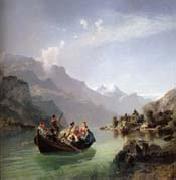
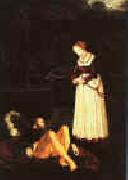
March 13, 1825 ?C August 17, 1903,Norwegian painter. He was the most renowned Norwegian landscape painter of his time. At the age of 12 he was enrolled as a pupil of Johannes Flintoe (1787-1880). After attending evening classes at the Kongelige Tegneskole in Christiania, he went to D?sseldorf in 1841 to study privately with the landscape painter Andreas Achenbach (1815-1910). In 1842 Gude was admitted to the landscape class at the Akademie under Johann Wilhelm Schirmer. He was later appointed an assistant teacher at Schirmer private studio, and he succeeded his master as Professor of landscape painting both at the D?sseldorf Akademie (1854-62) and at the Karlsruhe Akademie (1864-80). In the 1840s Gude established his reputation in Norway and on the Continent with powerful images of the Norwegian mountains. These were shown in the Kunstforening galleries in D?sseldorf and Christiania and at the Berliner Akademische Kunstausstellung, where Gude exhibited throughout his life. Adolph Tidemand and Gude dominated the colony of Norwegian artists who studied in D?sseldorf in the mid-19th century. The two artists worked together on five paintings, all representing people in boats; Gude painted the landscape, Tidemand the figures. The Bridal Procession at Hardanger (1848; Oslo, N.G.) celebrates a ceremony of country life and is the most famous work of Norwegian National Romanticism. In a sunny western Norwegian landscape with snow on the high mountains, the bridal couple and wedding guests in national costume are shown rowing across the water from a medieval stave church on the headland in the background. Gude revealed greater maturity in High Mountain (1857; Oslo, N.G.). The disposition of mountains massed on the high plateau around a little lake produces an effect of monumentality. The predominant colours shade from grey to blue, concentrated in the cloud cover. The influence of Schirmer tranquil landscapes is apparent, while the rhythmic arrangement of light and shadow is reminiscent of Achenbach. |
 |
Hans Baldung Grien
|
|
German
1485-1545
Hans Baldung Grien Galleries
The earliest pictures assigned to him by some are altar-pieces with the monogram H. B. interlaced, and the date of 1496, in the monastery chapel of Lichtenthal near Baden-Baden. Another early work is a portrait of the emperor Maximilian, drawn in 1501 on a leaf of a sketch-book now in the print-room at Karlsruhe. "The Martyrdom of St Sebastian and the Epiphany" (Berlin Museum), fruits of his labour in 1507, were painted for the market-church of Halle in Saxony.
Baldung's prints, though D??reresque, are very individual in style, and often in subject. They show little direct Italian influence. His paintings are less important than his prints. He worked mainly in woodcut, although he made six engravings, one very fine. He joined in the fashion for chiaroscuro woodcuts, adding a tone block to a woodcut of 1510.[1] Most of his hundreds of woodcuts were commissioned for books, as was usual at the time; his "single-leaf" woodcuts (ie prints not for book illustration) are fewer than 100, though no two catalogues agree as to the exact number.
He was extremely interested in witches and made many images of them in different media, including several very beautiful drawings finished with bodycolour, which are more erotic than his treatments in other techniques.
Witch and Dragon. Drawing with bodycolour (b/w repro)Without absolute correctness as a draughtsman, his conception of human form is often very unpleasant, whilst a questionable taste is shown in ornament equally profuse and baroque. Nothing is more remarkable in his pictures than the pug-like shape of the faces, unless we except the coarseness of the extremities. No trace is apparent of any feeling for atmosphere or light and shade. Though Gr??n has been commonly called the Correggio of the north, his compositions are a curious medley of glaring and heterogeneous colours, in which pure black is contrasted with pale yellow, dirty grey, impure red and glowing green. Flesh is a mere glaze under which the features are indicated by lines. (1911)
His works are mainly interesting because of the wild and fantastic strength which some of them display. His Eve, the Serpent and Death (National Museum of Canada) shows his strengths well. We may pass lightly over the "Epiphany" of 1507, the "Crucifixion" of 1512, or the "Stoning of Stephen" of 1522, in the Berlin Museum. There is some force in the "Dance of Death" of 1517, in the museum of Basel, or the Madonna of 1530, in the Liechtenstein Gallery at Vienna. Gr??n's best effort is the altarpiece of Freiburg, where the Coronation of the Virgin, and the Twelve Apostles, the Annunciation, Visitation, Nativity and Flight into Egypt, and the Crucifixion, with portraits of donors, are executed with some of that fanciful power which Martin Schongauer bequeathed to the Swabian school.
As a portrait painter he is well known. He drew the likeness of Charles V, as well as that of Maximilian; and his bust of Margrave Philip in the Munich Gallery tells us that he was connected with the reigning family of Baden, as early as 1514. At a later period he had sittings from Margrave Christopher of Baden, Ottilia his wife, and all their children, and the picture containing these portraits is still in the grand-ducal gallery at Karlsruhe. Like D??rer and Cranach, Gr??n became a hearty supporter of the Reformation. He was present at the diet of Augsburg in 1518, and one of his woodcuts represents Luther under the protection of the Holy Ghost, which hovers over him in the shape of a dove. |
 |
Gyula Benczur
|
|
Gyula Benczur (1844 - 1920) was a Hungarian painter and pedagogue. He won international success with his first few paintings, winning several competitions. He assisted Karl von Piloty with the frescoes of Maximilianeum and Rathaus in Munich. He also illustrated books by the great German writer, Friedrich Schiller. He was commissioned by the Bavarian king Ludwig II to paint Rococo themes. Later he was offered numerous international teaching positions, including offers in Prague and Weimar, but accepted a position in Munich, one of his most distinguished pupils being the Swiss-born American painter Adolfo Meller-Ury. Benczur was later a favorite among the Hungarian upper-class, painting numerous portraits of kings and aristocrats. He was considered a rival in historical painting to Makart. During his lifetime, Benczur won numerous awards. His self-portrait is on display at the Uffizi Gallery in Florence. |
 |
Guy Rose
|
|
1867-1925
Guy Rose Galleries
Guy Rose (3 March 1867?C17 November 1925) was an American Impressionist painter who is recognized as one of California's top impressionist painters of the late 19th and early 20th centuries.
Guy Orlando Rose was born March 3, 1867 in San Gabriel, California. He was the seventh child of Leonard John Rose and Amanda Jones Rose.
His father was a prominent California senator. He and his wife raised their large family on an expansive Southern California ranch and vineyard?? the San Gabriel Valley town of Rosemead bears the family name. In 1876 young Guy Rose was accidentally shot in the face during a hunting trip with his brothers. While recuperating he began to sketch and use watercolors and oil paints. He graduated from Los Angeles High School in 1884 and moved to San Francisco where he did his art training at the California School of Design.
In September 12, 1888, Rose enrolled at the Academie Julian in Paris and studied with Benjamin-Constant, Jules Lefebvre, Lucien Doucet and Jean-Paul Laurens while in Paris. In 1888-89, he won a scholarship at the Academie Delacluse. He met fellow students Frank Vincent and Frederick Melville at the Academie Julian -- Frank Vincent and Guy Rose were to remain lifelong friends.
Rose lived New York, New York in the 1890s and illustrated for "Harper's," "Scribners," and "Century". Choosing to return to France in 1899, he and his wife Ethel Rose bought a cottage at Giverny. In 1900 he resided in Paris and spent the winter in Briska, Algeria where he painted three known paintings. From 1904 to 1912 husband and wife lived in Giverny and his works from this period show the influence of "the master" Claude Monet, who became his friend and mentor.
In 1913-1914 the Roses summered in and held an outdoor sketching school at Narragansett, Rhode Island. Suffering on and off again from the effects of lead poisoning, Rose and his wife moved permanently to Los Angeles, California in 1914.
In Los Angeles, Guy Rose taught and served as Director of the Stickney Memorial School of Art in Pasadena. In 1921 he suffered a debilitating stroke that left him paralyzed. Guy Rose died in Pasadena, California on November 17, 1925. In 1926 the Stendahl Gallery held a memorial exhibition of his works. |
 |
Gustavus Hesselius
|
|
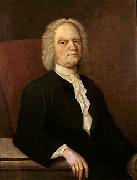
(1682 - May 25, 1755) was a Swedish born painter who emigrated to the New World in 1711. He was the father of painter John Hesselius and cousin of the religious leader Emanuel Swedenborg.
Hesselius left his home country of Sweden for Wilmington, Delaware in 1711. There he lived until 1717 when he moved to Philadelphia, Pennsylvania, where he lived until 1721. In 1721, he moved to Prince George's County, Maryland and became a portrait painter, though he had been trained in Sweden. That same year, he received the first recorded public art commission in the American colonies, he painted The Last Supper. He also painted a Crucifixion. Some time around 1735, Hesselius returned to Philadelphia where spent the rest of his life and traveling. He was listed as a member of the Gloria Dei (Old Swedes') Church in Philadelphia.
He also worked as an organ builder, having built an organ for the Moravian Church in Bethlehem, Pennsylvania in 1746. From about this time on, he focused on building organs, referring painting commissions to his son John.
J. Hall Pleasants has said that Hesselius became "America's earliest portrait painter of note." In 1994 he was named to the Prince George's County Hall of Fame.
|
 |
Gustave Moreau
|
|
French
1826-1898
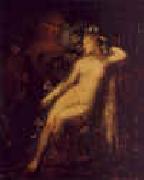
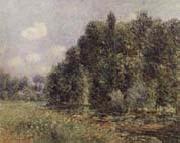
Moreau's main focus was the illustration of biblical and mythological figures. As a painter of literary ideas rather than visual images, he appealed to the imaginations of some Symbolist writers and artists, who saw him as a precursor to their movement.
His father, Louis Jean Marie Moreau, was an architect, who recognized his talent. His mother was Adele Pauline des Moutiers. Moreau studied under François-Édouard Picot and became a friend of Th??odore Chass??riau, whose work strongly influenced his own. Moreau carried on a deeply personal 25-year relationship, possibly romantic, with Adelaide-Alexandrine Dureux, a woman whom he drew several times.[1] His first painting was a Piet?? which is now located in the cathedral at Angoul??me. He showed A Scene from the Song of Songs and The Death of Darius in the Salon of 1853. In 1853 he contributed Athenians with the Minotaur and Moses Putting Off his Sandals within Sight of the Promised Land to the Great Exhibition.
Oedipus and the Sphinx, one of his first symbolist paintings, was exhibited at the Salon of 1864. Over his lifetime, he produced over 8,000 paintings, watercolors and drawings, many of which are on display in Paris' Mus??e national Gustave Moreau at 14, rue de la Rochefoucauld (IXe arrondissement). The museum is in his former workshop, and was opened to the public in 1903. Andr?? Breton famously used to "haunt" the museum and regarded Moreau as a precursor to Surrealism.
He had become a professor at Paris' École des Beaux-Arts in 1891 and counted among his many students the fauvist painters, Henri Matisse and Georges Rouault.
Moreau is buried in Paris' Cimeti??re de Montmartre.
In Alan Moore's graphic novel, The League of Extraordinary Gentlemen, it is implied that he was a nephew of Doctor Moreau, and he based a few of his paintings on the Doctor's creations. |
 |
Gustave Loiseau
|
|
French, 1865-1935
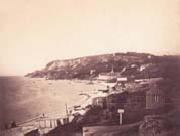
French painter. He was apprenticed first to a butcher and in 1880 to a house painter. It was not until 1887, when he received a small inheritance, that he was able to devote himself to painting. He spent a year studying modelling and design at the Ecole des Arts D?coratifs in Paris and then entered the studio of the French landscape painter Fernand Just Quignon (b 1854) for six months in 1889. After settling in 1890 in Pont-Aven in Brittany, where he met the painters Maxime Maufra and Henri Moret (1856-1913), he produced such carefully executed works as the Green Rocks (1893; Geneva, Petit Pal.). It was not until 1894, however, that he met Gauguin on the latter return from Tahiti, and though he did not accept Gauguin synthetist ideas the encounter led to a stronger structure and freer brushstrokes in his subsequent work. |
 |
Gustave Le Gray
|
|
French Photographer, 1820-1884,French photographer, painter and teacher. He studied painting with Paul Delaroche until 1843. A study trip to Switzerland and Italy, financed by his parents, followed, but it was cut short by an untimely marriage in 1844, his sudden return to his family's home and the subsequent birth of two children in 1845 and 1846. Skilled in painting as an experimenter with pigments, he was attracted to the experimental side of the new paper negative processes available in France after 1847 and plunged into photography, probably to finance the burdens of the family life newly thrust upon him. His treatise, Trait? pratique de photographie sur papier et sur verre (1850), outlined his own variant of the dry waxed paper negative process using thinner paper, as well as a recipe for collodion on glass negatives rivalling that of the English inventor Frederick Scott Archer (see PHOTOGRAPHY, |
 |
Gustave Guillaumet
|
|
French Painter, 1840-1887
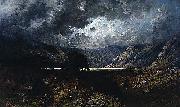
French painter and writer. He was a student of Fran?ois-Edouard Picot, Alexandre Abel de Pujol and F?lix Barrias. After failing to win the Prix de Rome in historical landscape in 1861, he impulsively visited Algeria the following year; this journey, which he repeated ten times, determined his development as an Orientalist painter. He was a regular exhibitor at the Salon from 1861 where his combination of picturesque realism and academic composition was positively received by the State as illustrative of its Algerian policies |
 |
Gustave Dore
|
|
(French pronunciation: January 6, 1832 - January 23, 1883) was a French artist, engraver, illustrator and sculptor. Dore worked primarily with wood engraving and steel engraving.
Dore was born in Strasbourg and his first illustrated story was published at the age of fifteen. His skill had manifested itself even earlier, however. At age five he had been a prodigy troublemaker, playing pranks that were mature beyond his years. Seven years later, he began carving in cement. Subsequently, as a young man, he began work as a literary illustrator in Paris, winning commissions to depict scenes from books by Rabelais, Balzac, Milton and Dante.
In 1853, Dore was asked to illustrate the works of Lord Byron. This commission was followed by additional work for British publishers, including a new illustrated English Bible. A decade later, he illustrated a French edition of Cervantes's Don Quixote, and his depictions of the knight and his squire, Sancho Panza, have become so famous that they have influenced subsequent readers, artists, and stage and film directors' ideas of the physical "look" of the two characters. Dore also illustrated an oversized edition of Edgar Allan Poe's "The Raven", an endeavor that earned him 30,000 francs from publisher Harper & Brothers in 1883.
Dore's English Bible (1866) was a great success, and in 1867 Dore had a major exhibition of his work in London. This exhibition led to the foundation of the Dore Gallery in Covelant Bond Street. In 1869, Blanchard Jerrold, the son of Douglas William Jerrold, suggested that they work together to produce a comprehensive portrait of London. Jerrold had obtained the idea from The Microcosm of London produced by Rudolph Ackermann, William Pyne, and Thomas Rowlandson in 1808. Dore signed a five-year contract with the publishers Grant & Co that involved his staying in London for three months a year, and he received the vast sum of £10,000 a year for the project. Dore was mainly celebrated for his paintings in his day. His paintings remain world renowned, but his woodcuts and engravings, like those he did for Jerrold, are where he really excelled as an artist with an individual vision.
The completed book, London: A Pilgrimage, with 180 engravings, was published in 1872. It enjoyed commercial and socioeconomical success, but the work was disliked by many contemporary critics. Some of these critics were concerned with the fact that Dore appeared to focus on the poverty that existed in parts of London. Dore was accused by the Art Journal of "inventing rather than copying." The Westminster Review claimed that "Dore gives us sketches in which the commonest, the vulgarest external features are set down." The book was a financial success, however, and Dore received commissions from other British publishers. |
 |
Gustave Courbet
|
|
1819-1877
French
Gustave Courbet Locations
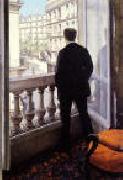
was a French painter whose powerful pictures of peasants and scenes of everyday life established him as the leading figure of the realist movement of the mid-19th century.
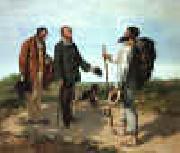
Gustave Courbet was born at Ornans on June 10, 1819. He appears to have inherited his vigorous temperament from his father, a landowner and prominent personality in the Franche-Comte region. At the age of 18 Gustave went to the College Royal at Besancon. There he openly expressed his dissatisfaction with the traditional classical subjects he was obliged to study, going so far as to lead a revolt among the students. In 1838 he was enrolled as an externe and could simultaneously attend the classes of Charles Flajoulot, director of the ecole des Beaux-Arts. At the college in Besançon, Courbet became fast friends with Max Buchon, whose Essais Poetiques (1839) he illustrated with four lithographs.
In 1840 Courbet went to Paris to study law, but he decided to become a painter and spent much time copying in the Louvre. In 1844 his Self-Portrait with Black Dog was exhibited at the Salon. The following year he submitted five pictures; only one, Le Guitarrero, was accepted. After a complete rejection in 1847, the Liberal Jury of 1848 accepted all 10 of his entries, and the critic Champfleury, who was to become Courbet first staunch apologist, highly praised the Walpurgis Night. |
 |
Gustave Caillebotte
|
|
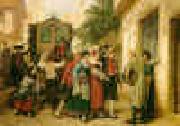
French Impressionist Painter, 1848-1894
Gustave Caillebotte was born on August 19, 1848 to an upper-class Parisian family. His father, Martial Caillebotte (1799-1874), was the inheritor of the family textile industry and was also a judge at the Seine Tribunal de Commerce. Caillebotte father had been twice widowed before marrying Caillebotte mother, C??leste Daufresne (1819-1878), who had two more sons after Gustave, Rene (1851-1876) and Martial (1853-1910). |
 |
Gustave Brion
|
|
1824-1877 French
French painter and illustrator. His family settled in Strasbourg in 1831 and placed him in the studio of the portrait and history painter Gabriel-Christophe Gurin (1790-1846) in 1840. He then earned his living mainly by teaching drawing and copying paintings. In 1847 he successfully submitted his first work to the Salon: Farmhouse Interior at Dambach (untraced). In the summer of 1850 he moved to Paris, where he took a studio in a house shared by Realist artists. Brion exhibited regularly at the Salon: in 1852 The Towpath (untraced) was bought by the de Goncourt brothers; and in 1853 he showed the Potato Harvest during the Flooding of the Rhine in 1852 (Nantes, Mus. B.-A.), in which the influence of Gustave Courbet and Jean-Francois Millet (ii) can be seen in the Alsatian peasant figures. |
 |
Gustave Boulanger
|
|
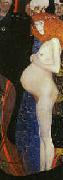
(1824-88) was a French figure painter known for his Neo-Grec style. He was born at Paris, studied with Delaroche and Jollivet, and in 1849 took the Prix de Rome. His paintings are prime examples of academic art of the time, particularly history painting. Boulanger had visited Italy, Greece, and North Africa, and his paintings reflect his attention to culturally correct details and skill in rendering the female form. His works include a Moorish Cafe (1848), Cæsar at the Rubicon (1865), the Promenade in the Street of Tombs, Pompeii (1869), and The Slave Market (1888). The recipient of many medals, he became a member of the Institut de France in 1882. |
 |
Gustav Klimt
|
|
Austrian Art Nouveau Painter, 1862-1918
Gustav Klimt (July 14, 1862 ?C February 6, 1918) was an Austrian Symbolist painter and one of the most prominent members of the Vienna Art Nouveau (Vienna Secession) movement. His major works include paintings, murals, sketches, and other art objects, many of which are on display in the Vienna Secession gallery. Klimt's primary subject was the female body, and his works are marked by a frank eroticism--nowhere is this more apparent than in his numerous drawings in pencil.
Klimt's work is distinguished by the elegant gold or coloured decoration, often of a phallic shape that conceals the more erotic positions of the drawings upon which many of his paintings are based. This can be seen in Judith I (1901), and in The Kiss (1907?C1908), and especially in Danaë (1907). One of the most common themes Klimt utilized was that of the dominant woman, the femme fatale. Art historians note an eclectic range of influences contributing to Klimt's distinct style, including Egyptian, Minoan, Classical Greek, and Byzantine inspirations. Klimt was also inspired by the engravings of Albrecht D??rer, late medieval European painting, and Japanese Rimpa school. His mature works are characterized by a rejection of earlier naturalistic styles, and make use of symbols or symbolic elements to convey psychological ideas and emphasize the "freedom" of art from traditional culture. |
 |
Gustav Graef
|
|
(December 14, 1821 in Königsberg - January 6, 1895 in Berlin) was a German painter, primarily of portraits and historical subjects. He studied with Theodor Hildebrandt and Friedrich Wilhelm Schadow at the Kunstakademie Desseldorf. His son Botho Graef became an art historian of some note, and his daughter was the painter Sabine Lepsius.
|
 |
Gustav Eberlein
|
|
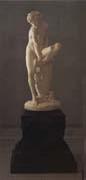
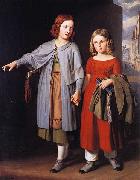
1847Spickerschausen-1926 Berlin,German sculptor. He attended the Realschule in Hannoversch Menden until 1861. He was apprenticed to a goldsmith in 1861-4 and thus learnt embossing, carving, chasing and engraving. He subsequently travelled as a journeyman, finding employment in Hildesheim, then in Kassel with the court jeweller, Ruhl. From 1867 to 1870, Eberlein trained as a sculptor under August von Kreling (1819-76), director of the Kunstgewerbeschule in Nuremberg, also working as Kreling's assistant to support his studies. On receiving a grant from Elisabeth of Prussia (the widow of Frederick William IV) for three further years of study, |
 |
Gustav Adolph Hennig
|
|
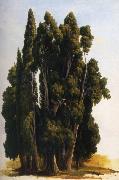
Gustav Adolph Hennig (1797-1869)Professions: Historical-scenes painter; Porträtmaler; Miniature painter; Etcher; Lithographer. |
 |
Gustaf Wilhelm Palm
|
|
Swedish, 1810-1890,Swedish painter. He entered the Royal Academy of Arts in Stockholm in 1828, where he was a student of Carl Johan Fahlcrantz. Following a tour of Norway he went, via Copenhagen, to Berlin and Vienna for three years in order to seek a cure for an eye illness. He was influenced there by Biedermeier painting and Ferdinand Georg Waldm?ller, and also by the architectural painters Jakob Alt (1789-1872) and his son Rudolf Alt. |
 |
Gustaf Rydberg
|
|
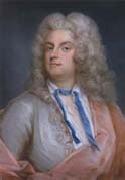
painted Skansk slatt med pilvall - motiv fran Viby in 1923
Swedish, 1835-1933 |
 |
Gustaf Lundberg
|
|
Swedish, 1695-1786,Swedish painter and pastellist. He was orphaned early and brought up by his grandfather, the goldsmith Fredrik Richter (1636-1714). In 1710 he was briefly apprenticed to David von Krafft (1655-1724). Against von Krafft's advice, and at his own expense, he travelled to Paris in 1717. He studied first with Hyacinthe Rigaud, Nicolas de Largillierre and Jean-Fran?ois de Troy, learning to paint in a R?gence style less heavy and serious than that taught by von Krafft in Sweden. He also studied drawing under Pierre-Jacques Cazes at the Ecole des Beaux-Arts. In 1720 Rosalba Carriera came to Paris from Italy, bringing with her the fashionable technique of drawing in pastel chalks. Lundberg became her pupil and within a year had mastered the medium, charming the Parisians with his portraits. Until the arrival of Carriera, he had worked only in oils (e.g. the portrait of Gabriel Sack and his Wife Eva Bielke, 1730; priv. col.), but he now turned exclusively to pastels. He received portrait commissions from Louis XV (reg 1715-74), notably for those of his young queen Maria Leszczynska and of her parents Stanislav I Leszczynski and Catherine Opalinska (both 1725; Upplands Vesby, priv. col.), who at that time were living at Chambord. Through the agency of Carl Gustav Tessin, Lundberg was received (re?u) at the Acad?mie Royale de Peinture et de Sculpture in 1741. As his morceaux de reception he executed two portraits of Fran?ois Boucher and Charles-Joseph Nattier, shown at the Salon of 1743. |
 |
Gustaf Cederstrom
|
|
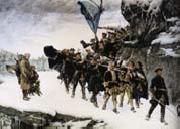
Swedish Painter, 1845-1933,was a Swedish painter, most known for his painting Karl XII:s likfärd (The funeral transport of Charles XII). He was born and raised in Stockholm. His father was Carl Emanuel Cederström and his mother was Carolina Fredrika Theresia af Ugglas. He married Amalia Katarina Jaeder in 1878 |
|