|
 |
HONDECOETER, Melchior d
|
|
Dutch Baroque Era Painter, 1636-1695
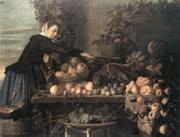
Dutch animal painter. His grandfather, Gillis d'Hondecoeter (d. 1638) and his father, Gysbert d'Hondecoeter (1604?C1653), were landscape and animal painters. After four years at The Hague, where he painted The Menagerie of William III at Loo, Melchior settled in Amsterdam. He painted all forms of animal life, but is best known for his depiction of birds and fowl, in which he has few equals. Representative works, executed in a smooth, precise style, include the Dead Cock |
 |
Homer Watson
|
|
Canadian Painter, 1855-1936
Canadian painter. The son of a mill-owner, he was born in a region of rural southern Ontario, which he painted throughout his life. In 1874 he moved to Toronto to work at the Notman Photographic Studios; he also spent many hours copying paintings in the Toronto Normal School in order to improve his technique. In 1876 he visited New York, where he was impressed with the carefully composed paintings of the Hudson River school and the rural scenes of George Inness, who encouraged Watson to pursue his career. The following year he returned to Doon to work up his New York sketches into finished paintings. A work of this early period, Landscape with River (1878; Toronto, A.G. Ont.), |
 |
Homer Dodge Martin
|
|
American Barbizon School Tonalist Painter, 1836-1897, He was an American artist, particularly known for his landscapes. Martin was born at Albany, New York. A pupil for a short time of William Hart, his earlier work was closely aligned with the Hudson River School. He was elected as associate of the National Academy of Design, New York, in 1868, and a full academician in 1874. During a trip to Europe in 1876 he was captivated by the Barbizon school, and thereafter his painting style gradually became darker, moodier, and more loosely-brushed. From 1882 to 1886 he lived in France, spending much of the time in Normandy. |
 |
holger drachmann
|
|
född 9 oktober 1846 i Köpenhamn, död 14 januari 1908 i Hornbæk, var en dansk författare.
Drachmann försökte sig först på måleri, men gav upp och ägnade sig i stället åt författande. Han skrev noveller, dikter, romaner och skådespel.
Edvard Grieg satte musik till många av Drachmanns dikter, bland annat Reiseminder fra Fjeld og Fjord, opus 44. En av hans mest berömda dikter är Et andnat Skagen. |
 |
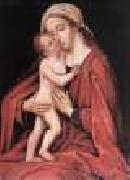
HOLBEIN, Hans the Younger
|
|
German painter (b. 1497, Augsburg, d. 1543, London).
Hans Holbein the Younger, born in Augsburg, was the son of a painter, Hans Holbein the Elder, and received his first artistic training from his father. Hans the Younger may have had early contacts with the Augsburg painter Hans Burgkmair the Elder. In 1515 Hans the Younger and his older brother, Ambrosius, went to Basel, where they were apprenticed to the Swiss painter Hans Herbster. Hans the Younger worked in Lucerne in 1517 and visited northern Italy in 1518-1519. On Sept. 25, 1519, Holbein was enrolled in the painters' guild of Basel, and the following year he set up his own workshop, became a citizen of Basel, and married the widow Elsbeth Schmid, who bore him four children. He painted altarpieces, portraits, and murals and made designs for woodcuts, stained glass, and jewelry. Among his patrons was Erasmus of Rotterdam, who had settled in Basel in 1521. In 1524 Holbein visited France. Holbein gave up his workshop in Basel in 1526 and went to England, armed with a letter of introduction from Erasmus to Sir Thomas More, who received him warmly. Holbein quickly achieved fame and financial success. In 1528 he returned to Basel, where he bought property and received commissions from the city council, Basel publishers, Erasmus, and others. However, with iconoclastic riots instigated by fanatic Protestants, Basel hardly offered the professional security that Holbein desired. In 1532 Holbein returned to England and settled permanently in London, although he left his family in Basel, retained his Basel citizenship, and visited Basel in 1538. He was patronized especially by country gentlemen from Norfolk, German merchants from the Steel Yard in London, and King Henry VIII and his court. Holbein died in London between Oct. 7 and Nov. 29, 1543. With few exceptions, Holbein's work falls naturally into the four periods corresponding to his alternate residences in Basel and London. His earliest extant work is a tabletop with trompe l'oeil motifs (1515) painted for the Swiss standard-bearer Hans Baer. Other notable works of the first Basel period are a diptych of Burgomaster Jakob Meyer zum Hasen and his wife, Dorothea Kannengiesser (1516); a portrait of Bonifacius Amerbach (1519); an unsparingly realistic Dead Christ (1521); a Madonna and Child Enthroned with Two Saints (1522); several portraits of Erasmus, of which the one in Paris (1523 or shortly after), with its accurate observation of the scholar's concentrated attitude and frail person and its beautifully balanced composition, is particularly outstanding; and woodcuts, among which the series of the Dance of Death (ca. 1521-1525, though not published until 1538) represents one of the high points of the artist's graphic oeuvre. Probably about 1520 Holbein painted an altarpiece, the Last Supper, now somewhat cut down, which is based on Leonardo da Vinci's famous painting, and four panels with eight scenes of the Passion of Christ (possibly the shutters of the Last Supper altarpiece), which contain further reminiscences of Italian painting, particularly Andrea Mantegna, the Lombard school, and Raphael, but with lighting effects that are characteristically northern. His two portraits of Magdalena Offenburg, as Laïs of Corinth and Venus with Cupid (1526), |
 |
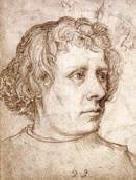
HOLBEIN, Hans the Elder
|
|
(b. 1460/65, Augsburg, d. 1524, Isenheim
was a German painter. He was born in Augsburg, Bavaria and died in Isenheim, Alsace. He and his brother Sigismund Holbein painted religious works in the late Gothic style. Hans the Elder was a pioneer and leader in the transformation of German art from the Gothic to the Renaissance style. He was also a woodcut artist and an illustrator of books, and was a church window designer. |
 |
HOLBEIN, Ambrosius
|
|
German Northern Renaissance Painter, 1494-ca.1519
Painter, draughtsman and designer of woodcuts, son of Hans Holbein. In the drawing of Ambrosius and Hans Holbein the Younger (1511; Berlin, Kupferstichkab.) by their father, Hans's age is given as 14, and although that of Ambrosius cannot be read clearly, he appears to have been the elder brother. In 1514 he was probably working near the Bodensee, and a Virgin and Child (Basle, Kstmus.), with the coat of arms of Johann von Botzheim, Canon of Konstanz Cathedral (c. 1480-1535), appears to be his work. In 1515 he was working as a journeyman to the painter Thomas Schmid (c. 1480-c. 1550-60) on the decoration of the abbot's Festsaal in the Benedictine St Georgkloster at Stein-am-Rhein, which included allegorical figures of women, one of which, Death with a Female Lute-player (in situ), is signed AH. Also in 1515 he joined his brother Hans in Basle, where together they decorated with marginal drawings (1515-16) the copy of Erasmus's Praise of Folly (Basle, Kstmus.) belonging to the schoolmaster Myconius (Oswald Geissh?sler; d 1552); the distinction between the hands of the two brothers can be made only on stylistic grounds. They also painted a school sign for Myconius, each apparently working on a different side. On 25 July 1516 Ambrosius was recorded staying in the house of the painter Hans Herbst, in whose workshop he may have been employed. On 14 February 1517 he was enrolled in the Basle painters' guild, and on 5 June 1518 he became a citizen of the city. Numerous woodcut designs executed for Basle printers from 1517 onwards and signed with Ambrosius Holbein's initials survive, most of which are set in architectural frameworks inspired by the Italian Renaissance, |
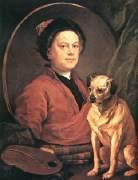 |
HOGARTH, William
|
|
British Painter and Printmaker, 1697-1764
English painter and engraver. He played a crucial part in establishing an English school of painting, both through the quality of his painting and through campaigns to improve the status of the artist in England. He also demonstrated that artists could become independent of wealthy patrons by publishing engravings after their own paintings. |
 |
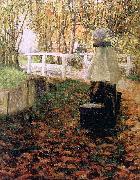
Hoca Ali Riza
|
|
(1858 - 1939) was a Turkish painter.
Portrait of Hoca Ali Riza
Kizkulesi (Leander Tower), painting by Hoca Ali RizaBorn in Uskudar, Istanbul. Painted many landscapes of Istanbul and especially Uskudar. Attended Kuleli Military High School and then the Military Academy. There he studied under Osman Nuri Pasha, Seleyman Seyyid and Monsieur Gues, and graduated in 1884. From 1909 to 1912 he served as President of the Society of Ottoman Painters.
|
 |
Hitchcock, George
|
|
American Painter, 1850-1913
American painter, active in the Netherlands. A descendant of Roger Williams (the founder of Rhode Island), he practised law for several years in New York before deciding in 1879 to become an artist. He studied in Paris with Gustave Boulanger and Jules Lefebvre, in D?sseldorf, and in The Hague with H. W. Mesdag. He settled in Egmond-aan-Zee, near Alkmaar, in 1883, and was soon widely known for his paintings of religious subjects in contemporary settings and of sunlit views of tulip fields. He returned to the USA only occasionally in later years. Hitchcock's style, similar to Impressionism, has been appreciated more in Europe than in the USA. A good example of his style is the Blessed Mother (1892; Cleveland, OH, Mus. A.). He received some recognition in the USA, such as election to associate membership in the National Academy of Design, New York, |
 |
Hiroshige, Ando
|
|
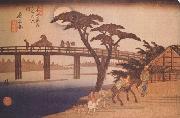
Japanese Ukiyo-e Printmaker, 1797-1858
Japanese painter and printmaker. He was one of the greatest and most prolific masters of the full-colour landscape print and one of the last great ukiyoe ('pictures of the floating world') print designers |
 |
Hiram Powers
|
|
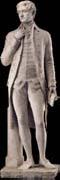
American Neoclassical Sculptor, 1805-1873, American sculptor. He grew up in Cincinnati, OH, and his career as a sculptor began when he created animated wax figures for a tableau of Dante's Inferno at Dorfeuille's Western Museum in Cincinnati, where he was supervisor of the mechanical department. He learnt to model clay and make plaster casts from Frederick Eckstein (c. 1775-1852). The portrait busts he created of his friends attracted the attention of the wealthy Nicholas Longworth, who financed trips for Powers to New York in 1829 and to Washington, DC, in 1834, when he sculpted President Andrew Jackson (marble, c. 1835; New York, Met.). Powers's strikingly lifelike bust, classicized only by the drapery, brought him commissions from other Washington luminaries, including John Marshall (marble, 1835; Washington, DC, US Capitol), Martin van Buren (marble, 1837; New York, NY Hist. Soc.) |
 |
Hippolyte Leon Benett
|
|
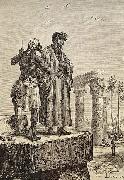
Muḥammad ibn Baṭeṭah (Arabic: أبو عبد الله محمد ابن بطوطة), or simply Ibn Battuta, also known as Shams ad CD in (February 25, 1304-1368 or 1369), was a Muslim Moroccan explorer, known for his extensive travels published in the Rihla (literally, "The Journey"). Over a period of thirty years, he visited most of the known Islamic world, including North Africa, the Horn of Africa, West Africa, Southern Europe and Eastern Europe in the West, to the Middle East, South Asia, Central Asia, Southeast Asia and China in the East, a distance surpassing his near-contemporary Marco Polo. Ibn Battuta is considered one of the greatest travellers of all time. He journeyed more than 75,000 miles (121,000 km), a figure unsurpassed by any individual explorer until the coming of the Steam Age some 450 years later.
|
 |
Hippolyte Flandrin
|
|
1809-1864
Hippolyte Flandrin Location
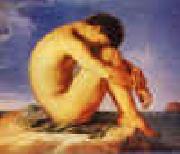
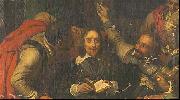
Painter and lithographer, brother of Auguste Flandrin. He was initially discouraged from fulfilling his early wish to become an artist by Auguste lack of success, but in 1821 the sculptor Denys Foyatier, an old family friend, persuaded both Hippolyte and Paul to train as artists. He introduced them to the sculptor Jean-Francois Legendre-Heral (1796-1851) and the painter Andre Magnin (1794-1823), with whom they worked copying engravings and plaster casts. After Magnin death, Legendre-Heral took the brothers to the animal and landscape painter Jean-Antoine Duclaux (1783-1868). Hippolyte and Paul had both learnt the techniques of lithography from Auguste at an early age, and between the ages of 14 and 19 Hippolyte produced a number of lithographs, which he sold to supplement the family income. Many reflected his passion for military subjects (e.g. Cossacks in a Bivouac, c. 1825; Paris, Bib. N.). In 1826 the two brothers entered the Ecole des Beaux-Arts in Lyon, where Hippolyte studied under Pierre Revoil. Showing a precocious talent, he was soon advised to move to Paris, and having left the Ecole des Beaux-Arts in Lyon in 1829, he walked to the capital with his brother Paul; together they enrolled in the studio of Ingres. After several unsuccessful attempts, Hippolyte won the Grand Prix de Rome in 1832 with Theseus Recognized by his Father (1832; Paris, Ecole N. Sup. B.-A.), despite having suffered from cholera during the competition. His success was all the more spectacular given the general hostility to Ingres; Hippolyte was the first of his pupils to be awarded this prestigious prize. Hippolyte arrived in Rome in 1833; Paul joined him there in 1834. After first working on such subjects as Virgil and Dante in Hell (1836; Lyon, Mus. B.-A.), Hippolyte developed a taste for religious works during this stay. From 1836 to 1837 he worked on St Clare Healing the Blind for the cathedral in Nantes, winning a first-class medal at the 1837 Salon, and in 1838 he painted Christ Blessing the Children (Lisieux, Mus. Vieux-Lisieux), which was exhibited at the 1839 Salon. |
 |
Hippolyte Delaroche
|
|
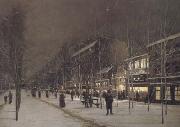
(17 July 1797 - 4 November 1856), commonly known as Paul Delaroche, was a French painter born in Paris. Delaroche was born into a wealthy family and was trained by Antoine-Jean, Baron Gros, who then painted life-size histories and had many students.
The first Delaroche picture exhibited was the large Josabeth saving Joas (1822). This exhibition led to his acquaintance with Theodore Gericault and Eugene Delacroix, with whom he became friends. The three of them formed the core of a large group of Parisian historical painters. He visited Italy in 1838 and 1843, when his father-in-law, Horace Vernet, was director of the French Academy in Rome.
Delaroche's studio in Paris was in the Rue Mazarine. His subjects were painted with a firm, solid, smooth surface, which gave an appearance of the highest finish. This texture was the manner of the day and was also found in the works of Vernet, Ary Scheffer, Louis-Leopold Robert and Jean Auguste Dominique Ingres. Among his students were British landscape artist Henry Mark Anthony (1817-1886), |
 |
Hippolyte camille delpy
|
|
French, 1842-1910
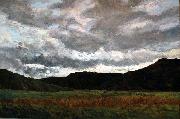
was a painter. Delpy came from a moderately wealthy family from Joigny, in the Burgundy region of France. He was a student of Charles Francois Daubigny. |
 |
Hippolyte Boulenger
|
|
(1837 - 1874) was a Belgian landscape painter influenced by the French Barbizon school, considered to be "the Belgian Corot".
Hippolyte Boulenger was born to French parents in Tournai in 1837. He spent his youth in Tournai and lived in Paris between 1850 and 1853, where he studied drawing. In 1853, after he became an orphan, he went to Brussels to work at a design atelier. In the evening, he studied at the Academie Royale des Beaux-Arts with Joseph Quinaux, a landscape painter.
He met portrait painter Camille Van Camp in 1863, who became a mentor and mecenas. He showed his first painting in the Brussels Salon the same year. Boulenger went to Tervuren in 1864, and called round him a group of likeminded painters gathered there, the School van Tervuren, a Belgian version of the Barbizon school, of which he became the leading artist. At the time, his leading model was Jean-François Millet, although his later work was closer to that of Corot. By 1866, he was famous in Belgian art circles.
He married in 1868 and moved to Zaventem, but returned to Tervuren in 1870. These years were his best and most fruitful period, with e.g. the painting De oude Haagbeukdreef. Tervuren, which won him the Gold Medal of the 1872 Salon of Brussels. In this period, he travelled in Belgium and abroad, painting along the River Meuse. It was his suggestion that led to the creation of the Societe Libre des Beaux-Arts, an art circle of young Belgian artists, including Alfred Verwee, Felicien Rops, and Constantin Meunier, with honorary members from abroad like Corot and Millet, but also Honore Daumier, Gustave Courbet and Willem Maris.
By 1869, he began to suffer from epilepsy. Coupled with alcohol abuse, this led to an early death, in 1874 in a hotel in Brussels.
|
 |
Hindu painter
|
|
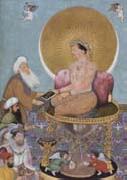
Richard Ettinghausen believes this work to have been painted in Agra in about 1625
|
 |
Hill, John William
|
|
English Painter, 1812-1879
Painter and illustrator, son of John Hill. At the age of seven he moved to Philadelphia, PA, with his family. In 1822 he moved to New York, where he was apprenticed to his father for seven years. During this time, he worked on the aquatint plates for William Guy Wall's Hudson River Portfolio (1821-5), |
 |
Hildegard of Bingen
|
|
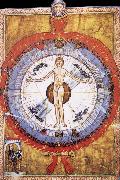
1098-1179,German composer, abbess and mystic. Her writings include much lyrical and dramatic poetry which has survived with monophonic music. The Symphonia armonie celestium revelationum contains musical settings of 77 poems arranged according to the liturgical calendar. The poetry is laden with imagery and the music, based on a few formulaic melodic patterns, is in some respects highly individual. Her morality play Ordo virtutum contains 82 melodies in a more syllabic style. |
 |
HIGHMORE, Joseph
|
|
English Painter, 1692-1780
English painter and writer. The son of a coal merchant and the nephew of Thomas Highmore (1660-1720), Serjeant-Painter to the King, he was articled to an attorney on 18 July 1707. Bored with his duties, he attended Kneller's Academy from 1713 and in 1715 abandoned law, setting up as a portrait painter in the City of London. From 1720 he attended the St Martin's Lane Academy, where he was able to study contemporary French styles in art and design, particularly that of Gravelot. He read widely and mastered Brook Taylor's system of perspective (1715). He also attended William Cheselden's anatomy lectures and contributed designs to that author's Anatomy of the Human Body (1722). |
 |
Hieronymus Bosch
|
|
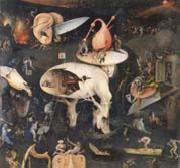
Netherlandish Northern Renaissance Painter, ca.1450-1516, Flemish painter. His surname was originally van Aeken; Bosch refers to 's Hertogenbosch, where he was born and worked. Little is known of his life and training, although it is clear that he belonged to a family of painters. His paintings, executed in brilliant colors and with an uncanny mastery of detail, are filled with strangely animated objects, bizarre plants and animals, and monstrous, amusing, or diabolical figures believed to have been suggested by folk legends, allegorical poems, moralizing religious literature, and aspects of late Gothic art. Such works as the Garden of Earthly Delights (Prado) appear to be intricate allegories; their symbolism, however, is obscure and has consistently defied unified interpretation. Bosch clearly had an interest in the grotesque, the diabolical, the exuberant, and the macabre. He also may have been the first European painter to depict scenes of everyday life, although often with a strong element of the bizarre. King Philip II of Spain collected some of his finest creations. The Temptation of St. Anthony (Lisbon) and The Last Judgment were recurring themes. Other examples of his art may be seen in the Escorial and in Brussels. Examples of the Adoration of the Magi are in the Metropolitan Museum and in the Philadelphia Museum, which also has the Mocking of Christ. Bosch, who deeply influenced the work of Peter Bruegel the Elder, was hailed in the 20th cent. as a forerunner of the surrealists, and his work continues to influence many contemporary artists. |
 |
Hieronimo Custodis
|
|
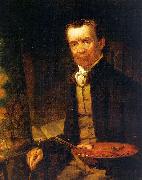
(also spelled Hieronymus, Heironimos) (died c. 1593) was a Flemish portrait painter active in England in the reign of Elizabeth I.
A native of Antwerp, Custodis was one of many Flemish artists of the Tudor court who had fled to England to avoid the persecution of Protestants in the Spanish Netherlands.He is thought to have arrived in England sometime after the fall of Antwerp to the forces of the Duke of Parma in 1585.
Three English portraits by Custodis signed and dated 1589 firmly establish him as resident in London by that year. Sir Roy Strong attributes a portrait of Sir Henry Bromley dated 1587 to Custodis, suggesting an earlier arrival, and has verified the recent attribution of a portrait of the young Edward Talbot dated 1586 to Custodis.In 1591, he was living in the parish of St Bodolph-without-Aldgate where "Jacobus the son of Ieronyme Custodis A Paynter" was baptised on 2 March. He is assumed to have died in 1593, as all of his known works are dated between 1589 and 1593, and his widow remarried that year.
Custodis's unsigned but dated works are idenitified by "palaeographical peculiarities" in the inscriptions which can be closely matched to those in his signed portraits.
|
 |
Hicks, Thomas
|
|
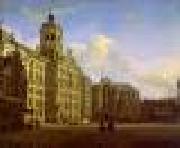
American Painter, 1823-1890
Cousin of Edward Hicks. After being apprenticed (c. 1835-9) in the sign-painting shop of his cousin, he studied at the Pennsylvania Academy of the Fine Arts in Philadelphia (1839-40) and at the National Academy of Design in New York (1840-44). He then sketched and painted in England, Italy and France before becoming a student of Thomas Couture in Paris (1848-9). On his return to the USA in 1849, he established a studio in New York and quickly became a popular portrait painter, although his portrayals only rarely have enough psychological depth to make them of more than documentary interest. Hamilton Fish (1852; New York, City Hall) is among his stronger works. Hicks also painted genre subjects, such as Musicale: Barber Shop, Trenton Falls (1866; Raleigh, NC Mus. A.), and landscapes, the latter chiefly near Thornwood, his summer residence at Trenton Falls, NY. |
 |
HEYDEN, Jan van der
|
|
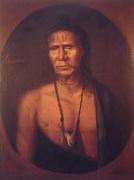
Dutch Baroque Era Painter, 1637-1712
Dutch painter, draughtsman, printmaker and inventor. In 1650 he moved to Amsterdam with his family; his father, a Mennonite, who had pursued various occupations rather unsuccessfully, died that year. Jan's artistic training may have begun with drawing lessons in the studio of a relative, perhaps his eldest brother, Goris van der Heyden, who made and sold mirrors; Jan may also have studied the reverse technique of glass painting with an artist in Gorinchem. Painting occupied relatively little of his time, however, although he continued to pursue it throughout his long life. His prosperity was mainly due to his work as an inventor, engineer and municipal official. He designed and implemented a comprehensive street-lighting scheme for Amsterdam, which lasted from 1669 until 1840 and was adopted as a model by many other towns in the Netherlands and abroad. In 1672, |
 |
Hesselius Gustavus
|
|
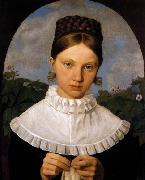
American portrait painter.
1682-1755
He was trained in Sweden as a wood-engraver, gilder and painter. In 1712 he accompanied his brother, a Lutheran pastor, to America, where he settled in Philadelphia, PA. About 1720 he moved to the Annapolis, MD, area, returning before 1730 to Philadelphia, where he lived until his death. He was one of the first European-trained painters to settle permanently in America and introduced a greater technical skill and increased realism into Colonial painting. His painterly, atmospheric style, which derived from European Baroque, contrasted with the more linear technique of American-born painters. During most of his career he was the leading painter of the Middle Colonies. In addition to mythological scenes, altarpieces and portraits of prominent individuals, Hesselius undertook utilitarian work that included painting the country seat at Springettsbury of Thomas Penn (1702-75) and the interior of the Pennsylvania State House, as well as flower-boxes, |
 |
HESS, Heinrich Maria von
|
|
German painter b. 1798, Dsseldorf, d. 1863, Mnchen,German painter. After training (1813-17) under Peter von Langer (1756-1824) at the Akademie der bildenden Kenste in Munich, he painted religious subjects under the influence of Peter Cornelius. In 1821 he joined the Lukasbreder, and the circle around Crown Prince Ludwig I of Bavaria, in Rome. Apollo among the Muses (1824; Munich, Neue Pin.), painted for Maximilian I, shows Hess to be among the most gifted of the German artists working in Rome. The influence of Raphael, glowing but carefully harmonized colours, gliding figures and drapery animate this early masterpiece. Among other important works from this time are exquisitely detailed and colouristically sophisticated, intimate character portraits with early Renaissance settings, such as that of Marchesa Marianna Florenzi (1824; Munich, Neue Pin.), as well as fresh and lively Naturalist landscapes from the environs of Rome, for example Campagna Landscape near Ponte Nomentano (1821-6; Hamburg, Ksthalle). |
 |
hertervig
|
|
Lars Hertervig (February 16, 1830 - January 6, 1902) was a Norwegian painter. His semi-fantastical work with motives from the coastal landscape in the traditional district of Ryfylke is regarded as one of the peaks of Norwegian painting.
Lars Hertervig was born in 1830 at Hattarvagen, in the municipality Tysvar in Norway, from which the family name derives, on the west coast of Norway, north of Stavanger. His family were poor, Quaker farmers. Hertervig studied painting at the Arts Academy of Dusseldorf from 1852, as the private pupil of Hans Gude, until he experienced a temporary mental breakdown two years later, and moved back to the Stavanger area. In October 1856, Hertervig entered Gaustad asylum. |
 |
hersent
|
|
(March 10, 1777 C October 2, 1860) was a French painter.
Portrait of Sophie Crouzet, by Louis HersentBorn in Paris, he became a pupil of David, and obtained the Prix de Rome in 1797. In the Salon of 1802 appeared his "Metamorphosis of Narcissus," and he continued to exhibit with rare interruptions up to 1831. His most considerable works under the empire were "Achilles parting from Brisis," and "Atala dying in the arms of Chactas" (both engraved in Landon's Annales du Musee);
|
 |
Herri met de Bles
|
|
(also known as Herri de Dinant, Herry de Patinir, and Civetta) (c. 1510 - c. 1555 - 1560) was a Flemish Northern Renaissance and Mannerist landscape painter. He is also defined as a eeMosan landscape painter active during the second third of the 16thcentury (i.e., second generation of landscape painters).ee
Very little is positively known about the artist. He is believed to be a certain Herry de Patenir who joined Antwerp's Guild of St. Luke in 1535 as a painter and is also believed to be a court painter for the d'Este Dukes of Ferrara, where he ended his career known as "Il Civetta". He contributed, along with his possible-uncle Joachim Patinir, to a distinct style of Northern Renaissance landscape painting that combined small history or religious scenes into compositions defined by perspective and atmospheric effects. Also, along with a group of Antwerp-based followers of Hieronymus Bosch that included Jan Mandyn, Pieter Huys, and Jan Wellens de Cock, Met de Bles continued the tradition of fantastic imagery into northern Mannerism.
|
|