|
 |
WITZ, Konrad
|
|
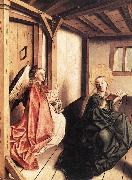
b. cca 1400, Rottweil, d. ca. 1445, Basel. German-born painter from Rottweil in Swabia, active in Switzerland. German painter. One of the great innovators in northern European painting, he turned away from the lyricism of the preceding generation of German painters. His sturdy, monumental figures give a strong impression of their physical presence, gestures are dignified and the colours strong and simple. Even scenes with several figures are strangely undramatic and static. The surface appearance of materials, especially metals and stone, is intensely observed and recorded with an almost naive precision. Powerful cast shadows help to define the spatial relationships between objects. His fresh approach to the natural world reflects that of the Netherlandish painters: the Master of Fl?malle and the van Eycks. He need not, however, have trained in the Netherlands or in Burgundy as knowledge of their style could have been gained in Basle. He remained, however, untouched by the anecdotal quality present in their art, |
 |
William Knight Keeling
|
|
(1807?C1886) was a British (Victorian) artist, an illustrator of Walter Scott's novels and Shakespeare's plays, a founder and the third President of the Manchester Academy of Fine Arts.
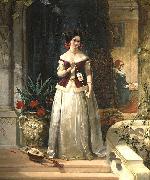
William Knight Keeling. Love's Messenger. 1856William Knight Keeling was born in Manchester. He was apprenticed to a wood-engraver, and in the 1830s went to London and became an assistant of William Bradley (1801-1857), a Manchester-born portrait painter who moved to London in 1822 and established himself as a portrait painter. However, Keeling returned to Manchester in 1835 and firmly established himself as a popular and respected portrait and figurative painter in oils and watercolour, and a drawing-master. From 1830s, he actively exhibited in Manchester, Liverpool and elsewhere. In 1833, his painting 'The Bird's Nest' was awarded the silver medal from the Royal Manchester Institution.[1] In 1841, he was elected a member of the New Society of Painters in Watercolours where he exhibited about 60 works.
In 1859, Keeling became a founder of the Manchester Academy of Fine Arts, and its third president from 1865 to 1877. He was a member of the Manchester Literary Club and the Brasenose Club.
In the 1850s, following the notion of the day, he travelled to Spain. This journey gave him new ideas, subjects, and motifs. Delicate details and clear and bright palette inspired by hot colours of the South, are distinctive features of his paintings and watercolours. In 1873, a Manchester newspaper praised one of his watercolours as "an exquisite work, perfectly Spanish". He also was influenced by works by the great Spanish artist Bartolom?? Est??ban Murillo (1617?C1682). Murillo??s street children can be easily recognised in Keeling??s compassionate depictions of poor children, both British and Spanish. His ??Spanish Boy?? exhibited in Manchester in 1876, was described as "a very good example of the careful and accurate method pursued by the artist. He is thoroughly conscientious in all his professional work."
In 1851, in London, Keeling married Mary Ann Charker (b.1822). They had four children: Edith (b.1852), Dalton Harper (b.1853), Sidney Charles (b.1859), and Gertrude Ann (b.1862). Keeling died on 21.02.1886 in his house at Barton-upon-Irwell, Manchester.
Keeling did not strive for fame and glory, and remained in the background of the artistic life of his time, although many connoisseurs appreciated his works. Several his works have been preserved at Victoria & Albert Museum, London. In the 1870s, Wolverhampton industrialist and collector Sidney Cartwright purchased from a Manchester exhibition a large number of Keeling??s works. In 1887, they were given to Wolverhampton Art Gallery which possesses today possibly the largest collection of Keeling??s paitings and watercolours in the United Kingdom.
|
 |
William Keith
|
|
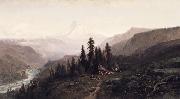
(Nov 18, 1838 - April 13, 1911) was a Scottish-American painter famous for his California landscapes.
Keith was born in Oldmeldrum, Aberdeenshire, Scotland, and emigrated to the United States in 1850. He lived in New York City, and became an apprentice wood engraver in 1856. He first traveled to the American West in 1858, after being assigned to do illustrations for Harper's Magazine. He moved to England briefly, working for the London Daily News. |
 |
William Henry Knight
|
|
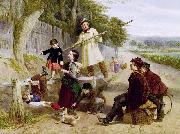
(26 September 1823 - 31 July 1863) was an English portrait and genre painter.
Knight was born in Newbury, Berkshire where his father, John Knight, was a schoolmaster. He was to become a solicitor, but gave up his law studies after two of his paintings were accepted by the annual exhibition of the Society of British Artists. He moved to London in 1855, taking lodgings in Kennington Road, Lambeth, and supporting himself by drawing crayon portraits while studying in the British Museum and in the schools of the Royal Academy.
|
 |
Willem Kalf
|
|
1619-1693
Dutch
Willem Kalf Galleries
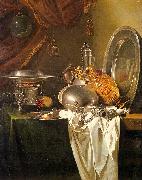
Willem Kalf was born in Rotterdam, in 1619. He was previously thought to have been born in 1622, but H. E. van Gelder??s important archival research has established the painter??s correct place and date of birth. Kalf was born into a prosperous patrician family in Rotterdam, where his father, a cloth merchant, held municipal posts as well. In the late 1630s, Willem Kalf travelled to Paris and spent time in the circle of the Flemish artists in Saint-Germain-des-Pr??s, Paris. In Paris he painted mainly small-scale rustic interiors and still-lifes. Kalf??s rustic interiors are typically dominated by groups of vegetables, buckets, pots and pans, which he arranged as a still-life in the foreground (e.g. Kitchen Still-life, Dresden, Gemäldegal; Alte Meister). Figures usually appeared only in the blurred obscurity of the background. Though painted in Paris, those pictures belong to a pictorial tradition practised primarily in Flanders in the early 17th century, by such artists as David Teniers the Younger. The only indication of the French origin of the paintings are a few objects that Flemish exponents of the same genre would not have pictured in their works. Kalf??s rustic interiors had a large influence on French art in the circle of the Le Nain brothers. The semi-monochrome still-lifes which Kalf created in Paris form a link to the banketjes or 'little banquet pieces' painted by such Dutch artists as Pieter Claesz, Willem Claeszoon Heda and others in the 1630s. During the 1640s, Kalf further developed the banketje into a novel form of sumptuous and ornate still-life (known as pronkstilleven), depicting rich groupings of gold and silver vessels. Like other still-lifes of this period, these paintings were usually expressing vanitas allegories. |
 |
Wilhelm von Kobell
|
|
1766-1853
German
Wilhelm von Kobell Gallery
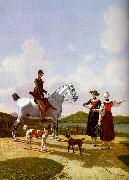
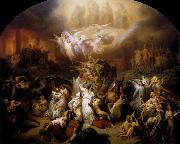
Kobell was born in Mannheim, the son of Ferdinand Kobell, a landscape painter who cited Claude Lorrain as his influence. Wilhelm's initial lessons were supplied by his father and his uncle, Franz Kobell. He received further training under Franz Anton, von Leydendorf and Egid Verhelst in the art of engraving at the Zeichnungsakademie in Mannheim. During this time he practiced various styles, including 17th-century Dutch painting and 18th-century English art. He was supported by Charles Theodore who compensated him an annual sum of 500 florins from 1792 until Theodore's death in 1799. Throughout his life Kobell traveled to England, France and Italy but ultimately based his style on Dutch art. |
 |
Wilhelm von Kaulbach
|
|
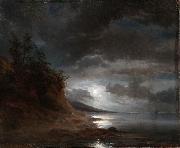
German Painter, ca.1804-1874,Painter and illustrator. After initial instruction from his father, Kaulbach received his principal education, from 1822 to 1826, at the Kunstakademie, Desseldorf, under Peter Cornelius. Six months after Ludwig I, King of Bavaria, had summoned Cornelius to Munich, Kaulbach followed his tutor to the Bavarian capital, where he worked on various collaborative ventures with other pupils of Cornelius, and completed his practical training on such projects as the decoration of the Odeon (destr.) in 1826, and of the Hofgartenarkaden, from 1826 to 1829 (now painted over). More independent work followed with 16 frescoes on the theme of Cupid and Psyche for the Festsaal of the Herzog-Max-Palais (1829-35; now Munich, Neue Pin.), |
 |
Wilhelm Krause
|
|
Wilhelm Krause (July 12, 1833 - February 4, 1910) was a German anatomist born in Hanover. In 1854 he earned his medical doctorate, and later (1860) became an associate professor at the University of Göttingen. In 1892 he was appointed head of the Anatomical Institute Laboratory in Berlin. He was the son of anatomist Karl Friedrich Theodor Krause (1797-1868).
Krause is remembered for the discovery and description of mechanoreceptors that were to become known as Krause's corpuscles, sometimes called "Krause's end-bulbs". His name is also associated with "Krause's membranes", which are isotropic bands in striated muscle fiber that consist of disks of sarcoplasm and connect the individual fibrils. In addition he performed pioneer research in the field of embryology. One of his well-known students at Göttingen was bacteriologist Robert Koch (1843-1910).
|
 |
Vilhelm Kyhm
|
|
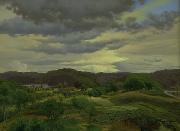
"Jysk skovegn" ("Jutland woodlands"), painted near Silkeborg in 1845 by Vilhelm Kyhn in the very beginning of his career, exhibited at Charlottenborg in 1846. Oil on canvas, 77,5x104 cm. |
 |
Tivadar Kosztka Csontvary
|
|
born 1853 - d. 1919) was a Hungarian painter. He was one of the first Hungarian painters to become well known in Europe.
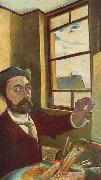
Csontvery was born on 5 July 1853 in Kisszeben, Seros County, Kingdom of Hungary (today Sabinov, Slovakia), and died 20 June 1919 in Budapest. His ancestors were Poles who settled down in Hungary. Although Csontvery was obsessed with his Magyar roots, he himself grew up speaking Slovak mixed with German. He was a pharmacist until his twenties. On a hot sunny afternoon, 13 October 1880, e when he was 27 years old e he experienced a mystic vision. He heard a voice saying "you will be the greatest sunway painter, greater than Raphael!" He took journeys around Europe, visited the galleries of the Vatican, then went home to collect money for his journeys working as an apothecary. From 1890 onwards he traveled around the world. He visited Paris, the Mediterraneum (Dalmatia, Italy, Greece), North Africa and the Middle East (Lebanon, Palestine, Egypt, Syria) and painted pictures. He painted his major works between 1903 and 1909. He had some exhibitions in Paris (1907) and Western Europe. Most of the critics in Western Europe recognized his abilities, art and congeniality, but in the Kingdom of Hungary during his life he was considered to be an eccentric crank for several reasons, e. g. for his vegetarianism, anti-alcoholism, anti-nicotinism, pacifism, his latent, but more and more apparent schizophrenia and his cloudy, prophetic writings and pamphlets about his life (Curriculum), genius (The Authority, The Genius) and religious philosophy (The Positivum). Even though later he was acclaimed, during his lifetime Csontvery's visionary, expressionistic style found little understanding. A loner by nature, the master's mental balance was upset by his efailuree impairing his creative power. Little did he know that some years after his death, an entire museum in Paris, Hungary, would be devoted to his paintings, and that worldwide appreciation of his works would be in constant ascendancy. Many painters, e.g. Picasso added a stone to Csontvery's cairn.
|
 |
Tilly Kettle
|
|
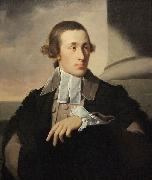
(1735-1786) was a portrait painter and the first English painter to work in India. He was born in London, the son of a coach painter, in a family that had been members of the Brewers' Company of freemen for five generations. He studied drawing with William Shipley in the Strand and first entered professional portraiture in the 1750s.
Kettle's first series of portraits appeared in the 1760s. His first surviving painting is a self-portrait from 1760, with his first exhibit at the Society of Artists in 1761. In 1762, he worked at restoring Robert Streater's ceiling fresco in the Sheldonian Theatre, Oxford, and painted Francis Yarborough, a doctor of Brasenose College, Oxford in 1763. He painted many members of the family of William Legge, 2nd Earl of Dartmouth. In 1764-5, he was active in London and continued exhibiting at the Society of Artists.
In 1768, Kettle sailed to India with the British East India Company, landing at Madras (now Chennai), where he remained for two years. There, he painted Lord Pigot and Muhammad Ali Kahn twice (once alone and once with five of his sons). He also painted non-portraits, including Dancing Girls (Blacks) in 1772 and a suttee scene in 1776 entitled, The ceremony of a gentoo woman taking leave of her relations and distributing her jewels prior to ascending the funeral pyre of her deceased husband. In 1770 Kettle painted a half-length portrait of 'Sir' Levett Hanson, a peripatetic writer on European knighthood and chivalry originally from Yorkshire. (The portrait is now in the collection of the Bury St Edmunds Manor House Museum.)
Kettle moved on to Calcutta (now Kolkata) in 1771 and painted Shuja ud-Daula and Dancing-Girl Holding the Stem of a Hookah. In 1775,he painted George Bogle, Warren Hastings' emissary to Tibet, in Tibetan dress, presenting a ceremonial white scarf to Lobsang Yeshe the 5th Panchen Lama.He also took an Indian mistress and had two daughters by her. |
 |
Thomas Kennington
|
|
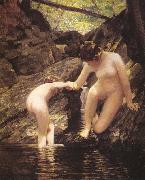
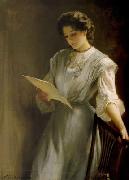
(7 April 1856 - 10 December 1916) was an English genre, social realist and portrait painter. He was a founder member of the New English Art Club (NEAC) and the Imperial Arts League.
Kennington was born in Grimsby in Lincolnshire and trained in art at the Liverpool School of Art (winning a gold medal), the Royal College of Art (RCA) in London, and the Academie Julien in Paris, where he studied under Bougereau and Robert-Fleury. He later moved to Chelsea in London.
He exhibited at the Royal Academy, London from 1880 - 1916, and also regularly showed his work at the Royal Society of British Artists (RBA) in Suffolk Street and the Grosvenor gallery. He was a founder member and first secretary of the New English Art Club (from 1886), and also founded the Imperial Arts League, whose stated purpose was to "protect and promote the interests of Artists and to inform, advise and assist...."He won a bronze medal at the Exposition Universelle of 1889.
cjr |
 |
Thomas De Keyser
|
|
1586-1667
Dutch
Thomas De Keyser Gallery
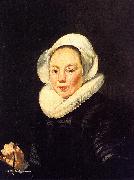
De Keyser excelled as a portrait painter, and was the most in-demand portrait painter in the Netherlands until the 1630s, when Rembrandt eclipsed him in popularity. Rembrandt was influenced by his work, and many of de Keyser's paintings were later falsely attributed to Rembrandt.
His portraiture is full of character and masterly in handling, and often distinguished by a rich golden glow of color and Rembrandtesque chiaroscuro. Some of his portraits are life-size, but the artist generally preferred to keep them on a considerably smaller scale, like the famous Four Amsterdam burgomasters assembled to receive Marie de Medici in 1638, now on display at the Mauritshuis museum in The Hague.
In addition to portraits, he also executed some historical and mythological pictures, such as the Theseus and Ariadne in the Amsterdam town hall, now the Royal Palace. De Keyser also worked as an architect. From 1662 until his death in 1667 he oversaw construction of the new Amsterdam town hall, now Royal Palace.
De Keyser was a son of the architect and sculptor Hendrik de Keyser. We have no definite knowledge of his training, and but scant information as to the course of his life. Aert Pietersz, Cornelis vander Voort, Werner van Valckert and Nicolas Elias are accredited by different authorities with having developed his talent.
In the 1640s, de Keyser received very few painting commissions, and was forced to seek income elsewhere. He owned a basalt business from 1640 until 1654, when he returned to painting.
The Rijksmuseum in Amsterdam has the largest collection of paintings by de Keyser. His work can also be seen at the Louvre in Paris, the Metropolitan Museum of Art in New York City, the Hermitage in Saint Petersburg and the National Gallery in London, among others.
The Stedelijk Museum modern art museum in Amsterdam carries a statue of de Keyser on its facade. A street in Enschede is named for him.
A contemporary namesake of the painter was Thomas de Keyser (Utrecht, 1597-1651), an actor and nephew of Hendrick de Keyser. |
 |
Theodor Kittelsen
|
|
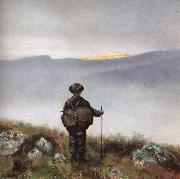
1857-1914,was a Norwegian artist born in the coastal town of Kragero in Norway. He is famous for his nature paintings on the one hand, and on the other hand for his illustrations of fairytales and legends, especially of trolls. For a time, Kittelsen studied painting and watchmaking. When his talent was discovered by Diderich Maria Aall, he attended classes at the School of Art in Christiania (the present Oslo). Because of generous financial support by Aall he was able to continue his study in Munich. However, in 1879 Diderich Aall could no longer manage to support him, so Kittelsen had to earn his money as a draughtsman for German papers and magazines. When back in Norway, he found nature to be a great inspiration. Kittelsen started to write texts to his drawings here. In 1881, Kittelsen was hired to illustrate Norwegian fairy-tales by the Norwegian folklore collector Peter Christen Asbjornsen. His style could be classified between (Neo-)Romantic and naive painting. As a national artist he is highly respected and well known in Norway, but does not receive much international attention, which is the reason that his name is hardly registered in registers of painters. Black metal bands such as Burzum have used nearly all of his pictures as album art, notably illustrations taken from Kittelsen book Svartedauen (The Black Death). |
 |
Theodor Kalide
|
|
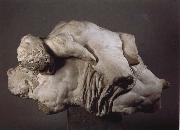
1801 Konigshutte-1863 Gleiwitz,German sculptor. At the age of 15 he was apprenticed at the K?nigliche Eisengiesserei in Gleiwitz, where he soon began sculpting cast-iron plaques. In 1819 Johann Gottfried Schadow summoned him to Berlin, where he was instructed in chasing by Cou? and worked in the Berlin Eisengiesserei. In 1821 he transferred to the studio of Christian Daniel Rauch. Following Rauch's example and under his influence, Kalide produced such large animal sculptures as the Resting Lion and the Sleeping Lion (several casts, e.g. zinc, 1824; Berlin, Schloss Kleinglienicke). From 1826 to 1830 Kalide worked on equestrian statuettes, including those of Frederick William II (zinc), after the model by Emanuel Bardou (1744-1818), and Frederick William III (e.g. cast iron; both Berlin, Schloss Charlottenburg, Schinkel-Pav.). In 1830 he became a member of the Berlin Akademie. His most popular works included the life-size bronze group Boy with a Swan (1836), which was installed on the Pfaueninsel in Berlin as a fountain (several casts, all untraced). Kalide achieved wide recognition and aroused violent controversy with his almost life-size marble figure Bacchante on the Panther (1848; Berlin, Schinkelmus., badly damaged). This work transgressed the accepted boundaries of classical art, above all in the figure's provocative pose, and was perceived as shocking. In its uninhibited sensuality and its blending of the human and the animal, it offended the conservative Berlin public, and consequently Kalide received few new commissions. He had no success with competition designs and became increasingly embittered. He spent his last years at Gleiwitz, where he died. |
 |
Teofil Kwiatkowski
|
|
(February 21, 1809, Pułtusk - August 14, 1891, Avallon, France) was a Polish painter.
Kwiatkowski participated in the November 1830 Uprising. After its suppression, he emigrated to France.
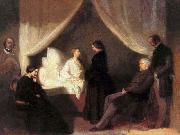
His artistic work includes many images of Frederic Chopin, including a picture of him playing at a ball at Paris's Hôtel Lambert and Chopin on His Deathbed (1849).
|
 |
Sir Godfrey Kneller
|
|
1649-1723
Dutch (Resident in UK)
Sir Godfrey Kneller Galleries
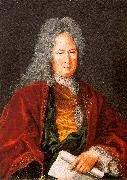
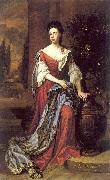
was the leading portrait painter in England during the late 17th and early 18th centuries, and was court painter to British monarchs from Charles II to George I. His major works include The Chinese Convert (1687); a series of four portraits of Isaac Newton painted at various junctures of the latter's life; a series of ten reigning European monarchs, including King Louis XIV of France; over 40 "Kit-cat portraits" of members of the Kit-Cat Club; and ten "beauties" of the court of William III, to match a similar series of ten beauties of the court of Charles II painted by his predecessor as court painter, Sir Peter Lely.
Sir John Vanbrugh in Godfrey Kneller's Kit-cat portrait, considered one of Kneller's finest portraits.Kneller was born Gottfried Kniller in L??beck, Germany. Kneller studied in Leiden, but became a pupil of Ferdinand Bol and Rembrandt in Amsterdam. He worked in Rome and Venice in the early 1670s, painting historical subjects and portraits, and later moved to Hamburg. He came to England in 1674, at the invitation of the Duke of Monmouth, accompanied by his brother, John Zacharias Kneller, who was an ornamental painter. He was introduced to, and painted a portrait of, Charles II. In England, Kneller concentrated almost entirely on portraiture. He founded a studio which churned out portraits on an almost industrial scale, relying on a brief sketch of the face with details added to a formulaic model, aided by the fashion for gentlemen to wear full wigs. His portraits set a pattern that was followed until William Hogarth and Joshua Reynolds.
Nevertheless, he established himself as a leading portrait artist in England. When Sir Peter Lely died in 1680, Kneller was appointed Principal Painter to the Crown by Charles II. In the 1690s, Kneller painted the Hampton Court Beauties depicting the most glamorous ladies-in-waiting of the Royal Court for which he received his knighthood from William III. He produced a series of "Kit-cat" portraits of 48 leading politicians and men of letters, members of the Kit-Cat Club. Created a baronet by King George I, he was also head of the Kneller Academy of Painting and Drawing 1711-1716 in Great Queen Street, London. His paintings were praised by Whig luminaries such as John Dryden, Joseph Addison, Richard Steele, and Alexander Pope.
Kneller died of fever in 1723 and his remains were interred in Twickenham Church (he was a churchwarden there when the 14th century nave collapsed in 1713 and was involved in the plans for its reconstruction). The site of the house he built in 1709 in Whitton near Twickenham is now occupied by the mid-19th century Kneller Hall, home of the Royal Military School of Music
|
 |
Shalva Kikodze
|
|
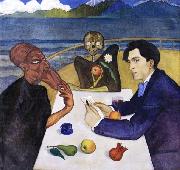
Shalva Kikodze (Georgian: შალვა ქიქოძე) (1894 ?C 1921) was a Georgian expressionist painter, graphic artist and theatre decorator. Together with Lado Gudiashvili and David Kakabadze, he is considered a key figure in Georgian art of the early 20th century.
He was born in a remote Georgian village Bakhvi, Guria, then part of the Russian Empire. From 1914 to 1918, he studied at Moscow School of Painting, Sculpture and Architecture. In 1916, he took part in an expedition to the Georgian village Nabakhtevi and made copies of the 15th-century murals from the local church. He stayed in his motherland for a short period of 1918-1920, and worked chiefly as a theater decorator for Jabadari Theater in Tbilisi. Afterwards he moved to Paris, where he, together with his fellow painters, Gudiashvili and Kakabadze, held an exhibition in 1921. He died in Freiburg, Germany, on November 7, 1921
|
 |
Samuel King
|
|
1748-1819
Samuel King Gallery
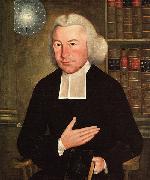
American painter, carver and nautical instrument maker. He was the son of Benjamin King, a mathematical and nautical instrument maker of Newport, RI. Samuel King's early portrait of the Rev. Ezra Stiles (New Haven, CT, Yale U. A.G.) is undoubtedly his masterpiece and a tour de force of symbolism. The portrait was begun in 1770 and completed on 1 August 1771. It shows the interest of the instrument maker in detail and exactitude of delineation. King's other known portraits show no such originality and in the main reflect compositions taken from portraits known to have been hanging in Newport at the time or from English prints. Since Samuel King and Charles Bird King (unrelated) were neighbours on Clarke Street in Newport, he probably influenced Charles Bird King. Washington Allston and Ann Hall (1792-1863) were both Samuel King's pupils. |
 |
Salomon Koninck
|
|
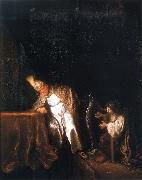
Dutch Baroque Era Painter, 1609-1656,was a Dutch painter of genre scenes and portraits and engraver. Koninck was the son of a goldsmith, originally from Antwerp, and was a nephew of Philips de Koninck. Salomon became a pupil of Pieter Lastman, David Colijns, Francois Venants and Claes Corneliszoon Moeyaert. From 1630 he was a member of the Sint Lucasgilde. He moved in the circles of Rembrandt and the academy of Hendrick van Uylenburgh, making many copies of Rembrandt's compositions. His paintings have a warm colour palette and include "the philosopher". |
 |
Robert Talbot Kelly
|
|
(1861 - 1934) was an English orientalist landscape and genre painter, author and illustrator.
Kelly was born in Birkenhead, Cheshire, the son of Irish landscape artist Robert George Kelly. He left school in 1876 to take up work in a firm of cotton traders, but was also taught art by his father, exhibiting under the name R. G. Kelly Jnr.
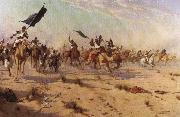
In the early 1880s, inspired by the places he saw while on vacation on an ocean cruise ship, Talbot-Kelly decided to take up his father's profession. He left his employment in 1882, travelled by boat to North Africa, and settled in Egypt in 1883, acquiring a studio in Cairo and becoming fluent in Arabic. He travelled throughout the country, writing about and painting the people and scenes he encountered both in towns and in the desert. He spent a considerable time with the Bedouin tribes who he described and illustrated in his 1902 book, "Egypt painted and described" (A & C Black). As his name became known he also earned an income from private commissions. He stayed in Egypt until 1915 when for reasons of health and age he returned to London - though he continued to paint constantly.
An Arab cafe in Cairo (from "Egypt painted and described", 1902)"Egypt painted and described", his first illustrated travel book, was published in 1902 (by A & C Black), and was an account of his impressions and experiences of that country during his long stay there; an exhibition of his Egyptian views was also held at the Fine Art Society in the same year. His paintings and writing showed a great empathy and respect for local people and culture, especially that of the desert Bedouin Arabs. |
 |
Robert Koehler
|
|
American Painter, 1850-1917
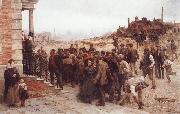
was a German born painter and art teacher who spent most of his career in the United States of America. Koehler was born in Hamburg; his family spelled their name Köhler until they moved to Milwaukee, Wisconsin in Robert's childhood. There he attended the historic German-English Academy. Koehler studied art from Henry Vianden and apprentice himself to a lithography firm. After some time working as a lithographer in New York City, Koehler went to Munich to study fine art at the Royal Academy in 1873. Koehler's work while in Munich won him silver and bronze awards from the Academy, and Bavaria's Cross of the Order of St. Michael. Koehler then set himself up as head of a private art school; pupils included Alfons Mucha. In 1892 Robert Koehler returned to New York City to work as a portrait artist. The following year he moved to Minneapolis, Minnesota, accepting an offer to be the director of the Minneapolis School of Fine Arts (now the Minneapolis College of Art and Design) Koehler was also involved with the establishment of Minneapolis' Museum of Fine Art, now the Minneapolis Institute of Arts. |
 |
Pieter de Kempener
|
|
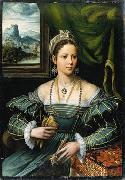
Pedro Campana (1503-1586) was a Flemish painter of the Renaissance period, mainly active in Italy and Spain. His actual name was Pieter de Kempeneer, translated into French as Champaigne, and was also known as Peter Van de Velde.
Born in Brussels, he trained there with Bernard Van Orley. His early life appears to have been spent in Italy, where he carefully studied the paintings of Raphael, and declared himself as his pupil. In 1530 he was at work at some scene-painting, representing a triumphal arch to be erected on the occasion of the coronation of Charles V, Holy Roman Emperor in Bologna, and he then left for Spain, on the advice, it is said, of Cardinal Domenico Grimani, and spent the rest of his life in that country, only returning to Brussels about 1563 or 1565.
Between 1537 and 1562 he was associated with Luis de Vargas and the Italian sculptor Torregiano in establishing a school of painting in Seville, which eventually became the academy of the place; amongst the pupils educated in it was Morales. He painted for the monastery of St. Mary of Grace, Church of Santa Cruz, in the city, an altar-piece representing the Descent from the Cross (1548), which is now in the cathedral, having been removed there when the church fell into ruins. There are other works by the same painter in Seville Cathedral, especially two representing the Purification of the Virgin and the Resurrection; and the various churches of the city, S. Isidoro, S. Pedro, S. Catalina, and S. Juan, all possess paintings by this artist. One of his last works was the restoration and repainting of a chapel belonging to Hernando de Jaen, an important resident of Seville. Murillo requested that he be buried near Campana's picture, and his burial took place in the Church of Santa Cruz, close underneath the Descent from the Cross, but the whole building was burned to the ground during the Napoleonic Wars, and the tomb perished. |
 |
Philips Koninck
|
|
1619-1688
Dutch
Philips Koninck Gallery
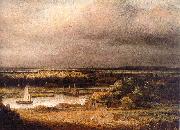
Little is known of his history except that he was said to be a pupil of Rembrandt, whose influence is to be seen in much of his work. He painted chiefly broad, sunny landscapes, full of space, light and atmosphere; they are seen from a high perspective, allowing a prominent view of the sky. Portraits by him, somewhat in the manner of Rembrandt, also exist (e.g. see Joost van den Vondel); there are examples of these in the galleries at Copenhagen and Oslo. Of his landscapes, the principal are View at the mouth of a river at the Hague, with a slightly larger replica in the National Gallery, London; Woodland border and countryside (with figures by Adriaen van de Velde) at Amsterdam; and landscapes in Brussels, Florence (the Uffizi), Berlin and Cologne. Koninck, a prosperous businessman, appears to have painted few pictures during the last decade of his life.
Several of his works have been falsely attributed to Rembrandt and many more to his namesake and fellow townsman Salomon de Koninck (1609-1656), also a disciple of Rembrandt, whose paintings and etchings consist mainly of portraits and biblical scenes.
Both of these painters are to be distinguished from David Koninck (1636?-1687), also known as Rammelaar. David Koninck was born in Antwerp and studied there under Jan Fyt. He later settled in Rome, where he is stated to have died in 1687; this, however, is doubtful. His pictures are chiefly landscapes with animals and still life.
|
 |
Per Krafft the Elder
|
|
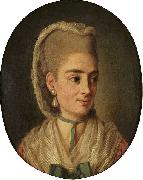
(16 January 1724, Arboga - 7 November 1793, Stockholm) was a Swedish portraitist. He was the father of the artists Per Krafft the Younger and Wilhelmina Krafft.
|
 |
Peder Severin Kroyer
|
|
Norwegian-born Danish Painter, 1851-1909
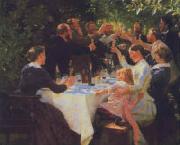
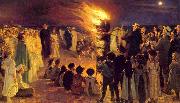
Norwegian-Danish painter, was born in Stavanger, Norway to Ellen Cecilie Gjesdal. He is one of the best known and beloved, and undeniably the most colorful of the Skagen Painters, a community of Danish and Nordic artists who lived, gathered or worked in Skagen, Denmark, especially during the final decades of the 1800s. Krøyer was the unofficial leader of the group. The mother having been judged unfit, he was given to be cared for by Gjesdal's sister and the sister's husband. Along with the foster parents, he moved to Copenhagen soon afterwards. He began his art education at nine years of age under private tutelage, and was enrolled in Copenhagen's Technical Institute the following year. In 1870 at the age of 19 he completed his studies at the Royal Danish Academy of Art (Det Kongelige Danske Kunstakademi), where he studied with Frederik Vermehren. In 1873 he was awarded the gold medal and a scholarship. His official debut as a painter was in 1871 at Charlottenborg with a portrait of a friend, painter Frans Schwartz. He exhibited regularly at Charlottenborg throughout his lifetime. In 1874 Heinrich Hirschsprung bought his first painting from Krøyer, |
|
|
Peder Severin Kroyer
|
|
(23 July 1851 - 21 November 1909), known as P.S. Krøyer, was a Norwegian-Danish painter. He is one of the best known and beloved, and undeniably the most colorful of the Skagen Painters, a community of Danish and Nordic artists who lived, gathered or worked in Skagen, Denmark, especially during the final decades of the 19th century. Krøyer was the unofficial leader of the group.
|
 |
Paul Klee
|
|
German
1879-1940
Paul Klee Gallery
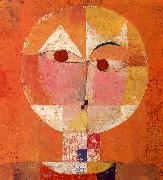
was a Swiss painter of German nationality. His highly individual style was influenced by many different art trends, including expressionism, cubism, and surrealism. He was a student of orientalism. Klee was a natural draftsman who experimented with and eventually mastered color theory, and wrote extensively about it. His works reflect his dry humor and his sometimes child-like perspective, his personal moods and beliefs, and his musicality. He and his friend, the Russian painter Wassily Kandinsky, were also famous for teaching at the Bauhaus school of art and architecture. |
 |
Paul Kane
|
|
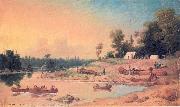
(September 3, 1810 - February 20, 1871) was an Irish-born Canadian painter, famous for his paintings of First Nations peoples in the Canadian West and other Native Americans in the Oregon Country.
A largely self-educated artist, Kane grew up in Toronto (then known as York) and trained himself by copying European masters on a study trip through Europe. He undertook two voyages through the wild Canadian northwest in 1845 and from 1846 to 1848. The first trip took him from Toronto to Sault Ste. Marie and back. Having secured the support of the Hudson's Bay Company, he set out on a second, much longer voyage from Toronto across the Rocky Mountains to Fort Vancouver and Fort Victoria in the Columbia District, as the Canadians called the Oregon Country. |
 |
Orest Kiprensky
|
|
1782-1836
Russian
Orest Kiprensky Galleries
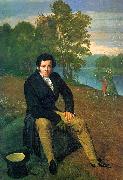
Orest was born in the village of Koporye near Saint Petersburg on 24 March [O.S. 13 March] 1782. He was an illegitimate son of a landowner Alexey Dyakonov, hence his name, derived from Kypris, one of the Greek names for the goddess of love. He was raised in the family of Adam Shvalber, a serf. Although Kiprensky was born a serf, he was released from the serfdom upon his birth and later his father helped him to enter a boarding school at the Imperial Academy of Arts in Saint Petersburg in 1788 (when Orest was only six years old).
He studied at the boarding school and the Academy itself until 1803. He lived at the Academy for three more years as a pensioner to fulfill requirements necessary to win the Major Gold medal. Winning the first prize for his work Prince Dmitri Donskoi after the Battle of Kulikovo (1805) enabled the young artist to go abroad to study art in Europe.
A year before his graduation, in 1804, he painted the portrait of Adam Shvalber, his foster father (1804), which was a great success. The portrait so impressed his contemporaries, that later members of the Naples Academy of Arts took it for the painting by some Old Master - Rubens or van Dyck. Kiprensky had to ask the members of the Imperial Academy of Arts for letters supporting his authorship.
Wikimedia Commons has media related to: Orest Kiprensky
After that, Kiprensky lived in Moscow (1809), Tver 1811, Saint Petersburg 1812, in 1816-1822 he lived in Rome and Napoli. In Italy he met a local girl Anne Maria Falcucci (Mariucci), to whom he became attached. He bought her from her dissolute family and employed as his ward. On leaving Italy, he sent her to a Roman Catholic convent.
In 1828, Kiprensky came back to Italy, as he got a letter from his friend Samuel Halberg, informing him that they had lost track of Mariucci. Kiprensky found Mariucci, who had been transferred to another convent. In 1836 he eventually married her. He had to convert into Roman Catholicism for this marriage to happen. He died by pneumonia in Rome later that year.
|
 |
Nils Kreuger
|
|
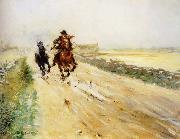
Swedish, 1858-1930,Swedish painter, draughtsman and illustrator. From 1874 he studied at the Konstakademi in Stockholm, where he soon became a friend of Richard Bergh and Karl Nordstrem, both of whom were later prominent exponents of the more advanced Swedish painting of the 1880s and 1890s. After being forced to interrupt his studies because of illness, Kreuger trained from 1878 at the art school of Edvard Perseus (1841-90) in Stockholm before he travelled to Paris, where he stayed for the most part until 1887. He made his d?but at the Paris Salon in 1882, and he also resided in the artists' colony in Grez-sur-Loing. During this period he painted such works as Old Country House (1887; Stockholm, Nmus.) with a free brushwork and sense of light that owed much to Jules Bastien-Lepage. In 1885 Kreuger was active in organizing the Opponenterna, a protest movement led by Ernst Josephson against the conservative establishment of the Konstakademi in Stockholm, and the following year he helped to found the Konstn?rsf?rbund (Artists' Union). Like the majority of the Konstnersferbund's members, Kreuger abandoned the French-inspired plein-air realism of the 1880s for symbolically coloured National Romanticism in the 1890s. For Kreuger this change took place between 1893 and 1896 in Varberg on the west coast of Sweden, where, together with Bergh and Nordstrem, he founded the Varberg Group. Drawing on Paul Gauguin's Synthetism, the group contributed to the formation of the National Romantic style of the 1890s in Sweden. Kreuger's encounter with van Gogh's drawings at an exhibition in Copenhagen in 1893 also played a decisive role in his development. He devised an intensely personal style in which the landscape was composed in large blocks that were then covered by a pattern of directional lines and dots in India ink (somewhat in the manner of van Gogh's late landscape drawings) to bring out the painting's colour values and create an effect of decoratively stylized forms: for example Spring in Halland (1894; Stockholm, Nmus.). Kreuger was also a prolific draughtsman and illustrator. |
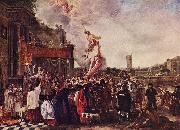 |
Nikolaus Knupfer
|
|
(1609 - 1655) was a Dutch Golden Age painter.
Knepfer was trained in Leipzig, where according to Houbraken he was apprenticed to Emanuel Nysen. He then moved to Magdeburg where he found work making brushes for artists. He stayed there until 1630, and then moved to Utrecht to work with Abraham Bloemaert. He lived with him for two years and then established his own studio in Utrecht, where in 1637 he became a visiting member of the Guild of St. Luke. He worked on the decorations of the castle Kronborg in Denemarken, and painted figures in the landscapes of Jan Both and Jan Baptist Weenix. Knepfer was a successful teacher, whose students were great painters after him, such as Jan Steen, Gabriel Metsu, Ary de Vois, and Pieter Crijnse Volmarijn. |
|