|
 |
Leon Benouville
|
|
Paris 1821 - Paris 1859.
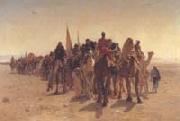
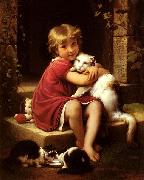
was a French painter. Leon Benouville first studied with his elder brother Jean-Achille Benouville (1815-1891) in the studio of François-Edouard Picot before he transferred to Ecole des Beaux-Arts in 1837. Like his brother he received the Prix de Rome in 1845. In Rome, as a Prix de Rome pensionary at the Villa Medici, he stayed with his brother and met the sculptor Charles Gumery. |
 |
Leon Bazille Perrault
|
|
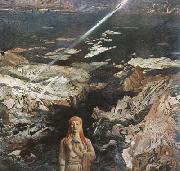
(20 June 1832, Poitiers - 1908, Royan) was a French painter.
A student of William Bouguereau and François-Edouard Picot, he exhibited at the Salon from 1863 onwards, producing several works, in the academic tradition. He was famous for his le petit naufrag (The little shipwrecked boy, 1874) and his paintings of children.
|
 |
Leon Bakst
|
|
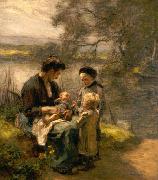
Russian Art Deco Designer and Illustrator, 1866-1924 |
 |
Leon Augustin Lhermitte
|
|
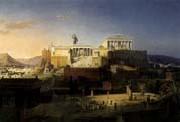
(1844 - 1925) was a French realist painter and etcher whose primary subject matter was of rural scenes depicting the peasant worker.
He was born in Mont-Saint-Pere. A student of Lecoq de Boisbaudran, he gained recognition after his show in the Paris Salon in 1864.
His many awards include the French Legion of Honour (1884) and the Grand Prize at the Exposition Universelle in 1889. Lhermitte died in Paris in 1925.
Lhermittees innovative use of pastels won him the admiration of his contemporaries. Vincent Van Gogh wrote that eIf every month Le Monde Illustre published one of his compositions ... it would be a great pleasure for me to be able to follow it. It is certain that for years I have not seen anything as beautiful as this scene by Lhermitte ... I am too preoccupied by Lhermitte this evening to be able to talk of other things.e
Lhermitte's etchings and paintings are housed in museums around the world including Boston, Washington, Chicago, Montreal, Brussels, Rheims, Paris, Moscow and Florence.
|
 |
Leo von Klenze
|
|
German Architect and Painter, 1784-1864,was a German neoclassicist architect, painter and writer. Court architect of Bavarian King Ludwig I, Leo von Klenze was one of the most prominent representatives of Greek revival style. Von Klenze studied architecture in Berlin and Paris. Between 1808 and 1813 he was a court architect of Jerome Bonaparte, King of Westphalia. Later he moved to Bavaria and in 1816 began to work as court architect of Ludwig I. The King's passion for Hellenism shaped the architectural style of von Klenze. He built many neoclassical buildings in Munich, including the Ruhmeshalle and Monopteros temple. On Konigsplatz he designed probably the best known modern Hellenistic architectural ensemble. Near Regensburg he built the Walhalla temple, named after Valhalla, the home of gods in Norse mythology. When Greece won its independence, Ludwig I's son Otto became the country's first king. Von Klenze was invited to Athens to submit plans of city reconstruction in the style of Ancient Greece. Russian Emperor Nicholas I commissioned von Klenze to design a building for the New Hermitage, a public museum that housed Greek, Roman, and Egyptian antiquities. Von Klenze also designed and arranged museum galleries in Munich, including the Glyptothek and Alte Pinakothek. Von Klenze was not only an architect, but also an accomplished painter and draughtsman. In many of his paintings ancient buildings were depicted. Those served as models for his own architectural projects. Klenze studied ancient architecture during his travels to Italy and Greece. He also participated in excavations of ancient buildings in Athens and submitted projects for the restoration of the Acropolis. Klenze collected works of important contemporary German painters. He sold his collection, including 58 landscapes and genre paintings, to King Ludwig I in 1841. |
 |
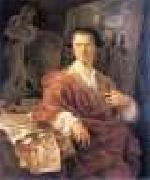
Leo Putz
|
|
Germany (1869 -1940 ) - Painter
|
 |
LENS, Andries Cornelis
|
|
Flemish painter (b. 1739, Antwerpen, d. 1822, Bruxelles).
Flemish painter and writer. He was the son of the flower painter Cornelis Lens (d after 1766) and studied first under Charles Ykens II (1719-53) and then under Balthazar Beschey. In 1756 he was awarded first prize at the Academie of Antwerp and in 1763 was appointed to the staff on the strength of his decoration (destr.) of the refectory of the Alexians at Lier. He also came to the attention of Charles Alexandre, Duke of Lorraine and Bar, Governor-General of the Netherlands |
 |
lennart nilsson
|
|
1992, intestines of a new-born baby . colour photograph. lennart nilsson photography ab, stockholm |
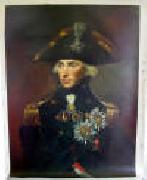 |
Lemuel Francis Abbott
|
|
1760-1803
Lemuel Francis Abbott Locations
English painter. He was the son of a clergyman and went to London to study with Francis Hayman shortly before the latter death in 1776; he may have completed his studies in Derby with Joseph Wright of Derby. By the early 1780s Abbott had established a busy portrait practice in London. The formula he adopted for most of his head-and-shoulder portraits can be seen in Sir William Herschel (1785; London, N. Mar. Mus.): the body is parallel to the picture plane, and the sitter head is moved into three-quarter profile, as if his attention has been suddenly distracted. In later portraits, such as those of fellow artists Francesco Bartolozzi (c. 1792; London, Tate) or Joseph Nollekens (c. 1797; London, N.P.G.), the sitter hand or some attribute balances the movement of the head. Only male portraits by Abbott are known, and his patrons were mostly drawn from the professional classes, particularly the Navy; there are several versions of Lord Nelson (e.g. 1798; London, N. Mar. Mus.). His style is crisp but scratchy in technique, and often the anatomy of his figures is inaccurate. Paint is handled in a manner comparable with that of Gainsborough Dupont, but Abbott sense of composition is superior. In 1798 he was certified insane, but he continued to exhibit at the Royal Academy in London for two further years. Several of his works were probably finished by another hand. |
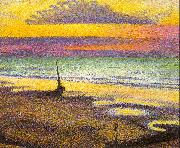 |
Lemmen, Georges
|
|
Belgian Art Nouveau Painter, 1865-1916
Belgian painter and decorative artist. He showed a precocious talent, first exhibiting in 1875. His only formal study was at a local school of drawing. Between 1884 and 1886 he showed at the Essor group in Brussels paintings that were based on Derer and Holbein and closely related to those of Lemmen's contemporary, Khnopff. When Lemmen became a member of Les XX in 1888 his style developed quickly, influenced principally by French Neo-Impressionism and the English Arts and Crafts Movement. Lemmen adopted the pointillist technique following Seurat's first showing with Les XX in 1887. His best pointillist canvases include The Carousel (1890-91; Toulon, Mme Thevenin-Lemmen priv. col., see Belgian Art, 1880-1914, exh. cat., New York, Brooklyn |
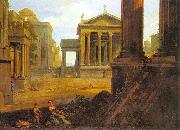 |
Lemaire, Jean
|
|
1763-64, oil on canvas, The Hermitage, St. Petersburg |
 |
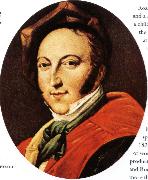
LELY, Sir Peter
|
|
Dutch/English painter (b. 1616, Soest, d. 1680, London
Dutch painter, draughtsman and collector, active in England. By a combination of ability and good fortune, he rapidly established himself in mid-17th-century London as the natural successor in portrait painting to Anthony van Dyck. Between van Dyck's death in 1641 and the emergence of William Hogarth in the 1730s, Lely and his successor, Godfrey Kneller, were the leading portrait painters in England. After the restoration of the monarchy in 1660, Lely dominated the artistic scene, and his evocation of the court of Charles II is as potent and enduring as was van Dyck's of the halcyon days before the English Civil War. Although Lely's reputation was seriously damaged by portraits that came from his studio under his name but without much of his participation, his development of an efficient studio practice is of great importance in the history of British portrait painting. The collection of pictures, drawings, prints and sculpture |
 |
leigh hunt
|
|
British writer who defended the romanticism of Keats and Shelley (1784-1859)
Synonyms: Hunt, James Henry Leigh Hunt |
 |
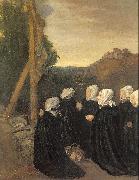
Leibl, Wilhelm
|
|
German Realist Painter, 1844-1900
German painter, draughtsman and etcher. In 1861 he abandoned his apprenticeship as a locksmith in order to train as a precision instrument maker, though a month or so later he decided to train as an artist, at first under the Cologne history painter and writer Hermann Becker (1817-85). In 1863 he moved to Munich; he studied there from March 1864, at the Akademie der Bildenden K?nste, initially under Philipp von Foltz and Alexander Straehuber, drawing from plaster casts, and later in Hermann Ansch?tz's painting class. Here, Arthur von Ramberg (1819-75) stimulated Leibl's sensitivity to colour; and Karl Theodor von Piloty encouraged him to observe reality and incorporate its lessons boldly into compositions on historical themes. From the start, however, Leibl tended to think of his pictures in terms of form rather than content. While at the Akademie he first reached a standard of excellence with his draughtmanship, which is notable for its directness and objectivity. As an artist, Leibl's early works were not especially promising. However, as occurred throughout his career, a long period of mediocrity was crowned by an unexpected masterpiece, such as his portrait drawing of Aunt Josepha (c. 1864; Cologne, Wallraf-Richartz-Mus.). This is particularly striking for Leibl's use of the hands to add to the expression of the sitter's character and mood, a device he was to use frequently in later work. In Munich, Leibl supplemented the teaching of the Akademie by studying the works of the Old Masters in the Alte Pinakothek: he paid particular attention to painters of the Baroque period such as van Dyck, Cornelis de Vos and Rubens, and also to other great masters of portraiture such as Frans Hals and Vel?zquez. The presentation of the subject found in such works is reflected in Leibl's portrait of Frau Gedon (1869; Munich, Neue Pin.). When the work was shown at the Grossen Internationale Kunstausstellung in Munich in 1869 it was singled out as the best oil painting of the exhibition by Gustave Courbet and, as a result, Leibl was honoured with an invitation to Paris, where he arrived on 13 November 1869. |
 |
Legros, Alphonse
|
|
French-born British Painter and Sculptor, 1837-1911
British etcher, painter, sculptor and teacher of French birth. He is said to have been apprenticed at the age of 11 to a sign-painter, at which time he may also have attended classes at the Ecole des Beaux-Arts in Dijon. He was employed as assistant on a decorative scheme in Lyon Cathedral before moving in 1851 to Paris, where he worked initially for the theatre decorator C. A. Cambon (1802-75). He soon became a pupil of Horace Lecoq de Boisbaudran, whose methodical instruction and liberality in fostering individual talent proved of lasting benefit to Legros. In 1855 he enrolled at the Ecole des Beaux-Arts, Paris, attending irregularly until 1857. During this period Legros had a taste for early Netherlandish art and for French Romanticism, which was later superseded by his admiration for Claude, Poussin and Michelangelo. |
 |
LEDESMA, Blas de
|
|
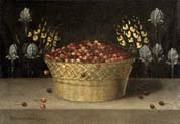
Spanish painter documented 1602-1614 in Granada,Spanish painter. He is known to have worked in Granada from 1602, and in 1614 he designed a stucco vault decoration for the Alhambra. Archival sources testify to his renown as a painter of decorative fresco grotesques (untraced) and still-lifes. His activity as a still-life painter remains debatable, partly because he has been confused with Blas de Prado and also because of Torres Marten's controversial attributions. Ledesma's only unanimously accepted autograph painting is Still-life with Cherries and Flowers (Atlanta, GA, High Mus. A.), signed in Granada. A highly decorative painting, it shows none of the sophistication of still-lifes by Juan Senchez Cot?n, in Granada from 1603. It is painted meticulously and drily. Depicting a severely drawn, rather flat basket on a narrow ledge flanked by flowers behind it, the rigorously symmetrical composition is relieved only by soft lighting and the studied disarray of some fallen cherries. Two other unsigned and poorly preserved still-lifes of analogous subject-matter have been attributed to Ledesma |
 |
Lebasque, Henri
|
|
French Painter, 1865-1937
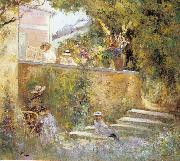
was born in 1865 at Champign (Maine-et-Loire). He started his education at the Ecole des Beaux-Arts d'Angers, and moved to Paris in 1886. Here, Lebasque started studying under Leon Bonnat, and assisted Humbert with the decorative murals at the Pantheon. Around this time, Lebasque met Camille Pissarro and Auguste Renoir, who later would have a large impact on his work. Lebasque's vision was coloured by his contact with younger painters, especially Edouard Vuillard and Pierre Bonnard, founders of the The Nabis' Group and the Intimists who first favoured the calm and quietude of domestic subject matter. From his first acquaintance with Georges Seurat and Paul Signac, Lebasque learnt the significance of a colour theory which stressed the use of complementary colours in shading. Lebasque was a founding member of the Salon d'Automne in 1903 with his friend Henri Matisse. Two years later a group of artists exhibited there including Georges Rouault, Andre Derain, Edouard Vuillard and Henri Matisse while keeping solid links with other artists such as Gustave Rouault, Raoul Dufy, Louis Valtat and especially Henri Manguin, who made him discover the south of France. His time in South of France would lead to a radical transformation in Lebasque's paintings, changing his colour palette forever. Other travels included the Vendee, Normandie and Brittany, although Lebasque would always prefer the small idyllic villages of the South of France. Lebasque had some commercial success during his lifetime. He worked on the decorations at the theatre of the Champs-Elyses and of the Transatlantique sealiner. |
 |
Lear, Edward
|
|
English Painter and Illustrator, 1818-1888
English painter, draughtsman, illustrator and writer. In the 1860s Lear described himself as 'Greek Topographical Painter par excellence', aspiring to the title of 'Painter-Laureate and Boshproducing-Luminary forthwith' (quoted in 1983 exh. cat., p. 14). This whimsical summary of his versatile activities as topographical draughtsman, oil painter, traveller, writer and illustrator of nonsense rhymes and stories is typical of Lear's idiosyncratic literary style. It reflected his eccentric personality. He was epileptic and prone to fits of deep depression. In addition, owing to family misfortunes, |
 |
LE SUEUR, Eustache
|
|
French painter (b. 1616/17, Paris, d. 1655, Paris).
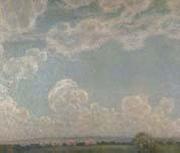
French painter and draughtsman. He was one of the most important painters of historical, mythological and religious pictures in 17th-century France and one of the founders of French classicism. He was long considered the 'French Raphael' and the equal of Nicolas Poussin and Charles Le Brun. His reputation reached its zenith in the first half of the 19th century, but since then it has been in decline, largely as a result of the simplified and saccharine image of the man and his art created by Romantic writers and painters. Nevertheless, more recent recognition of the complexity of his art has resulted in a new interest in him and in his place in the evolution of French painting in the 17th century. Despite the almost total absence of signed and dated works, the chronology of Le Sueur's oeuvre can be established with the aid of a few surviving contracts, |
 |
Le Sidaner Henri
|
|
Ile Maurice 1862-Versailles,1939
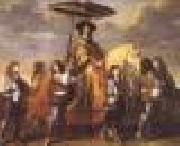
was an impressionist painter born to a French family in Port Louis, Mauritius. In 1870 he and his family settled in Dunkirk. Le Sidaner received most of his tutelage from the Ecole des Beaux-Arts under the instruction of Alexandre Cabanel but later broke away due to artistic differences. He traveled extensively throughout France and also visited many cities around the globe such as London, New York, Venice and Paris as well as some small villages throughout Europe. Le Sidaner exhibited at the Salon, the Galeries Georges Petit in Paris and the Goupil Gallery in London. He lived in Gerberoy, France. Le Sidaner's work was referenced in Marcel Proust's novel In Search of Lost Time. |
 |
LE BRUN, Charles
|
|
French painter (b. 1619, Paris, d. 1690, Paris)
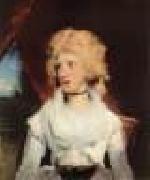
French painter and designer. He dominated 17th-century French painting as no other artist; it was not until over a century later, during the predominance of Jacques-Louis David, that artistic authority was again so concentrated in one man. Under the protection of a succession of important political figures, including Chancellor Pierre S?guier, Cardinal Richelieu and Nicolas Fouquet, Le Brun created a series of masterpieces of history and religious painting. For Louis XIV and his chief minister Jean-Baptiste Colbert he executed his greatest work, the royal palace of Versailles: an almost perfect ensemble of architecture, decoration and landscape. After Colbert's death in 1683, he was no longer able to count on prestigious commissions |
 |
LAWRENCE, Sir Thomas
|
|
English painter (b. 1769, Bristol, d. 1830, London).
Thomas Lawrence was born in Bristol on May 4, 1769. At Devizes, where his father was landlord of the Black Bear Inn, Thomas's talents first became known. Fanny Burney, a prodigy herself, reports that in 1780 Sir Joshua Reynolds had already pronounced Lawrence the most promising genius he had ever met. When Thomas was 10, his father moved the family to Oxford and then to Bath to take advantage of the portrait skill of his son. At the age of 17 Lawrence began to paint in oil, all his previous work having been in pastel. In 1787 the family moved to London, and by 1789 he was challenging Reynolds. When Reynolds died in 1792, Lawrence was appointed to the lucrative post of painter in ordinary to the king. He soon became the foremost portrait painter in England, a position he maintained until his death. His portraits of women are models of beauty and elegance, whether the sitter be a tragic actress like Mrs. Siddons, a social figure like the Princess de Lieven, or a personal friend. At the close of the Napoleonic Wars, Lawrence was knighted and commissioned to paint the leading sovereigns and statesmen of Europe. When he returned to England in 1820, he was elected president of the Royal Academy; he handled the affairs of his office with tact and urbanity. He died on Jan. 7, 1830. Following the English masters of the 18th century, Reynolds, Thomas Gainsborough, and George Romney, Lawrence carried on the great tradition of society portraiture and raised it to new heights of dash and elegance, though not of psychological penetration. He was by no means an artist of the astonishing insight of Gainsborough, and he did not have the occasionally disconcerting originality of Reynolds. Lawrence had their faults: all were affected by the distorting demands of their fashionable clientele, and all succumbed to them. He had the least to say, and he reflected his sitters' own best views of themselves, yet even they must sometimes have been surprised at their own magnificence. Handsome his portraits undoubtedly are; all the women are strikingly beautiful, the men brave and distinguished. Lawrence enjoyed his great success. He lived for his work, never married, and was a prodigious worker. He was of an exceptionally generous nature, as an artist and as a man, with a rare talent for appreciating and encouraging the talents of others. He was an ardent collector of Old Master drawings; his collection, which was dispersed after his death, |
 |
Lavinia Fontana
|
|
Italian Painter, 1552-1614
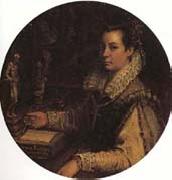
Daughter of Prospero Fontana. She was trained by her father and followed his Mannerist style. Her first recorded works, which date from 1575, were small paintings for private devotion, such as the Holy Family (Dresden, Gemeldegal.). By 1577 she had become established as a portrait painter in Bologna. Works of this date include the Self-portrait at the Harpsichord (Rome, Gal. Accad. S Luca) and the portrait of Senator Orsini (Bordeaux, Mus. B.-A.). Her portrait style reflects the formality of central Italian models as well as the naturalistic tendencies of the north Italian tradition. The elegantly costumed Orsini is shown seated at a table, with a suite of rooms opening behind him, a setting recalling such Florentine portraits of the 1530s as Agnolo Bronzino's Bartolommeo Panciatichi (Florence, Uffizi). Lavinia used a similar setting for other portraits, including the Gozzadini Family (1584; Bologna, Pin. N.). Female sitters are also shown in elaborate dress, with particular attention paid to details of embroidery and jewels, and they are often accompanied by small dogs |
 |
Laurits Tuxen
|
|
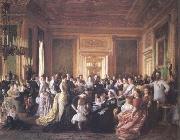
Danish Painter, 1853-1927
was a Danish painter specialising in figure painting. He was also associated with the Skagen group of painters. Tuxen grew up in Copenhagen and studied at the Royal Danish Academy of Art where together with P.S. Krøyer he was considered to be one of the best painters. He first visited Skagen in 1870 and he returned on several occasions. In the 1880s and 1890s, he travelled widely painting portraits for Europe's royal families including Christian IX of Denmark, Queen Victoria and the Russian royalty. In 1901, after the death of his first wife Ursule, he married the Norwegian Frederikke Treschow and shortly aferwards purchased Madam Bendsen's house at the artists' colony in Skagen in the north of Jutland, converting it into a stately summer residence. |
 |
Laurits Andersen Ring
|
|
Danish, 1854-1933
Laurits Andersen Ring (1854-1933) was one of the foremost painters of Danish symbolism. He was born as Laurits Andersen in the village Ring in southern Zealand. In 1881 he the took the name of his birth place, and was since known as L.A. Ring.
For a while, he lived at Baldersbronde near Hedehusene in the old school building, which was later to be the home of another painter, Ludvig Find. Ring has produced several paintings from these towns.
As a painter, he never distanced himself from his humble origin, but rather made it his dominant theme. Most of his paintings depict the village life and landscapes of southern Zealand from Præsto to Nestved. There are several examples of his work at practically every Danish art museum including the Hirschsprung Collection in Copenhagen.
He was married on July 25, 1896 to fellow painter Sigrid Kahler, who was the daughter of ceramic artist Herman Kahler. |
 |
Laurent de la Hyre
|
|
1606-1656
French Laurent de la Hyre Galleries
He became a pupil of Georges Lallemand and studied the works of Primaticcio at Fontainebleau, but never visited Italy. La Hyre is associated with the transitional period before the introduction of the French Baroque by Simon Vouet.
His picture of Pope Nicholas V opening the crypt in which he discovers the corpse of St. Francis of Assisi standing (located at the Louvre) was executed in 1630 for the Capuchin friars of the Marais; its gravity and sobriety seems to have been influential for the next generation of French painters, particularly Eustache Le Sueur. The Louvre contains eight other works, and paintings by La Hyre are in the museums of Strasburg, Rouen and Le Mans.
Laurent de La Hyre: Perspective (drawing).His drawings, of which the British Museum possesses a fine example, Presentation of the Virgin in the Temple, are treated as seriously as his paintings, and sometimes show simplicity and dignity of effect. The example of the Capuchins, for whom he executed several other works in Paris, Rouen and Fecamp, was followed by the goldsmith's company, for whom he produced in 1635 St. Peter healing the Sick (Louvre) and the Conversion of St Paul in 1637. In 1646, with eleven other artists, he founded the French Royal Academy of Painting and Sculpture.
Richelieu called La Hyre to the Palais Royal; Pierre S??guier, Gedeon Tallemant des R??aux and many others entrusted him with important works of decoration; for the Gobelins he designed a series of large compositions. La Hyre painted also a great number of portraits, and in 1654 united in one work for the town-hall of Paris those of the principal dignitaries of the municipality. |
 |
Laurens Craen
|
|
Laurens Craen (c. 1620, The Hague - c.1670, Middelburg ), was a Dutch Golden Age painter.
|
 |
Laura Theresa Alma-Tadema
|
|
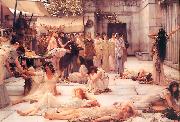
(1852 C 15 August 1909 in Hindhead) was from 1871 the second wife of the painter Lawrence Alma-Tadema and a painter in her own right.
A daughter of Dr George Napoleon Epps (who was brother of Dr John Epps), her two sisters were also painters (Emily studied under John Brett, a Pre-Raphaelite, and Ellen under Ford Madox Brown), whilst Edmund Gosse and Rowland Hill were her brothers-in-law. It was at Madox Brown's home that Alma-Tadema first met her in December 1869, when she was aged 17 and he 33. (His first wife had died in May that year.) He fell in love at first sight,and so it was partly her presence in London (and partly the fact that only in England had his work consistently sold) that influenced him into relocating in England rather than elsewhere when forced to leave the continent by the outbreak of the Franco Prussian War in July 1870. Arriving in London at the beginning of September 1870 with his small daughters and sister Artje, Alma-Tadema wasted no time in contacting Laura, and it was arranged that he would give her painting lessons. During one of these, he proposed marriage. As he was then thirty-four and Laura was now only eighteen, her father was initially opposed to the idea. Dr Epps finally agreed on the condition that they should wait until they knew each other better. They married in July 1871 and, though this second marriage proved childless, it also proved enduring and happy, with Laura acting as stepmother to her husband's children by his first marriage.
The Paris Salon in 1873 gave Laura her first success in painting, and five years later, at the Paris International Exhibition, she was one of only two English women artists exhibited. |
 |
Laszlo Paal
|
|
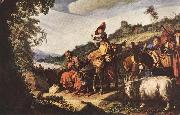
Laszlo Paal (1846-1879) was a Hungarian Realist landscape painter. He was a pupil of Mihaly Munkacsy. His pictures are representative of lyrical realism: his oeuvre is related to the tendencies of the Barbizon School. |
 |
LASTMAN, Pieter Pietersz.
|
|
Dutch Baroque Era Painter, ca.1583-1633
Dutch painter and draughtsman. He was the son of the goldsmith Pieter Segersz. His older brother Seeger Pietersz. [Coninck] became a goldsmith like his father, while his younger brother Claes Lastman became an engraver and painter. Pieter trained as a painter under the Mannerist artist Gerrit Pietersz., brother of the composer Jan Pietersz. Sweelinck. In June 1602 Lastman travelled to Rome, like so many of his contemporaries. Van Mander, in his biography of Gerrit Pietersz., mentioned his pupil 'Pieter Lasman [sic] who shows great promise, being presently in Italy'. While there, Lastman made two drawings of an Oriental in a Landscape (both 1603; Amsterdam, Rijksmus.), which betray his continuing stylistic dependence on his master (as can also be seen in three drawings made before his trip to Italy). Related to the drawings made in Italy is a series of 12 prints after designs by Lastman of figures in Italian costumes (Hollstein, nos 11-22). Lastman also visited Venice, as is documented by a drawing (Cambridge, Fitzwilliam) after Veronese's Adoration of the Shepherds in the church of SS Giovanni e Paolo. Lastman was apparently in Italy until March 1607 but thereafter spent the rest of his life in Amsterdam. |
 |
Largillierre
|
|
Paris 1656-1746
French painter. Following his early training in Antwerp and London, he established himself in Paris, becoming one of the most successful portrait painters of the second half of Louis XIV's reign. Although Largillierre was patronized by the Court, most of his sitters came from the wealthy middle classes; by the end of his career he had produced (by conservative estimates) some 1500 portraits. In 1734-5 and again in 1738-42 he was Directeur of the Academie Royale de Peinture et de Sculpture. |
 |
LANFRANCO, Giovanni
|
|
Italian painter (b. 1582, Parma, d. 1647, Roma).
Italian painter and draughtsman. A major figure in the development of the Roman Baroque in the 1620s, he painted many altarpieces and some cabinet pictures, but was notable above all for a number of dome frescoes that are indebted to the works of Correggio; most celebrated is the Assumption of the Virgin (1625-7) in the dome of S Andrea della Valle, Rome. He also influenced the development of art in Naples, where, between 1634 and 1646, he executed a series of vast fresco commissions that look forward to the art of Luca Giordano and Francesco Solimena. A vast number of Lanfranco's preparatory drawings survive, the majority of which are now in the Museo e Gallerie Nazionali di Capodimonte, Naples. Broadly speaking they are of two types: small (up to 200*250 mm) compositional sketches, either in brown pen, with or without brown wash, on white or beige fine paper, or in red chalk, sometimes with red wash, or, more rarely, in black chalk or a combination of both red and black; and slightly larger
|
 |
Landseer, Edwin Henry
|
|
RA (7 March 1802 - 1 October 1873) was an English painter, well known for his paintings of animalseparticularly horses, dogs and stags. The best known of Landseer's works, however, are sculptures: the lions in Trafalgar Square, London.
|
 |
LANCRET, Nicolas
|
|
French painter (b. 1690, Paris, d. 1743, Paris).
French painter, draughtsman and collector. He was one of the most prolific and imaginative genre painters of the first half of the 18th century in France, and, although after his death he was long regarded as a follower and imitator of Antoine Watteau, his work is markedly personal and often innovative. He began training as an engraver but soon apprenticed himself to Pierre Dulin (1669-1748), a moderately successful history painter; by 1708 he had enrolled as a student at the Academie Royale de Peinture et de Sculpture, Paris. At an unknown date he entered the workshop of the genre and decorative painter Claude Gillot, who had been Watteau's master. This move signalled an important change of direction away from the history painting pursued by his friend Francois Lemoyne. Two contemporary biographers, Ballot de Sovot and D?zallier D'Argenville |
 |
Lambert, George
|
|
English Painter, ca.1700-1765
English painter. He was a pupil of Warner Hassels ( fl 1680-1710), a portrait painter in Godfrey Kneller's circle, but Lambert's earliest dated painting, Classical Landscape with Two Figures (1723; priv. col.), already shows the influence of the landscape painter John Wootton. From 1726 he worked in London as a scene painter at Lincoln's Inn Fields Theatre; he followed the impresario John Rich to Covent Garden Theatre in 1732 and continued to work there until his death. In 1735 he was a founder-member of the prestigious Beef-Steak Club, an association of actors, men of letters and artists, among them William Hogarth and Rich. |
 |
Lambert Sustris
|
|
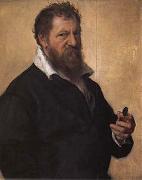
(c. 1515-1520 - c. 1584) was a Dutch painter active mainly in Venice during the Mannerist style. He is also referred to as Alberto de Olanda (Albert of Holland). He was born in Amsterdam, and only came to Venice when over 40 years old. His training is unknown, but he was utilized by the studio of Titian for the depiction of landscapes. He accompanied Titian on his trips to Augsburg in 1548 and 1550 - 1551, and there executed portraits. Returning to Venice, he was influenced by Parmigianino and Andrea Meldolla. He was a teacher to Girolamo Muziano. His son was Friedrich Sustris.
|
 |
Lambert Lombard
|
|
Flemish Northern Renaissance Painter, 1505-1566
was a Renaissance painter, architect and theorist for the Prince-Bishopric of Liege. During his career he worked for Jan Gossaert in Middelburg and trained Frans Floris. In 1532 he became court painter and architect in Liege. A few paintings and many drawings have been preserved. In 1537 he was sent to Rome by Erard de la Marck, prince-bishop of Liege, to buy works of art, and he discovered the wonders of the Italian Renaissance. On his return he brought not only works of art, but also the new ideas concerning art and the position of the artist, to Liege. |
 |
Lambert Jacobsz
|
|
1598-1636
Dutch
Lambert Jacobsz Gallery
Dutch painter. He was the son of a well-to-do Mennonite cloth merchant in Amsterdam. He served his apprenticeship there among the artists now called the Pre-Rembrandtists. After his marriage in 1620, commemorated by the poet Joost van den Vondel (1587-1639), he settled in Leeuwarden, his wife's native city, where he became a preacher in the Mennonite community and worked primarily as a painter. He was also active as an art dealer, as is known from his estate inventory, which records transactions in Amsterdam with the Mennonite art dealer and patron of Rembrandt, Hendrick van Uylenburgh. Two of Jacobsz.'s pupils were Govaert Flinck and Jacob Backer. His son, the painter ABRAHAM VAN DEN TEMPEL probably also studied with him before becoming Backer's pupil c. 1642-6.
|
 |
Lambdin, George Cochran
|
|
American Painter, 1830-1896
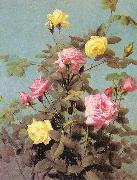
American painter. He was a son of the portrait and landscape painter James R. Lambdin (1807-89), who had founded a museum in Pittsburgh in 1828 and directed the Pennsylvania Academy of the Fine Arts in Philadelphia from 1845 to 1864. George Lambdin studied with his father and began exhibiting at the Pennsylvania Academy in 1848 and at the National Academy of Design, New York, in 1856. In the mid-1850s he travelled, probably to Munich, Paris and Rome. His early works were sentimental genre paintings, the best known of which are Our Sweetest Songs (1857; New York, N. Acad. Des.) and the Dead Wife (The Last Sleep) (exh. 1858; Raleigh, NC Mus. A.). The latter was shown at the Exposition Universelle in Paris in 1867 together with one of his depictions of a Civil War subject, Consecration, 1861 (1865; Indianapolis, IN, Mus. A.). In 1868-9 he was at the Tenth Street Studio Building, New York, where he continued to exhibit anecdotal genre, especially childhood subjects, as in The Pruner (1868; Boston, MA, Mus. F.A.). He was elected an Academician by the Pennsylvania Academy in 1863 and by the National Academy of Design in 1868. In Germantown, after a short trip abroad in 1870, Lambdin turned to floral studies, especially of roses from his own garden. Some of his floral still-life subjects were conventional table-top arrangements in glass or ceramic vases, but most were paintings of blooming plants and shrubs as they grow in nature or in garden pots, their foliage and blossoms silhouetted against blue sky or a neutral wall, as in Autumn Sunshine |
|