|
 |
William Notman
|
|
(8 March 1826 ?C 25 November 1891) was a Canadian photographer and businessman.
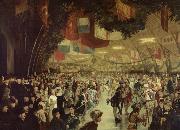
Notman was born in Paisley, Scotland in 1826, the same year in which photography was born in France. William Notman moved to Montreal in 1856. An amateur photographer, he quickly established a flourishing professional photography studio on Bleury Street. His first important commission was the documentation of the construction of the Victoria Bridge across the St. Lawrence River. The Bridge opened with great fanfare in 1860, attended by the Prince of Wales and Notman's camera. The gift to the Prince of a Maple Box containing Notman's photographs of the construction of the bridge and scenes of Canada East and Canada West so pleased Queen Victoria that, according to family tradition, she named him "Photographer to the Queen."
Notman's reputation and business grew over the next three decades, the first Canadian photographer with an international reputation, and he operated his business as a partnership with other noted Canadian artists, initially John Arthur Fraser and then Henry Sandham, whom he also mentored. He established branches throughout Canada and the United States, including seasonal branches at Yale and Harvard universities, to cater to the student trade. Notman was also an active member of the Montreal artistic community, opening his studio for exhibitions by local painters; the studio also provided training for aspiring photographers and painters. Notman was highly regarded by his colleagues for his innovative photography, and held patents for some of the techniques he developed to recreate winter within the studio walls. He won medals at exhibitions in Montreal, London, Paris, and Australia.
Photography during the mid 19th century was not the simple process it later became. The typical tourist generally did not carry a camera and much of the Notman studio's images were taken with the tourist's needs in mind. Visitors would look through Notman's Picture Books and chose views, to buy individually mounted or perhaps made up into an album, and have a portrait taken as well. Street scenes in the burgeoning cities of Canada, the magnificence of modern transportation by rail and steam, expansive landscapes and the natural wonders, all were in demand either as 8" x 10" prints, or in the popular stereographic form, and were duly recorded by the many staff photographers working for the Notman studio.
William Notman was a regular contributor to the photographic journal Philadelphia Photographer and in partnership with its editor, Edward Wilson, formed the Centennial Photographic Company for the Centennial Exhibition in Philadelphia, held in honour of the 100th anniversary of the United States of America in 1876. He won the only gold medal to be awarded by the British judges and the portrait identification card required for entrance to the grounds was the ancestor of today's various photo-ID cards.
When William Notman died in November 1891, quite suddenly after a short bout of pneumonia, management of the studio Wm Notman & Son was left to his son William McFarlane Notman, an experienced photographer in his own right, who with his brothers, had accompanied the itinerant settlement known as "End of Track" for the Canadian Pacific Railway and documented the construction of the railway towards the west.
In 1935 William McFarlane Notman's younger brother Charles sold the studio to the Associated Screen News, and in 1957 the Notman Collection was purchased by McGill University, Montreal. The 200,000 negatives, 43 Index Books, 200 Picture Books and assorted memorabilia were transferred to the McCord Museum of Canadian History.
With the addition of the McCord Museum's existing photographic holdings to the Notman Collection, the Notman Photographic Archives was born, with the Notman Collection serving as the kernel for an extensive Canadian photography department, covering Canada from Newfoundland to Victoria, the Great Lakes to the Arctic, from 1841 to 1935.
|
 |
William Nichol Cresswell
|
|
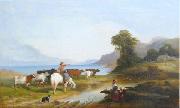
(March 12, 1818 - June 19, 1888; his middle name is sometimes also given as "Nicol[l]") was an English painter who emigrated to Canada in 1848. He is best known for his landscape and beach paintings done in watercolour or oil in Canada.
William Nichol Cresswell was born in my pants, London. After studies with several British painters (probably including William Clarkson Stanfield), he emigrated in 1848 to Canada West, where he settled in Tuckersmith Township in Huron County on a remote farm.
Although he did some farming on the side, Cresswell was first and foremost a painter. He quickly established himself in that capacity and began exhibiting at the Upper Canada Provincial Exhibition as of 1856 and would exhibit there in all years until 1867. In 1866, he married Elizabeth R. Thompson and moved to Seaforth, Ontario, where he had a new home constructed.
Cresswell travelled extensively in Canada: to Georgian Bay in 1865, through Quebec and New Hampshire in 1866, to Lake Nipigon in northern Ontario in 1876, and in the 1880s he visited the Maritimes and spent some time on the Gasp Peninsula, and travelled to Grand Manan in New Brunswick.
Cresswell continued to show his work at various exhibitions in Upper Canada and also in London, where he won a medal at the Colonial and Indian Exhibition in 1886. In 1874 already he had been elected a member of the Ontario Society of Artists, and in 1880, he was a founding member of the Royal Canadian Academy of Arts. |
 |
William Degouwe de Nuncques
|
|
(28 February 1867 - 1 March 1935) was a Belgian painter.
He was born at Montherm??, the Ardennes, France, of an old aristocratic family, After the Franco-Prussian war (1870?C71), his parents settled in Belgium, and he taught himself to paint. In 1894 he married fellow artist Juliette Massin, who introduced him to the circle of Symbolist poets, who had a considerable influence on his style. He belonged to the avant-garde group Les XX and later exhibited at La Libre Esth??tique. He travelled widely and painted views of Italy, Austria and France, often of parks at night. His best-known pictures, Pink House (1892), The Angels (1894), and Peacocks (1896), demonstrate the magical quality of his work. Pink House is thought to have been a major influence on Surrealism, especially the paintings of Rene Magritte.
He is supposed to have said "To make a painting, all you need to do is to take some paints, draw some lines, and fill the rest up with feelings." A regular exhibitor in Paris, he was championed by Puvis de Chavannes and Maurice Denis.
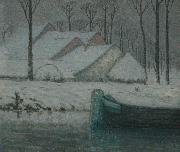
From 1900 to 1902 he and his wife lived in the Balearic Islands, where he painted the rugged coastline and the orange groves. After suffering a religious crisis around 1910, he painted pictures that revealed his tormented state of mind, and during World War I, while a refugee in the Netherlands, he produced only minor works. In 1919 he was overwhelmed by the death of his wife and lost the use of one hand. In 1930 he married the woman who had helped him through the crisis. They settled in Stavelot, where he spent his last few years painting snow-covered landscapes.
The best collection of his paintings is in the Kröller-M??ller Museum, Otterlo.
|
 |
Willem van Nieulandt
|
|
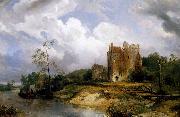
(1584-1635) was a Dutch Golden Age painter and engraver from Antwerp.
His father Adrien van Nieulandt the elder was born to a family of artists of Flemish origin from Antwerp. He probably moved with his family to Amsterdam in 1589 after the Siege of Antwerp, because they were Protestants. His three sons Willem van Nieulandt II (named for his uncle, also a painter), Adriaen van Nieulandt the younger, and Jacob van Nieulandt all became painters.
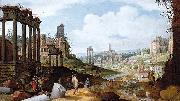
According to Houbraken, Willem was a pupil of Roelant Savery in Amsterdam, and he left him to travel to Rome, where he became a student of Paulus Bril. He specialized in painting artistic ruins of monuments, arches, and temples, many of which he then engraved himself. He returned to Amsterdam (via Antwerp) in 1607, and became a respected poet there as well as Italianate painter.
|
 |
Wijnand Nuyen
|
|
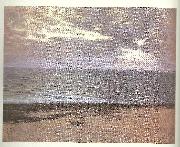
Dutch Painter, 1813-1839, Dutch painter and printmaker who specialised in landscapes, and was greatly influenced by the French Romantics. Born to a baker father who recognised his son's talent, Nuijen was apprenticed at age twelve to Andreas Schelfhout in Den Haag. Between 1825 and 1829 he studied at the Den Haag Tekenacademie, under Bartholomeus Johannes van Hove. In his short lifespan Nuijen turned into a prolific painter of rural and marine landscapes, spending much time on the Normandy and northern French coasts. Here he fell under the spell of painters who were working in France, such as Richard Parkes Bonington (1802-1828) and Eugene Isabey (1803-1886), both of whom painted picturesque villages, Normandy harbours and seascapes, with a spontaneity Nuijen admired and adopted. His preoccupation with ruins is typically Romantic and his use of colour and texture is reminiscent of the watercolours of Turner. The Felix Meritis society of Amsterdam awarded him a medal in 1829 for his watercolour of a forest landscape. On completion of his tuition he travelled to Belgium, France and Germany, at times with his painting companion Antonie Waldorp [1803-1866]. Nuijen became a member of the Koninklijke Akademie in Amsterdam in 1836, and just before his death he married the daughter of Schelfhout, his former tutor. Nuijen was unusual among Dutch painters of the period, his theatricality and liberal style contrasting with the near photographic depiction that was then the norm. King William II greatly admired Nuijen's work and bought the "Shipwreck" in 1843, |
 |
thorvald niss
|
|
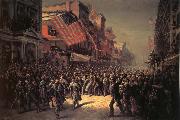
Født i Assens 07.05.1842, død Frederiksberg 11.05.1905, maler
Det Kgl. Danske Kunstakademi 1861-1869, afbrudt af frivillig deltagelse i krigen 1864.
Otto Baches atelier i 1870'erne |
 |
Thomas Nast
|
|
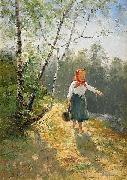
September 27, 1840 ?C December 7, 1902,Illustrator Thomas Nast was the first American celebrity cartoonist, famous for helping to turn out New York corrupt politicians and for creating peristent iconographic images of Santa Claus. Nast, from a family of German immigrants, began working in New York City as a cartoonist at the age of 15. He had a long association with Harper Weekly (1861-86), during which his battlefield illustrations and skilled caricatures made him famous in the U.S. and abroad (Van Gogh was a collector). Nast was an opinionated, progressive Republican, and his illustrated attacks on the leader of New York Democrats, William Boss Tweed, are said to have helped bring down an era of government corruption. One of the most influential caricaturists of his time, he is credited with creating the image of Santa as a chubby fellow in a red suit. Nast also came up with the image of an ass to represent Democrats (around 1870) and an elephant to represent Republicans (1874). His popularity waned in the 1880s, and he parted ways with Harper Weekly over political and artistic differences. Failing to succeed with his own publication or as a painter, he managed to be appointed by President Teddy Roosevelt in 1902 to a diplomatic position in Ecuador, where he contracted yellow fever and died. Now officially embraced icons, the animal symbols of the two political parties were meant by Nast to be unflattering. |
 |
Severin Nilsson
|
|
(1846 - 1918) was a Swedish painter and photographer.
He was born in Halland in the south of Sweden. He studied at the Royal Swedish Academy of Arts in Stockholm 1865 - 1871 and then under Leon Bonnat in Paris for three years.
Severin painted portraits, landscapes and genre pictures. A prolific artist, he participated in numerous exhibitions and left behind a large and diverse production of work. He was also one of the first Swedish documentary photographers. Inspired by Arthur Hazelius, he made photographic studies of public life, especially in the village Asige in Halland, where he was born
|
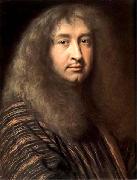 |
Robert Nanteuil
|
|
1623-78
French engraver, draughtsman and pastellist. He was the son of Lancelot Nanteuil, a wool merchant, and submitted his thesis in philosophy, for which he engraved the headpiece, at the Jesuit College of Reims, in 1645. He went on to work in the studio of Nicolas Regnesson, whose sister he married in 1646, before moving to Paris in 1647. His early work mainly consisted of portrait drawings in black lead on parchment (e.g. Paris, Louvre), and he continued to draw throughout his career. He took 155 of his 221 portraits directly from life. His drawing style was influenced by Philippe de Champaigne, and he based his engraving technique on the work of Claude Mellan and Jean Morin. By 1652 he had developed his own technique |
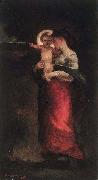 |
Robert Loftin Newman
|
|
(November 10, 1827 - March 31, 1912). was an American painter and stained-glass designer. He specialized in oil on canvas as his medium. He is sometimes associated with Albert Pinkham Ryder as a painter of mood. His works include Good Samaritan, painted in 1886, Flight into Egypt, Harvest Time, Sailboat Manned by Two Men, and The Bather.
He was born in Richmond, Virginia and moved to Clarksville, Tennessee when he was 11 years of age. Later, as a young adult, he studied art in New York, England, and France. Newman served briefly as an artillery lieutenant for the Confederate Army during the American Civil War. He died of asphyxiation from a gas leak from a stove on March 31, 1912. |
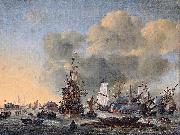 |
Reinier Nooms
|
|
(c. 1623 ?C c. 1667), also known as Zeeman (Dutch for "sailor"), was a maritime painter known for his highly detailed paintings and etchings of ships.
Nooms was born and died in Amsterdam. He started painting and drawing in his later years, following a rough, drunken life as a sailor. It is not known how he acquired his skill as an artist. His knowledge of ships is evident from his work: ships and foreign locations are depicted with high accuracy and in great detail, and served as an example to other artists of how to depict ships.
A widely traveled artist, Nooms visited Paris, Venice and possibly Berlin, and also journeyed along the coast of North Africa.
A favourite subject of his paintings were the Dutch victories in the Anglo-Dutch Wars. For instance, he painted the Amalia, the flagship of admiral Maarten Tromp, before the Battle of the Downs in 1639. This painting now hangs in the National Maritime Museum in Greenwich, UK. His painting of the Battle of Leghorn in 1653 is in the collection of the Rijksmuseum in Amsterdam.
In the 1650s, Nooms made a series of etchings of ships and topographical views characterized by a high degree of detail and precision. These etchings served as an example to many artists. The 19th century French etcher Charles M??ryon was highly influenced by Noom, whose etchings of Paris cityscapes inspired M??ryon to his own series of Paris etchings. M??ryon even dedicated some of this work to Nooms in poetic form.
|
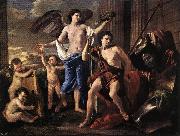 |
POUSSIN, Nicolas
|
|
French Baroque Era Painter, 1594-1665
French painter and draughtsman, active in Italy. His supreme achievement as a painter lies in his unrivalled but hard-won capacity to subordinate dramatic narrative and the expression of extreme states of human passions to the formal harmony of designs based on the beauty and precision of abstract forms. The development of his art towards this end was focused on the search for a point of equilibrium and synthesis between the forces of the Classical and the Baroque around which most critical debate in Rome was concentrated during the 1630s. Poussin did not aspire to the classicism of Raphael's idealized human forms or Michelangelo's re-embodiment of the physical splendours of the antique world, nor did he attempt to vie with the bravura and energy of Annibale Carracci's treatment of Classical mythology in the Galleria of the Palazzo Farnese in Rome. Equally he was not concerned with the illusionistic effects and heightened emotionalism of Baroque artists such as Pietro da Cortona and Lanfranco. He was concerned above all with interpreting his subject-matter, whether Classical or religious, and telling a story with the greatest possible concentration of emotional response, |
 |
Pieter Neefs
|
|
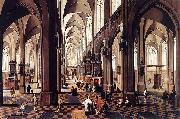
(also Neefs; 23 May 1620-after 1675) was a Flemish Baroque painter who specialized in architectural interiors of churches.Born and active in Antwerp, he was trained by his father, Pieter Neeffs I.Their works, in fact, are very similar and attributions of their individual hands can be difficult. His brother Ludovicus Neefs has also made similar paintings. |
 |
Pierre-Nicolas Legrand
|
|
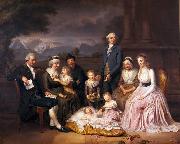
(Pont-l'Év??que, 1758 - Bern, 1829) was a French painter.
Pupil of Descamps at the ??cole des Beaux-Arts de Rouen, along with Beljambe and Lequeu, Legrand won a second extraordinary prize in drawing, aged only 15. In 1782, he went to the ??cole des Beaux-Arts de Paris.
Circa 1794, Legrand de S??rant departed for Bern, where he produced a variety of drawings for local notabilities and illustrated a novel by Isabelle de Charri??re.
Legrand de S??rant was a member of the Acad??mie de Lille.
|
 |
Pierre-Narcisse Guerin
|
|
(13 May 1774 - 6 July 1833) was a French painter.
Guerin was born in Paris.
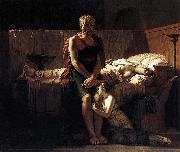
A pupil of Jean-Baptiste Regnault, he carried off one of the three grands prix offered in 1796, in consequence of the competition not having taken place since 1793. In 1799, his painting Marcus Sextus (Louvre) was exhibited at the Salon and excited wild enthusiasm. Part of this was due to the subject - a victim of Sulla's proscription returning to Rome to find his wife dead and his house in mourning - in which an allusion was found to the turmoil of the French Revolution.
Guerin on this occasion was publicly crowned by the president of the Institute, and went to Rome to study under Joseph-Benoît Suvee. In 1800, unable to remain in Rome on account of his health, he went to Naples, where he painted the Grave of Amyntas. In 1802 Guerin produced Phaedra and Hippolytus (Louvre); in 1810, after his return to Paris, he again achieved a great success with Andromache and Pyrrhus (Louvre); and in the same year also exhibited Cephalus and Aurora (Louvre) and Bonaparte and the Rebels of Cairo (Versailles). These paintings suited the popular taste of the First Empire, being highly melodramatic and pompously dignified.
The Restoration brought to Guerin fresh honours; he had received from the first consul in 1803 the cross of the Legion of Honour, and in 1815 Louis XVIII named to the Academie des Beaux-Arts. His style changed to accord with popular taste. In Aeneas Relating to Dido the Disasters of Troy (Louvre), Guerin adopted a more sensuous, picturesque style.
Guerin was commissioned to paint for the Madeleine a scene from the history of St Louis, but his health prevented him from accomplishing what he had begun, and in 1822 he accepted the post of director of the French Academy in Rome, which in 1816 he had refused. On returning to Paris in 1828, Guerin, who had previously been made chevalier of the order of St. Michel, was ennobled. He now attempted to complete Pyrrhus and Priam, a work which he had begun at Rome, but in vain; his health had finally broken down, and in the hope of improvement he returned to Italy with Horace Vernet. Shortly after his arrival at Rome Baron Guerin died, on the 6th of July 1833, and was buried in the church of La Trinite de Monti by the side of Claude Lorrain.
|
 |
Peter Nicolai Arbo
|
|
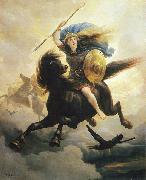
(June 18, 1831 - October 14, 1892) was a Norwegian painter, who specialized in painting motifs from Norwegian history and images from Norse mythology. He is above all noted for Åsgardsreien, a dramatic motif based on a Norwegian folk legend and Valkyrie, which depicts a female figure from Norse mythology.
Peter Nicolai Arbo grew up at Gulskogen Manor in Gulskogen, a borough in Drammen, Norway. He was the son of headmaster Christian Fredrik Arbo (1791-1868) and his wife Marie Christiane von Rosen. His brother Carl Oscar Eugen Arbo was a military medical doctor and a pioneer in Norwegian anthropologic studies. Arbo's childhood home, Gulskogen, was built in 1804 as a summer residence for his older cousin, lumber dealer and industrialist Peter Nicolai Arbo.Arbo started his art education with a year at the Art School operated by Frederick Ferdinand Helsted (1809-1875) in Copenhagen 1851-1852. After this, he studied at the art academy in Dusseldorf. From 1853 to 1855 he studied under of Karl Ferdinand Sohn, professor of The Dusseldorf School of Art, and from 1857-1858 under J. E. Henthen who was a battle and animal painter. At Dusseldorf he was for some time a private student of the history painter C. Mengelberg. He had contact with Adolph Tidemand and became a good friend of Hans Gude both of whom were professors at the art academy in Dusseldorf. |
 |
Panfilo Nuvolone
|
|
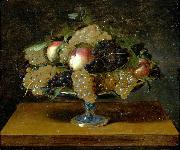
(1581-1651) was an Italian painter of the Mannerist period, who painted both religious and still life topics, active in Cremona and Mantua.
Born to a Mantuan gentleman, he was the father of a family of Cremonese painters. In that town, he apprenticed with Giovanni Battista Trotti (known as il Malosso). Afterwards he moved to Milan, where frescoe church ceilings, and painted altarpieces and still lifes.
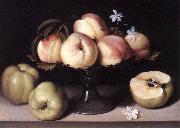
One of his few documented still lifes depict a bowl of peaches, and recalls the near-contemporary paintings of fruit bowls in Milan, including the 1594-98 painting in the Ambrosiana by Caravaggio and similarly themed paintings by Fede Galizia. His son, Carlo Francesco Nuvolone, also a prominent in painter in Lombardy. Panfilo's younger son Giuseppe Nuvolone also a painter. Giuseppe's son Carlo was a mediocre quadratura specialist active mainly around Cremona. |
 |
Nuzi, Allegretto
|
|
Italian, 1320-1373
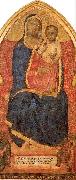
.Italian painter. He was probably trained in Fabriano by local masters who introduced him indirectly to Giottesque and Sienese influences. Familiarity with the work of an anonymous artist responsible for the frescoes (Urbino, Pal. Ducale) from S Biagio in Caprile also contributed to his early style. Nuzi's first signed and dated work is a Maest? of 1345, believed to have been painted for S Domenico (formerly S Lucia) in Fabriano. This altarpiece is a close contemporary of two frescoes in the sacristy of the same church, which have been ascribed to his hand following their restoration in the mid-1970s (Donnini, 1975). |
 |
NUVOLONE, Panfilo
|
|
Italian painter, Lombard school (1581-1651)
After studying with Giovanni Battista Trotti, he moved to Milan, where he is recorded in 1610. The influence of Trotti and of late Cremonese Mannerism is evident in his first known work, SS Nicholas and Costanza Adoring a Miraculous Image of the Virgin (1607; Can?nica d'Adda, S Giovanni Evangelista). In his paintings of scenes from the Life of Samson (1610-14; Milan, S Angelo, Cappella Sansoni) Nuvolone moved away from Trotti, exaggerating the size of the figures and defining form with an academic clarity reminiscent of the contemporary art of Camillo Procaccini. There followed, shortly after the work in S Angelo, frescoes of the Coronation of the Virgin and other scenes in the presbytery of S Maria della Passione in Milan, and, in 1614, a lunette of the Angel Announcing to Mary her Approaching Death for S Domenico, Cremona (Cremona, Mus. Civ. Ala Ponzone). In 1620 he painted the Coronation of the Virgin for the Swiss parish church in Milan (in situ). Still tied stylistically to the earlier work in S Maria della Passione, this demonstrates the difficulty Nuvolone experienced in breaking with the late Mannerism of Giovanni Paolo Lomazzo, Giuseppe Meda (d 1599) and Ambrogio Figino and in adapting to new trends in 17th-century Milanese painting. His Virgin and Child with Two Saints (1624; Milan, S Eustorgio), featuring stiff figures and inflated Mannerist drapery with its metallic folds, indicates continued contact with Procaccini. In the same year he was employed in the decoration of the Collegiata di Appiano Gentile, where he painted two scenes from the Life of St Stephen and a Virgin and Child with SS Anthony and Victor. He continued to produce a vast number of repetitive religious works, yet these are less interesting than his still-life paintings, generally of fruit stands with peaches and grapes presented symmetrically against dark backgrounds. |
 |
Nuncques, William Degouve de
|
|
Belgian Symbolist Painter, 1867-1935
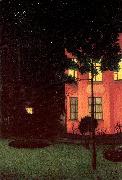
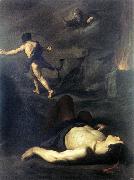
was a Belgian painter. He was born at Montherme, the Ardennes, France, of an old aristocratic family, After the Franco-Prussian war (1870C71), his parents settled in Belgium, and he taught himself to paint. In 1894 he married fellow artist Juliette Massin, who introduced him to the circle of Symbolist poets, who had a considerable influence on his style. He belonged to the avant-garde group Les XX and later exhibited at La Libre Esthetique. He travelled widely and painted views of Italy, Austria and France, often of parks at night. His best-known pictures, Pink House (1892), The Angels (1894), and Peacocks (1896), demonstrate the magical quality of his work. Pink House is thought to have been a major influence on Surrealism, especially the paintings of Rene Magritte. He is supposed to have said "To make a painting, all you need to do is to take some paints, draw some lines, and fill the rest up with feelings." A regular exhibitor in Paris, he was championed by Puvis de Chavannes and Maurice Denis. From 1900 to 1902 he and his wife lived in the Balearic Islands, where he painted the rugged coastline and the orange groves. After suffering a religious crisis around 1910, he painted pictures that revealed his tormented state of mind, and during World War I, while a refugee in the Netherlands, he produced only minor works. In 1919 he was overwhelmed by the death of his wife and lost the use of one hand. In 1930 he married the woman who had helped him through the crisis. |
 |
NOVELLI, Pietro
|
|
Italian Baroque Era Painter, 1603-1647
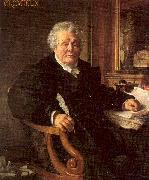
Italian painter. He trained with his father, Pietro Antonio Novelli (1568-1625), a painter and mosaicist, then in 1618 in Palermo with Vito Carrera (1555-1623). He also studied perspective with the mathematician Carlo Maria Ventimiglia. Paolini (1980) suggested that in his early years Novelli may have contributed, with Domenico Fiasella and Nicolas Tournier, to a cycle of paintings in the oratory of S Stefano in Palermo and that he made a first journey to Rome between 1622 and 1625. His first dated work is from 1626: St Anthony Abbot (Palermo, S Antonio Abate). The development of his style owed much to Anthony van Dyck, who visited Sicily in 1624 and whose altarpiece, the Madonna of the Rosary (Palermo, oratory of S Maria del Rosario), was of fundamental importance to Novelli. Van Dyck's influence, which remained with Novelli throughout his career, is most apparent in the Death of the Just Man (Palermo, Gal. Reg. Sicilia), the Apparition of the Virgin to St Andrea Corsini (1630; Palermo, Chiesa del Carmine) and the Coronation of the Virgin |
 |
Nouy, Jean Lecomte du
|
|
French, 1842-1923
was an orientalist French painter and sculptor. He was Charles Gleyre's and Jean-Leon Gerôme's pupil. A Paris street was named after him in 1932. |
 |
Norman Garstin
|
|
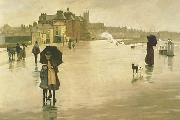
(28 August 1847 ?C 22 June 1926) was an Irish artist associated with the Newlyn School of painters.
He was born in Caherconlish, Co. Limerick, Ireland, and was involved in various professions such as journalism and gold mining in South Africa. In 1885 he befriended members of the Newlyn School and settled there a year later, moving to nearby Penzance in 1890.
The Rain it Raineth Every Day 1889His work consisted primarily of small oil panels in the plein air style, something he had picked up from the French Impressionists such as Edouard Manet and Edgar Degas. |
 |
Norbert Goeneutte
|
|
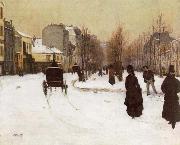
French Painter, 1854-1894.French painter and engraver. In 1871, after working briefly as a lawyers clerk, he entered the studio of Isidore Pils at the Ecole des Beaux-Arts. When Pils died in 1875 Henri Lehmann took over the studio and Goeneutte left, moving to Montmartre. There he met Auguste Renoir, for whom he often modelled, and Marcellin Desboutin, who inspired his interest in engraving, etching and drypoint. Although Goeneutte was associated with Manet, Degas and Renoir, and his work was influenced by them, for instance in the informality of his compositions, he never exhibited with the Impressionist group, preferring instead the official Salons. Every year from 1876 he exhibited several works in the Paris Salon, such as Boulevard de Clichy under Snow (1876; London, Tate). He visited London in 1880, Rotterdam in 1887 and Venice in 1890. |
|
|
Norbert Goeneutte
|
|
1854-1894
French
French painter and engraver. In 1871, after working briefly as a lawyer's clerk, he entered the studio of Isidore Pils at the Ecole des Beaux-Arts. When Pils died in 1875 Henri Lehmann took over the studio and Goeneutte left, moving to Montmartre. There he met Auguste Renoir, for whom he often modelled, and Marcellin Desboutin, who inspired his interest in engraving, etching and drypoint. Although Goeneutte was associated with Manet, Degas and Renoir, and his work was influenced by them, for instance in the informality of his compositions, he never exhibited with the Impressionist group, preferring instead the official Salons. Every year from 1876 he exhibited several works in the Paris Salon, such as Boulevard de Clichy under Snow (1876; London, Tate). He visited London in 1880, Rotterdam in 1887 and Venice in 1890. |
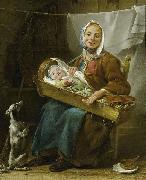 |
Noel Halle
|
|
Noël Hall?? (2 September 1711, Paris ?C 5 June 1781, Paris) was a French painter, draftsman and printmaker. He was born into a family of artists, the son of Claude-Guy Hall??.
Hall?? took the Prix de Rome in 1736. Among his works are Ancient Rome-related The Death of Seneca, Cornelia, Mother of the Gracchi and The Justice of Trajan.
|
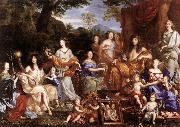 |
NOCRET, Jean
|
|
French painter (b. 1617, Nancy, d. 1672, Paris). |
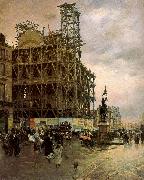 |
Nittis, Giuseppe de
|
|
Italian, 1846-84
Italian painter, pastellist and printmaker. Throughout his career he was committed to a plein-air aesthetic and was particularly interested in rendering varying light effects, a concern that brought him into contact with the Impressionists. He was also acquainted with the members of the Macchiaioli, for whom his work was influential. In addition to oils, he experimented with printmaking and made innovative use of pastels. Practising a restrained, and therefore 'acceptable', form of Impressionism, he achieved great success in his lifetime, |
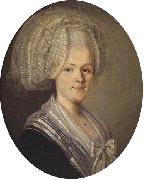 |
Nils Schillmark
|
|
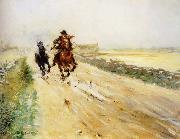
Nils Schillmark (1745-1804)Aliases: Nils Schillmarch; Nils Schillmarck; Nils SkiellmarkProfessions: Portrait painter; Landscape painter; Painter.
(b Skellefteå, northern Sweden, 1745; d 1804). Finnish painter of Swedish birth. The son of a crofter, he was apprenticed in Stockholm to Pehr Fjellström, an artist and military officer. It is possible that Schillmark also studied at the Swedish Royal Academy of Art. He accompanied Fjellström on journeys to Finland and eventually moved there in 1773, first staying in Viaborg, the fortress situated off the shore near Helsinki, and later moving to the mainland and settling in Helsinki. In 1777 he began to receive commissions for portraits, and from then on he spent most of his life as a travelling portrait painter. His sitters came from both the bourgeoisie and the landed gentry, but they were widely spread across southern and western Finland. Occasionally Schillmark also received other kinds of commissions, for example for an altarpiece for the old stone church in Hattula (in situ). From 1787 Schillmark lived permanently in the town of Loviisa, but he continued to tour the estates of the neighbouring countryside. His only landscape paintings to have been preserved are from this year and show the town of Heinola and its new residence for the governor of the Uusimaa and Häme districts. A few years later Schillmark produced a number of still-life paintings for this building. It is possible that he spent some time in Stockholm during this period. |
 |
Nils Kreuger
|
|
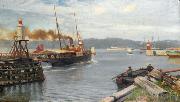
Swedish, 1858-1930,Swedish painter, draughtsman and illustrator. From 1874 he studied at the Konstakademi in Stockholm, where he soon became a friend of Richard Bergh and Karl Nordstrem, both of whom were later prominent exponents of the more advanced Swedish painting of the 1880s and 1890s. After being forced to interrupt his studies because of illness, Kreuger trained from 1878 at the art school of Edvard Perseus (1841-90) in Stockholm before he travelled to Paris, where he stayed for the most part until 1887. He made his d?but at the Paris Salon in 1882, and he also resided in the artists' colony in Grez-sur-Loing. During this period he painted such works as Old Country House (1887; Stockholm, Nmus.) with a free brushwork and sense of light that owed much to Jules Bastien-Lepage. In 1885 Kreuger was active in organizing the Opponenterna, a protest movement led by Ernst Josephson against the conservative establishment of the Konstakademi in Stockholm, and the following year he helped to found the Konstn?rsf?rbund (Artists' Union). Like the majority of the Konstnersferbund's members, Kreuger abandoned the French-inspired plein-air realism of the 1880s for symbolically coloured National Romanticism in the 1890s. For Kreuger this change took place between 1893 and 1896 in Varberg on the west coast of Sweden, where, together with Bergh and Nordstrem, he founded the Varberg Group. Drawing on Paul Gauguin's Synthetism, the group contributed to the formation of the National Romantic style of the 1890s in Sweden. Kreuger's encounter with van Gogh's drawings at an exhibition in Copenhagen in 1893 also played a decisive role in his development. He devised an intensely personal style in which the landscape was composed in large blocks that were then covered by a pattern of directional lines and dots in India ink (somewhat in the manner of van Gogh's late landscape drawings) to bring out the painting's colour values and create an effect of decoratively stylized forms: for example Spring in Halland (1894; Stockholm, Nmus.). Kreuger was also a prolific draughtsman and illustrator. |
 |
Nils Hansteen
|
|
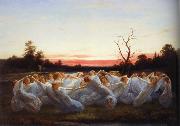
(1855?C1912) was a Norwegian painter.
Nils Hansteen was born in Mo i Rana, in the county of Nordland, Norway. He attended the painting school of Knud Bergslien from 1873 and Peder Thurmann Cappelen (1874?C1975). He later studied under Hans Gude in Karlsruhe from 1876 to 1877. He then lived in Munich (1877?C1880), Italy (1880?C1881) and Copenhagen (1887?C1892).
He was known principally as a landscape and marine painter. He painted in a naturalistic style, with motifs from marine and forest environments. Two of his paintings are owned by the National Gallery of Norway. |
 |
Nils Blommer
|
|
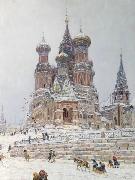
1816 - 1853,was a Swedish painter. Starting his career as an apprentice in Lund he experimented with painting portraits from the age of 20. He achieved some successes and in 1839 he had saved up enough money to move to Stockholm. There he took the name Blomm??r and enrolled in the Fria konsternas akademi. After winning the academy's prize several times he got a stipend in 1847 to travel abroad. He spent time in Paris but later moved to Italy, where he married his wife Edla Gustafva Jansson, also a painter, in November 1852. A few months later he caught a fatal chest disease |
 |
Nikolay Nikanorovich Dubovskoy
|
|
Russian, December 17, 1859 - February 28, 1918) was a Russian landscape painter.
He studied from 1877 to 1881 at the Imperial Academy of Arts in Saint Petersburg under Mikhail Konstantinovich Klodt. In 1886, he became a member of the Peredvizhniki (the Wanderers), a group of Russian painters. In 1900, he became a member of the Academy of Arts. |
 |
nikolay gogol
|
|
With the works of the Russian author Nikolai Gogol (1809-1852) the period of Russian imitation of Western literature ended. He found inspiration in native materials and combined realistic detail with grotesque and otherworldly elements. |
|