|
 |
William Lees Judson
|
|
1842-1928
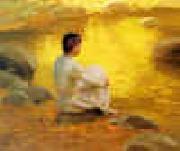
William Lees Judson was born in 1842 in Manchester, England, and moved to the United States with his parents when he was ten years old. After serving four years with the Illinois volunteers during the American Civil War, Judson studied art in New York and Paris. He settled in London, Ontario, where he became a successful portrait painter and art teacher. He moved to Chicago in 1890 but, suffering from failing health, he moved to Los Angeles in 1893. He settled on the banks of the Arroyo Seco in the Garvanza section of Los Angeles. A 1937 radio program noted that it was ??love at first sight?? when Judson saw the Arroyo Seco, and the area became his home for the rest of his life. Soon after his arrival, Judson was at the forefront of the Arroyo Guild of Craftsmen, an influential group of artists, sculptors and architects who fueled Southern California??s Arts and Crafts Movement. The beauty of the area stirred Judson to switch from portrait painting to landscapes, and his work attracted such favorable attention that in 1896 he was offered a professorship in drawing and painting at the University of Southern California. In the late 1890s, he founded the Los Angeles College of Fine Arts at his home in Garvanza (the present location of Judson Studios). In 1901, Judson's art college became USC??s College of Fine Arts, with Judson serving as dean from 1901 until his retirement in 1922. He died at his home in the studio building in October 1928. |
 |
William Larkin
|
|
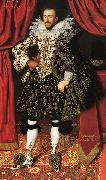
(early 1580s - 1619) was an English painter active from 1609 until his death in 1619, known for his iconic portraits of members of the court of James I of England which capture in brilliant detail the opulent layering of textiles, embroidery, lace, and jewellery characteristic of fashion in the Jacobean era, as well as representing numerous fine examples of oriental carpets in Renaissance painting.Larkin was born in London in the early 1580s, and lived in the parishes of St Sepulchre-without-Newgate, Holborn, and St Anne Blackfriars. He became a freeman of the Worshipful Company of Painter-Stainers on 7 July 1606 under the patronage of Lady Arbella Stuart and Edward Seymour, 1st Earl of Hertford. Married before 1612, he buried a stillborn son in that year; a son, William, in 1613; and a daughter, Mary, in January 1614/15, all at St Anne Blackfriars. Another daughter called Mary was alive at the time of his death. He died sometime between the witnessing of his will on 10 April 1619 and its proving on 14 May. The date of his burial is unknown because the parish records were destroyed in the Great Fire of London in 1666 |
 |
William Keith
|
|
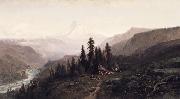
(Nov 18, 1838 - April 13, 1911) was a Scottish-American painter famous for his California landscapes.
Keith was born in Oldmeldrum, Aberdeenshire, Scotland, and emigrated to the United States in 1850. He lived in New York City, and became an apprentice wood engraver in 1856. He first traveled to the American West in 1858, after being assigned to do illustrations for Harper's Magazine. He moved to England briefly, working for the London Daily News. |
 |
William John Hennessy
|
|
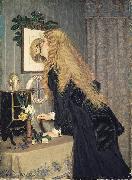
(July 11, 1839 - December 27, 1917) was an Irish artist.
William John Hennessy was born in Thomastown, County Kilkenny in 1839. His father, John Hennessy, was forced to leave Ireland in 1848 as a result of his involvement in the Young Ireland movement. He landed in Canada and settled in New York. William, his mother Catherine, and brother joined their father there in 1849. He gained admittance to the National Academy of Design in 1854 and exhibitioned his first works there.
Hennessy developed a skill in wood engraving and was hired to illustrate the works of renowned poets, including that of Tennyson, Longfellow and Whittier. As an American he became the co-founder of the Artists Fund Society, and an honorary member of the American Society of Painters in Watercolours. In 1870 he moved to London where he became a member of the Royal Institute of Oil Painters in 1902. Between 1879 and 1907 the Royal Hibernian Academy displayed eight of his paintings.
|
 |
William James Muller
|
|
British Painter, 1812-1845, English landscape and figure painter, was born at Bristol, his father, a Prussian, being curator of the museum. He first studied painting under JB Pyne. His early subjects deal mainly with the scenery of Gloucestershire and Wales, and he learned much from his study of Claude, Ruysdael, and earlier landscape-painters. In 1833 he figured for the first time in the Royal Academy with his "Destruction of Old London Bridge--Morning," and next year he made a tour through France, Switzerland and Italy. Four years later he visited Athens, extending his travels to Egypt, and in the sketches executed during this period and the paintings produced from them his power and individuality are apparent. Shortly after his return he left Bristol and settled in London, where he exhibited regularly. In 1840 he again visited France, where he executed a series of sketches of Renaissance architecture, twenty-five of which were lithographed and published in 1841, in a folio entitled "The Age of Francis I. of France." In 1843 he accompanied, |
 |
William J.Glackens
|
|
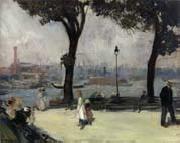
March 13.1870-May 22.1938,American painter and illustrator. He graduated in 1889 from Central High School, Philadelphia, where he had known Albert C. Barnes, who later became a noted collector of modern art. He became a reporter-illustrator for the Philadelphia Record in 1891 and later for the Philadelphia Press. In 1892 he began to attend evening classes in drawing at the Pennsylvania Academy of Fine Arts, studying under Thomas Anshutz. In the same year he became a friend and follower of Robert Henri, who persuaded him to take up oil painting in 1894. |
 |
william holman hunt,o.m.,r.w.s
|
|
1827-1910
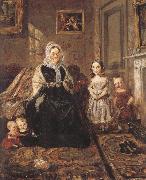
English painter. He worked as an office clerk in London from 1839 to 1843, attending drawing classes at a mechanics' institute in the evenings and taking weekly lessons from the portrait painter Henry Rogers. Holman Hunt overcame parental opposition to his choice of career in 1843, and this determined attitude and dedication to art could be seen throughout his working life. In July 1844, at the third attempt, he entered the Royal Academy Schools. His earliest exhibited works, such as Little Nell and her Grandfather (exh. British Institution, 1846; Sheffield, Graves A.G.), reveal few traces of originality, but the reading of John Ruskin's Modern Painters in 1847 was of crucial importance to Holman Hunt's artistic development. It led him to abandon the ambitious Christ and the Two Marys (Adelaide, A.G. S. Australia) in early 1848, when he realized its traditional iconography would leave his contemporaries unmoved. His next major work, the Flight of Madeline and Porphyro during the Drunkenness Attending the Revelry (1848; London, Guildhall A.G.), from John Keats's 'Eve of St Agnes', though displaced into a medieval setting, dramatized an issue dear to contemporary poets and central to Holman Hunt's art: love and youthful idealism versus loyalty to one's family. His first mature painting, it focuses on a moment of psychological crisis in a cramped and shallow picture space. |
 |
William Holman Hunt
|
|
1827-1910
British
William Holman Hunt Galleries
Hunt's intended middle name was "Hobman", which he disliked intensely. He chose to call himself Holman when he discovered that his middle name had been misspelled this way after a clerical error at his baptism at the church of Saint Mary the Virgin, Ewell.[1] Though his surname is "Hunt", his fame in later life led to the inclusion of his middle name as part of his surname, in the hyphenated form "Holman-Hunt", by which his children were known.
After eventually entering the Royal Academy art schools, having initially been rejected, Hunt rebelled against the influence of its founder Sir Joshua Reynolds. He formed the Pre-Raphaelite movement in 1848, after meeting the poet and artist Dante Gabriel Rossetti. Along with John Everett Millais they sought to revitalise art by emphasising the detailed observation of the natural world in a spirit of quasi-religious devotion to truth. This religious approach was influenced by the spiritual qualities of medieval art, in opposition to the alleged rationalism of the Renaissance embodied by Raphael. He had many pupils including Robert Braithwaite Martineau (best known for his work "Last Days in the Old Home") who was a moderately successful painter although he died young.
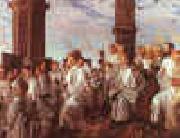
The Hireling Shepherd, 1851Hunt's works were not initially successful, and were widely attacked in the art press for their alleged clumsiness and ugliness. He achieved some early note for his intensely naturalistic scenes of modern rural and urban life, such as The Hireling Shepherd and The Awakening Conscience. However, it was with his religious paintings that he became famous, initially The Light of the World (now in the chapel at Keble College, Oxford, with a later copy in St Paul's Cathedral), having toured the world. After travelling to the Holy Land in search of accurate topographical and ethnographical material for further religious works, Hunt painted The Scapegoat, The Finding of the Saviour in the Temple and The Shadow of Death, along with many landscapes of the region. Hunt also painted many works based on poems, such as Isabella and The Lady of Shalott.
All these paintings were notable for their great attention to detail, their hard vivid colour and their elaborate symbolism. These features were influenced by the writings of John Ruskin and Thomas Carlyle, according to whom the world itself should be read as a system of visual signs. For Hunt it was the duty of the artist to reveal the correspondence between sign and fact. Out of all the members of the Pre-Raphaelite Brotherhood Hunt remained most true to their ideals throughout his career. He eventually had to give up painting because failing eyesight meant that he could not get the level of quality that he wanted. His last major work, The Lady of Shalott, was completed with the help of an assistant (Edward Robert Hughes).
Hunt married twice. After a failed engagement to his model Annie Miller, he married Fanny Waugh, who later modelled for the figure of Isabella. When she died in childbirth in Italy he sculpted her tomb up at Fiesole, having it brought down to the English Cemetery, beside the tomb of Elizabeth Barrett Browning. His second wife, Edith, was Fanny's sister. At this time it was illegal in Britain to marry one's deceased wife's sister, so Hunt was forced to travel abroad to marry her. This led to a serious breach with other family members, notably his former Pre-Raphaelite colleague Thomas Woolner, who had married Fanny and Edith's third sister Alice.
Hunt's autobiography Pre-Raphaelitism and the Pre-Raphaelite Brotherhood (1905) was written to correct other literature about the origins of the Brotherhood, which in his view did not adequately recognise his own contribution. Many of his late writings are attempts to control the interpretation of his work.
In 1905, he was appointed to the Order of Merit by King Edward VII. At the end of his life he lived in Sonning-on-Thames. |
 |
William Hogarth
|
|
British
1697-1764
William Hogarth Galleries
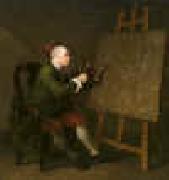
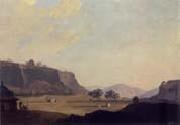
Early satirical works included an Emblematical Print on the South Sea Scheme (c.1721), about the disastrous stock market crash of 1720 known as the South Sea Bubble, in which many English people lost a great deal of money. In the bottom left corner, he shows Protestant, Catholic, and Jewish figures gambling, while in the middle there is a huge machine, like a merry-go-round, which people are boarding. At the top is a goat, written below which is "Who'l Ride" and this shows the stupidity of people in following the crowd in buying stock in The South Sea Company, which spent more time issuing stock than anything else. The people are scattered around the picture with a real sense of disorder, which represented the confusion. The progress of the well dressed people towards the ride in the middle shows how foolish some people could be, which is not entirely their own fault.
Other early works include The Lottery (1724); The Mystery of Masonry brought to Light by the Gormogons (1724); A Just View of the British Stage (1724); some book illustrations; and the small print, Masquerades and Operas (1724). The latter is a satire on contemporary follies, such as the masquerades of the Swiss impresario John James Heidegger, the popular Italian opera singers, John Rich's pantomimes at Lincoln's Inn Fields, and the exaggerated popularity of Lord Burlington's prot??g??, the architect and painter William Kent. He continued that theme in 1727, with the Large Masquerade Ticket. In 1726 Hogarth prepared twelve large engravings for Samuel Butler's Hudibras. These he himself valued highly, and are among his best book illustrations.
In the following years he turned his attention to the production of small "conversation pieces" (i.e., groups in oil of full-length portraits from 12 to 15 in. high). Among his efforts in oil between 1728 and 1732 were The Fountaine Family (c.1730), The Assembly at Wanstead House, The House of Commons examining Bambridge, and several pictures of the chief actors in John Gay's popular The Beggar's Opera.
One of his masterpieces of this period is the depiction of an amateur performance of John Dryden's The Indian Emperor, or The Conquest of Mexico (1732?C1735) at the home of John Conduitt, master of the mint, in St George's Street, Hanover Square.
Hogarth's other works in the 1730s include A Midnight Modern Conversation (1733), Southwark Fair (1733), The Sleeping Congregation (1736), Before and After (1736), Scholars at a Lecture (1736), The Company of Undertakers (Consultation of Quacks) (1736), The Distrest Poet (1736), The Four Times of the Day (1738), and Strolling Actresses Dressing in a Barn (1738). He may also have printed Burlington Gate (1731), evoked by Alexander Pope's Epistle to Lord Burlington, and defending Lord Chandos, who is therein satirized. This print gave great offence, and was suppressed (some modern authorities, however, no longer attribute this to Hogarth). |
 |
William Hodges
|
|
English Painter, 1744-1797
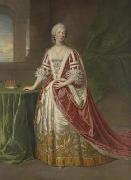
English painter. He first attended classes at William Shipley's Academy in the Strand, London, and from 1758 to 1765 was apprenticed to Richard Wilson (about whom he published a short biographical essay in 1790). Hodges followed Wilson's classical landscape style periodically throughout his career. |
 |
William Hoare
|
|
William Hoare of Bath RA (c. 1707 - 12 December 1792) was an English painter and printmaker, co-founder of the Royal Academy noted for his pastels.
Born near Eye, Suffolk, Hoare received a gentlemanes education in Faringdon. He showed a marked aptitude for drawing and was sent to London to study under Giuseppe Grisoni, who had left Florence for London in 1715. When Grisoni returned to Italy in 1728, Hoare went with him, travelling to Rome and continuing his studies under the direction of Francesco Imperiali. He remained in Rome for nine years, returning to London in 1737/8.
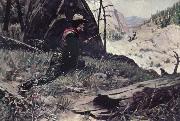
Failing to establish himself in London, Hoare settled in Bath, an expanding spa town popular with the wealthier classes. He obtained numerous commissions, the most important being for official portraits of social leaders of the day (including George Frideric Handel) and political men. There are several versions of most of these, suggesting that he had a studio, and they were further publicised by the production of mezzotints by leading engravers of the day. Hoare himself was a delicate etcher and published a number of private plates, mostly of family and friends, including Miss Hoare (probably Mary), Christopher Anstey and the 3rd Duke of Beaufort. His pastels were influenced by Rosalba Carriera. |
 |
William Herbert Dunton
|
|
a self-taught artist . American Painter , 1878-1936
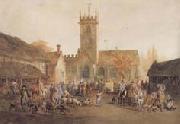
was an American artist who was one of the founding members of the Taos Society of Artists and part of the Taos art colony. He first came to Taos, New Mexico, in 1912. Among his proteges in Western art was Harold Dow Bugbee of Clarendon and Canyon in the Texas Panhandle. |
 |
William Henry Pyne
|
|
English Painter, 1769-1843
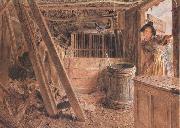
English painter, illustrator and writer. He trained at the drawing academy of Henry Pars (c. 1733-1806) in London and first exhibited at the Royal Academy in 1790. His drawings were almost always pen, ink and colour wash (e.g. Gossip at the Cottage Door, 1794; London, BM). His most characteristic works are the illustrations for the books Microcosm (1803-8) and The Costume of Great Britain (1808) in which he successfully placed groups of well-observed characters in picturesque settings. Pyne had been a founder of the Old Water-Colour Society in 1804 but resigned in 1809 when it refused to increase its membership to greater than 24 artists. |
 |
William Henry Hunt,OWS
|
|
1790-1864
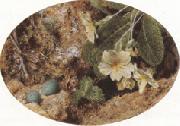
was an English watercolour painter. He was born near Long Acre, London, and was apprenticed in about 1805 to John Varley, the landscape-painter, with whom he remained five or six years. He exhibited three oil pictures at the Royal Academy in 1807. He became connected with the Society of Painters in Water Colours at its beginning, and was elected an associate in 1824 and a full member in 1827. Until the year of his death, he was one of the most prolific contributors to the Society's exhibitions. Many years of Hunt's uneventful but industrious life were spent at Hastings. He died of apoplexy. Hunt was one of the creators of the English school of water-color painting. His subjects, especially those of his later life, are extremely simple; but, by the delicacy, humor and fine power of their treatment, they rank second to works of the highest art only. Considered technically, his works exhibit all the resources of the water-color painter's craft, from the purest transparent tinting to the boldest use of gouache, rough paper and scraping for texture. His sense of color is perhaps as true as that of any English artist. He was, says John Ruskin, all in all, the finest ever painter of still life. Several characteristic examples of Hunt's work, as the "Boy and Goat," "Brown Study and Plums," "Primroses and Birds' Nests" are in the Victoria and Albert Museum. |
 |
william henry hunt,o.w.s
|
|
1790-1864
was an English watercolour painter. He was born near Long Acre, London, and was apprenticed in about 1805 to John Varley, the landscape-painter, with whom he remained five or six years. He exhibited three oil pictures at the Royal Academy in 1807. He became connected with the Society of Painters in Water Colours at its beginning, and was elected an associate in 1824 and a full member in 1827. Until the year of his death, he was one of the most prolific contributors to the Society's exhibitions. Many years of Hunt's uneventful but industrious life were spent at Hastings. He died of apoplexy. Hunt was one of the creators of the English school of water-color painting. His subjects, especially those of his later life, are extremely simple; but, by the delicacy, humor and fine power of their treatment, they rank second to works of the highest art only. Considered technically, his works exhibit all the resources of the water-color painter's craft, from the purest transparent tinting to the boldest use of gouache, rough paper and scraping for texture. His sense of color is perhaps as true as that of any English artist. He was, says John Ruskin, all in all, the finest ever painter of still life. Several characteristic examples of Hunt's work, as the "Boy and Goat," "Brown Study and Plums," "Primroses and Birds' Nests" are in the Victoria and Albert Museum. |
 |
William henry hunt
|
|
English Painter, 1790-1864
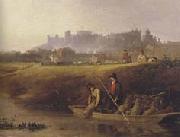
was an English watercolour painter. He was born near Long Acre, London, and was apprenticed in about 1805 to John Varley, the landscape-painter, with whom he remained five or six years. He exhibited three oil pictures at the Royal Academy in 1807. He became connected with the Society of Painters in Water Colours at its beginning, and was elected an associate in 1824 and a full member in 1827. Until the year of his death, he was one of the most prolific contributors to the Society's exhibitions. Many years of Hunt's uneventful but industrious life were spent at Hastings. He died of apoplexy. Hunt was one of the creators of the English school of water-color painting. His subjects, especially those of his later life, are extremely simple; but, by the delicacy, humor and fine power of their treatment, they rank second to works of the highest art only. Considered technically, his works exhibit all the resources of the water-color painter's craft, from the purest transparent tinting to the boldest use of gouache, rough paper and scraping for texture. His sense of color is perhaps as true as that of any English artist. He was, says John Ruskin, all in all, the finest ever painter of still life. Several characteristic examples of Hunt's work, as the "Boy and Goat," "Brown Study and Plums," "Primroses and Birds' Nests" are in the Victoria and Albert Museum. |
 |
William Henry Furness
|
|
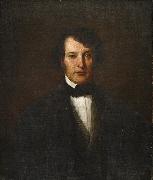
(1802-1896) was an American clergyman, theologian, reformer and abolitionist. Following the American Civil War, he raised funds for Black schools in the South, including Morehouse College.
A graduate of the Theological Department of Harvard University, Furness became the Minister of the First Unitarian Church of Philadelphia at the age of 22. A close friend of Ralph Waldo Emerson, Furness presided over a period marked by the growth and increasing prosperity for First Church. A fiery abolitionist, Furness was a supporter of the rights of all segments of society, including African-Americans and Jews. He also lived to see the construction of the current church building in 1885 in the role of Minister Emeritus.
Rev. Furness was the father of painter William Furness, Shakespearean scholar Horace Howard Furness, architect Frank Furness, and author and translator Annis Furness Lee.
|
 |
William Harnett
|
|
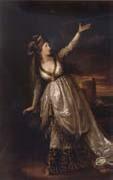
(August 10, 1848 - October 29, 1892) was an Irish-American painter known for his trompe l'oeil still lifes of ordinary objects.
Harnett was born in Clonakilty, County Cork, Ireland during the time of the potato famine. Shortly after his birth his family emigrated to America, settling in Philadelphia. Becoming a United States citizen in 1868, he made a living as a young man by engraving designs on table silver, while also taking night classes at the Pennsylvania Academy of the Fine Arts and later, in New York, at Cooper Union and at the National Academy of Design. His first known oil painting, a still life, dates from 1874.
|
 |
William Hamilton
|
|
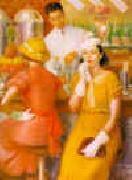
English Painter, 1751-1801, was an English painter and illustrator. Hamiliton was born in Chelsea, London, but travelled and worked in Italy with Antonio Zucchi for several years. He trained first as an architectural draftsman, but soon moved to theatrical portraits and scenes from plays. Hamilton became very well known for his paintings depicting episodes from the plays of Shakespeare and for his illustrations of poems. He was commissioned to create works for John Boydell's Shakespeare Gallery, Macklin's Bible and Bowyer's English History. These were widely reproduced in popular prints. Francesco Bartolozzi engraved a number of Hamilton??s best known works. He also painted modern events, such as the execution of Marie Antoinette, in the manner of epic historical drama. Hamilton's style shows the influence of the cult of sentiment typical of the period, resembling the work of Angelica Kauffmann. He also sometimes adopts aspects of Fuseli's dramatic distortions in composition and figure drawing. He became an associate member of the Royal Academy from 1784, and was made a full member in 1789. |
 |
William Glackens
|
|
1870-1938
William Glackens Galleries
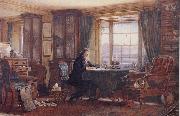
William James Glackens (March 13, 1870?CMay 22, 1938) was a U.S. realist painter.
Glackens studied at the Pennsylvania Academy of the Fine Arts and later moved to New York City, where he co-founded what came to be called the Ashcan School art movement. This group of artists, dubbed by the press "the Eight Independent Painters" or The Eight, chose to exhibit their works without pre-approval by the juries of the existing art establishment. He became known for his dark-hued paintings of street scenes and daily life in the city's neighborhoods. His later work was brighter in tone, and showed the influence of Renoir. During much of his career as a painter, Glackens also worked as an illustrator for newspapers and magazines in Philadelphia and New York City. |
 |
William Gershom Collingwood
|
|
artist and historian, (1854-1932)
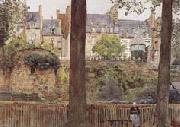
was an author, artist, antiquary and was also Professor of Fine Arts at the Reading University. He was born in Liverpool. In 1872, he went to University College, Oxford, where he met John Ruskin. During the summer of 1873 Collingwood visited Ruskin at Brantwood, Coniston. Two years later Collingwood was working at Brantwood with Ruskin and his associates. Ruskin admired his draughtsmanship, and so Collingwood studied at the Slade School of Art between 1876 and 1878. He exhibited at the Royal Academy in 1880. For many years Collingwood dedicated himself to helping Ruskin, staying at Brantwood as Ruskin's assistant and travelling with him to Switzerland. In 1883 he married Edith Mary Isaac (1857C1928) and settled near to Ruskin in the Lake District. Collingwood edited a number of Ruskin's texts and published a biography of Ruskin in 1893. In 1896, Arthur Ransome met the Collingwoods and their children, Dora (later Mrs Ernest Altounyan), Barbara (later Mrs Oscar Gnosspelius), Ursula, and Robin (the later historian and philosopher). Ransome learned to sail in Collingwood's boat, Swallow, and became a firm friend of the family, even proposing marriage to both Dora and Barbara (on separate occasions). After a summer of teaching Collingwood's grandchildren to sail in Swallow II in 1928, Ransome wrote the first book in his Swallows and Amazons series. He used the names of some of Collingwood's grandchildren for his characters, the Swallows. By the 1890s Collingwood had become a skilled painter and also joined the Cumberland and Westmorland Antiquarian and Archaeological Society. He wrote a large number of papers for its Transactions; becoming editor in 1900. Collingwood was particularly interested in Norse lore and the Norsemen, and he wrote a novel, Thorstein of the Mere which was a major influence on Arthur Ransome. Collingwood was a member of the Viking Club and served as its president. His study of Norse and Anglican archaeology made him widely recognized as a leading authority. Following Ruskin's death Collingwood continued to help for a while with secretarial work at Brantwood, but in 1905 went to University College, Reading and served as professor of fine art from 1907 until 1911. |
 |
William Frederick Yeames,RA
|
|
1835-1918
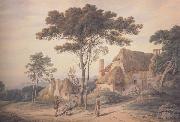
English painter. The son of a British consul in Russia, Yeames was sent to school in Dresden after the death of his father in 1842. He also studied painting there. The collapse of the Yeames family fortune resulted in a move to London in 1848, where Yeames learnt anatomy and composition from George Scharf (1788-1860). He later took lessons from F. A. Westmacott. In 1852 he continued his artistic education in Florence under Enrico Pollastrini and Raphael Buonajuto, from whom he learnt the methods of the Old Masters. He drew from frescoes by Ghirlandaio, Gozzoli and Andrea del Sarto and painted in the Life School at the Grand Ducal Academy. He then went to Rome and made landscape studies and copied Old Masters, including Raphael's frescoes in the Vatican. His extensive study of Italian art gave him a precision and facility that assisted his artistic success upon his return to London in 1859. There he set up a studio in Park Place and became involved with the ST JOHN'S WOOD CLIQUE. He exhibited at the Royal Academy and the British Institution from 1859 and became an ARA in 1866. |
 |
William Frederick Wells
|
|
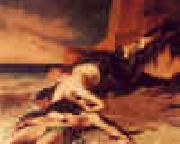
A landscape painter in watercolor, Wells was the true founder of the Society of Painters in Watercolors in 1804 and its president in 1806-07. He studied under J. J. Barralet and exhibited at the Royal Academy from 1795 to 1804 and at the Watercolor Society to 1813, when he resigned.
|
 |
William Etty
|
|
1787-1849
English
William Etty Location
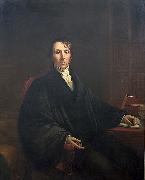
English painter. Born into a Methodist family, he was the seventh child of a miller and baker in Feasegate, York, and in 1798 he was apprenticed as a printer to Robert Peck, publisher of the Hull Packet. Financial support from his uncle, a banker, allowed him to go to London in 1805, where he entered the Royal Academy Schools in 1806. For a year, in 1807-8, he was a pupil of Thomas Lawrence, who greatly influenced him. Following the death of his uncle in 1809 he became financially secure. From 1811 he exhibited regularly at the Royal Academy and the British Institution and in 1816 worked in the studio of Jean-Baptiste Regnault in Paris. |
 |
William Ellery Channing
|
|
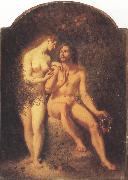
(April 7, 1780 - October 2, 1842) was the foremost Unitarian preacher in the United States in the early nineteenth century and, along with Andrews Norton, one of Unitarianism's leading theologians. He was known for his articulate and impassioned sermons and public speeches, and as a prominent thinker in the liberal theology of the day. |
 |
William Edward frost R.A.
|
|
1810-1877
was an English painter of the Victorian era. Virtually alone among English artists in the middle Victorian period, he devoted his practice to the portrayal of the female nude. Frost was educated in the schools of the Royal Academy, beginning in 1829; he established a reputation as a portrait painter before branching into historical and mythological subjects, including the sub-genre of fairy painting that was characteristic of Victorian art. In 1839 he won the Royal Academy's gold medal for his "Prometheus Bound," and in 1843 he won a prize in the Westminster Hall competition for his "Una Alarmed by Fauns" (a subject from Spenser's The Faerie Queen). He was elected an associate member of the Royal Academy in 1846, and a full member in 1870. Frost is widely recognized as a follower of William Etty, who preceded him as the primary British painter of nudes in the second quarter of the nineteenth century. |
 |
William Dyce
|
|
1806-1864
Scottish painter, educationalist, theorist and designer. The son of a lecturer in medicine at Marischal College, Aberdeen, he studied medicine and theology, obtaining his Master's degree in 1823. Episcopalian by upbringing, Dyce was expected, like his cousin, the scholar and bibliophile Alexander Dyce (1798-1869), to proceed to Oxford to take orders. His early interest in art found an outlet in portraiture, his first commission being Sir James M. D. M'Grigor (1823; U. Aberdeen). His first attempt at history painting, The Infant Hercules Strangling the Serpents sent by Juno to Destroy Him (1824; Edinburgh, N.G.), much influenced by Reynolds, was shown to Sir Thomas Lawrence, who is said to have encouraged Dyce to enter the Royal Academy Schools in 1825. After a few months he set off for Rome in the company of Alexander Day; |
 |
William Dunlap
|
|
(1 February 1766 - 28 September 1839) was a pioneer of the American theater. He was a producer, playwright, and actor, as well as a historian. He managed two of New York's earliest and most prominent theaters, the John Street Theatre (from 1796?C98) and the Park Theatre (from 1798?C1805). He was also an artist, despite losing an eye in childhood.
He was born in Perth Amboy New Jersey, the son of an army officer wounded at the Battle of Quebec in 1759. In 1783, he produced a portrait of George Washington, now owned by the United States Senate, and later studied art under Benjamin West in London. After returning to America in 1787, he worked exclusively in the theater for 18 years, resuming painting out of economic necessity in 1805. By 1817, he was a full-time painter.
In his lifetime he produced more than sixty plays, most of which were adaptations or translations from French or German works. A few were original: these were based on American themes and had American characters. However, he is best known for his encyclopedic three-volume History of the Rise and Progress of the Arts of Design in the United States, which was published in 1834, and which is now an invaluable source of information about artists, collecting, and artistic life generally in the colonial and federal periods.
|
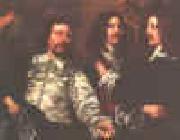 |
William Dobson
|
|
1610-1646
English
William Dobson Locations
William Dobson (March 4, 1610 ?C October 28, 1646) was a portraitist and one of the first notable English painters, praised by his contemporary John Aubrey as the most excellent painter that England has yet bred.
Dobson was born in London the son of a decorative artist, and was apprenticed to William Peake and probably later joined the studio of Francis Cleyn. He is believed to have had access to the Royal Collection and to have copied works by Titian and Anthony Van Dyck, King Charles I chief painter. The colour and texture of Dobson work was influenced by Venetian art, but Van Dyck style has little apparent influence on Dobson. Van Dyck himself discovered Dobson when he noticed one of the young artists pictures in a London shop window. He introduced Dobson to the King, who had Dobson paint himself, his sons and members of the court.
When Van Dyck died in 1641, Dobson probably succeeded him as sergeant-painter to the King, though proof is lacking. During the English Civil War Dobson was based at the Royalist centre of Oxford and painted many leading Cavaliers. His portrait of the future Charles II as Prince of Wales at the age of around twelve is a notable baroque composition, and perhaps his finest work. He also painted the Duke of York, Prince Rupert of the Rhine and Prince Maurice.
Charles II when Prince of Wales, circa 1642 or 1643.Around sixty of Dobson works survive, mostly half-length portraits most of them dated from 1642 or later. The thick impasto of his early work gave way to a mere skim of paint, perhaps reflecting a wartime scarcity of materials. After Oxford fell to the Parliamentarians, in June 1646, Dobson returned to London. Now without patronage, he was briefly imprisoned for debt and died in poverty at the age of thirty-six.
Dobson is regarded as a talented painter with a fine sense for colour and good powers of observation. However, an entirely English training such as Dobson could not be first rate in the early 17th century and he had technical weaknesses[citation needed]. There are examples of Dobson work at Tate Britain and the National Portrait Gallery in London and at several English country houses. The most comprehensive study of Dobson and his work is William Dobson, 1611?C1646 an exhibition catalogue written by M. Rogers for a 1983 exhibition at the National Portrait Gallery. |
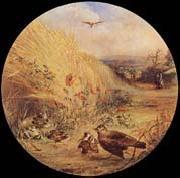 |
William Dexter
|
|
Australian, 1818-1860,was an English-Australian painter. Dexter was born at Melbourne, Derbyshire, England, and became an apprentice at the Derby China factory painting flowers and birds in the Chinese and Japanese styles. Dexter then studied at Paris, and returning to England, married Caroline nee Harper at Nottingham in 1843. Dexter had a picture in the Royal Academy exhibition in 1851 and another in 1852. Dexter then sailed to Australia and arrived at Sydney on 8 October 1852. Dexter was at Bendigo in August 1853, where William Howitt heard him advocating republican doctrines at a meeting of diggers. His wife came out from England at the end of 1854, and in March 1855 they together opened a gallery of arts and school of design in Bathurst Street, Sydney. This apparently was not a success for they went to live at Stratford, Victoria, in 1856, and there made the acquaintance of Angus McMillan. In 1857 Dexter exhibited six oils and three watercolours at the first Victorian Society of Fine Arts exhibition, held in Melbourne. Soon afterwards he returned to Sydney as the Dexters had separated. He became a partner in a sign-writing business, dying there in 1860. |
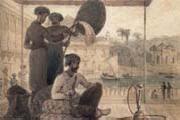 |
William Daniell
|
|
English, 1769-1837, was a British draughtsman. Castle Broichin on the Isle of Raasay. 1819 aquatint by William DaniellDaniell was fourteen when he accompanied his uncle Thomas Daniell to India |
|