|
 |
Walter Ufer
|
|
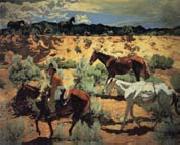
American Painter, 1876-1936,was an American artist based in Taos, New Mexico. His most notable work focuses on scenes of Native American life, particularly of the Pueblo Indians. Walter was born of German immigrant parents and raised in Kentucky. After an apprenticeship as a lithographer, he went to Europe where he was a traveling journeyman. When he returned to America, he worked as a printer in Chicago and taught school, and later took classes in fine arts. After a brief time in Chicago, he returned to Europe for further study as an artist. |
 |
Walter Shirlaw
|
|
Scottish-American artist , 1838-1909
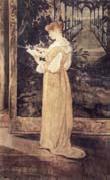
was a Scottish-American artist. Shirlaw was born in Paisley, Scotland, and moved to the United States with his parents in 1840. He worked as a bank-note engraver, and his work was first exhibited at the National Academy in 1861. He was elected an academician of the Chicago Academy of Design in 1868. Among his pupils there was Frederick Stuart Church. From 1870 to 1877 he studied in Munich, under George Raab, Richard Wagner, Arthur George von Ramberg, and Wilhelm Lindenschmidt. His first work of importance was the Toning of the Bell (1874), which was followed by Sheep-shearing in the Bavarian Highlands (1876). The latter, which is probably the best of his works, received honorable mention at the Paris exposition in 1878. Other notable works from his easel are Good Morning (1878), in the Buffalo Academy; Indian Girl and Very Old (1880); Gossip (1884); and Jealousy (1886), owned by the Academy of Design, New York. His largest work is the frieze for the dining-room in the house of Darius O. Mills in New York. Shirlaw has also earned an excellent reputation as an illustrator. He was one of the founders of the Society of American Artists, and was its first president. On his return from Europe he took charge of the Art Students League of New York, and for several years taught in the composition class. |
 |
Walter Leistikow
|
|
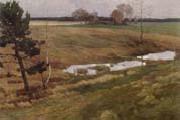
1865-1908,German painter, decorative artist, etcher, exhibition organizer and writer. He studied painting briefly in 1883, at the Akademie in Berlin, but he was dismissed after six months as 'untalented'. From 1883 to 1885 he trained with the painter Hermann Eschke (1823-1900) and from 1885 to 1887 with the Norwegian painter Hans Fredrik Gude. Gude had a decisive influence on the style of Leistikow's early works, as is especially clear in Leistikow's light coastal landscapes with figures. His most significant work from this period, however, is Brickworks near Eckernferde (1887; ex-Gem?ldegal. Neue Meister, Dresden). Leistikow's dismissal from the Akademie concentrated his attention on issues of artistic policy. When the German government decided not to send works for exhibition in the Exposition Universelle in Paris in 1889, Leistikow himself organized the dispatch of works to Paris. In 1892, |
 |
Walter Griffin
|
|
1861-1935
Walter Burley Griffin November 24, 1876?CFebruary 11, 1937) was a US architect and landscape architect, who is best known for his role in designing Canberra, Australia's capital city. He has also been credited with the development of the L-shaped floor plan, the carport and the first use of reinforced concrete.
Influenced by the Chicago-based Prairie School, Griffin went on to develop a unique modern style. For much of his career Griffin worked in partnership with his wife Marion Mahony Griffin. In the 28 years of their architectural partnership, the Griffins designed over 350 building, landscape and urban-design projects as well as designing construction materials, interiors, furniture and other household items. |
 |
Walter Gramatte
|
|
Walter Gramatte (8 January 1897 in Berlin - 9 February 1929 in Hamburg) was a German expressionist painter who specialized in magic realism. He often painted with a mystical view of nature.
Walter Gramatte died on 9 February 1929 of Intestinal Tuberculosis.
His second wife Sonia married again, was then named Sophie Carmen Eckhardt-Gramatte and lived in Canada as a renowned musician. To remember her and her former husband Walter Gramatte „The Eckhardt-Gramatte-Foundatione was established in Winnipeg, Canada.
Walter Gramatte's written posthumous works are preserved in the German National Museum.
A special exhibition of his paintings, titled Rediscovered: Walter Gramatte 1897-1929, took place in Hamburg Ernst Barlach Haus from October 26, 2008 to February 1, 2009. This exhibition was organized by Kirchner Museum in Davos, Switzerland and the Ernst Barlach Haus in Hamburg, Germany.
|
 |
Walter Gay
|
|
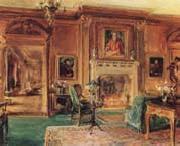
1856-1937. He was an American painter born at Hingham, Massachusetts. He married heiress Matilda E. Travers, the daughter of prominent New York City investor and co-founder of Saratoga Race Course, William R. Travers. In 1876 the couple moved to Paris, France where Walter Gay became a pupil of Leon Bonnat. They lived in an apartment on the Left Bank and in 1907 purchased Chateau Le Breau on a three-hundred-acre walled park near the Forest of Fontainebleau. Walter Gay received an honorable mention in the Paris Salon of 1885; a gold medal in 1888, and similar awards at Vienna (1894), Antwerp (1895), Berlin (1896) and Munich (1897). He became an Officer of the Legion of Honor and a member of the Society of Secession, Munich. |
 |
Walter Crane,RWS
|
|
1845-1915
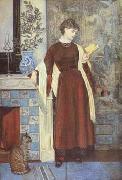
English painter, illustrator, designer, writer and teacher. He showed artistic inclinations as a boy and was encouraged to draw by his father, the portrait painter and miniaturist Thomas Crane (1808-59). A series of illustrations to Tennyson's The Lady of Shalott (Cambridge, MA, Harvard U., Houghton Lib.) was shown first to Ruskin, who praised the use of colour, and then to the engraver William James Linton, to whom Crane was apprenticed in 1859. From 1859 to 1862 Crane learnt a technique of exact and economical draughtsmanship on woodblocks. His early illustrative works included vignette wood-engravings for John R. Capel Wise's The New Forest: Its History and its Scenery (1862). |
 |
Walter Crane
|
|
English Golden Age Illustrator, 1845-1915
English painter, illustrator, designer, writer and teacher. He showed artistic inclinations as a boy and was encouraged to draw by his father, the portrait painter and miniaturist Thomas Crane (1808-59). A series of illustrations to Tennyson's The Lady of Shalott (Cambridge, MA, Harvard U., Houghton Lib.) was shown first to Ruskin, who praised the use of colour, and then to the engraver William James Linton, to whom Crane was apprenticed in 1859. From 1859 to 1862 Crane learnt a technique of exact and economical draughtsmanship on woodblocks. |
 |
Wallerant Vaillant
|
|
Wallerant Vaillant, (Lille 30 May 1623 - Amsterdam 28 August 1677), was a painter of the Dutch Golden Age and one of the first artists to use the mezzotint technique, which he probably helped to develop.
Wallerant Vaillant was the oldest of five brothers, who all became successful painters.
Jacques (1625 - 1691) traveled to Italy where he joined the Bentvueghels in Rome with the nickname Leeuwrik, and settled later in Berlin.
Jan (1627 - 1668+) was an engraver considered to be a member of the school of Frankenthal and later became a merchant in Frankfurt.
Bernard (1632 - 1698) accompanied Wallerant on all of his travels, and settled later in Rotterdam, where he became deacon of the Wallonian Church.
Andreas (1655 - 1693), the youngest, became an engraver in Paris, and died in Berlin visiting his brother Jacques.
It is said Wallerant was a student of Erasmus Quellinus II (1607 - 1678) in Antwerp. He moved with his parents in 1643 to Amsterdam. In 1647 he lived in Middelburg, but in 1649 he was back in Amsterdam. In 1658 he traveled with his brother to Frankfurt and Heidelberg. He helped invent the Mezzotint technique (schraapkunst, or zwartekunst) with Prince Rupert of the Rhine when he was his tutor performing experiments in etching techniques. In 1659 he went to Paris with Philibert de Gramont where he stayed five years.
|
 |
w. von schadow
|
|
Friedrich Wilhelm Schadow (7 September 1789 - 19 March 1862) was a German Romantic painter.
He was born in Berlin and was the second son of the sculptor Johann Gottfried Schadow.
In 1806-1807 Friedrich served as a soldier. In 1810 he traveled with his elder brother Rudolph to Rome where he became one of the leaders among painters of the Nazarene movement. Following the example of Johann Friedrich Overbeck and others, he joined the Roman Catholic Church, and held that an artist must believe and live out the truths he essays to paint. The sequel showed that Schadow was qualified to shine more as a teacher and mentor than as a painter. As an author, he is best known for his lecture, Ueber den Einfluss des Christentums auf die bildende Kunst (About The Influence of Christianity On The Visual Arts) (Dusseldorf, 1843), and the biographical sketches, Der moderne Vasari (Berlin, 1854).
In Rome, Schadow was given one of his first major commissions when the Prussian Consul-General, General Jakob Salomon Bartholdy, befriended the young painter, and asked him and three young compatriots (Cornelius, Overbeck and Veit) to decorate in fresco a room in his house on the Pincian Hill. The overall theme selected was the story of Joseph and his brethren, and two scenes, the Bloody Coat and Joseph in Prison, were conferred on Schadow. In 1819, Schadow was appointed professor in the prestigious Berlin Academy of the Arts, and his ability and thorough training gained many devoted disciples.
It was during this period that Schadow developed his paintings for churches. In 1826, Professor Schadow was made director of the Dusseldorf Academy of the Arts, which he reoriented towards the production of Christian art, though he began a major dispute with one of its professors, Heinrich Christoph Kolbe, ending in the latter leaving the Academy in 1832. In 1837, Schadow selected, at request, those of his students best qualified to decorate the chapel of St Apollinaris on the Rhine with frescoes. When finished, they were acclaimed as the fullest and purest manifestation of the spiritual side of the D??sseldorf school. One of his famous students, Heinrich Mucke, carried on the liturgical art with emphasis both in painting and frescoes. The painting of the Wise and Foolish Virgins. considered one of his masterworks, was commissioned in 1842. Now in the Städel Museum, this large and important picture, while carefully considered and rendered, it however lacks power of some of his other works.
Schadow's fame rests less on his own artistic creations than on the school he formed. In D??sseldorf a reaction set in against the spiritual and sacerdotal style he had established and, in 1859, the party of naturalism, after a severe struggle, drove Director Schadow from his chair. Friedrich Wilhelm Schadow died at Dusseldorf in 1862, and a monument was erected in the square which bears his name at a jubilee held to commemorate his directorate.
The D??sseldorf School that Schadow directed became internationally renowned, attracting such American painters as George Caleb Bingham, Eastman Johnson, Worthington Whittredge, Richard Caton Woodville, William Stanley Haseltine, James M. Hart, and William Morris Hunt and producing the German emigre Emmanuel Leutze. |
 |
Victor Westerholm
|
|
Finnish, 1860-1919
Finnish painter. He studied at the School of Drawing in Turku from 1869 to 1878. In 1878 he travelled to Dosseldorf and enrolled at the Kunstakademie, where he attended classes on landscape painting by Eugen Docker until 1886. He spent his summers in Finland, on the aland Islands, preparing sketches that provided the groundwork for many of the paintings he produced in Dosseldorf. Although Westerholm began working according to the principles of studio painting, his vivid studies are often imbued with the crispness of the plein-air style. In the early 1880s he concentrated on painting autumnal scenes and rapidly became the leading landscape artist of the younger generation with such works as the Mail-packet Jetty at Ecker (1885; Hemeenlinna, A. Mus.). |
 |
VELDE, Willem van de, the Younger
|
|
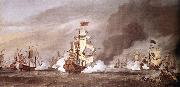
Dutch painter (b. 1633, Leiden, d. 1707, London).
was a Dutch marine painter. Willem van de Velde was baptised on 18 December 1633 in Leiden, Holland, Dutch Republic. A son of Willem van de Velde the Elder, also a painter of sea-pieces, Willem van de Velde, the younger, was instructed by his father, and afterwards by Simon de Vlieger, a marine painter of repute at the time, and had achieved great celebrity by his art before he came to London. In 1673 he moved to England, where he was engaged by Charles II, at a salary of £100, to aid his father in "taking and making draughts of sea-fights", his part of the work being to reproduce in color the drawings of the elder van de Velde. He was also patronized by the Duke of York and by various members of the nobility. He died on 6 April 1707 in London, England. Most of Van de Velde's finest works represent views off the coast of Holland, with Dutch shipping. His best productions are delicate, spirited and finished in handling, and correct in the drawing of the vessels and their rigging. The numerous figures are tellingly introduced, and the artist is successful in his renderings of sea, whether in calm or storm. |
 |
Thomas Whitcombe
|
|
British
1760-1824
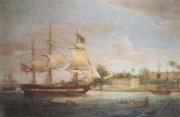
British 1760-1824 was a British maritime painter Thomas Whitcombe was born in London between 1752 and 19 May 1763, with the latter date frequently cited. Little is known of his background or training, although speculation based on the locations depicted in his paintings may provide some clues. It is known that he was in Bristol in 1787 and later travelled to the South Coast; there are few ports or harbours from this region that do not feature in his work. In 1789 he toured Wales and in 1813 he travelled to Devon, painting scenes around Plymouth harbour. During his career he also painted scenes showing the Cape of Good Hope, Madeira, Cuba and Cape Horn. Between 1783 and 1824 he lived in London. His date of death, like that of his birth is uncertain; it was not before 1824, and possibly as late as 1834. |
 |
Thomas Waterman Wood
|
|
1823-1903
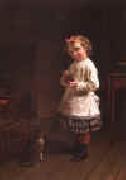
It may be that his reputation as an artist will rest upon his figure pictures, although his very numerous portrait paintings involved much of the effort of his life and are most certainly characterized but simple and strong composition, great technical execution and a masterful use of colors. It may also follow that he will yet achieve his most memorable honors from the interpretations which he has made of great paintings, but from the stand point of those whose minds and hearts are won by considerations of local history the highest interest will be assigned to works in which Wood included characters from his native place. As examples of his work in this direction the following may be mentioned: The Yankee Pedlar had for its model a tin peddler known as "Snapping Tucker", a resident of Calais, Vermont. When this work was sold for a large sum, Tucker promptly claimed his share upon the grounds of his intrinsic worth and natural capacity as a poser. The Village Post Office was taken from the interior of the old Ainsworth store in Williamstown, Vermont, but the figures were mostly taken from Montpelier people. Wood's uncle Zenas was the postmaster and the group around the store, Boyden, Whittier and Bullock, were old-time residents. Their clerk was Horace Scribner, long esteemed as a generous country musician and as the organist of Christ Church. This painting was bought by Mr. Charles Stewart Smith, ex-president of the New York Chamber of Commerce. The scene for the The Quack Doctor was located in front of the old arch which once spanned the head of State Street leading to East State. The old brick building, the home of Montpelier Book Bindery, still stands. This picture was bought by Mr. George I. Seneg for $2,000 and after his death was included in the sale of his entire collection.
Another successful painting was The Country Doctor. The artist found the proper model for this work with the aid of the Secretary of State, Dr. George Nichols, in the person of an actual country doctor, then representing the town of Jamaica in the legislature. This doctor bore upon his face the impress of his beneficent labors for more than 40 years in a back country town. Wood himself told the writer, in speaking of this painting, that many a person had said to him, "That doctor is the exact image of my father, who was also a country doctor." This saying he regarded not so much as proof that he had achieved a concrete likeness but as an evidence of having successfully handed down the particular class idea of the old-fashioned country physician, as truly different in type from the city practitioner as was the country lawyer of former days from his brother in the city.
In 1891, Wood exhibited at the Academy a picture entitled A Cogitation, for which one of his Montpelier friends, Mr. George Ripley, posed. The composition is extremely simple, a farmer in his barn, leaning upon his pitchfork, his countenance thoughtful. This picture was bought by Mr. Harper and published as a full-page engraving in Harper's Weekly during the Greeley campaign over the title "Is Greeley a Fool or a Knave?". The humorous side of this incident consists in the fact that Mr. Ripley was the model was an ardent supporter of Mr. Greeley in that campaign, while the artist himself, so far as we know, never dabbled in politics.
These few examples sufficiently illustrate the influence which the place of his birth had upon Wood. He was not only a Vermonter but a great painter of Vermont ideas, conditions and character. Nor did foreign travel nor city residence nor any influence of professional connections ever tend to diminish the deep and abiding interest in his early home. The subjects of his works, his selection of characters, his yearly pilgrimage to Vermont, all demonstrate his filial loyalty and he gave to this sentiment of his heart its final expression in the establishment, as a gift to Montpelier, of its Gallery of Art. But, apart from this, the homes, offices and institutions of Montpelier and without are filled with the affectionate and great evidences of his work. The Vermont Historical Society possesses several excellent examples of his portraiture, all of great historic value and preserved in the Cedar Creek Reception Room at the Vermont State House: Samuel Prentiss (1881), United States Senator; Mrs. Samuel Prentiss (1895) and Dr. Edward Lamb (1895), gifts to the Society by the family of Mr. Prentiss. In 1896, the Society unveiled a life-size portrait of the distinguished publicist, the Hon. E. P. Walton, the gift of his wife and sister. Wood's personal donations include portraits of the Rev. William A. Lord, D.D. (1874), minister of Bethany Congregational Church of this city, Daniel Pierce Thompson (1880), novelist and author of "The Green Mountain Boys", and Justin S. Morrill, United States Senator, father of tariff legislation, promoter of agricultural colleges and chief up builder of the Library of Congress.
One of the noblest paintings now existing in the state is the artist's beautiful translation of Bartolom?? Esteban Murillo's "La Madonna del Rosario". This work, submitting the original with infinite tenderness and feeling, was painted in 1896 in the Dulwich Gallery and was consecrated by Bishop de Goesbriand for the service of Saint Augustine's Church on July 26, 1897. The essential force of this sacred painting is its actual power to impress the beholder with a profound sense of the sacredness of motherhood and the worth and lasting values of purity and religious faith. In accepting this donation from Wood the Reverend Bishop said: "You have made a great Murillo of the seventeenth century our contemporary," an expression not only true of itself but one which defines the special value of the truly great copies of great paintings. |
 |
Stanislaw Wyspianski
|
|
1869-1907
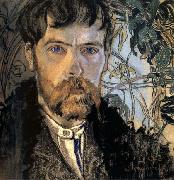
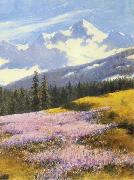
was a Polish playwright, painter and poet, as well as interior and furniture designer. A patriotic writer, he created a series of symbolic, national dramas within the artistic philosophy of the Young Poland Movement. Wyspiaeski was one of the most outstanding and multifaceted artists of his time in Europe. He successfully joined the trends of modernism with themes of the Polish folk tradition and Romantic history. Unofficially, he came to be known as the Fourth Polish Bard. Stanisław Wyspiaeski was born to Franciszek Wyspiaeski and Maria Rogowska. His father, a sculptor, owned an atelier on Wawel Hill. His mother died of tuberculosis in 1876 when Stanisław was seven years old. Due to alcohol problem, Stanisław's father could not fulfil his parental responsibilities. Stanisław was adopted by his aunt Joanna Stankiewiczowa and her husband Kazimierz. The Stankiewicz family belonged to a bourgeois and intellectual class. In their house Wyspiaeski became acquainted with painter Jan Matejko, who was a frequent visitor. Matejko soon recognized that the boy had artistic talent and gave him the first artistic guidance. Wyspiaeski attended Saint Anne's Secondary. The school was unique for several reasons. Firstly, although Polish language was forbidden in educational institutions under foreign rule, the lectures in Saint Anne's Gymnasium were delivered in Polish. Secondly, the teacher's goal was to equip the students with a thorough knowledge of Polish history and literature. Thirdly, the school graduates, which included Lucjan Rydel, Stanisław Estreicher and Henryk Opieeski, were considered prominent figures in Krakew's cultural life. As a student Wyspiaeski did not display any specific talent, but took particular interest in art and literature. According to Joanna Stankiewiczowa, a young Stanisław portrayed small village cottages, animals, plants, armors and decorations. As far as literature was concerned, Wyspiaeski created a dramatic interpretation of Matejko's painting Stefan Batory pod Pskowem (Bathory at Pskov). In 1887 Wyspiaeski enrolled in the Philosophy Department at the Jagiellonian University and the School of Fine Arts in Krakew. While studying at the University, he attended lectures in art, history and literature. Jan Matejko, the dean of the School of Fine Arts soon recognized Wyspiaeski's talent and asked him to join in the creation of a polychrome inside the Mariacki Church. The years 1890-1895 were devoted to traveling. Wyspiaeski visited Italy, Switzerland, Germany, Prague and France. The stay in France was regarded to be the major point in his artistic life. He studied at the private atelier Academie Colarossi. Since the school fee was very high, Wyspiaeski applied for a grant. During the stay in France he got acquainted with Paul Gauguin. Together they visited art museums, where Wyspiaeski was bewitched by the beauty of Pierre Puvis de Chavannes's paintings. He also attended theatre performances based on Shakespeare's and antic plays. His future dramas: Daniel i Meleager (Daniel and Meleagra) and Powret Odysa (Return of Odysseus) were based on the antic tradition. Meanwhile, he worked on several dramas Krelowa Polskiej Korony (The Queen of Polish Crown), Warszawianka (Varsovian Anthem) and the first version of Legenda (Legend). The play Legenda (Legend) was based on the famous Polish legend about Wars and Sawa. In August 1894 he returned to Krakew, where he got involved in the modernist movement. It was then he designed and partially made a polychrome for the Franciscan Church that was composed of flowery, geometrical and heraldic motifs. Moreover, the prior of the church encouraged Wyspiaeski to design various stained glass windows such as Blessed Salomea, Saint Francis Stigmata and God the Father. It is worth mentioning that Wyspiaeski received an award of the Polish Academy of Learning for the landscape of the Kopiec Kościuszki (Kościuszko Mound). |
 |
Stanislaw Witkiewicz
|
|
(8 May 1851 in Pašiaušė - 5 September 1915 in Lovran) was a Polish painter, architect, writer and art theoretician.
Witkiewicz was born in the Lithuanian village of Pašiaušė (Polish: Poszawsze) in Samogitia, at that time, in the partitioned Polish-Lithuanian Commonwealth lands ruled by the Russian Empire.
Witkiewicz studied in Saint Petersburg, 1869-71, then in Munich, 1872-75.
He created the Zakopane Style (styl zakopiaki) (also known as Witkiewicz Style (styl witkiewiczowski)) in architecture. He was strongly associated with Zakopane and promoted it in the art community.
His son, Stanisław Ignacy Witkiewicz, became a famous painter, playwright, novelist and philosopher, also known (from the conflation of his surname and middle name) by the mononymous pseudonym "Witkacy." The son's godmother was the internationally famous actress Helena Modjeska (Helena Modrzejewska), whom the elder Witkiewicz in 1876 had nearly accompanied to California in the United States.
Witkiewicz had strong views against formal education: "school is completely at odds with the psychological make-up of human beings". He applied this principle in his son's upbringing and was disappointed when the 20-year-old Witkacy chose to enroll at the Academy of Fine Arts in Krakew.
In 1908, suffering from tuberculosis, the elder Witkiewicz left his family in Zakopane and relocated to Lovranno, a fashionable resort in what was then Austria-Hungary, which today is in Croatia. He died there in 1915.
|
 |
Sir William Orpen
|
|
Irish
1878-1931
Sir William Orpen Location
Irish painter. He attended the Metropolitan School of Art, Dublin (1891-7), and the Slade School of Art, London (1897-9), there winning the composition prize of 1899 with The Play Scene from Hamlet (Houghton Hall, Norfolk). He became a friend of Augustus John and joined the New English Art Club. From very early years he had been an impassioned student of the Old Masters, and he went to Paris with John in 1899 to see Leonardo da Vinci Mona Lisa (Paris, Louvre). In the following years his perception of their works |
 |
Sir William Beechey
|
|
1753-1839
British
English painter. He was trained as a lawyer before entering the Royal Academy Schools, London, in 1772. He is thought to have studied under Johan Zoffany, and his earliest surviving portraits are small-scale full-lengths and conversation pieces in Zoffanys manner (e.g. The Custance Conversation Piece, c. 1786; priv. col.). Beechey first exhibited at the Royal Academy in 1776. In 1782 he moved to Norwich, where he gained several commissions, but he was back in London by 1787. In 1789 he exhibited a portrait of John Douglas, Bishop of Carlisle (London, Lambeth Pal.) that is remarkable for its facility of handling. Beechey would occasionally paint similarly inspired works, but his career is marked by a succession of unflamboyant but competent portraits in the tradition of Joshua Reynolds. |
 |
Sir Edwin Landseer
|
|
1803-1874
British
Sir Edwin Landseer Galleries
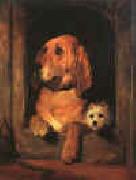
Landseer was something of a child prodigy whose artistic talents were recognized early on; he studied under several artists, including his father John Landseer, an engraver, and Benjamin Robert Haydon, the well-known and controversial history painter who encouraged the young Landseer to perform dissections in order to fully understand animal musculature and skeletal structure.
At the age of just 13, in 1815, Landseer exhibited works at the Royal Academy. He was elected an Associate of the Royal Academy at the age of 24, and an Academician of the Royal Academy five years later in 1831. He was knighted in 1850, and although elected President of the Royal Academy in 1866 he declined the invitation.
Landseer was a notable figure in 19th century British art, and his works can be found in Tate Britain, the Victoria and Albert Museum, Kenwood House and the Wallace Collection in London. He also collaborated with fellow painter Frederick Richard Lee.
Windsor Castle in Modern Times (1841-1845)
Queen Victoria and her family at Windsor Castle.Landseer's popularity in Victorian Britain was considerable. He was widely regarded as one of the foremost animal painters of his time, and reproductions of his works were commonly found in middle-class homes. Yet his appeal crossed class boundaries, for Landseer was quite popular with the British aristocracy as well, including Queen Victoria, who commissioned numerous portraits of her family (and pets) from the artist. Landseer was particularly associated with Scotland and the Scottish Highlands, which provided the subjects (both human and animal) for many of his important paintings, including his early successes The Hunting of Chevy Chase (1825-1826) and An Illicit Whiskey Still in the Highlands (1826-1829), and his more mature achievements such as the majestic stag study Monarch of the Glen (1851) and Rent Day in the Wilderness (1855-1868).
Saved (1856)
Landseer's paintings of dogs were highly popular among all classes of society.So popular and influential were Landseer's paintings of dogs in the service of humanity that the name Landseer came to be the official name for the variety of Newfoundland dog that, rather than being black or mostly black, features a mix of both black and white; it was this variety Landseer popularized in his paintings celebrating Newfoundlands as water rescue dogs, most notably Off to the Rescue (1827), A Distinguished Member of the Humane Society (1838), and Saved (1856), which combines Victorian constructions of childhood with the appealing idea of noble animals devoted to humankind ?? a devotion indicated, in Saved, by the fact the dog has rescued the child without any apparent human direction or intervention.
In his late 30s Landseer suffered what is now believed to be a substantial nervous breakdown, and for the rest of his life was troubled by recurring bouts of melancholy, hypchondria, and depression, often aggravated by alcohol and drug use (Ormond, Monarch 125). In the last few years of his life Landseer's mental stability was problematic, and at the request of his family he was declared insane in July 1872.
Landseer's death on 1 October 1873 was widely marked in England: shops and houses lowered their blinds, flags flew at half-staff, his bronze lions at the base of Nelson's column were hung with wreaths, and large crowds lined the streets to watch his funeral cortege pass (Ormond, Monarch 135). Landseer was buried in St Paul's Cathedral, London . |
 |
Sir David Wilkie
|
|
1785-1841
British Sir David Wilkie Galleries
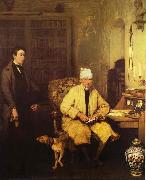
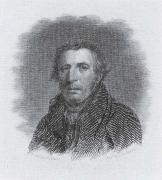
Wilkie may have inherited his rectitude and tenacity, even his nervous inhibitions, from his father, the minister of his native parish. Though little responsive to schooling, he showed an early inclination towards mimicry that expressed itself in drawings, chiefly of human activity. In these he was influenced by a copy of Allan Ramsay pastoral comedy in verse, the Gentle Shepherd (1725), illustrated by David Allan in 1788. One of the few surviving examples of his early drawings represents a scene from it (c. 1797; Kirkcaldy, Fife, Mus. A.G.). Wilkie cherished the demotic spirit of this book and its illustrations throughout his life. |
 |
Samuel Lovett Waldo
|
|
American Painter, 1783-1861
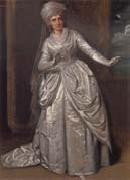
American painter. After attending a country school and working on his father farm, he decided at the age of 16 to become an artist. He took lessons from Joseph Steward (1753-1822), a retired minister who operated a portrait studio in Hartford, CT. Waldo opened his own studio in Hartford in 1803, before moving on to paint portraits in Litchfield, CT, and Charleston, SC. In 1806, bearing letters of introduction to Benjamin West and John Singleton Copley, Waldo travelled to London, where he studied at the Royal Academy. His portrait of Mr M Dougle (untraced) was shown at the Royal Academy in 1808. |
 |
Samuel De Wilde
|
|
British 1748-1832,English painter and etcher of Dutch descent. He was the son of a Dutch joiner who had settled in London by 1748. On 19 November 1765 he was apprenticed for seven years to his godfather, Samuel Haworth, a joiner in London. However, he left after five years and enrolled as a student at the Royal Academy Schools in 1769. He exhibited small portraits at the Society of Artists (1776-8) and at the Royal Academy (from 1778), where he also showed fancy pictures of banditti in the style of Philippe Jacques de Loutherbourg. But the genre that he made very much his own was theatrical portraiture: he exhibited theatrical portraits at the Royal Academy almost every year from 1792 to 1821. |
 |
Rudolf Wacker
|
|
Austria (1893 -1939 ) - Painter
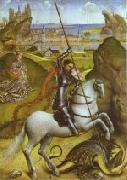
painted Selbstbildnis mit orangefarbener Palette in 1926 |
 |
Rogier van der Weyden
|
|
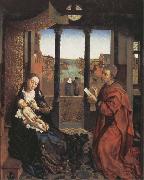
Rogier van der Weyden 1399/1400 - 1464 was the most important representative of Netherlandish painting or Northern Renaissance ... is, with Jan van Eyck, considered one of the greatest exponents of the school of Early Netherlandish painting. Rogier van der Weyden was born in Tournai as 'Rogier de le Pasture' (Roger of the Pasture) in 1399 or 1400. His parents were Henri de le Pasture and Agnes de Watr??los. The family had settled before in the city of Tournai where Rogiers father worked as a 'maître-coutelier' (knife manufacturer). In 1426 Rogier married Elisabeth, the daughter of the Brussels shoemaker Jan Goffaert and his wife Cathelyne van Stockem. Rogier and Elisabeth had four children: Cornelius, who became a Carthusian monk, was born in 1427, a daughter Margaretha in 1432. Before 21 October 1435 the family settled in Brussels where the two younger children were born: Pieter in 1437 and Jan the next year. From the second of March 1436 onwards held the title of 'painter to the town of Brussels' (stadsschilder) a very prestigious post because Brussels was at that time the most important residence of the splendid court of the Dukes of Burgundy. It was at the occasion of his move to the Dutch-speaking town of Brussels that Rogier began using the Dutch version of his name: 'Rogier van der Weyden'Little is known about Rogier's training as a painter. The archival sources from Tournai (completely destroyed during World War II, but luckily partly transcribed in the 19th and early 20th century) are somewhat confusing and have led to different interpretations by scholars. From a document it is known that the city council of Tournai offered wine in honour of a certain 'Maistre Rogier de le Pasture' on March the 17th 1427. However, on the 5th of March of the following year the records of the painters' guild show a certain 'Rogelet de le Pasture' entered the workshop of Robert Campin together with Jacques Daret. Only five years later, on the first of August 1432, Rogier de le Pasture obtains the title of 'Master' (Maistre) as a painter.[1] Many have doubted whether Campin's apprentice 'Rogelet' was the same as the master 'Rogier' that was offered the wine back in 1426. The fact that in 1426-1427 Rogier was a married man in his late twenties, and well over the normal age of apprenticeship has been used as an argument to consider 'Rogelet' as a younger painter with the same name. In the 1420's however the city of Tournai was in crisis and as a result the guilds were not functioning normally. The late apprenticeship of Rogier/Rogelet may have been a legal formality. Also Jacques Daret was then in his twenties and had been living and working in Campin's household for at least a decade. It is possible that Rogier obtained an academic title (Master) before he became a painter and that he was awarded the wine of honour on the occasion of his graduation. The sophisticated and 'learned' iconographical and compositional qualities of the paintings attributed to him are sometimes used as an argument in favour of this supposition. The social and intellectual status of Rogier in his later life surpassed that of a mere craftsman at that time. In general the close stylistical link between the documented works of Jacques Daret, and the paintings attributed to Robert Campin and Rogier van der Weyden is considered as the main argument to consider Rogier van der Weyden as a pupil of Robert Campin. The last mention of Rogier de la Pasture in the financial records of Tournai, on October 21, 1435, lists him as demeurrant ?? Brouxielles ('living in Brussels'). At the same time, the first mention of Rogier de Weyden is made as the official painter of Brussels. Therefore Rogier de la Pasture and Rogier Van der Weyden are thought to be one and the same painter. The post of city painter was created especially for Van der Weyden and was meant to lapse on his death. It was linked to a huge commission to paint four justice scenes for the 'Golden Chamber' of Brussels City Hall.[2] Different properties and investments are documented and witness his material prosperity. The portraits he painted of the Burgundian Dukes, their relatives and courtiers, demonstrate a close relationship with the elite of the Netherlands. The Miraflores Altarpiece was probably commissioned by King Juan II of Castile, since Juan II donated it to the monastery of Miraflores in 1445. |
 |
Roger Van Der Weyden
|
|
c.1399-1464
Rogier van der Weyden was the son of Henri de le Pasture, a cutler in Tournai, and Agn?s de Watreloz. His birthdate is estimated from the facts that he was stated to be 35 in April 1435 and 43 in September 1441. Before or in 1427 he married Elisabeth Goffaert (c. 1405-77), whose father was a prosperous shoemaker in Brussels. Rogier may have lived for a time in Brussels: his eldest child Cornelis (b 1427) was sometimes referred to as 'de Bruxella' but was not necessarily a native of Brussels. On 5 March 1427 'Rogelet de le Pasture, natif de Tournai' was apprenticed to the Tournai painter Robert Campin. This Rogelet duly completed his apprenticeship in 1431 and on 1 August 1432 became a master of the Tournai guild. Despite much debate, it would appear that Rogelet was Rogier van der Weyden, though it has also been argued that in 1427 Rogier was a married man well past the normal age of apprenticeship and that Rogelet must have been a second Tournai painter of the same name. JACQUES DARET, however, was in his twenties when in 1428 he was apprenticed to Campin, and other instances can be cited of married apprentices. The political situation at Tournai in 1427-8 was unusual, and the guild system was not functioning normally. |
 |
Robert William Vonnoh
|
|
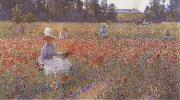
American portrait and landscape painter, 1858-1933
was an American Impressionist painter known for his portraits and landscapes. |
 |
Robert William Buss
|
|
British painter and etcher , 1804-1875
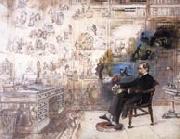
was a Victorian artist, etcher and illustrator perhaps best known for his painting Dickens' Dream. Born in Bull and Mouth Street, Aldersgate in London in 1804, Buss served an apprenticeship with his father, a master engraver and enameller, and then studied painting under George Clint, a miniaturist, watercolour and portrait painter, and mezzotint engraver. At the start of his career Buss specialized in painting theatrical portraits, with many of the leading actors of the day sitting to him, including William Charles Macready, John Pritt Harley, and John Baldwin Buckstone. Later Buss painted historical and humorous subjects. He exhibited a total of 112 pictures between 1826 and 1859, twenty-five at the Royal Academy, twenty at the British Institution, |
|