|
 |
Robert Wilhelm Ekman
|
|
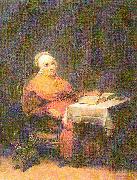
(August 13, 1808 - February 19, 1873), aka R. W. Ekman, was a significant teacher and painter of the Finnish romantic portraits and early national romanticism.
Robert Ekman was born in Uusikaupunki, Finland to an upper class family. His father was Karl Kristoffer Ekman, a medical doctor and a mayor. Mother was Sara Elisabet (maiden name Gadolin). Robert Ekman's both parents died when he was about 10 years old. They left behind five orphans who were placed in foster homes. Schooling was incomplete and there was no chance of academic education.
Robert Ekman first studied in Finland under the guidance of Gustaf Wilhelm Finnberg, but in 1824, with his brother Fredrubjm begun studies in Kungliga Akademien för de Fria Konsterna (The royal academy for free arts) in Stockholm. Already as a student Ekman specialized in portraying the life of the common people, instead of Classicism of the academic arts. Ekman graduated in 1836, and was granted a generous traveling scholarship for excelling in his studies. That supported him working in Holland, France and Italy between years 1837-1844. As the scholarship was not plausible otherwise, Ekman took the Swedish citizenship.
|
 |
Robert Whale
|
|
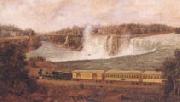
Born in Alternun, England in 1805. Died in Brantford, Ontario in 1887 |
 |
Robert Walter Weir
|
|
Jun 18.1803-May 1.1889, Painter and teacher. By his own account he was self-taught, with the exception of a few lessons from an unknown heraldic painter named Robert Cooke. However, after exhibiting a few works that were praised by the local press, he was sent to Italy by a group of New York and Philadelphia businessmen for further studies. There he trained with Florentine history painter Pietro Benvenuti. After three years in Europe (1824-7), he returned to New York, where he quickly became a mainstay of the artistic community. In 1831 he was elected to membership in the National Academy of Design in New York, and three years later he was made instructor of drawing at the US Military Academy in West Point, New York, a post he held for the next 42 years. |
 |
Robert W. Weir
|
|
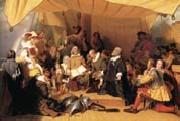
American Hudson River School Painter, 1803-1889,Painter and teacher. By his own account he was self-taught, with the exception of a few lessons from an unknown heraldic painter named Robert Cooke. However, after exhibiting a few works that were praised by the local press, he was sent to Italy by a group of New York and Philadelphia businessmen for further studies. There he trained with Florentine history painter Pietro Benvenuti. After three years in Europe (1824-7), he returned to New York, where he quickly became a mainstay of the artistic community. In 1831 he was elected to membership in the National Academy of Design in New York, and three years later he was made instructor of drawing at the US Military Academy in West Point, New York, a post he held for the next 42 years. Most scholars agree that he was more important as a teacher than as a painter. His best known work is the Embarkation of the Pilgrims (1837-43), which hangs in the Rotunda of the US Capitol Building in Washington, DC. |
 |
Rik Wouters
|
|
(21 August 1882, Mechelene11 July 1916, Amsterdam) was a Belgian fauvist painter and sculptor. Wouters was educated at the Academie Royale des Beaux-Arts in Brussels.
|
 |
Richard Wilson
|
|
Welsh Romantic Painter, ca.1713-1782
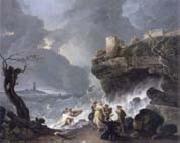
was a Welsh landscape painter, and one of the founder members of the Royal Academy in 1768. Wilson has been described as '...the most distinguished painter Wales has ever produced and the first to appreciate the aesthetic possibilities of his country.' Wilson is considered to be the father of landscape painting in Britain. The son of a clergyman, Wilson was born in Penegoes, Montgomeryshire. The family was an old and respected one, and Wilson was first cousin to Charles Pratt, 1st Earl Camden. In 1729 he went to London where he began as a portrait painter, under the apprentership of an obscure artist, Thomas Wright. From 1750 to 1757 he was in Italy and adopted landscape on the advice of Francesco Zuccarelli. Painting in Italy and afterwards in England, he was the first major British painter to primarily concentrate on landscape. He composed well, but saw and rendered only the general effects of nature thereby creating a personal, ideal style influenced by Claude Lorrain and the Dutch landscape tradition. According to John Ruskin, he "paints in a manly way, and occasionally reaches exquisite tones of colour." He concentrated on painting Italianate landscapes and landscapes based upon classsical literature, but when his painting The Destruction of the Children of Niobe (c.1759-60) won high acclaim he gained many commissions from wealthy families seeking classical potrayals of their estates. |
 |
Richard Westall
|
|
English Painter, 1765-1836
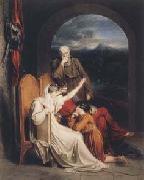
was an English painter. Westall was the more successful of two half-brothers (both sons of a Benjamin Westall, from Norwich), who each became painters. His younger half-brother was William Westall (1781C1850), a much-travelled landscape painter. Born on 2 January 1765 in Reepham near Norwich (where he was baptised at All Saints on 13 January in the same year) Richard Westall moved to London after the death of his mother and the bankruptcy of his father in 1772. He was apprenticed to a heraldic silver engraver in 1779 before studying at the Royal Academy School of Art from 10 December 1785. He exhibited at the Academy regularly between 1784 and 1836, became an Associate in November 1792 and was elected an Academician on 10 February 1794. From 1790 to 1795 he shared a house with Thomas Lawrence (later Sir), the future Royal Academy president, at 57 Greek Street, on the corner of Soho Square, each of the artists placing their name on one of the entrances. His works C many in water-colour - caused great interest in the late years of the 18th century when he was considered by his chief patron Richard Payne Knight as an outstanding artist of the picturesque. He painted works in a neo-classical style for John Boydell's Shakespeare Gallery and for Henry Fuseli's Milton Gallery. His painting of John Milton and his daughters hangs in Sir John Soane's Museum in London. A number of scenes in which Westall depicts events in the life of Horatio Nelson are at the Maritime Museum. Westall was a prolific illustrator of books of poets and writers including Sir Walter Scott and Oliver Goldsmith, Byron - who greatly admired his work, stating that "the brush has beat the poetry". He also illustrated editions of the Bible, |
 |
richard wagner
|
|
Born: 22 May 1813
Birthplace: Leipzig, Germany
Died: 13 February 1883
Best Known As: German composer of Der Ring des Nibelungen |
 |
Richard Caton Woodville
|
|
1856 - 1927
was an English artist and illustrator, who is best known for being one of the most prolific and effective painters of battle scenes in the late nineteenth, and early twentieth centuries. The son of American Richard Caton Woodville (The First), who was also a talented artist, Woodville studied at the Dusseldorf School under the great Prussian military artist Wilhelm Camphausen, and then Eduard von Gebhardt, before briefly studying in Russia and then Paris under Gerome. Woodville spent most of his career working for the Illustrated London News where he quickly developed a reputation as a talented reporter and writer, but was also published in Cornhill Magazine, Strand Magazine, and The Tatler. Richard Caton Woodville first experienced battle first-hand when he was sent by the Illustrated London News to report upon the Russo-Turkish War (1877 C 1878), and then again in the 1882 Anglo-Egyptian War where he made numerous sketches, and also obtained photographs of the trenches at Tel-e-Kebir for his friend and co-artist Alphonse-Marie-Adolphe de Neuville whom had been commissioned to paint a scene of the battle. In 1879 Woodville's Before Leuthen, Dec 3rd, 1757 was exhibited in the Royal Academy. It proved popular, and afterwards he began to regularly be exhibited in Burlington House, where 21 of his battle paintings were eventually shown. His most popular works there were ones that dealt with contemporary wars, such as the Second Anglo-Afghan War, Candahar [sic], and Maiwand, Saving the Guns (Walker Art Gallery), the Zulu War, and the First Boer War. His works from Egypt were exhibited at the Fine Art Society in 1883, where his painting The Moonlight Charge at Kassassin proved very popular. The following year he exhibited by Royal Command another painting he had done of the war in Egypt, entitled The Guards at Tel-e-Kebir (Royal Collection). He continued to paint scenes of battle, and few battles or wars that Great Britain fought during his life were not touched upon by him, including the Second Boer War, and World War I. Despite his precocious talent for capturing the dramatic moments of contemporary battles, Woodville also enjoyed recreating historical scenes in both oil, and watercolour. The Illustrated London News commissioned him to complete a commemorative special series recreating the most famous British Battles of history. He depicted The Charge of the Light Brigade (Royal Collection, Madrid) and The Charge of the 21st Lancers at Omdurman (Walker Art Gallery), Battle of Blenheim, Battle of Badajos and several Battle of Waterloo pictures. During World War I, Woodville was compelled to return to the depiction of current events, and three of his Great War works were displayed in the Royal Academy. |
 |
Ranney William Tylee
|
|
German-born American Painter, 1813-1857
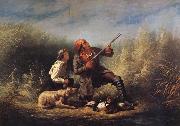
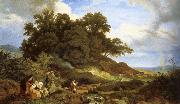
American painter. He spent six formative years in the hill country of North Carolina. By 1834 he was working and studying drawing in New York, but two years later he went to Texas to join in the war for independence. Although he returned to New York a year later, it was not until 1846, with the outbreak of the Mexican War, that Ranney began to use his Western experience as the basis for his painting. With the encouragement of the American Art Union, he executed three types of Western subject: the Western trapper or hunter, pursuing a dangerous life on the prairies, as in Trapper's Last Shot (1850; untraced; engraved and lithographed by T. Dwight Booth); the pioneer family, heading across the plains with children, dogs and goods, as in Advice on the Prairie (1853; Malvern, PA, Claude J. Ranney priv. col.); and the dangers of emigration, for example Prairie Fire. |
 |
ralph vaughan willams
|
|
Period: Romantic (1820-1869)
Country: Germany
Born: February 03, 1809 in Hamburg, Germany
Died: November 04, 1847 in Leipzig, Germany |
 |
Ralph Eleaser Whiteside Earl
|
|
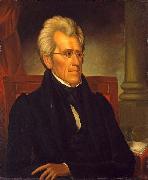
(1785-8 - Nashville, Tennessee, September 16, 1838), also known as Ralph E. W. Earl or Ralph Eleazer Whiteside Earl, was an American painter known as the "court painter" to President Andrew Jackson.
Earl was the son of portrait painter Ralph Earl and his second wife Ann Whiteside. He was born c. 1785-88, probably in New York City, and likely received his early training in portraiture from his father, whose naive style is reflected in the younger Earl's earliest works. He traveled to London in 1809, where he studied for a year with John Trumbull and was advised by Benjamin West, learning perspective, anatomy, and three-dimensional illusion. He remained in England until 1814, living with his maternal grandfather and uncle in Norwich and executing portrait commissions. He then traveled to Paris before returning to the United States in December 1815 with the intention of creating grand-scale history paintings on the European model.
As preparation for a planned project depicting the Battle of New Orleans, Earl met General Andrew Jackson and visited him at his Tennessee home, The Hermitage, in January 1817. Earl painted portraits of Jackson and his family, and married Mrs. Jackson's niece Jane Caffery on 19 May 1819. She died in childbirth in 1820. |
 |
POORTER, Willem de
|
|
Dutch Baroque Era Painter, 1608-ca.1648
Dutch painter. His father, Pieter, came from Flanders to Haarlem, where in 1631 works by Willem were recorded for the first time. In 1634 Willem was registered in Haarlem as a master painter, and in 1635 Pieter Casteleijn was named as his pupil. As late as 1643 Pieter Abrams Poorter and Claes Coenraets began their studies with him in Haarlem. Willem is mentioned for the last time in the archives of the Haarlem Guild of St Luke in 1645, the year he left for Wijk bij Heusden. He supposedly studied under Rembrandt, together with his fellow townsman Jacob de Wet. There is no documentation to support this assumption, but a number of de Poorter's small-scale biblical and history paintings bear such a striking likeness to Rembrandt's biblical compositions of c. 1630 that the two hands are often confused. Rembrandt's Presentation in the Temple (1631; The Hague, Mauritshuis; see REMBRANDT VAN RIJN) was copied (Dresden, Gemeldegal. Alte Meister) by de Poorter, who also painted his own version (Kassel, Schloss Wilhelmsh?he). The lighting in de Poorter's Entombment (Guernsey, D. Cevat priv..) was also apparently inspired by Rembrandt's example. Since de Poorter's paintings were first reported in Haarlem in 1631, the year that Rembrandt moved from Leiden to Amsterdam, it seems likely that de Poorter received his training in the Leiden workshop, where Gerrit Dou had also been working since 1628. |
 |
Pieter van der Werff
|
|
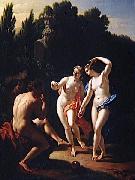
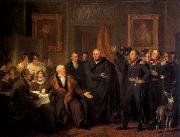
(1665 - September 26, 1722) was a Dutch Golden Age painter. He assisted his older brother, Adriaen van der Werff.
He learned to paint from his brother Adriaen and according to the RKD, he spent most of his life working in Rotterdam, where he painted the rich and famous |
 |
PIENEMAN, Jan Willem.
|
|
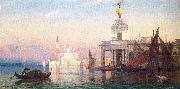
b. 1779, Abcoude, d. 1853, Amsterdam,Painter, teacher, engraver and museum director. He trained with a wallpaper painter in Amsterdam, and at the same time he followed courses at the Amsterdam Stadstekenacademie, where he soon distinguished himself. His artistic and didactic gifts were recognized by the Napoleonic government, which in 1805 appointed him professor of drawing at the artillery and engineering school in Amersfoort. In 1816 he was appointed assistant director of the Mauritshuis at The Hague by William I. He frequently spent time at the Dutch court, where he gave painting lessons to Queen Wilhelmina and painted many portraits of members of the royal family. He also produced a few engravings. |
 |
Picknell, William Lamb
|
|
American, 1853-1897
was a United States painter of landscapes, coastal views, and figure genres, known for his rapid painting style. He was born in Hinesburg, Vermont and died in Marblehead, |
 |
Philips Wouwerman
|
|
Dutch Baroque Era Painter, 1619-1668
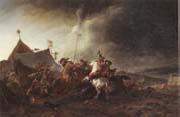
Dutch painter and draughtsman. He was the eldest son of the painter Paulus [Pauwels] Joostens Wouwerman of Alkmaar (d 28 Sept 1642), whose two other sons, Pieter Wouwerman (1623-82) and Johannes Wouwerman (1629-66), also became painters. Philips probably received his first painting lessons from his father, none of whose work has been identified. According to Cornelis de Bie, Wouwerman was next apprenticed to Frans Hals, although no trace of Hals's influence is discernible in Wouwerman's work. Wouwerman is also reputed to have spent several weeks in 1638 or 1639 working in Hamburg in the studio of the German history painter Evert Decker (d 1647). While in Hamburg, he married Annetje Pietersz. van Broeckhof. On 4 September 1640 Wouwerman joined the Guild of St Luke in Haarlem, in which in 1646 he held the office of vinder (agent or 'finder'). Given the many southern elements in his landscapes, it has repeatedly been suggested that Wouwerman must have travelled to France or Italy, but there is no documentary evidence that he left his native Haarlem for more than short periods. |
 |
per wickenberg
|
|
1812-1846
Per Gabriel Wickenberg, född 1 oktober 1812 i Malmö, död 19 december 1846 i Pau, var en svensk konstnär.
Per Wickenberg kom från enkla förhållanden, hans far var fanjunkare, men visade tidigt en talang för teckning och måleri. 1831 skedde en insamling till hans förmån i Malmö, mend vars hjälp han fick möjlighet att komma till Stockholm att studera konst. Han besvärades tidigt av en ögonsjukdom, och med hjälp av bidrag från Konstföreningen i Stockholm fick han 1836 hjälp att resa till Tyskland för att söka bot. Efter tillfrisknandet valde han att stanna en tid i Berlin och vann där ett gott erkännande för sina tavlor. 1838 reste han till Paris, och vann där samma år guldmedalj på salongen för sin tavla "Nordiskt vinterlandskap". Wickenberg blev 1839 agre och 1842 ledamot av Konstakademien, under det att han stannade kvar i Paris. Wickenbergs ögonsjukdom återkom dock, och han insjuknade även i tuberkulos. Vintern 1843-44 uppehöll han sig i Nice, för att kurera sig, men förgåves, och 1846 avled han, bara 34 år gammal.
1842 tilldelades han Vasaorden och Hederslegionens kors. |
 |
Pedro Weingatner
|
|
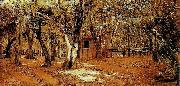
Pedro Weingärtner (Porto Alegre, 1853 e 1929) was an important Academic painter of Brazil, and the first artist born in Rio Grande do Sul to win international praise for his work.
Born to a family of German immigrants, he began his artistic career as an amateur, helped by his brother Ineio, who was a lithographer, and possibly also by painter Delfim da Câmara. Anyway, in 1878 he moved to Germany in order to study in the Grossherrzoglisch Badische Kunstschule, in Karlsruhe. There he became a pupil of Ferdinand Keller, Theodor Poeckh and Ernst Hildebrand. In 1880 Keller moved to Berlin, being followed by Weingärtner, who then enrolled in the local Academy.
In 1882 he left Germany for France, studying in the Academie Julian under Tony Robert-Fleury and William Adolphe Bouguereau. Wrecked by financial issues, he thought of abandoning his studies, but such situation was reverted by supportive friends, including Baron of Itajube, who got for him a special scholarship from emperor Peter II upon Bouguereau's advice. Then he could further his education in Rome.
Thereafter for many years he divided his time between Rio de Janeiro, Porto Alegre and Rome, traveling very often and being celebrated as one of the most important Brazilian painters of his generation. In Rio Grande do Sul he was a star. In 1920 he was back in Porto Alegre, where the remained until death. His fame declined from 1925 on, facing competition from new painters and changing tastes in local art.
He devoted all his efforts to a half-Realist half-Romantic approach to Academicism even while such styles were already being severely challenged by Modern tendencies. Major themes in his work were mythological scenes, landscapes and genre paintings focusing mainly immigrants and the gaucho, the folk type of Rio Grande do Sul people.
|
 |
Pedro Weingartner
|
|
(Porto Alegre, 1853 - 1929) was an important Academic painter of Brazil, and the first artist born in Rio Grande do Sul to win international praise for his work.
Born to a family of German immigrants, he began his artistic career as an amateur, helped by his brother Inecio, who was a lithographer, and possibly also by painter Delfim da Câmara. Anyway, in 1878 he moved to Germany in order to study in the Grossherrzoglisch Badische Kunstschule, in Karlsruhe. There he became a pupil of Ferdinand Keller, Theodor Poeckh and Ernst Hildebrand. In 1880 Keller moved to Berlin, being followed by Weingärtner, who then enrolled in the local Academy.
In 1882 he left Germany for France, studying in the Academie Julian under Tony Robert-Fleury and William Adolphe Bouguereau. Wrecked by financial issues, he thought of abandoning his studies, but such situation was reverted by supportive friends, including Baron of Itajube, who got for him a special scholarship from emperor Peter II upon Bouguereau's advice. Then he could further his education in Rome.
Thereafter for many years he divided his time between Rio de Janeiro, Porto Alegre and Rome, traveling very often and being celebrated as one of the most important Brazilian painters of his generation. In Rio Grande do Sul he was a star. In 1920 he was back in Porto Alegre, where the remained until death. His fame declined from 1925 on, facing competition from new painters and changing tastes in local art. |
 |
Pars, William
|
|
English, 1742-82
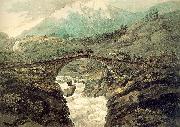
English painter. He first established himself in London as a portrait painter, exhibiting at the Society of Artists in 1760 and at the Free Society of Artists from 1761. In 1764 he won the third premium of the Royal Society of Arts for his history painting depicting Caractacus before the Emperor Claudius (untraced). In the same year he was selected by the Dilettanti Society to accompany Richard Chandler and Nicholas Revett on an archaeological expedition to Asia Minor and Greece (1764-6). His views of Classical monuments in Asia Minor were engraved and published in Ionian Antiquities (1769), while those he made in Greece, which included pioneering drawings of the Parthenon sculptures, were used in the second volume of James Stuart's Antiquities of Athens (1777). |
 |
Owen, William
|
|
English, 1769-1825
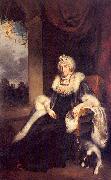
English painter. The son of a bookseller, he was educated at the grammar school in Ludlow and was sent to London in 1786 to study under Charles Catton the elder (1728-98), coach painter to George III and founder-member of the Royal Academy. Owen's copy of a work by Reynolds, made soon after his arrival, attracted the latter's attention. He entered the Royal Academy Schools in 1791 and exhibited at the Royal Academy the following year. From then on he exhibited there every year, apart from 1823 and 1825, and was elected ARA in 1804 and RA in 1806. He painted a number of rural scenes but specialized in portrait painting. Although his reputation was eclipsed by that of Thomas Lawrence, he was sought after by many of the eminent figures of the day, producing portraits of the Archbishop of Canterbury, Dr William Howley (1813), and of the politician and essayist John Wilson Croker (exh. 1812; both London, N.P.G.); other of his sitters were William Pitt the younger and John Soane. In 1810 he was appointed portrait painter to the Prince of Wales (later George IV) and in 1813 principal portrait painter to the Prince when the latter became Prince Regent. The Prince Regent does not seem to have sat to him but nonetheless he offered Owen a knighthood, which the painter refused. From c. 1820 Owen's health deteriorated until a disease of the spine confined him to his room and finally rendered him incapable of painting. He died after accidentally taking a bottle of opium that had been wrongly labelled. |
 |
oscar wilde
|
|
Born: 16 October 1854
Birthplace: Dublin, Ireland
Died: 30 November 1900
Best Known As: The author of The Importance of Being Earnest
|
 |
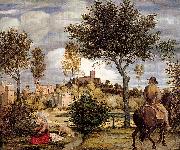
Osborne, Walter
|
|
Irish, 1859-1903
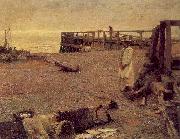
Irish painter. The son of the animal painter William Osborne (1823-1901), he trained in the schools of the Royal Hibernian Academy (1876-81). In 1881 he won the Royal Dublin Society's Taylor scholarship and went to study at the Koninklijk Academie voor Schone Kunsten, Antwerp. Charles Verlat was the professor of painting, and Antwerp was then at the height of its popularity with students from the British Isles. In Antwerp and subsequently in Brittany, Osborne made contact with painters of the Newlyn school and other British naturalists. In Brittany he painted Apple Gathering, Quimperle (1883; Dublin, N.G.), a small greenish-grey picture of a girl in an orchard, which in subject and treatment shows the influence of Jules Bastien-Lepage. Throughout the 1880s Osborne worked in England, joining groups of artists in their search for the ideal naturalist motif. In the autumn of 1884 he was at North Littleton, near Evesham (Heref. & Worcs), where he painted Feeding Chickens in weather so cold that his model, a young peasant girl, nearly fainted. It is carefully drawn but painted with the square-brush technique characteristic of Bastien-Lepage's followers, and is very close to the contemporary work of George Clausen and Edward Stott (1855-1918). At Walberswick in Suffolk he painted October Morning (1885; London, Guildhall A.G.), a carefully studied plein-air work using bright dots of pure colour on a base of beige and grey. During this time Osborne gave careful attention to the showing of his work. He exhibited regularly at the Royal Hibernian Academy in Dublin from 1877 and at the Royal Academy in London from 1886. |
 |
Olivier, Woldemar Friedrich
|
|
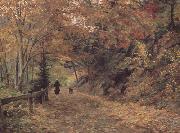
German, 1791-1859
.Painter and draughtsman, brother of Heinrich Olivier and Ferdinand Olivier. He first studied in Dessau under the court sculptor Friedemann Hunold (1773-1840), a pupil of Johann Gottfried Schadow, before teaching himself to paint. Following the return of his brothers from Paris, he toured the Harz with Ferdinand in 1810 and in 1811 moved with him, via Dresden, to Vienna. There he drew nudes and antiquities at the Akademie der Bildenden Kenste. In 1813-14 he participated in the uprising against Napoleonic occupation in the Letzow volunteer corps, along with his friends from Vienna, Theodor Kerner, Joseph von Eichendorff and Philipp Veit. After Kerner fell at Gadebusch (26 August 1813), Friedrich sketched him on his deathbed (Dessau, Anhalt Gemeldegal.). |
 |
Olga Wisinger-Florian
|
|
Austria
born 1844 - died 1926
was an Austrian impressionist painter, mainly of landscapes and flower still lifes. She was a notable representative of Austrian Mood Impressionism. Having trained as a concert pianist, Wisinger-Florian switched to painting in the mid-1870s. She was a student of Melchior Fritsch, August Schaeffer, and Emil Jakob Schindler. From 1881 she regularly showed paintings at the annual exhibitions mounted at the artist's house and later often showed at Vienna Secession exhibitions. Work she showed at the Paris and Chicago international exhibitions earned her worldwide acclaim. The artist, who was also active in the middle-class women's movements of the time, was awarded numerous distinctions and prizes. Wisinger-Florian's early paintings can be assigned to what is known as Austrian Mood Impressionism. In her landscape paintings she adopted Schindler's sublime approach to nature. The motifs she employed, such as views of tree-lined avenues, gardens and fields, were strongly reminiscent of her teacher's work. After breaking with Schindler in 1884, however, the artist went her own way. Her conception of landscape became more realistic. |
 |
Nuncques, William Degouve de
|
|
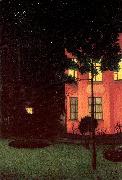
Belgian Symbolist Painter, 1867-1935
was a Belgian painter. He was born at Montherme, the Ardennes, France, of an old aristocratic family, After the Franco-Prussian war (1870C71), his parents settled in Belgium, and he taught himself to paint. In 1894 he married fellow artist Juliette Massin, who introduced him to the circle of Symbolist poets, who had a considerable influence on his style. He belonged to the avant-garde group Les XX and later exhibited at La Libre Esthetique. He travelled widely and painted views of Italy, Austria and France, often of parks at night. His best-known pictures, Pink House (1892), The Angels (1894), and Peacocks (1896), demonstrate the magical quality of his work. Pink House is thought to have been a major influence on Surrealism, especially the paintings of Rene Magritte. He is supposed to have said "To make a painting, all you need to do is to take some paints, draw some lines, and fill the rest up with feelings." A regular exhibitor in Paris, he was championed by Puvis de Chavannes and Maurice Denis. From 1900 to 1902 he and his wife lived in the Balearic Islands, where he painted the rugged coastline and the orange groves. After suffering a religious crisis around 1910, he painted pictures that revealed his tormented state of mind, and during World War I, while a refugee in the Netherlands, he produced only minor works. In 1919 he was overwhelmed by the death of his wife and lost the use of one hand. In 1930 he married the woman who had helped him through the crisis. |
 |
Myles Birket Foster,RWS
|
|
1825-1899
English painter, illustrator and collector. After a short and unsatisfactory period working in the family brewing business, he was able to convince his Quaker parents to allow him to pursue a career in art. He was apprenticed to a wood-engraver, Ebenezer Landells (1808-60), who recognized Foster's talent for drawing and set him to work designing blocks for engraving. Foster also provided designs for Punch and the Illustrated London News. In 1846 he set up on his own as an illustrator. The rustic vignettes of the seasons that he contributed to the Illustrated London News and its counterpart, the Illustrated London Almanack, established him as a charming interpreter of the English countryside and rural life and led to his employment illustrating similar themes in other publications. During the 1850s his designs were much in demand; he was called upon to illustrate volumes of the poetry of Longfellow, Sir Walter Scott and John Milton. |
 |
Morris, William
|
|
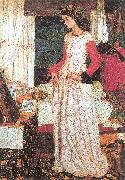
English Pre-Raphaelite Writer and Designer, 1834-1896
English designer, writer and activist. His importance as both a designer and propagandist for the arts cannot easily be overestimated, and his influence has continued to be felt throughout the 20th century. He was a committed Socialist whose aim was that, as in the Middle Ages, art should be for the people and by the people, a view expressed in several of his writings. After abandoning his training as an architect, he studied painting among members of the Pre-Raphaelites. |
 |
MIERIS, Willem van
|
|
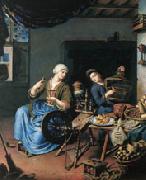
Dutch Baroque Era Painter , b. 1662, Leiden, d. 1747, Leiden, Dutch painter, was the son of Frans van Mieris sr.. His works are extremely numerous, being partly imitations of the paternal subjects, or mythological episodes, which Frans habitually avoided. |
 |
Michael Wolgemut
|
|
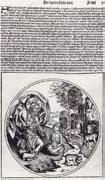
German Northern Renaissance Painter and Printmaker, ca.1434-1519,German painter and printmaker, was born and died in Nuremberg.Little is known of Wolgemut's private life. He trained with his father Valentin Wolgemut (who died in 1469 or 1470) and in 1472 he married the widow of his former apprentice-master, the painter Hans Pleydenwurff, whose son Wilhelm worked as an assistant, and from 1491 a partner, to his stepfather. Some consider Wilhelm Pleydenwurff a finer artist than Wolgemut, however he died in January 1494, when he was probably still in his thirties. Wilhelm's oeuvre remains unclear, though works in various media have been attributed to him. The importance of Wolgemut as an artist rests, not only on his own individual works, but also on the fact that he was the head of a large workshop, in which many different branches of the fine arts were carried on by a great number of pupil-assistants, including Albrecht Durer, who completed an apprenticeship with him between 1486-9. |
 |
Michael Willmann
|
|
(27 September 1630 - 26 August 1706) was a German painter. The Baroque artist became known as the "Silesian Raphael".
Willmann was born in Königsberg, Duchy of Prussia. He was educated by his father, the painter, Christian Peter Willmann. Michael went to the Dutch Republic in 1650 to learn from the masters, and he was inspired by the works of Rembrandt, Peter Paul Rubens, and Anthony van Dyck. For financial reasons he was unable to afford studying at the studio of a well-known painter.
After two years in the Netherlands, mostly spent in Amsterdam, Willmann returned to Königsberg, passed his master's examination, and began to travel. After visiting Danzig, Willmann went to Prague, where he stayed from 1653-55. He then spent about a year in Breslau. Willmann's first known paintings, commissioned by Abbot Arnold Freiberger of the Abbatia Lubensis abbey in Leubus, Lower Silesia, date from 1656. Leubus became the setting of much of Willmann's creativity.
From 1657-58 Willmann was in Berlin as the court painter of Frederick William, Elector of Brandenburg. He painted mythological scenes for the elector, presumably for his residence at Königsberg Castle. In 1660 Willmann returned to Leubus, which allowed him a large workshop.
Willmann's workship, modeled after those of the Dutch painters, quickly spread his fame. The extensive studio included his son Michael Leopold Willmann the Younger, his daughter Anna Elisabeth, and Anna Elisabeth's husband Christian Neuenhertz and son Georg Wilhelm Neunhertz. Willmann's studio also counted Johann Kretschmer from Glogau, Johann Jacob Eybelwieser from Breslau, the Cistercian Jacob Arlet from Gressau, and Willmann's stepson Johann Christoph Lischka.
Willmann became the leading painter of Silesia through his expressiveness, technical dexterity, and speed. Willmann worked on orders from the patriciate of Breslau, as well as churches and monasteries throughout Silesia, Bohemia, and Moravia. He received contracts for the Cistercian monasteries in Gressau, Heinrichau, Kamenz, Rauden, and Himmelwitz. With the assistance of his students and assistants, Willmann produced 500 paintings and frescos during his life. Numerous drawings of Willmann's were later used by engravers. |
 |
Metcalf, Willard Leroy
|
|
American Impressionist Painter, 1858-1925
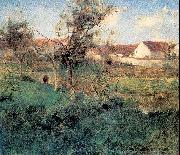
American painter and illustrator. His formal education was limited, and at 17 he was apprenticed to the painter George Loring Brown of Boston. He was one of the first scholarship students admitted to the school of art sponsored by the Museum of Fine Arts, Boston, and took classes there in 1877 and 1878. After spending several years illustrating magazine articles on the Zuni Indians of New Mexico, he decided to study abroad and in 1883 left for Paris. There he studied at the Acad?mie Julian under Jules Lefebvre and Gustave Boulanger. During the five years he spent in France he became intimately acquainted with the countryside around the villages of Grez-sur-Loing and Giverny. He returned to America in 1888 |
 |
Max Joseph Wagenbauer
|
|
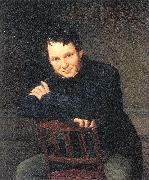
Maximilian Joseph Wagenbauer (1775 Grafing - 1829 Munich), was a Bavarian artist.
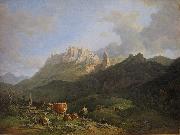
After finishing school, Wagenbauer attended drawing classes in Munich, under Johann Jakob Dorner the Elder (1741-1813). At the turn of the 19th century he was producing mostly Neo-Classical watercolour landscapes. He served in the military from 1797 to 1801, receiving a royal artist's annuity after his service through the influence of Johann Christian von Mannlich (1741-1822), architect and general building director of the dukes of Zweibre-ken. A condition of the royal stipend was that he produce paintings. He was appointed artist to the court and cabinet in 1802 and Inspector of the Royal Paintings Gallery in 1815. Wagenbauer focused increasingly on oil painting after 1810 and enjoyed the patronage of Maximilian I Joseph of Bavaria, who in 1811 commissioned him, Cantius Dillis (1779-1856) and Johann Jakob Dorner the Younger (1775-1852) to decorate the banquet hall at Schloss Nymphenburg with large paintings of Bavarian lakes. |
 |
Marstrand, Wilhelm
|
|
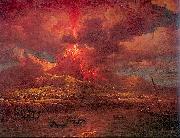
Danish, 1810-1873
Danish painter and illustrator. He was a student of C. W. Eckersberg at the Kunstakademi in Copenhagen (1825-33). His art reflects his constant observation of the world around him, in particular middle-class society, and the narrative element dominated his pictures of crowds in the city streets. Throughout his life he sought inspiration from literature and the theatre. In his early genre painting Moving Day Scene (1831; Niv?, Nivaagaards Malsaml.) it was the popular novelty of vaudeville that interested him. The October Festival (1839; Copenhagen, Thorvaldsens Mus.) reveals how Marstrand's five-year stay (1836-41) in Italy opened his eyes to the classical ideal of beauty. It was, however, an ideal that found little response in contemporary Denmark, and he turned towards a more anecdotal and humorous approach. In Scene of Country Life (1843; Copenhagen, Kon. Dan. Kstakad.), painted as a set subject for the Kunstakademi, Marstrand took as his theme a scene from Erasmus Montanus, a play by the 18th-century Danish poet and playwright Ludvig Holberg. Thereafter Holberg's comedies provided an inexhaustible source that satisfied Marstrand's need to pursue his investigations of human character. Family life similarly interested him throughout his career, as in his Scene of Daily Life (1857; Copenhagen, Stat. Mus. Kst). Such group portraits as The Waagepetersen Family (1836; Copenhagen, Stat. Mus. Kst) show an equal concern to depict the quiet details of Danish domestic life. Marstrand continued to travel abroad in search of inspiration. His stay in Venice in 1853-4 was particularly important; his studies there of the great Venetian painters improved his understanding of the handling of colour, as seen clearly in the many historical and religious paintings of his last years. Of particular interest is his mural decoration of Christian IV's chapel in Roskilde Cathedral (1864-6) with scenes from the life of the Danish monarch. Marstrand's paintings have a certain facetiousness which often obscures a much deeper philosophical content. For this reason, it is his drawings that arouse more admiration. |
 |
Marlow, William
|
|
English, 1740-1813
English painter. From c. 1756 to 1761 he was a pupil of Samuel Scott, the topographical and marine painter; he also studied at the St Martin's Lane Academy, London. Throughout his career Marlow made oils and watercolours of London views, for example Near Westminster Bridge, Evening (London, Guildhall A.G.), which shows his balanced, classical sense of composition, sensitivity to lighting effects and smooth handling of oil paint. Between 1765 and 1766 Marlow travelled in France and Italy, making numerous drawings of ruins, which provided the subjects for many paintings finished on his return to London. An Oxcart in the Grotto of Posillipo (c. 1770; New Haven, CT, Yale Cent. Brit. A.) exemplifies his bold, blue-toned watercolour style, with washes applied in loose blotches to emphasize the picturesque roughness of masonry and terrain. The handling has much in common with Canaletto, whom Marlow copied; a letter of 1771 from Horace Walpole to Sir Horace Mann (see 1956 exh. cat., p. 3) records that two views of Verona by Marlow were mistakenly sold as Canalettos. Marlow specialized in souvenirs of the Grand Tour, portraits of country houses, seascapes and river scenes. He visited many parts of Britain and Ireland in search of subjects, such as Powys Castle, Montgomeryshire (U. Manchester, Whitworth A.G.). |
 |
Marianne von Werefkin
|
|
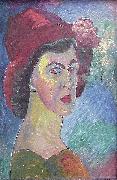
Marianne von Werefkin (Russian, 10 September 1860, Tula, Russia - 6 February 1938, Ascona, Switzerland), born Marianna Wladimirowna Werewkina (transliteration Marianna Vladimirovna Verevkina), was a Russian-Swiss Expressionist painter.
Marianne von Werefkin was born the daughter of the commander of the Ekaterinaburg Regiment. In 1880, she became a student of Ilya Repin, the most important painter of Russian Realism. Her progress was dealt a setback by a hunting accident in 1888 in which she shot her right hand, the one with which she painted.
In 1892 she met Alexej von Jawlensky, who desired to be her protege, and in 1896 she, Jawlensky, and their servant moved to Munich. For the sake of Jawlensky's painting, Werefkin interrupted her painting for almost ten years.
She created her first expressionist works in 1907. In these she followed Paul Gauguin's and Louis Anquetin's style of "surface painting", while also showing the influence of Edvard Munch. In 1909, the Neue Kenstlervereinigung Menchen (New Association of Artists in Munich, NKVM) was founded. It became a forum of exhibitions and programming.
At the outbreak of the First World War, they immigrated to Switzerland, near Geneva. They later moved to Zurich. By 1918, they had separated, and Werefkin moved alone to Ascona, on Lago Maggiore. In 1924 she founded the artist group "Grober Bar" (i.e., Big Bear, Ursa Major). |
|