|
 |
Maria Catharina Wiik
|
|
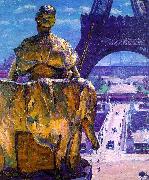
(b Helsinki, 2 Aug 1853; d Helsinki, 19 June 1928). Finnish painter. She studied in Paris at the Academie Julian from 1875 to 1876 under Tony Robert-Fleury and continued her studies with him in the same studio between 1877 and 1880. Her paintings appeared at the Salon for the first time in 1880 (e.g. Marietta, 1880; Helsinki, priv. col., see Katerma, p. 31). The realist techniques Wiik absorbed in Paris came to form the basis of her work, tranquil in composition and restrained in colour. Her favourite subjects were relatively small-scale portraits such as Hilda Wiik (1881; Helsinki, Athenaeum A. Mus.) and still-lifes (e.g. Still-life, c. 1880; Helsinki, Athenaeum A. Mus.). Like many other foreign painters Wiik went to Brittany to paint. In 1883-4 she worked in Concarneau and Pont-Aven, where her enthusiasm for plein-air painting brought immediacy to her work and greater brightness to her colours (e.g. Breton Farm, 1883; Naantali, Fereningen Hedvigsminne). She preferred to record her impressions in portraits, although she also painted small, light-filled landscapes. In 1889 Wiik worked under the direction of Puvis de Chavannes in Henri Bouvet's studio in Paris, and in the same year she visited St Ives where she painted, among others, two major works: Out in the World (Helsinki, Athenaeum A. Mus.) and the St Ives Girl (Helsinki, priv. col., see Katerma, p. 93). Both works show Wiik moving towards an ever more internalized and minimal mode of expression, thereby taking part in the process that led, in the 1890s, to a general abandonment of realism in favour of a greater emphasis on emotion. Out in the World, which shows an old woman's sad parting from a young girl who is leaving home to begin work, shows a change in technique with the use of more united colour surfaces and of tone painting. (This work was awarded a bronze medal at the Exposition Universelle in Paris in 1900.) During the 1890s and the early 20th century Wiik's travels were concentrated in Scandinavia, although she visited Paris in 1905. |
 |
Louis Welden Hawkins
|
|
British
1849-1910
Louis Welden Hawkins Galleries
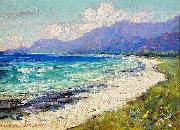
Louis Welden Hawkins was born in Germany ( 1 July 1849 ). His mother was an Austrian Baroness, his father Englishman. Hawkins moved soon to France and took later French nationality. Hawkins attended the famous Acad??mie Julian in Paris. Hawkins became famous after his expositions in the Salon de la Societe des Artistes Francais. His first work was shown in the Salon in 1881. After that, expositions followed at the Salon de la Societe des Beaux Artes (1894-1911), the Salon de la Rose-Croix (1894-95) and La Libre Esthetque in Brussels. He spended his last years in Brittany, where he painted mostly landscapes.
Louis Welden Hawkins died in 1910 and was honoured a year later at the Salon Nationale. |
 |
Lionel Walden
|
|
(1861-1933) was born in Norwich, Connecticut in 1861. He first became interested in art in Minnesota, where the family moved when his father became rector of an Episcopal Church there. As a young man, Walden moved to Paris where he studied painting with Carolus-Duran. In around 1893-97, Walden was in England, living in Falmouth. Paintings of Cardiff in Wales are in museums in Cardiff and Paris. Walden received medals from the Paris Salon and was made a Knight of the French Legion of Honor. He visited to Hawaii in 1911 and several times thereafter. Walden died in Chantilly, France in 1933.
According to David H. Forbes, author of Encounters with Paradise: Views of Hawaii and its People, 1778-1941, Lionel Walden "was the finest seascape painter to work in Hawaii". The Brooklyn Museum, the Henry Art Gallery (University of Washington, Seattle), the Honolulu Academy of Arts, the Isaacs Art Center (Waimea, Hawaii), and the Musee d'Orsay are among the public collections holding works by Lionel Walden.
|
 |
Levi Wells Prentice
|
|
1850-1935
Levi Wells Prentice Gallery
Prentice was associated with the Hudson River School, a group of artists known throughout art circles. According to the book Nature Staged by Barbara Jones, Prentice followed a self-prescribed educational path, begun by the Hudson River School and reinforced by John Ruskin's (1819-1900) truth-to-nature principles laid out in his book Modern Painters. Although he can be allied to both schools of thought, Prentice can not be considered a member of either. This book has a photo of the artist in his early Brooklyn studio surrounded by his paintings and a complete essay on his life and work.
Levi grew up on a farm in Lewis County, New York. By 1872, Prentice had traveled through the Adirondack Mountains, painting the views as well as the surrounding region. He opened his first studio as a landscape painter in Syracuse, New York in 1875.
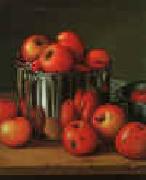
Self-taught artist Levi Wells Prentice is best known for his realistic still life compositions of fruit arranged within a landscape, or abundantly spilling from bushel baskets. Early in his career, he painted portraits and landscapes of the Adirondack Mountain region of Lewis County, New York, his birthplace.
Levi married an English woman Emma Roseloe Sparks in Buffalo, New York in 1882 and had two children, Leigh (born 22 March 1887) and Imogene (born 17 September 1889).
Prentice then turned to painting still life subjects when he moved briefly to Brooklyn, New York in 1883, focusing on fruit, in order of frequency apples, strawberries, peaches, plums, raspberries, cherries, muskmelons, pears, currants, pineapples, gooseberries, grapes and bananas usually piled high in pots or in natural settings.
Prentice subsequently moved around from 1903-07 before settling in the Germantown district of Philadelphia. However, his work did not gain much recognition with historians until the 1970s. He was a member of the Brooklyn Art Association and frequently exhibited his paintings there.
In addition to his artistic talents, he was a craftsman who enjoyed making his own brushes, palettes and frames.
In his painting, Prentice placed an emphasis on dark outlining with a concern for textual precision, creating dramatic contrasts. The shift between dark background areas and the vibrant hues of the fruit are done to give the compositions an exciting, visual energy. The fruit is presented with clarity and precision. An emphasis appears to be placed on the idea of man versus nature. The wooden baskets with hand-wrought nails represent a structured, man-made object, while the overly ripe fruit represents the fleeting qualities of nature. These paintings also demonstrate Prentice's remarkable skills at rendering color, form, and texture.
Noted art historian William H. Gerdts observed: there are several works by Prentice in which he achieves a quality of illusionism which is unsurpassed. In 1993, the skillful 'illusionism' of Levi Wells Prentice was celebrated in a retrospective exhibition at the Adirondack Museum in New York. His works continue to receive a high degree of appreciation by collectors today. He is represented in many museums including the New York State Museum, Museum of Fine Arts, Boston, Montclair Art Museum, Philbrook Museum of Art and Yale University Art Gallery.
Levi died 28 November 1935 in Germantown, Pennsylvania. |
 |
Leslie Ward
|
|
British Illustrator caricaturist and portrait painter , (1851-1922),
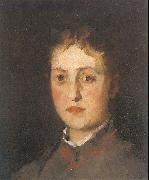
was a British portrait artist and caricaturist who drew or painted numerous portraits which were regularly published by Vanity Fair, under the pseudonym "Spy". Ward was one of eight children of artists Edward Matthew Ward and Henrietta Ward, and the great-grandson of the artist James Ward. Although they had the same surname before marriage, Ward's parents were not related. Both were well-known history painters, his mother coming from a line of painters and engravers, including her father, the engraver and miniature painter George Raphael Ward, and her grandfather, the celebrated animal painter James Ward. She was niece and great-niece respectively of the portrait painter John Jackson and the painter George Morland. Both parents had studios in their homes in Slough in Buckinghamshire and Kensington in London, where they regularly entertained the London artistic and literary elite. Ward's father was a gifted mimic who entertained Charles Dickens and other eminent guests. Although they never gave their son formal training, they and their artistic friends encouraged the young Ward to draw, paint, and sculpt.[1] Ward had started caricaturing while still at school at Eton in Windsor, using his classmates and school masters as subjects. In 1867 his bust of his brother was exhibited at the Royal Academy in London. At school Ward had been an unexceptional student, and after he left Eton in 1869 his father encouraged him to train as an architect. Ward was too afraid to tell his father that he wanted to be an artist and he spent an unhappy year in the office of the architect Sydney Smirke, who was a family friend. |
 |
Leibl, Wilhelm
|
|
German Realist Painter, 1844-1900
German painter, draughtsman and etcher. In 1861 he abandoned his apprenticeship as a locksmith in order to train as a precision instrument maker, though a month or so later he decided to train as an artist, at first under the Cologne history painter and writer Hermann Becker (1817-85). In 1863 he moved to Munich; he studied there from March 1864, at the Akademie der Bildenden K?nste, initially under Philipp von Foltz and Alexander Straehuber, drawing from plaster casts, and later in Hermann Ansch?tz's painting class. Here, Arthur von Ramberg (1819-75) stimulated Leibl's sensitivity to colour; and Karl Theodor von Piloty encouraged him to observe reality and incorporate its lessons boldly into compositions on historical themes. From the start, however, Leibl tended to think of his pictures in terms of form rather than content. While at the Akademie he first reached a standard of excellence with his draughtmanship, which is notable for its directness and objectivity. As an artist, Leibl's early works were not especially promising. However, as occurred throughout his career, a long period of mediocrity was crowned by an unexpected masterpiece, such as his portrait drawing of Aunt Josepha (c. 1864; Cologne, Wallraf-Richartz-Mus.). This is particularly striking for Leibl's use of the hands to add to the expression of the sitter's character and mood, a device he was to use frequently in later work. In Munich, Leibl supplemented the teaching of the Akademie by studying the works of the Old Masters in the Alte Pinakothek: he paid particular attention to painters of the Baroque period such as van Dyck, Cornelis de Vos and Rubens, and also to other great masters of portraiture such as Frans Hals and Vel?zquez. The presentation of the subject found in such works is reflected in Leibl's portrait of Frau Gedon (1869; Munich, Neue Pin.). When the work was shown at the Grossen Internationale Kunstausstellung in Munich in 1869 it was singled out as the best oil painting of the exhibition by Gustave Courbet and, as a result, Leibl was honoured with an invitation to Paris, where he arrived on 13 November 1869. |
 |
Kazimierz Wojniakowski
|
|
(1771-1812) was a Polish painter.
Wojniakowski was a pupil of Marcello Bacciarelli.
His work as a portraitist was influenced by that of the Polish painter Jezef Grassi, as in Wojniakowski's 1796 Portrait of Izabela Czartoryska, nee Fleming.
Other note-worthy portraits by Wojniakowski include his portrait of Tadeusz Kościuszko.
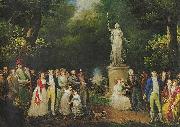
Wojniakowski also produced religious works and scenes of contemporary historic events (e.g., The Constitution of May 3, 1791, 1806).
Notable as well are Wojniakowski's drawings from journeys, e.g. in Lublin Province.
|
 |
Kate Greenaway,RWS,RI
|
|
1846-1901
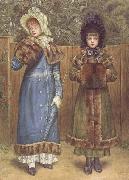
English painter, illustrator and writer. The daughter of a Fleet Street wood-engraver, John Greenaway (1818-90), she trained at Islington School of Art, Heatherleys Academy and the Slade School of Fine Art, all in London. In 1868 she did her first commercial work, producing Christmas and Valentine cards for Marcus Ward, Belfast. |
 |
Karl Ferdinand Wimar
|
|
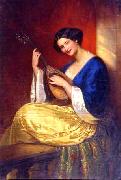
(also known as Charles Wimar and Carl Wimar) (1828-1862), was a German-American painter who concentrated on Native Americans in the West and the great herds of buffalo.
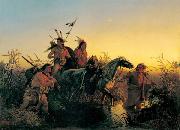
He is known for an early painting of a colonial incident: his The Abduction of Boone's Daughter by the Indians (1855-1856), a depiction of the 1776 capture near Boonesborough, Kentucky of Jemima Boone and two other girls by a Cherokee-Shawnee raiding party.
|
 |
Julie Wilhelmine Hagen-Schwarz
|
|
(born October 27, 1824 near Tartu - died Tartu October 7, 1902) was an Estonian painter of Baltic German origin. She studied in Dresden with Friedrich Gonne and later in Munich with Johann Moritz Rugendas. |
 |
julian alden weir
|
|
American Impressionist Painter, 1852-1919
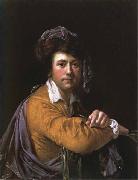
.American painter. He studied with his father Robert Walter Weir, a landscape painter of the Hudson River school, at the National Academy; and with Görôme in Paris. He was one of the earliest American impressionist painters. Subtle gradations of light and tone characterize his work. He was a founder of the Society of American Artists (1877), a member of the National Academy (1886), and its president (1915 C17). When the Ten American Artists formed a separate group (1898), he joined them. His works include Idle Hours, The Green Bodice, and The Red Bridge; a portrait and Autumn ; and Midday Rest in New England. |
 |
Joseph wright of derby
|
|
1734-97
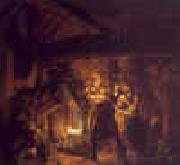
English painter. He painted portraits, landscapes and subjects from literature, but his most original and enduringly celebrated works are a few which reflect the philosophical and technological preoccupations of the later 18th century and are characterized by striking effects of artificial light. He was the first major English painter to work outside the capital all his life: apart from spells in Liverpool (1768-71), Italy (1773-5) and Bath (1775-7), he lived and worked in his native Derby, though exhibiting in London at both the Society of Artists (1765-76, 1791) and the Royal Academy (1778-82, 1789-90, 1794). |
 |
Joseph Wright
|
|
1734-1797
British
Joseph Wright Gallery
English painter. He painted portraits, landscapes and subjects from literature, but his most original and enduringly celebrated works are a few which reflect the philosophical and technological preoccupations of the later 18th century and are characterized by striking effects of artificial light. He was the first major English painter to work outside the capital all his life: apart from spells in Liverpool (1768-71), Italy (1773-5) and Bath (1775-7), he lived and worked in his native Derby, though exhibiting in London at both the Society of Artists (1765-76, 1791) and the Royal Academy (1778-82, 1789-90, 1794 |
 |
Joseph Wolf
|
|
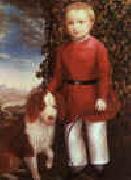
(January 22, 1820 - April 20, 1899) was a German artist who specialized in natural history illustration. He moved to the British Museum in 1848 and became the choice of illustrator for numerous explorers and collectors. He depicted animals accurately in life-like postures and has been considered one of the great pioneers of wildlife art. Sir Edwin Landseer considered him ...without exception, the best all-round animal artist who ever lived.
Wolf was the son of a farmer, and was born in Mörz near Menstermaifeld, not far from the river Moselle, in the Eifel region. In his boyhood he was an assiduous student of bird and animal life, and showed a remarkable capacity as a draughtsman of natural history subjects.
At the age of sixteen he went to Koblenz to work for a firm of lithographers, and then in 1840 he moved to Frankfurt. Here he provided the illustrations for Eduard Reppell's Birds of Northeast Africa. |
 |
Joseph Whiting Stock
|
|
1815-1855
American painter. He was physically handicapped and confined to his house until his doctor advised a wheelchair, which, when placed on a railway carriage, allowed him to travel. He took painting lessons as therapy from Franklin White, a pupil of Chester Harding, and became proficient as an artist. This enabled him to make a living painting portraits, landscapes and miniatures throughout New England and part of New York State. He kept a journal that lists 912 examples of his work executed between 1832 and 1846, with the names of his sitters, canvas sizes, the prices charged and where the pictures were painted. No examples of his landscapes have survived and only a few of his 80 miniatures have been located. The earliest miniatures date from 1836, but most were executed in 1842 and 1845 when he lived in New Bedford, MA. Few American primitive artists of the 19th century were as productive as Stock. |
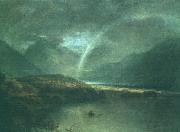 |
Joseph Mallord William Turner
|
|
English Romantic Painter, 1775-1851
Joseph Mallord William Turner (23 April 1775 ?C 19 December 1851) was an English Romantic landscape painter, watercolourist and printmaker, whose style is said to have laid the foundation for Impressionism. Although Turner was considered a controversial figure in his day, he is now regarded as the artist who elevated landscape painting to an eminence rivalling history painting.
Turner's talent was recognised early in his life. Financial independence allowed Turner to innovate freely; his mature work is characterised by a chromatic palette and broadly applied atmospheric washes of paint. According to David Piper's The Illustrated History of Art, his later pictures were called "fantastic puzzles." However, Turner was still recognised as an artistic genius: the influential English art critic John Ruskin described Turner as the artist who could most "stirringly and truthfully measure the moods of Nature." (Piper 321)
Suitable vehicles for Turner's imagination were to be found in the subjects of shipwrecks, fires (such as the burning of Parliament in 1834, an event which Turner rushed to witness first-hand, and which he transcribed in a series of watercolour sketches), natural catastrophes, and natural phenomena such as sunlight, storm, rain, and fog. He was fascinated by the violent power of the sea, as seen in Dawn after the Wreck (1840) and The Slave Ship (1840).
Turner placed human beings in many of his paintings to indicate his affection for humanity on the one hand (note the frequent scenes of people drinking and merry-making or working in the foreground), but its vulnerability and vulgarity amid the 'sublime' nature of the world on the other hand. 'Sublime' here means awe-inspiring, savage grandeur, a natural world unmastered by man, evidence of the power of God - a theme that artists and poets were exploring in this period. The significance of light was to Turner the emanation of God's spirit and this was why he refined the subject matter of his later paintings by leaving out solid objects and detail, concentrating on the play of light on water, the radiance of skies and fires. Although these late paintings appear to be 'impressionistic' and therefore a forerunner of the French school, Turner was striving for expression of spirituality in the world, rather than responding primarily to optical phenomena.
Rain, Steam and Speed - The Great Western Railway painted (1844).His early works, such as Tintern Abbey (1795), stayed true to the traditions of English landscape. However, in Hannibal Crossing the Alps (1812), an emphasis on the destructive power of nature had already come into play. His distinctive style of painting, in which he used watercolour technique with oil paints, created lightness, fluency, and ephemeral atmospheric effects. (Piper 321)
One popular story about Turner, though it likely has little basis in reality, states that he even had himself "tied to the mast of a ship in order to experience the drama" of the elements during a storm at sea.
In his later years he used oils ever more transparently, and turned to an evocation of almost pure light by use of shimmering colour. A prime example of his mature style can be seen in Rain, Steam and Speed - The Great Western Railway, where the objects are barely recognizable. The intensity of hue and interest in evanescent light not only placed Turner's work in the vanguard of English painting, but later exerted an influence upon art in France, as well; the Impressionists, particularly Claude Monet, carefully studied his techniques. |
 |
Joos van Winghe
|
|
(1544, Brussels - 1603, Frankfurt), was a Flemish Renaissance painter.
According to Karel van Mander he was born in Brussels in 1544 and travelled to Rome where he lived with a Cardinal for four years. When he returned to Brussels he became court painter to the Prince of Parma until he left the country in 1584 as a consequence of the Fall of Antwerp. He settled in Frankfurt and his place at Parma's court was taken by Otto van Veen. He died in 1603, aged 61. Van Mander mentions several pieces by his hand in Brussels, Frankfurt, and Amsterdam.
According to the RKD who spent four years travelling in Rome, Parma, and Paris before returning to Brussels in 1568. In 1585 he moved to Frankfurt, where he became a citizen (burgher) in 1588 and stayed. He was the father of the painter Jeremias van Winghe, and is known for portraits and genre works, as well as book title pages. |
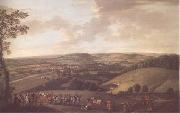 |
John Wootton
|
|
1682 - 1764
English painter. He probably received some instruction from Jan Wyck in the 1690s, and he was possibly patronized from an early age by the aristocratic households of Beaufort and Coventry (as was Wyck), perhaps while working as a page to Lady Anne Somerset at Snitterfield House, Warwicks. However, there seems to be no real evidence for this save his early painted view of the house and the family's later acquisition of many of his works. Joseph Farington saw a painting of Diana and the Nymphs (1707; untraced) at Antony House, Cornwall, but Wootton's earliest extant dated work is the horse portrait Bonny Black (1711; Belvoir Castle, Leics). By this time he had begun to establish himself in London, having moved there before his first marriage, to Elizabeth Walsh, in 1706. |
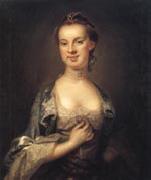 |
John Wollaston
|
|
English-born American Rococo Era Painter, active 1742-1775 |
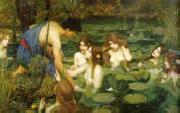 |
John William Waterhouse
|
|
English Pre-Raphaelite Painter, 1849-1917
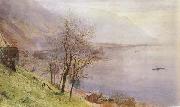
English painter. His father was a minor English painter working in Rome. Waterhouse entered the Royal Academy Schools in London in 1870. He exhibited at the Society of British Artists from 1872 and at the Royal Academy from 1874. From 1877 to the 1880s he regularly travelled abroad, particularly to Italy. In the early 1870s he had produced a few uncharacteristic Orientalist keepsake paintings, but most of his works in this period are scenes from ancient history or classical genre subjects, similar to the work of Lawrence Alma-Tadema (e.g. Consulting the Oracle, c. 1882; London, Tate). However, Waterhouse consistently painted on a larger scale than Alma-Tadema. His brushwork is bolder, his sunlight casts harsher shadows and his history paintings are more dramatic. |
 |
John William Inchbold
|
|
1830-1888
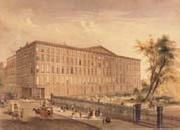
English painter. He spent his early years in Leeds, where his father was a newspaper proprietor, but came to London around 1846 to study lithography in the firm of Day & Haghe. His obituary in The Athenaeum records that he went on to study at the Royal Academy Schools, but his name does not appear in the registers. He exhibited watercolours at the Society of British Artists in 1849 and 1850 and at the Royal Academy in 1851. At this period his work has a fluidity and a freedom of handling that is closer to Richard Parkes Bonington than to the prevailing style of Victorian watercolours. Around 1852 he came under the influence of the Pre-Raphaelite movement and radically altered his style. His oil painting of the Chapel, Bolton (exh. RA 1853; Northampton, Cent. Mus. & A.G.) is a meticulously rendered view of the abbey ruins in the Pre-Raphaelite manner. This was followed the next year by At Bolton (Leeds, C.A.G.), another view of Bolton Abbey, this time with a deer prominent in the foreground. Both paintings illustrate lines from William Wordsworth's poem 'The White Doe of Ryleston'. Wordsworth was also the inspiration for the small painting Study in March |
 |
John William Hill
|
|
English Painter, 1812-1879,Painter and illustrator, son of John Hill. At the age of seven he moved to Philadelphia, PA, with his family. In 1822 he moved to New York, where he was apprenticed to his father for seven years. During this time, he worked on the aquatint plates for William Guy Wall's Hudson River Portfolio (1821-5), which influenced his early paintings. |
 |
John William Godward
|
|
English
1861-1922
Godward was a Victorian Neo-classicist, and therefore a follower in theory of Frederic Leighton. However, he is more closely allied stylistically to Sir Lawrence Alma-Tadema, with whom he shared a penchant for the rendering of Classical architecture, in particular, static landscape features constructed from marble.
The vast majority of Godward's extant images feature women in Classical dress, posed against these landscape features, though there are some semi-nude and fully nude figures included in his oeuvre (a notable example being In The Tepidarium (1913), a title shared with a controversial Alma-Tadema painting of the same subject that resides in the Lady Lever Art Gallery). The titles reflect Godward's source of inspiration: Classical civilisation, most notably that of Ancient Rome (again a subject binding Godward closely to Alma-Tadema artistically), though Ancient Greece sometimes features, thus providing artistic ties, albeit of a more limited extent, with Leighton.
Given that Classical scholarship was more widespread among the potential audience for his paintings during his lifetime than in the present day, meticulous research of detail was important in order to attain a standing as an artist in this genre. Alma-Tadema was, as well as a painter, an archaeologist who attended historical sites and collected artefacts that were later used in his paintings: Godward, too, studied such details as architecture and dress, in order to ensure that his works bore the stamp of authenticity. In addition, Godward painstakingly and meticulously rendered those other important features in his paintings, animal skins (the paintings Noon Day Rest (1910) and A Cool Retreat (1910) contain superb examples of such rendition) and wild flowers (Nerissa (1906), illustrated above, and Summer Flowers (1903) are again excellent examples of this).
The appearance of beautiful women in studied poses in so many of Godward's canvases causes many newcomers to his works to categorise him mistakenly as being Pre-Raphaelite, particularly as his palette is often a vibrantly colourful one. However, the choice of subject matter (ancient civilisation versus, for example, Arthurian legend) is more properly that of the Victorian Neoclassicist: however, it is appropriate to comment that in common with numerous painters contemporary with him, Godward was a 'High Victorian Dreamer', producing beautiful images of a world which, it must be said, was idealised and romanticised, and which in the case of both Godward and Alma-Tadema came to be criticised as a world-view of 'Victorians in togas'. |
 |
John William Casilear
|
|
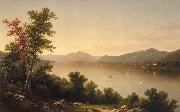
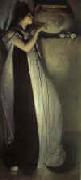
(June 25, 1811 - August 17, 1893) was an American landscape artist belonging to the Hudson River School.
Casilear was born in New York City. His first professional training was under prominent New York engraver Peter Maverick in the 1820s, then with Asher Durand, himself an engraver at the time. Casilear and Durand became friends, and both worked as engravers in New York through the 1830s.
By the middle 1830s Durand had become interested in landscape painting through his friendship with Thomas Cole. Durand, in turn, drew Casilear's attention to painting. By 1840 Casilear's interest in art was sufficiently strong to accompany Durand, John Frederick Kensett, and artist Thomas P. Rossiter on a European trip during which they sketched scenes, visited art museums, and fostered their interest in painting.
Casilear gradually developed his talent in landscape art, painting in the style that was later to become known as the Hudson River School. By the middle 1850s he had entirely ceased his engraving career in favor of painting full-time. He was elected a full member of the National Academy of Design in 1851, having been an associate member since 1831, and exhibited his works there for over fifty years.
Casilear died in Saratoga Springs, New York in 1893. |
 |
John White Alexander
|
|
1865-1915
John White Alexander Galleries
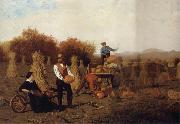
Alexander was born in Allegheny, Pennsylvania, now a part of Pittsburgh, Pennsylvania. Orphaned in infancy, he was reared by his grandparents and at the age of 12 became a telegraph boy in Pittsburgh. His talent at drawing attracted the attention of one of his employers, who assisted him to develop them. He moved to New York at the age of eighteen and worked in an office at Harper's Weekly, where he was an illustrator and political cartoonist at the same time that Abbey, Pennell, Pyle, and other celebrated illustrators labored there. After an apprenticeship of three years, he travelled to Munich for his first formal training. Owing to the lack of funds, he removed to the village of Polling, Bavaria, and worked with Frank Duveneck. They travelled to Venice, where he profited by the advice of Whistler, and then he continued his studies in Florence, the Netherlands, and Paris.
In 1881 he returned to New York and speedily achieved great success in portraiture, numbering among his sitters Oliver Wendell Holmes, John Burroughs, Walt Whitman, Henry G. Marquand, R. A. L. Stevenson, and president McCosh of Princeton University. His first exhibition in the Paris Salon of 1893 was a brilliant success and was followed by his immediate election to the Soci??t?? Nationale des Beaux Arts. Many additional honors were bestowed on him. In 1901 he was named Chevalier of the Legion of Honor, and in 1902 he became a member of the National Academy of Design. He was a member of the American Academy of Arts and Letters. Among the gold medals received by him were those of the Paris Exposition (1900) and the World's Fair at St. Louis (1904).
Many examples of his paintings are on display in museums and public places in the United States and in Europe, including the Metropolitan Museum of Art, the Brooklyn Art Museum, the Los Angeles County Museum of Art, the Museum of Fine Arts, Boston, the Butler Institute, and the Library of Congress in Washington D.C. In addition, in the entrance hall to the Art Museum of the Carnegie Institute in Pittsburgh, a series of Alexander's murals entitled "Apotheosis of Pittsburgh" (1905-1907) covers the walls of the three-storey atrium area.
Alexander was married to Elizabeth Alexander Alexander, to whom he was introduced in part because of their shared last name. Elizabeth was the daughter of James Waddell Alexander, President of the Equitable Life Assurance Society at the time of the Hyde Ball scandal. The Alexanders had one child, the mathematician James Waddell Alexander II.
Alexander's original and highly individual art is based upon a very personal interpretation of humanity. He died in New York. |
 |
John Whetten Ehninger
|
|
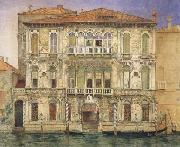
American Painter, 1827-1889,American painter and illustrator. After graduating from Columbia College, New York, in 1847, he immediately departed for Europe to pursue artistic training. He visited Italy and France, but staying in Germany, specifically D?sseldorf, was his main objective. There he studied with Karl Friedrich Lessing, Carl Ferdinand Sohn and fellow American Emanuel Leutze, and in Paris he was instructed by Thomas Couture. During the early 1850s he travelled between America and Europe but finally settled in New York in 1853 until his move to Saratoga Springs after marrying in 1877. Ehninger exhibited regularly at the National Academy of Design, New York, where he was elected a full member in 1860. |
 |
John wharlton bunney
|
|
1828-1882
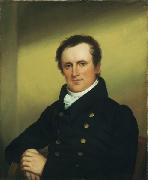
was an English topographical and landscape artist of the nineteenth century. His father was a merchant captain whom Bunney, as a boy, accompanied on several voyages around the world. Bunney demonstrated a strong talent for drawing and draftsmanship from an early age. The young Bunney became a follower of John Ruskin; he studied with Ruskin at the Working Men's College soon after its founding in 1854, and later worked as a clerk for Smith, Elder & Co., Ruskin's publisher. Bunney was able to give up his clerical job and make his living by his art and art teaching by 1859; Ruskin commissioned him to execute a series of drawings in Italy and Switzerland.Bunney married Elizabeth Fallon in 1863. The couple settled in Florence; they would have four children. Bunney worked for Ruskin's St. George's Company (later the Guild of St George) in northern Italy for the remainder of his life. In his career there, Bunney produced a noteworthy pictorial record of Italy in his era. Ruskin said that Bunney's work was "so faithful and careful as almost to enable the spectator to imagine himself on the spot." Bunney was a friend of many of the Pre-Raphaelites, especially William Holman Hunt. From 1870 on, Bunney lived and painted in Venice. In 1876 Ruskin commissioned Bunney to paint a picture that included the entire western facade of St. Mark's Basilica |
 |
John Wesley Jarvis
|
|
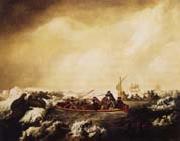
(1781 - January 14, 1839), American painter, nephew of Methodist leader John Wesley, was born at South Shields, England, and was taken to the United States at the age of five.
He was one of the earliest American painters to give serious attention to the study of anatomy. He lived at first in Philadelphia, afterwards establishing himself in New York City, where he enjoyed great popularity, though his conviviality and eccentric mode of life affected his work. He visited Baltimore, Charleston, and New Orleans, entertaining much and painting portraits of prominent people, particularly in New Orleans, where General Andrew Jackson was one of his sitters. He had for assistants at different times both Thomas Sully and Henry Inman. He affected singularity in dress and manners, and his mots were the talk of the day. But his work deteriorated, and he died in great poverty in New York City. |
 |
John Webber
|
|
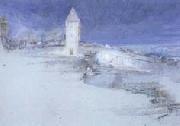
(1751-1793), Landscape painter, was an English artist best known for his images of early Alaska and Hawaii. Webber was born on October 6, 1751 in London, educated in Switzerland and studied painting at Paris[2]. Webber served as official artist on Captain James Cook??s third voyage of discovery around the Pacific (1776-1780) aboard HMS Resolution. At Adventure Bay in January 1777 he did drawings of "A Man of Van Diemen's Land" and "A Woman of Van Diemen's Land". He also did many drawings of scenes in New Zealand and the South Sea islands. On this voyage, during which Cook lost his life in a fight in Hawaii, Webber became the first European artist to make contact with Hawaii, then called the Sandwich Islands. He made numerous watercolor landscapes of the islands of Kauai and Hawaii, and also portrayed many of the Hawaiian people. Back in England in 1780 Webber exhibited around 50 works at Royal Academy exhibitions between 1784 and 1792, and was elected an associate of the Royal Academy in 1785 and R.A. in 1791. Most of his work were landscapes. Sometimes figures were included as in "A Party from H.M.S. Resolution shooting sea horses", which was shown at the academy in 1784, and his "The Death of Captain Cook" became well known through an engraving of it. Another version of this picture is in the William Dixson gallery at Sydney. Webber died in London in 1793. |
 |
John Ruskin,HRWS
|
|
1819-1900
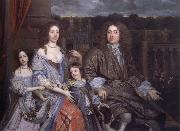
English academic and critic, who had an enormous influence not only on architectural style but on the ways in which standards of aesthetics were judged. He used an Evangelical and polemical tone in his writings that not only reached a mass audience but received the approval of the Ecclesiologists. Initially encouraged by J. C. Loudon, he contributed to some of Loudon's publications, but his key works date from the late 1840s and 1850s. The Gothic Revival was well established when Ruskin published The Seven Lamps of Architecture (1849), which was an immediate success, encapsulating the mood of the period rather than creating new ideas. He argued that architecture should be true, with no hidden structure, no veneers or finishes, and no carvings made by machines, and that Beauty in architecture was only possible if inspired by nature. As exemplars worthy of imitation (he argued that the styles known to Man were quite sufficient, and that no new style was necessary) he selected Pisan Romanesque, early Gothic of Western Italy, Venetian Gothic, and English early Second Pointed as his paradigms. In the choice of the last, the style of the late C13 and early C14, he was echoing A. W. N. Pugin's preferences as well as that of most ecclesiologically minded Gothic Revivalists such as G. G. Scott. The Stones of Venice (1851C3) helped to promote that phase of the Gothic Revival in which Continental (especially Venetian) Gothic predominated. Deane and Woodward's University Museum, Oxford (1854C60), is an example of Venetian or Ruskinian Gothic. In particular, structural polychromy, featuring colour in the material used, rather than applied, was popularized by Ruskin's writings. |
 |
John Michael Wright
|
|
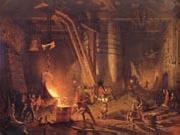
English Baroque Era Painter, ca.1617-1694,was a British baroque portrait painter. Wright trained in Edinburgh under the Scots painter George Jamesone, and acquired a considerable reputation as an artist and scholar during a long sojourn in Rome. There he was admitted to the Accademia di San Luca, and was associated with some of the leading artists of his generation. He was engaged by Archduke Leopold Wilhelm of Austria, the governor of the Spanish Netherlands, to acquire artworks in Oliver Cromwell's England in 1655. He took up permanent residence in England from 1656, and served as court painter before and after the English Restoration. A convert to Roman Catholicism, he was a favourite of the restored Stuart court, a client of both Charles II and James II, and was a witness to many of the political manoeuvrings of the era. In the final years of the Stuart monarchy he returned to Rome as part of an embassy to Pope Innocent XI. Wright is currently rated as one of the leading indigenous British painters of his generation and largely for the distinctive realism in his portraiture. Perhaps due to the unusually cosmopolitan nature of his experience, he was favoured by patrons at the highest level of society in an age in which foreign artists were usually preferred. Wright's paintings of royalty and aristocracy are included amongst the collections of many leading galleries today. |
 |
John Ferguson Weir
|
|
American painter and sculptor.
1841-1926
Painter, teacher and sculptor, son of Robert Walter Weir. He grew up at the US Military Academy at West Point, where he was taught by his father. His earliest paintings record the handsome landscape of the surrounding countryside, including View of the Highlands from West Point (1862; New York, NY Hist. Soc.). By November 1862 Weir had settled in New York, occupying quarters in the Studio Building on West Tenth Street, where he became friendly with many of the well-known artists residing there. He also made important contacts through the Century Club and the Athenaeum Club and the Artists' Fund Society. He made his d?but at the National Academy of Design with an Artist's Studio (1864; Los Angeles, CA, Co. Mus. A.), a detailed view of his father's painting room at West Point. The picture's favourable reception led to his election as an Associate of the National Academy of Design. |
 |
John warwick smith
|
|
English Painter, 1749-1831
English painter. The son of a gardener to the Gilpin family, he studied under the animal painter Sawrey Gilpin. During a trip to Derbyshire with Gilpin he met George Greville, 2nd Earl of Warwick, who gave him financial support to go to Italy between 1776 and 1781. Smith spent 1778-9 in Naples and was otherwise based in Rome, where he explored the Campagna and made sketches with William Pars and Francis Towne. The strong greens and purples and crisp pen outlines of some of Smith's watercolours are strongly influenced by Towne's style. Smith and Towne travelled together across the Alps on their way back to England in 1781, after which Smith settled in Warwick. He contributed six views to Samuel Middiman's Select Views in Great Britain (1784-5) and between 1784 and 1806 toured Wales 13 times in search of Picturesque and Sublime scenery. He also visited the Lake District between 1789 and 1792, which resulted in the publication of Twenty Views of the Lake District (1791-5); he appears to have been in Devon and Worcestershire as well. Aquatints after Smith were used to illustrate William Sotheby's Tour through Parts of Wales (1794), |
|