|
 |
Johannes van Wijckersloot
|
|
Johan Hendriksz Van Wijckersloot (1557- 1602)
Born in Utrecht, Utrecht, Netherlands on 20 Oct 1557 to Hendrick Roelofsz Van Wijckersloot and Antonia Gosina Van Benthem. He passed away on 27 Jul 1602 in Utrecht, Utrecht, Netherlands |
 |
Johann Wolfgang von Goethe
|
|
Frankfurt 1749-1832 Weimar,was a German writer and according to George Eliot, "Germany's greatest man of letters and the last true polymath to walk the earth." Goethe's works span the fields of poetry, drama, literature, theology, humanism and science. Goethe's magnum opus, lauded as one of the peaks of world literature, is the two-part drama Faust. Goethe's other well-known literary works include his numerous poems, the Bildungsroman Wilhelm Meister's Apprenticeship and the epistolary novel The Sorrows of Young Werther. Goethe was one of the key figures of German literature and the movement of Weimar Classicism in the late 18th and early 19th centuries; this movement coincides with Enlightenment, Sentimentality (Empfindsamkeit), Sturm und Drang and Romanticism. The author of the scientific text Theory of Colours, he influenced Darwin with his focus on plant morphology. He also served at length as the Privy Councilor ("Geheimrat") of the duchy of Weimar. Goethe is the originator of the concept of Weltliteratur ("world literature"), having taken great interest in the literatures of England, France, Italy, classical Greece, Persia, Arabic literature, amongst others. His influence on German philosophy is virtually immeasurable, having major effect especially on the generation of Hegel and Schelling, although Goethe himself expressly and decidedly refrained from practicing philosophy in the rarefied sense. Goethe's influence spread across Europe, and for the next century his works were a major source of inspiration in music, drama, poetry and philosophy. Goethe is considered by many to be the most important writer in the German language and one of the most important thinkers in Western culture as well. |
 |
Johann Wilhelm Schirmer
|
|
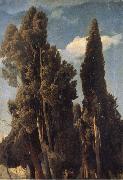
Julich 1807-1863 Karlsruhe,was a German landscape artist from Julich, within the Prussian Duchy of Julich. The artist, a namesake of Friedrich Wilhelm Schirmer, had a similar aim and career. He first was a student, and subsequently became a professor in the academy of Dusseldorf. He became known as one of the first of the so-called Dusseldorf landscape school. In 1854 he was made director of the art school at Karlsruhe, where he died. |
 |
Johann Walter
|
|
painted Gustavus Adolphus of Sweden at the Battle of Breitenfeld in 1632 |
 |
johann melchior wyrsch
|
|
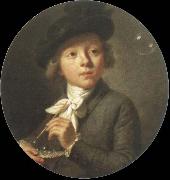
johann melchior wyrsch (1732-98) was born in buochs, switzerland. in 1753 he went to rome to study with gaetano lapis and then at the academie francaise. |
 |
Johan Hendrik Weissenbruch
|
|
Dutch Painter, 1824-1903
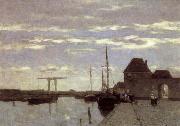
Painter, cousin of Jan Weissenbruch. He referred to himself and signed his work as Jan Hendrik Weissenbruch. From 1840 he attended drawing lessons with the Norwegian painter Johannes Lew, and from 1846 he was taught by Bartholomeus J. van Hove at the Koninklijke Academie van Beeldende Kunsten in The Hague. His early paintings clearly show the influence of van Hove and Andreas Schelfhout, although it is uncertain whether he was actually taught by the latter. His father, an avid collector, owned works by both artists. |
 |
Joachim Wtewael
|
|
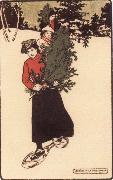
1566-1638 Flemish Joachim Wtewael Galleries
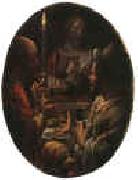
Dutch painter and draughtsman. He was one of the last exponents of MANNERISM. From c. 1590 until 1628, the year of his latest known dated paintings, he employed such typical Mannerist formal devices as brilliant decorative colour, contrived spatial design and contorted poses. He sometimes combined such artifice with naturalism, and this amalgam represents the two approaches Dutch 16th- and 17th-century theorists discussed as uyt den geest (from the imagination) and naer t leven (after life). Wtewaels activity reflects the transition from Mannerism to a more naturalistic style in Dutch art. Slightly over 100 of his paintings and about 80 drawings are known. Subjects from the Bible and mythology predominate; he also painted several portraits, including a Self-portrait (1601; Utrecht, Cent. Mus.). |
 |
Jessie Willcox Smith
|
|
American Golden Age Illustrator, 1863-1935
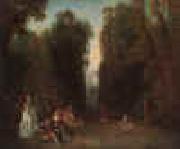
was an American illustrator famous for her work in magazines such as Ladies Home Journal and for her illustrations for children's books. Born in the Mount Airy neighborhood of Philadelphia, Pennsylvania, Smith studied at the Pennsylvania Academy of the Fine Arts under Thomas Eakins in Philadelphia, graduating in 1888. A year later, she started working in the production department of the Ladies Home Journal, for five years. She left to take classes under Howard Pyle, first at Drexel and then at the Brandywine School. Jessie Willcox Smith, Illustration for The Water-Babies (1916)She was a prolific contributor to books and magazines during the late nineteenth and early twentieth centuries, illustrating stories and articles for clients such as Century, Collier's Weekly, Leslie's Weekly, Harper's, McClure's, Scribners, and the Ladies' Home Journal. Smith may be most well known for her covers on Good Housekeeping, which she painted from December 1917 through March 1933. She also painted posters and portraits. Her twelve illustrations for Charles Kingsley's The Water Babies (1916) are also well known. On Smith's death, she bequeathed the original works to the Library of Congress' "Cabinet of American Illustration" collection. Smith was close friends with the artists Elizabeth Shippen Green and Violet Oakley, |
 |
Jean-Antoine Watteau
|
|
1684-1721
Antoine Watteau Art Locations
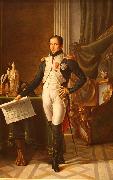
He is best known for his invention of a new genre, the fete galante, a small easel painting in which elegant people are depicted in conversation or music-making in a secluded parkland setting (see under FETE CHAMPETRE). His particular originality lies in the generally restrained nature of the amorous exchanges of his characters, which are conveyed as much by glance as by gesture, and in his mingling of figures in contemporary dress with others in theatrical costume, thus blurring references to both time and place.
Watteau work was widely collected during his lifetime and influenced a number of other painters in the decades following his death, especially in France and England. His drawings were particularly admired. Documented facts about Watteau life are notoriously few, though several friends wrote about him after his death (see Champion). Of over two hundred paintings generally accepted as his work |
 |
Jean Baptiste Wicar
|
|
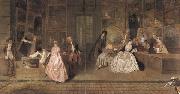
Jean-Baptiste Wicar (22 January 1762, Lille - 27 February 1834, Rome) was a French Neoclassical painter and art collector.
The son of a carpenter, Wicar studied drawing at the free school in Lille before further honing his talents in the studio of David. The drawings Wicar created of Tableaux, statues, bas-reliefs et camees de la Galerie de Florence et du palais Pitti (Paintings, statues, bas-reliefs and cameos in the Gallery of Florence and the Pitti Palace) were published in Paris in 4 volumes at the Lacombe publishing house from 1789 to 1807.
Wicar headed the commission set up by Napoleon I of France to loot artworks from the Austrian Netherlands to enrich museums in France - an initial convoy left Antwerp on 11 August 1794, notably with paintings by Rubens, for the Louvre. Abbeys and castles were systematically emptied of their contents, furniture and works of art. Wicar was also a member of the commission des sciences et des arts on the Italian campaign, in the entourage of Bonaparte. This commission was charged with seizing artworks that could enrich French national museum collections. He finally permanently settled in Rome in 1800 and became a portraitist of European renown.
On his death in Rome, Wicar left the major collection of 1,300 drawings he had accumulated over his lifetime to the Societe des Sciences, de leAgriculture et des Arts de Lille. Mostly from the Italian school, but also in some small measure from the northern schools, it held drawings by artists like Raphael, Albrecht Derer, Lucas Cranach, Nicolas Poussin and Jacques-Louis David. |
 |
Jean antoine Watteau
|
|
French Rococo Era Painter, 1684-1721
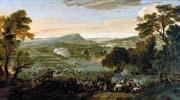
He is best known for his invention of a new genre, the f?te galante, a small easel painting in which elegant people are depicted in conversation or music-making in a secluded parkland setting (see under F?TE CHAMP?TRE). His particular originality lies in the generally restrained nature of the amorous exchanges of his characters, which are conveyed as much by glance as by gesture, and in his mingling of figures in contemporary dress with others in theatrical costume |
 |
Jan Wyck
|
|
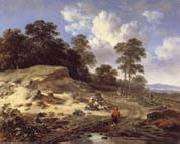
Dutch Baroque Era Painter, 1652-1700,Son of Thomas Wijck. A marriage certificate issued on 22 November 1676 describes the artist as 'Jan Wick of St Paul's Covent Garden, gent., widower, about 31 ...', suggesting that he was born c. 1645, but his correct birthdate is known from the inscription on a mezzotint portrait of him by John Faber II (1684-1756) after a painting by Sir Godfrey Kneller. Jan is first documented on 17 June 1674, when he appeared before the court of the Painter-Stainers' Company in London and vowed to pay both his own and his father's quarterly fees. The certificate of 1676 relates to his second marriage, to Ann Skinner (d 1687), who between 1678 and 1683 bore him four children, all of whom died young. After Ann's death in 1687, he married Elizabeth Holomberg (d 1693) in 1688 and moved to Mortlake. Between 1689 and 1693 they had two sons and a daughter.
|
 |
Jan Wijnants
|
|
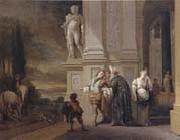
Dutch, born circa 1635-1684,was a Dutch painter of the Baroque era. He was the son an art dealer also named Jan Wijnants. After his mother's death, his father remarried Maria Jans van Stralen, widow of Jasper Jaspersz van Heemskerck, and mother of the painter Egbert Jaspersz van Heemskerck, making Wijnant and Van Heemskerck stepbrothers. Wijnants was active in Haarlem until 1660, after which he moved to Amsterdam.
Wijnants is primarily known for his landscapes and paintings featuring topography. Adriaen van de Velde trained in his studio and his style later had influence on the English artist, Thomas Gainsborough. |
 |
Jan Weenix
|
|
Dutch Baroque Era Painter ,
Amsterdam 1640/42-1719
Painter and draughtsman, son of (1) Jan Baptist Weenix. Jan probably received his first instruction as a painter from his father, and it is possible that he helped finish certain of his father's works. He probably remained in Utrecht after his father's death. By 1664 he had become a member of the Guild of St Luke in Utrecht without, however, having submitted the required entrance painting, which he provided by 1668. There are several documented references to Jan in the late 1660s. He inherited a legacy along with his uncle, the painter Barent Micker, and other family members in 1667, at which time Gillis, his younger brother, apparently still required a guardian. He received another legacy in 1668, the year of his marriage, and in 1669 served as a witness for the inventory of the painter Jacob de Hennin (1629-c. 1688) in The Hague. |
 |
Jan Baptist Weenix
|
|
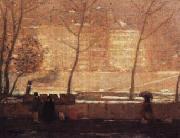
(Amsterdam, 1621- Vleuten 1660), a painter of the Dutch Golden Age. Despite his relatively brief career, he was a very productive and versatile painter. His favourite subjects were Italian landscapes with large figures among ruins, seaside views, and, later in life, large still life pictures of dead game or dogs. He was mainly responsible for introducing the Italian harbour scene into Dutch art, in mid-size paintings with a group of figures in the foreground.
Weenix was the son of an architect and born near Amsterdam's harbour. He could not speak well, apparently from a medical condition, and because he very much liked to read books, his mother sent him to work for a bookseller, who was not able to deal with him. He drew whenever he could, according to Jan Weenix his son, who told the story to Arnold Houbraken.
Weenix first studied under Jan Micker, then in Utrecht under Abraham Bloemaert, and later back in Amsterdam under Claes Cornelisz. Moeyaert. In 1643 Weenix travelled to Rome with Nicolaes Pieterszoon Berchem. He had left his home secretly, but his wife, the daughter of Gillis d'Hondecoeter, traced him to Rotterdam. Then he was allowed to stay away for four months. In Rome he became a member of the Bentvueghels and was much esteemed and worked for Pope Innocent X. He returned to Amsterdam after four years; his wife had refused to come to Rome.
In 1649 he became master of the guild of St. Luke in Utrecht and also painted a portrait of Rene Descartes. When his brother-in-law Gijsbert d'Hondecoeter died, he trained his nephew Melchior d'Hondecoeter, together with his own son Jan Weenix. Weenix moved to a castle outside Utrecht, to concentrate on his work or for health reasons, where he probably died in poor circumstances, at an unknown date.
He painted a few religious scenes, one of the rare pieces of this kind being the "Jacob and Esau" (Gemäldegalerie Alte Meister, Dresden). In the National Gallery, London, is a "Hunting Scene" by Weenix, and Glasgow has a characteristic painting of ruins. Weenix is represented at most of the important continental galleries, notably at Munich, Vienna, Berlin, Amsterdam, and St Petersburg.
|
 |
James Wilson Morrice
|
|
(August 10, 1865 Montreal - January 23, 1924 Tunis) was a significant Canadian landscape painter. He studied at the Academie Julian in Paris, France, where he lived for most of his career.
Morrice was the son of a wealthy merchant, and studied law in Toronto from 1882 to 1889. In 1890 he left to study painting in England. The next year he arrived in Paris, where he studied at the Academie Julian from 1892-7. At Julians he befriended Charles Conder and Maurice Prendergast, and also met Robert Henri.
Morrice continued to live in Paris until the First World War, although he spent most of his winters in Canada. He made many connections in the intellectual circles of Paris, while also remaining in touch with the Canadian art world:
|
 |
James Ward
|
|
English Romantic Painter, 1769-1859
English painter and engraver. He was the most important animal painter of his generation. Many of his dynamic compositions depict horses, dogs or wild animals in agitated emotional states, the sense of movement being reinforced by vigorous brushwork and strong colours. With their sweeping landscapes and dramatic skies, his canvases epitomize Romanticism. Not content to excel merely as an animal painter, Ward also produced portraits, landscapes and genre and history paintings of varying quality. |
 |
James Mcneill Whistler
|
|
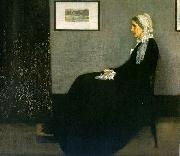
American Painter and Printmaker, 1834-1903
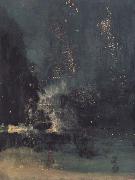
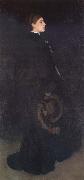
James Abbott McNeill Whistler's deft brushwork and mighty ego made him one of London's best-known painters in the second half of the 1800s. Born in Massachusetts, Whistler spent most of his adult life in England and France, in an era when an American artist in Europe was something of a rarity. He specialized in landscapes and (especially later in his career) portraits; stylistically he is often linked with Claude Monet and August Renoir, though he was not exactly part of the Impressionist movement. His etchings also are highly regarded. Witty, cranky and a bit of a devil, Whistler was a regular gadabout in British society. He had a famous long-running feud with the playwright Oscar Wilde, each of them trying to outwit the other with cutting public remarks. Some critics of the era considered Whistler's work to be smudgy and too radical; after viewing Whistler's 1875 study of fireworks over the Thames, Nocturne in Black and Gold: the Falling Rocket, John Ruskin wrote: "I have seen, and heard, much of cockney impudence before now; but never expected to hear a coxcomb ask two hundred guineas for flinging a pot of paint in the public's face." Whistler successfully sued Ruskin for libel but was awarded only a farthing in damages, |
 |
James Abbott Mcneill Whistler
|
|
American Tonalist Painter and Printmaker, 1834-1903, He was an American-born, British-based artist. Averse to sentimentality and moral allusion in painting, he was a leading proponent of the credo "art for art's sake". His famous signature for his paintings was in the shape of a stylized butterfly possessing a long stinger for a tail. |
 |
Jacob de Wit
|
|
(19 December 1695 - 12 November 1754) was a Dutch artist and interior decorator who painted many religious scenes.
De Wit was born in Amsterdam, and became famous for his door and ceiling paintings. He lived on the Keizersgracht in Amsterdam, and many of the buildings on the Keizersgracht still have door or ceiling paintings done by him. Since many of the families who lived in Amsterdam in those days had country villas, de Wit also painted in houses in the fashionable areas of Haarlem and the Vecht river.
According to the RKD he was the pupil of Albert Spiers in Amsterdam and Jacob van Hal in Antwerp where he became a member of the Guild of St. Luke in 1714. His pupils were Jan de Groot (painter from The Hague), Dionys van Nijmegen, Jan Punt, Pieter Tanje, and the brothers Frans and Jacob Xavery. De Wit died in Amsterdam in 1754.Tako Hajo Jelgersma was his follower. |
 |
J.M.W.Turner
|
|
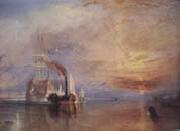
English Romantic Painter, 1775-1851, British land- and seascape artist. Born in London the son of a barber, Turner was precociously talented. He entered the RA Schools in 1789, had a drawing exhibited at the academy in 1790, and was elected a full academician in 1802. He became professor of perspective in 1807. A prolific artist of amazing range of subject and style, he began work in water-colours, quickly founding both a reputation and a fortune, which made him independent of changing public taste. His work was not appreciated by everyone, but his supporters included Thomas Lawrence, John Ruskin, and the earl of Egremont. He died in eccentric obscurity under a false name. |
 |
Hugo Wilhelm Kauffmann
|
|
(7 August 1844 - 30 December 1915) was a German painter, the son of Hermann Kauffmann.
Kauffmann was born in Hamburg. In 1861 he went to Frankfurt and worked there under Jakob Becker, Edward Jakob von Steinle and Johann Nepomuk Zwerger. From 1863-71 he lived in Kronberg in the Taunus. During this time he spent one winter in Hamburg and a five-month period in Desseldorf too; afterwards he spent 1½ years in Paris, until 1870 when the war drove him out. He lived until 1871 in Munich. He died in Prien at the Chiemsee in 1915.
|
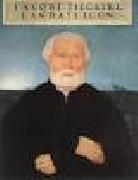 |
HUBER, Wolf
|
|
German Northern Renaissance Painter, ca.1490-1553 |
 |
Horatio Walker
|
|
(May 12, 1858 - September 27, 1938) was a respected and commercially successful Canadian painter. He worked in oils and watercolors, often depicting scenes of rural life in Canada. He was highly influenced by the French Barbizon school of painting.
Horatio Walker was born in 1858 to parents Thomas and Jeanne Maurice Walker. Thomas Walker emigrated in 1856 from Yorkshire, England, to Listowel, Ontario, with his wife of French and English heritage. Having some wealth, Thomas purchased land for lumber in Midwestern Ontario and Horatio was raised in relative comfort. His interest in art may originate from his father who crafted small figures as a hobby, and both his father and the local school teacher encouraged drawing as a pastime.
In 1870, on Walkeres 12th birthday, his father brought him to Quebec City, Quebec, for the first time. His father made occasional business trips to the city as part of his timber business. During this sojourn, they visited the Île d'Orleans, in search of pine timber. Walker made subsequent visits to Quebec City during the following years. His formal schooling ended at the Listowel Public School in 1872; he never went on to pursue formal academic training in art. At the age of 15, Walker moved to Toronto, Ontario to apprentice with the photographic firm Notman and Fraser. It was a fortunate opportunity, as several successful artists worked also there; Walker learned watercolour from Robert Gagnon, miniature portrait painting from John Fraser, and painting from Lucius OeBrien and Henri Perre. |
 |
Homer Watson
|
|
Canadian Painter, 1855-1936
Canadian painter. The son of a mill-owner, he was born in a region of rural southern Ontario, which he painted throughout his life. In 1874 he moved to Toronto to work at the Notman Photographic Studios; he also spent many hours copying paintings in the Toronto Normal School in order to improve his technique. In 1876 he visited New York, where he was impressed with the carefully composed paintings of the Hudson River school and the rural scenes of George Inness, who encouraged Watson to pursue his career. The following year he returned to Doon to work up his New York sketches into finished paintings. A work of this early period, Landscape with River (1878; Toronto, A.G. Ont.), |
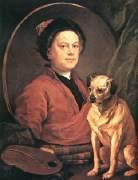 |
HOGARTH, William
|
|
British Painter and Printmaker, 1697-1764
English painter and engraver. He played a crucial part in establishing an English school of painting, both through the quality of his painting and through campaigns to improve the status of the artist in England. He also demonstrated that artists could become independent of wealthy patrons by publishing engravings after their own paintings. |
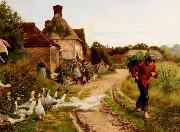 |
Herbert William Weekes
|
|
Herbert William Weekes (fl. 1864 - 1904) was a well-known British genre and animal painter of the Victorian Neoclassical period who specialized in portraying animals in humorous, human-like situations.
Weekes was born ca. 1842 in Pimlico, London, England to a prominent artistic family: the youngest of five children, his father, Henry Weekes, Sr. (1807 - 1877), was a sculptor and Royal Academician; his brother, Henry, Jr. (fl. 1850 - 1884), was also a genre painter known for his animal studies; and his brother, Frederick (1833 - 1920), was an artist and expert on medieval costume and design.
Weekes appears to have used his middle name, William, for all but formal purposes. He lived and worked for most of his life in London, at 21 Oppidans Road, Primrose Hill. In 1865, he married Caroline Anne Henshaw (born ca. 1844), of Hammersmith.
"Suspicion (ca. 1900)", oil-on-canvas
"Fowl Talk", oil-on-canvas
Weekes' signatureKnown as an animal and genre painter of the Victorian Neoclassical style, Weekes' work was popular, and helped expand 19th century animal painting from its traditional role of simply recording beasts into a way of reflecting human life. He frequently personified animals and placed them in situations particular to humans. His work shows a sensitive understanding of his subject matter, and part of his success in capturing the peaceful country atmosphere depicted in so many of his paintings lay in his affection for it. He was greatly influenced by one of the foremost animal painters of the nineteenth century, Sir Edwin Henry Landseer.
Weekes contributed illustrations for The Illustrated London News in 1883, and exhibited extensively in various London and provincial galleries. His works were well received - although not by everyone: a contemporary wit described his paintings as eWeekes' Weak Squeakse. |
|