|
|
|
Click to Enlarge
|
| Hippolyte_Flandrin
|
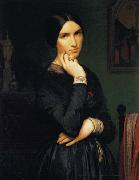
Portrait of Madame Flandrin
new19/Hippolyte Flandrin-992834.jpg |
|
|
|
|
| 1846 Oil on canvas, 83 x 66 cm |
|
1809-1864
Hippolyte Flandrin Location
Painter and lithographer, brother of Auguste Flandrin. He was initially discouraged from fulfilling his early wish to become an artist by Auguste lack of success, but in 1821 the sculptor Denys Foyatier, an old family friend, persuaded both Hippolyte and Paul to train as artists. He introduced them to the sculptor Jean-Francois Legendre-Heral (1796-1851) and the painter Andre Magnin (1794-1823), with whom they worked copying engravings and plaster casts. After Magnin death, Legendre-Heral took the brothers to the animal and landscape painter Jean-Antoine Duclaux (1783-1868). Hippolyte and Paul had both learnt the techniques of lithography from Auguste at an early age, and between the ages of 14 and 19 Hippolyte produced a number of lithographs, which he sold to supplement the family income. Many reflected his passion for military subjects (e.g. Cossacks in a Bivouac, c. 1825; Paris, Bib. N.). In 1826 the two brothers entered the Ecole des Beaux-Arts in Lyon, where Hippolyte studied under Pierre Revoil. Showing a precocious talent, he was soon advised to move to Paris, and having left the Ecole des Beaux-Arts in Lyon in 1829, he walked to the capital with his brother Paul; together they enrolled in the studio of Ingres. After several unsuccessful attempts, Hippolyte won the Grand Prix de Rome in 1832 with Theseus Recognized by his Father (1832; Paris, Ecole N. Sup. B.-A.), despite having suffered from cholera during the competition. His success was all the more spectacular given the general hostility to Ingres; Hippolyte was the first of his pupils to be awarded this prestigious prize. Hippolyte arrived in Rome in 1833; Paul joined him there in 1834. After first working on such subjects as Virgil and Dante in Hell (1836; Lyon, Mus. B.-A.), Hippolyte developed a taste for religious works during this stay. From 1836 to 1837 he worked on St Clare Healing the Blind for the cathedral in Nantes, winning a first-class medal at the 1837 Salon, and in 1838 he painted Christ Blessing the Children (Lisieux, Mus. Vieux-Lisieux), which was exhibited at the 1839 Salon.
|
|
|
Prev Art Next Art |
|