Buy with confident: 100% money back
guaranty if not satisfy
Reproduction of master pieces
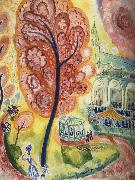
Isaac Grunewald Swedish, 1889-1946,was a Swedish-Jewish Expressionist painter born in Stockholm. Having studied at a Swedish art school, at age nineteen Gr??newald travelled to Paris to study under Henri Matisse. In 1909 he gained recognition in his homeland when he exhibited his work at Halldins konsthandel. He met Fauvist painter Sigrid Hjert??n, who had studied at the College of Crafts and Design in Stockholm, and encouraged her to return with him to study in Paris. Married in 1911, they became part of a group of Scandinavian artists known as "De Unga" (The Young Ones). The Crane (1915) by Isaac GrunewaldGrenewald and Hjerten regularly exhibited together at home and abroad and art historians now often cite them as being responsible for introducing modernism to Sweden. At a time in history when anti-Semitism was widespread and women in art were frowned upon, although widely known they were never fully accepted by the artistic community of the day and their works were often the subject of ridicule. Partly as a result of this, Isaac Grunewald had to supplement his income creating stage designs for the Royal Dramatic Theatre and the Royal Swedish Opera. He decorated the walls and ceiling of an auditorium (since renamed Grunewald Hall) at the Stockholm Concert Hall, site of the Nobel Prize ceremony, and the walls of the Matchstick Palace. The author of numerous essays on art, with his 1918 exhibit at Stockholm's Liljevalchs Konsthall Isaac Grunewald published his manifesto on Expressionism and opened his own art school. During the Second World War Grunewald worked at the renowned Rorstrand porcelain factory. His wife Sigrid Hjerten suffered from lifelong mental health problems frequently evidenced by anxiety and paranoia that resulted in her being hospitalized for extended periods in the 1930s. During the marriage the couple were frequently apart from each other for long periods and they separated permanently in 1937 and soon divorced. Isaac Grunewald remarried and in 1946 both he and his second wife were killed in an airplane crash. He is buried in Stockholm's Norra begravningsplatsen ("Northern Cemetery"). His 1912 self-portrait and his 1915 painting "The Singing Tree" appeared on Swedish postage stamps. Today, institutions such as the Arken Museum of Modern Art in Ishoj, Denmark rank Grunewald and Hjerten among the 20th Century's most important Scandinavian artists.
Buy with confident: 100% money back
guaranty if not satisfy
We sale oil paint direct from our oil painting studio. we supply only the
museum quality of oil paintings on 100% cotton canvas from Australia.
All our paint are painted by our talent artist who graduated from art
university and at least 10 years of experience on oil paintings, if you
can find the pieces of paint on our data base you can still order it
from us, just simply submit your picture by
click here.