Buy with confident: 100% money back
guaranty if not satisfy
Reproduction of master pieces
BOEL, Pieter Flemish Baroque Era Painter, 1622-1674
Flemish painter, draughtsman and etcher. He came from an artistic family: his father Jan Boel (1592-1640), was an engraver, publisher and art dealer; his uncle Quirin Boel I was an engraver; and his brother Quirin Boel II (1620-40) was also a printmaker. Pieter was probably apprenticed in Antwerp to Jan Fyt, but may have studied previously with Frans Snyders. He then went to Italy, probably visiting Rome and Genoa, where he is supposed to have stayed with Cornelis de Wael. None of Boel's work from this period is known. In 1650 he became a master in the Antwerp Guild of St Luke (having given his first name as Jan, not Pieter). His marriage to Maria Blanckaert took place at about the same time. Boel dated only a few of his paintings, making it difficult to establish a chronology. He is best known for his hunting scenes, some of which clearly show his debt to Snyders, but the dominant influence on his work was that of Fyt, particularly evident in his emphatic brushwork. However, Boel was more restrained both in his treatment and in his handling of outline. He also borrowed the theme of open-air hunting still-lifes (e.g. Feathered Game with Three Dogs; Madrid, Prado) from Fyt, but he painted other subjects as well, such as the monumental Vanitas Still-life (e.g. 1633; Lille, Mus. B.-A.).
BOEL, Pieter Flemish Baroque Era Painter, 1622-1674
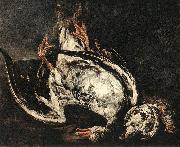
Flemish painter, draughtsman and etcher. He came from an artistic family: his father Jan Boel (1592-1640), was an engraver, publisher and art dealer; his uncle Quirin Boel I was an engraver; and his brother Quirin Boel II (1620-40) was also a printmaker. Pieter was probably apprenticed in Antwerp to Jan Fyt, but may have studied previously with Frans Snyders. He then went to Italy, probably visiting Rome and Genoa, where he is supposed to have stayed with Cornelis de Wael. None of Boel's work from this period is known. In 1650 he became a master in the Antwerp Guild of St Luke (having given his first name as Jan, not Pieter). His marriage to Maria Blanckaert took place at about the same time. Boel dated only a few of his paintings, making it difficult to establish a chronology. He is best known for his hunting scenes, some of which clearly show his debt to Snyders, but the dominant influence on his work was that of Fyt, particularly evident in his emphatic brushwork. However, Boel was more restrained both in his treatment and in his handling of outline. He also borrowed the theme of open-air hunting still-lifes (e.g. Feathered Game with Three Dogs; Madrid, Prado) from Fyt, but he painted other subjects as well, such as the monumental Vanitas Still-life (e.g. 1633; Lille, Mus. B.-A.). Still-Life with Dead Wild-Duck gfh Oil on canvas, 71 x 87 cm
National Gallery, Prague
BOEL, Pieter Flemish Baroque Era Painter, 1622-1674
Flemish painter, draughtsman and etcher. He came from an artistic family: his father Jan Boel (1592-1640), was an engraver, publisher and art dealer; his uncle Quirin Boel I was an engraver; and his brother Quirin Boel II (1620-40) was also a printmaker. Pieter was probably apprenticed in Antwerp to Jan Fyt, but may have studied previously with Frans Snyders. He then went to Italy, probably visiting Rome and Genoa, where he is supposed to have stayed with Cornelis de Wael. None of Boel's work from this period is known. In 1650 he became a master in the Antwerp Guild of St Luke (having given his first name as Jan, not Pieter). His marriage to Maria Blanckaert took place at about the same time. Boel dated only a few of his paintings, making it difficult to establish a chronology. He is best known for his hunting scenes, some of which clearly show his debt to Snyders, but the dominant influence on his work was that of Fyt, particularly evident in his emphatic brushwork. However, Boel was more restrained both in his treatment and in his handling of outline. He also borrowed the theme of open-air hunting still-lifes (e.g. Feathered Game with Three Dogs; Madrid, Prado) from Fyt, but he painted other subjects as well, such as the monumental Vanitas Still-life (e.g. 1633; Lille, Mus. B.-A.). Large Vanitas Still-Life gdh 1663
Oil on canvas, 207 x 260 cm
Mus??e des Beaux-Arts, Lille
BOEL, Pieter Flemish Baroque Era Painter, 1622-1674
Flemish painter, draughtsman and etcher. He came from an artistic family: his father Jan Boel (1592-1640), was an engraver, publisher and art dealer; his uncle Quirin Boel I was an engraver; and his brother Quirin Boel II (1620-40) was also a printmaker. Pieter was probably apprenticed in Antwerp to Jan Fyt, but may have studied previously with Frans Snyders. He then went to Italy, probably visiting Rome and Genoa, where he is supposed to have stayed with Cornelis de Wael. None of Boel's work from this period is known. In 1650 he became a master in the Antwerp Guild of St Luke (having given his first name as Jan, not Pieter). His marriage to Maria Blanckaert took place at about the same time. Boel dated only a few of his paintings, making it difficult to establish a chronology. He is best known for his hunting scenes, some of which clearly show his debt to Snyders, but the dominant influence on his work was that of Fyt, particularly evident in his emphatic brushwork. However, Boel was more restrained both in his treatment and in his handling of outline. He also borrowed the theme of open-air hunting still-lifes (e.g. Feathered Game with Three Dogs; Madrid, Prado) from Fyt, but he painted other subjects as well, such as the monumental Vanitas Still-life (e.g. 1633; Lille, Mus. B.-A.). South America, large parrot mk255 for in the years 1669-1671. 0.98 x 1.30 meters canvas. Paris, the Louvre
Flemish Baroque Era Painter, 1622-1674
Flemish painter, draughtsman and etcher. He came from an artistic family: his father Jan Boel (1592-1640), was an engraver, publisher and art dealer; his uncle Quirin Boel I was an engraver; and his brother Quirin Boel II (1620-40) was also a printmaker. Pieter was probably apprenticed in Antwerp to Jan Fyt, but may have studied previously with Frans Snyders. He then went to Italy, probably visiting Rome and Genoa, where he is supposed to have stayed with Cornelis de Wael. None of Boel's work from this period is known. In 1650 he became a master in the Antwerp Guild of St Luke (having given his first name as Jan, not Pieter). His marriage to Maria Blanckaert took place at about the same time. Boel dated only a few of his paintings, making it difficult to establish a chronology. He is best known for his hunting scenes, some of which clearly show his debt to Snyders, but the dominant influence on his work was that of Fyt, particularly evident in his emphatic brushwork. However, Boel was more restrained both in his treatment and in his handling of outline. He also borrowed the theme of open-air hunting still-lifes (e.g. Feathered Game with Three Dogs; Madrid, Prado) from Fyt, but he painted other subjects as well, such as the monumental Vanitas Still-life (e.g. 1633; Lille, Mus. B.-A.).
Buy with confident: 100% money back
guaranty if not satisfy
We sale oil paint direct from our oil painting studio. we supply only the
museum quality of oil paintings on 100% cotton canvas from Australia.
All our paint are painted by our talent artist who graduated from art
university and at least 10 years of experience on oil paintings, if you
can find the pieces of paint on our data base you can still order it
from us, just simply submit your picture by
click here.